Explore the world of tennis
Tennis rewards the eye at first glance and the mind on closer inspection. A point may last five shots or fifty, yet every exchange reveals choices about angle, pace, balance, and courage. That mix helps explain why the sport matters far beyond its famous champions: it is accessible in public parks, central to global sporting culture, and rich enough to keep players learning for decades. This guide explores the game from foundation to finish.
Article Outline
- The origins of tennis and how it grew into a global sport
- The rules, scoring system, court layout, surfaces, and equipment
- The technical, tactical, physical, and mental demands of high-level play
- The tournaments, iconic players, and wider culture that shape the sport
- How beginners and recreational players can start, improve, and enjoy tennis for years
The Origins of Tennis and Its Journey Around the World
Tennis feels modern when viewed under bright stadium lights, but its roots stretch back centuries. Historians often connect today’s game to earlier European racket sports, especially real tennis, which was played indoors and enjoyed by aristocrats. The version most people now recognize as lawn tennis took shape in the late nineteenth century, when outdoor play on grass courts became more structured. Major Walter Clopton Wingfield is frequently associated with codifying an early form of the game in the 1870s, and only a few years later the rules were refined into something much closer to the sport we know today.
A landmark moment arrived in 1877, when the first Wimbledon Championship was held in London. That event did more than crown a winner; it helped establish tennis as an organized competitive sport with standardized expectations. Once a formal rulebook, recognized tournaments, and clubs were in place, tennis spread quickly through Europe, North America, Australia, and beyond. It traveled with empire, trade, schools, and private clubs, but it also gradually moved into public spaces. That shift matters, because the story of tennis is not only about elite competition. It is also about access, infrastructure, and the ability of ordinary players to step onto a court and join a tradition much bigger than themselves.
The twentieth century brought even greater transformation. International team competition expanded with events such as the Davis Cup, first contested in 1900, while women’s tennis gained stronger visibility and legitimacy through pioneering champions and organizers. For decades, strict divides separated amateur events from professional tours. That changed dramatically in 1968 with the start of the Open Era, when major tournaments began allowing professionals and amateurs to compete together. This reform reshaped the sport’s economics, public appeal, and level of performance.
Since then, tennis has become unmistakably global. Champions have emerged from every inhabited continent, and junior development systems now operate across many countries. Television and streaming have further widened the audience, turning a match in Melbourne, Paris, London, or New York into a live event for viewers thousands of miles away. In a way, tennis has always contained a small paradox: it is an intimate duel, one player facing another across a narrow net, yet it has grown into a worldwide language of competition.
Several forces helped that growth happen:
- Clear rules that made organized competition easier across countries
- Prestigious tournaments that created tradition and public interest
- Club, school, and community programs that introduced new players
- Media coverage that turned great rivalries into shared global stories
What began as a niche pastime evolved into a sport with professional tours, youth pathways, recreational leagues, wheelchair tennis divisions, and a year-round international calendar. Its history is not simply a timeline of champions; it is the record of a game learning how to belong to more people.
Rules, Scoring, Court Surfaces, and Equipment: The Structure Behind the Drama
One reason tennis is so compelling is that its rules create tension without unnecessary complexity. At its heart, the objective is straightforward: hit the ball into the opponent’s court in a way that prevents a successful return. Yet within that simple aim lies a scoring system unlike almost any other mainstream sport. Points progress from love to 15, 30, and 40, and if both players reach 40, the game moves to deuce. From there, a player must win two consecutive points to secure the game. This structure creates frequent turning points. A player can seem in control, then suddenly face pressure after one loose forehand or a double fault.
The court itself is precisely defined. A tennis court is 78 feet long. For singles, it is 27 feet wide; for doubles, 36 feet wide. The net is 3 feet high at the center and slightly higher at the posts. These measurements matter because tennis is a sport of margins. A shot that misses by an inch counts exactly the same as one that flies into the back fence, but the player experiences those misses very differently. Tiny differences in timing can change a point, a game, and sometimes an entire match.
Matches are generally played as best of three sets, though some major men’s singles matches use a best-of-five format. To win a set, a player usually needs six games with at least a two-game margin. At 6-6, many events use a tiebreak. That compact scoring race adds another layer of drama, because every point suddenly feels louder. The silence before a serve, the bounce of the ball, the short intake of breath from the crowd: tennis knows how to stage suspense.
Surface type changes how the game behaves. The main categories each reward different styles:
- Grass: traditionally faster and lower-bouncing, often favoring quick reactions and first-strike tennis
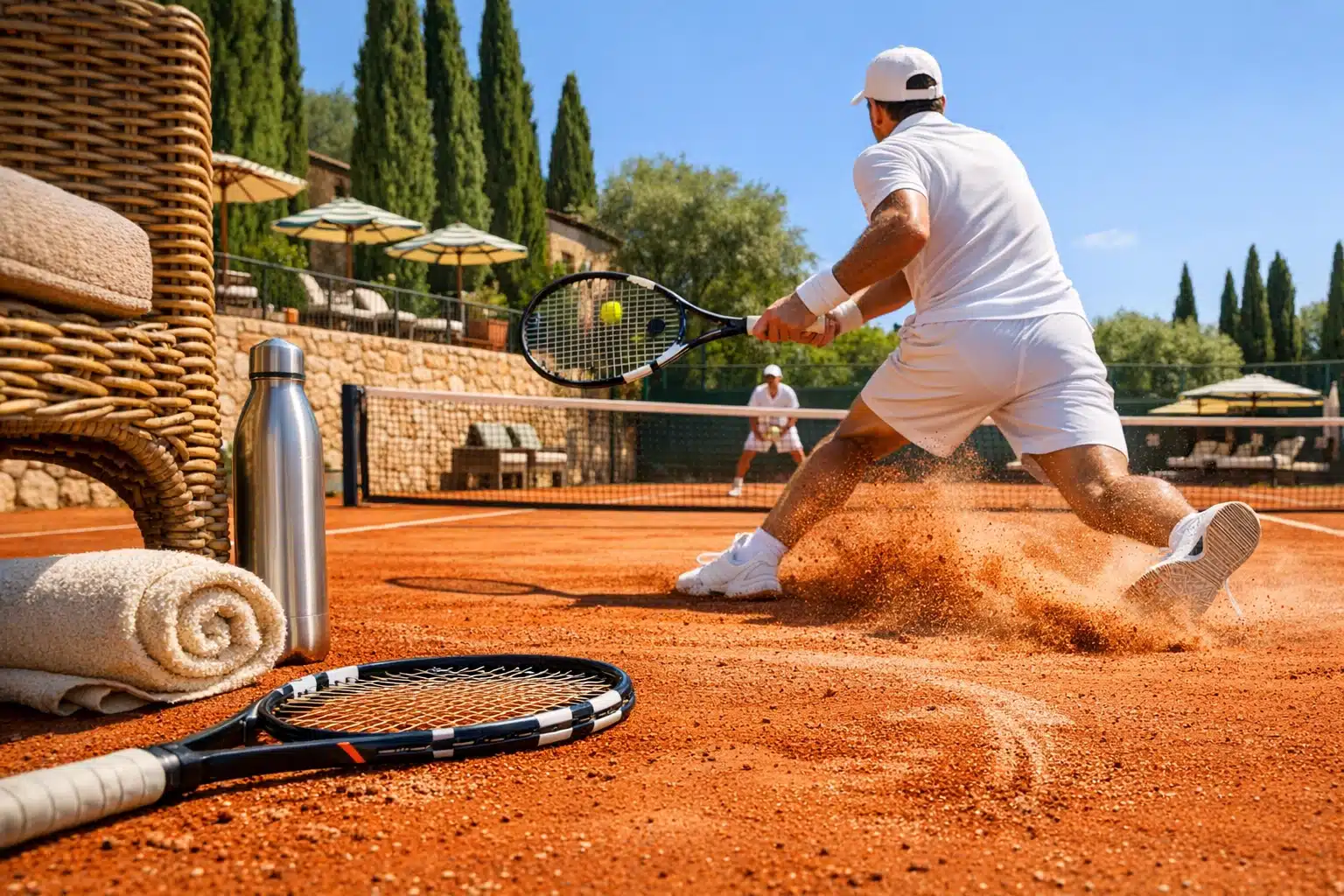
- Clay: slower and higher-bouncing, often encouraging longer rallies, heavy topspin, and patient construction
- Hard court: typically the most neutral, blending speed, consistency, and variety
Equipment also shapes performance. Modern rackets are commonly made from graphite composites rather than wood, allowing players to generate greater power and spin. String patterns, string tension, and grip size all influence feel. Tennis balls may look identical to casual viewers, yet factors such as pressure, felt texture, and court conditions affect bounce and speed. Even shoes are specialized: clay-court tread patterns differ from hard-court designs because movement demands differ.
For new fans, these details explain why tennis is so rich. It is not just player versus player. It is also player versus geometry, rhythm, and surface. Understanding the structure makes the spectacle sharper. Suddenly, what looks like a simple rally becomes a chain of calculations unfolding in real time.
Technique, Tactics, and the Physical and Mental Demands of the Game
Tennis is one of those sports that can look deceptively graceful on television. The camera often smooths out the violence of the movement: the explosive first step, the abrupt stop, the twist through the torso, the split-second decision to defend, attack, slice, or reset the point. At recreational level, players feel this immediately. A ball arrives with less time than expected, footwork becomes rushed, and suddenly technique matters far more than raw enthusiasm.
The basic strokes form the sport’s technical foundation. The serve begins every point and is the only shot fully initiated by the player, making it both a weapon and a responsibility. A good serve combines rhythm, leg drive, shoulder rotation, and placement. The forehand is often the most natural attacking shot, while the backhand can be played with one hand or two, each style offering different strengths in reach, stability, and spin production. The return of serve is frequently underrated, yet it is one of the hardest skills in sport because it demands instant reading and compact timing. Volleys, overheads, drop shots, lobs, and slices complete the toolbox.
Technique alone, however, does not win enough matches. Tactics turn strokes into patterns. A player might use heavy topspin to push an opponent back, then redirect down the line. Another may serve wide to open the court, then finish at the net. A counterpuncher can absorb pace and force one more ball, one more uncomfortable decision, until the attacker cracks. This is why tennis rewards problem-solvers. There is no timeout after every difficult point, no large team huddle, no coach stepping in during most play at many levels. The player must read the situation and adjust alone.
Common tactical ideas include:
- Targeting a weaker wing, often the less reliable side under pressure
- Changing height and spin to disrupt rhythm rather than hitting harder
- Using depth to keep an opponent from attacking inside the baseline
- Mixing pace and direction to create uncertainty
The physical demands are equally serious. Tennis requires acceleration, deceleration, lateral movement, balance, coordination, and repeat-effort stamina. Elite players may sprint, slide, recover, and strike at full stretch dozens of times in a match that lasts two or three hours, and sometimes much longer. Top professional serves can exceed 140 miles per hour, which means the receiver has very little time to react. Yet endurance matters just as much as speed. On clay, especially, points and matches can become drawn-out tests of legs and concentration.
The mental side is inseparable from the physical. Because scoring is segmented into points, games, and sets, momentum in tennis is peculiar. A player can lose a lopsided set and still begin the next one level. Confidence can rise or evaporate over a few minutes. The best competitors manage emotion without pretending they feel none. They develop routines between points, reset after mistakes, and treat pressure not as a personal insult but as part of the job. In that sense, tennis resembles chess played in running shoes: calculation, nerve, and execution must travel together.
Grand Slams, Great Players, and the Culture That Surrounds Tennis
If the rules provide tennis with structure, the tournament calendar gives it narrative. The four Grand Slam events stand at the center of the sport: the Australian Open, the French Open, Wimbledon, and the US Open. Each carries its own texture. Melbourne opens the season in summer heat for the Southern Hemisphere. Paris tests endurance and patience on clay. Wimbledon preserves a sense of ceremony with grass courts, white clothing traditions, and an atmosphere unlike any other venue. New York closes the Slam year with noise, pace, and a late-night energy that can feel almost theatrical.
These majors matter because they combine prestige, history, ranking importance, and public attention. Winning one can define a career. Reaching the second week can launch a reputation. Even early-round matches often tell revealing stories, because the tournament format demands sustained excellence rather than a single brilliant afternoon. Beyond the Slams, the ATP and WTA tours create the weekly rhythm of the sport, while team competitions such as the Davis Cup and Billie Jean King Cup remind fans that this highly individual game can also carry national colors and collective emotion.
Tennis culture has been shaped by remarkable players across eras. The sport has seen champions who built points like engineers, artists who bent the ball into impossible-looking curves, and defenders who seemed to turn defeat into delay and delay into victory. Names such as Serena Williams, Roger Federer, Rafael Nadal, Novak Djokovic, Steffi Graf, Martina Navratilova, Billie Jean King, and many others have influenced not just results but expectations. Some changed what athleticism looked like on a court. Some expanded the tactical vocabulary of the game. Some pushed for prize money fairness, visibility, and wider opportunity.
The sport’s culture also lives beyond trophies:
- In local clubs where players gather before work or after sunset
- In junior tournaments where ambition first takes recognizable form
- In fashion traditions, from classic whites to bold modern designs
- In commentary and analysis that turn shot selection into conversation
Tennis has a strong relationship with memory. Fans often recall not only who won but how a match felt: a tiebreak under lights, a comeback from two sets down, a rally that drew applause before the point had even ended. Because the game offers both individual expression and formal tradition, it attracts many kinds of followers. Some love the statistics, some the rivalries, some the aesthetics, and some the personal resilience shown in long contests. That breadth helps explain why tennis remains relevant in crowded modern sports culture. It is not merely a tournament circuit; it is a world with its own rituals, legends, and recurring drama.
How to Start Playing Tennis and Keep Improving Over Time
For beginners, tennis can seem intimidating because the ball rarely waits for anyone. The first few sessions may involve missed swings, awkward footwork, and serves that travel everywhere except the service box. That is normal. Tennis has a learning curve, but it also offers unusually clear feedback. When timing improves, players feel it immediately. The ball comes off the strings more cleanly, the court appears larger, and rallies begin to flow. Progress is rarely linear, yet it is often deeply satisfying.
Getting started does not require professional-level equipment. A suitable racket, comfortable court shoes, and a few balls are enough for most newcomers. Many clubs and community programs also provide loaner gear or introductory classes. For children, modified formats with smaller courts and lower-compression balls can make the game more manageable and more fun. Adults benefit from the same principle, even if the terminology differs: start with conditions that encourage success, then build difficulty gradually.
A practical entry path often looks like this:
- Learn basic grips, ready position, and simple footwork patterns
- Focus first on rallying and clean contact rather than hitting hard
- Practice serving with relaxed mechanics before chasing speed
- Play points early, because competition teaches decision-making quickly
- Use short, regular sessions to build consistency without overload
Improvement depends on balancing repetition with purpose. Simply hitting balls for an hour can be enjoyable, but targeted practice works better. One session might center on crosscourt forehands. Another might focus on returning serve or recovering to the middle after each shot. Match play reveals weaknesses that practice can then address. Video analysis, coaching feedback, and even a notebook of simple observations can accelerate development. A player who writes, “Late on wide backhands” or “Serve percentage drops when I rush,” already has a roadmap.
Tennis also offers long-term lifestyle value. It can be played competitively or socially, in singles or doubles, indoors or outdoors, from youth through older adulthood. Public courts make it accessible in many communities, and doubles provides a lower-impact option for people who still want movement and strategy without covering the entire court alone. General physical activity guidelines often encourage adults to accumulate at least 150 minutes of moderate exercise per week, and tennis can contribute meaningfully to that goal when practiced regularly. It also builds coordination, reaction speed, and situational focus.
Injury prevention matters, especially for wrists, elbows, shoulders, knees, and ankles. Warm up properly, strengthen the legs and core, and avoid increasing training volume too quickly. Technique helps here too; efficient movement and sound stroke mechanics reduce unnecessary strain. Most importantly, keep the game enjoyable. Improvement comes faster when curiosity stays alive. Tennis is demanding, but that is part of its charm. Every session offers another puzzle, another adjustment, another reason to return to the court and try again.
Conclusion for New Players, Curious Fans, and Lifelong Followers
Tennis rewards many different kinds of people. New players can appreciate its straightforward objective and the thrill of learning to sustain a rally. Regular club competitors can enjoy the endless tactical variety that makes one opponent completely different from the next. Dedicated fans can follow a global calendar filled with tradition, stylistic contrast, and matches that reveal as much about temperament as talent.
If you are just entering the sport, the best approach is to begin with patience and attention. Learn the rules, watch how surfaces change strategy, and practice the basics until the game starts to slow down in your mind. If you already know the sport, there is always another layer to notice: footwork patterns, return positioning, shot tolerance under pressure, or the subtle geometry of court openings. That is one of tennis’s great strengths. It stays familiar while never becoming fully exhausted.
In the end, tennis is more than a sequence of serves and scorelines. It is a meeting point for athleticism, precision, resilience, and imagination. Whether you pick up a racket, follow the Grand Slams, or simply learn enough to watch with sharper eyes, the sport offers lasting value. Once you understand how much is happening inside each point, it becomes very hard not to look closer.