Explore the world of swimming
Step into a pool and the usual rules of movement begin to soften. Gravity loosens its grip, breathing gains rhythm, and every stroke turns effort into glide. That is why swimming matters far beyond sport: it helps people build endurance, recover from injury, gain confidence in open water, and enjoy a form of exercise that can stay accessible across decades. In a world packed with sedentary routines, few skills are as useful, versatile, and quietly liberating.
Outline
This article first explains why swimming has such broad appeal, then examines its physical and mental benefits. After that, it compares the main strokes and the technical choices behind them. The fourth part focuses on safety, learning progress, and useful equipment. The final section looks at swimming as a lifelong activity, from recreation to competition, before closing with a practical conclusion for readers who want to get started or improve.
- The appeal and foundations of swimming
- Health, fitness, and mental well-being
- Stroke technique and useful comparisons
- Safety, instruction, and essential gear
- Swimming as recreation, sport, and long-term habit
1. Why Swimming Holds Such Lasting Appeal
Swimming stands apart from many other activities because it combines movement, survival skill, and recreation in one experience. A person can swim to train for a race, to relax after work, to recover from physical strain, or simply to enjoy a hot afternoon. Few activities move so easily between necessity and pleasure. That broad usefulness is one reason swimming appears in schools, public health advice, elite sport, holiday culture, and rehabilitation programs alike.
Part of its appeal comes from the environment itself. Water changes the body’s relationship with effort. On land, impact is constant; in water, buoyancy reduces stress on joints while still providing resistance in every direction. That makes swimming especially attractive for people who want a full-body workout without the pounding associated with running or court sports. It is often recommended, with professional guidance where needed, for older adults, people returning to exercise, and individuals managing certain mobility limitations. The water does not make work disappear, but it redistributes it in a way many people find more forgiving.
Swimming also crosses age groups with unusual ease. A child may first meet it as a safety lesson, a teenager may discover it as team sport, an adult may value it as exercise, and an older swimmer may keep it as a reliable form of low-impact movement. In that sense, swimming is less like a short-lived fitness trend and more like a language: once learned well, it stays available for different chapters of life.
Its global reach adds another layer. From Olympic pools to village rivers, from surf beaches to indoor leisure centers, swimming belongs to many cultures and climates. Some communities emphasize endurance and technique, others focus on water safety, and others celebrate seasonal recreation. Yet the core attraction remains similar:
- it teaches practical confidence in water,
- it offers a demanding but adaptable workout,
- it can be solitary, social, or competitive,
- and it invites people into an environment that feels almost weightless.
There is something quietly transformative about learning to move well in water. The first smooth length of a pool can feel like unlocking a new setting for the body. That sense of discovery is one reason people return to it year after year.
2. The Physical and Mental Benefits of Swimming
Swimming is widely valued as a whole-body exercise because it draws on the arms, shoulders, back, core, hips, and legs in continuous coordination. Unlike activities that isolate one or two major muscle groups, swimming asks the body to work as an integrated system. A single session may challenge cardiovascular endurance, muscular stamina, breathing control, posture, and timing all at once. This is one reason many coaches and health professionals see it as an efficient form of training when practiced regularly and with suitable intensity.
From a fitness standpoint, swimming helps improve heart and lung function. Public health guidance commonly recommends that adults aim for at least 150 minutes of moderate aerobic activity per week, and swimming can contribute strongly to that target. Depending on stroke, pace, and body size, a 30-minute swim can burn a meaningful number of calories, often in the rough range of 200 to 350 or more. Faster efforts, interval training, and demanding strokes such as butterfly can raise that figure. At the same time, the cooling effect of water allows some people to sustain exercise more comfortably than they might during hot-weather land workouts.
The mental side matters just as much. Many swimmers describe a distinct shift in attention once they settle into rhythm. The repeated pattern of stroke, kick, exhale, and turn can narrow the mind’s focus in a healthy way. It is not magic, and it does not replace proper mental health care when needed, but it often supports stress reduction, mood regulation, and a sense of calm. For some, lap swimming feels almost meditative; for others, open-water swimming offers the mental reset that comes from being fully present in a natural setting.
There are also practical long-term advantages. Swimming may support healthy aging by helping maintain mobility and endurance. It can be useful in cross-training plans for runners and cyclists who need aerobic work with less impact. People recovering from certain injuries may find it beneficial when supervised appropriately. Commonly noted benefits include:
- reduced joint stress compared with many land exercises,
- improved aerobic capacity and circulation,
- better muscular endurance and body awareness,
- structured breathing practice that encourages control,
- and a strong sense of refreshment after training.
Of course, swimming is not automatically easy or universally comfortable. Beginners may tire quickly, struggle with breathing, or feel uneasy in deep water. Yet that challenge is part of its value. Progress in swimming often comes with visible gains in confidence, and confidence is a benefit that reaches beyond the pool.
3. Understanding the Main Strokes and How They Compare
To an observer, swimming can seem simple: get from one end of the pool to the other. In practice, technique changes everything. The main competitive strokes, freestyle, backstroke, breaststroke, and butterfly, each demand a different balance of speed, efficiency, timing, and muscle use. Learning the differences helps beginners choose a starting point and allows more experienced swimmers to train with greater purpose.
Freestyle, usually swum as front crawl, is the fastest and most commonly practiced stroke. It uses alternating arm recovery, a flutter kick, and side breathing. Because the body stays relatively streamlined, freestyle is often the most efficient choice for distance. It is typically the first stroke taught for lap swimming fitness. Backstroke shares some similarities, especially the alternating arm action and flutter kick, but it is performed face-up. That makes breathing easier for some beginners, although body position and directional control can be tricky. Swimmers must learn to stay flat and aligned rather than letting the hips sink.
Breaststroke is different in both rhythm and feel. The arms move together, the kick is symmetrical, and the stroke includes a natural glide phase. Many casual swimmers enjoy breaststroke because breathing can feel more intuitive and the pace can be gentler. However, it is not always the easiest stroke technically. An effective breaststroke requires precise timing between pull, breath, kick, and glide. Poor timing wastes energy quickly. Butterfly is the most demanding of the four for many swimmers. With simultaneous arm recovery, a dolphin kick, and wave-like body action, it requires strength, coordination, and excellent timing. It is powerful and visually dramatic, but it can exhaust beginners in a short distance.
A simple comparison helps clarify how they differ:
-
Freestyle: fastest overall, efficient for fitness and racing, moderate breathing challenge.
-
Backstroke: good for posture awareness and shoulder mobility, easier access to air, harder to navigate straight.
-
Breaststroke: slower but often comfortable for recreational swimming, highly dependent on rhythm.
-
Butterfly: strongest power demand, high technical difficulty, excellent for advanced conditioning.
Beyond the strokes themselves, several technical principles apply to all forms of swimming. Streamline reduces drag. Controlled breathing prevents panic and wasted motion. Body rotation can improve reach and power. A relaxed recovery often matters more than frantic effort. New swimmers frequently try to overpower the water, but skilled swimmers learn a different lesson: speed grows when resistance falls.
This is where swimming becomes quietly fascinating. Two people may cover the same distance, yet one appears to wrestle the pool while the other seems to slide through it as if the water had agreed to cooperate. Technique is that difference. It turns exertion into efficiency and effort into elegance.
4. Safety, Learning Progress, and Choosing the Right Equipment
Swimming is enjoyable and beneficial, but it is inseparable from safety. Water can be inviting one moment and dangerous the next, especially in open environments such as lakes, rivers, or the sea. That is why learning to swim should never be framed only as a hobby. It is also a core life skill. Basic swimming ability, floating, treading water, safe entry and exit, and an understanding of local conditions can reduce risk significantly. Globally, public health organizations continue to stress that drowning remains a serious issue, especially where supervision, instruction, or safe facilities are limited.
For beginners, structured lessons are usually the smartest route. A good instructor helps students build confidence step by step rather than forcing progress too quickly. Early learning often focuses on breath control, floating, kicking, and feeling balanced in the water before full strokes are introduced. That progression matters. Many adults who say they “cannot swim” are not lacking courage; they often never had the chance to build comfort in those early stages. Patient instruction can change that. Children benefit as well, but lessons do not replace supervision. Even confident young swimmers need attentive adults nearby.
Open-water swimming adds another set of skills. Pool swimmers must adapt to waves, currents, lower visibility, and the absence of lane lines or walls. Cold water can affect breathing and muscle control. Weather can shift rapidly. Anyone entering natural water should know the location, understand conditions, and avoid swimming alone when possible. A lifeguarded area remains the safest choice.
Equipment should support safety and comfort rather than complicate them. Useful basics include:
- a well-fitted swimsuit that allows free movement,
- goggles that seal comfortably without excessive pressure,
- a swim cap when needed for hair control or reduced drag,
- a kickboard or pull buoy for specific drills,
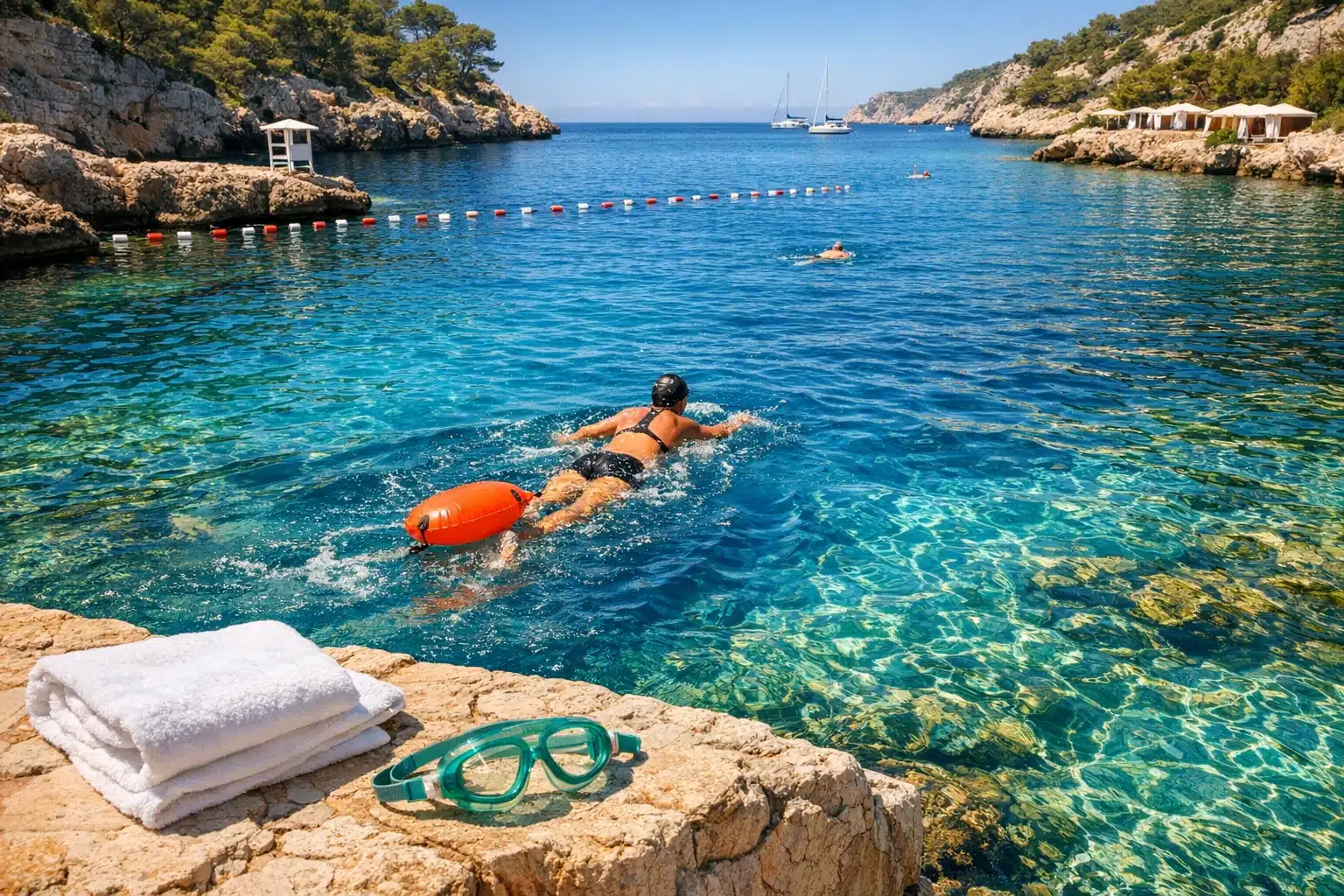
- and, in open water, visible safety gear such as a brightly colored tow float where appropriate.
Expensive gear is not the secret to progress. Clear instruction, regular practice, and good habits matter more. Showering before entering shared pools, following lane etiquette, respecting lifeguard rules, and knowing personal limits are all part of responsible swimming. In simple terms, the smartest swimmers are not only the strongest or fastest; they are the ones who treat water with steady respect.
5. Swimming as Recreation, Competition, and a Lifelong Habit
One of swimming’s greatest strengths is that it can mean different things without losing its value. For some people, it is a quiet personal routine, a few early laps before the rest of the city wakes up. For others, it is a team environment filled with pace clocks, split times, and hard sets that leave the shoulders burning. It can also be family recreation, travel activity, rehabilitation tool, or community sport. This flexibility helps explain why swimming remains relevant across such a wide audience.
Competitive swimming gives the activity one public face. From local meets to the Olympic Games, racing highlights precision, discipline, and incremental improvement. Victories are often measured in tenths or even hundredths of a second, which shows how much technical detail matters. Training plans may include endurance sets, sprint work, turns, starts, dryland strength, and careful recovery. Yet competition is only one branch of the wider swimming world. Recreational swimmers may never race, and still gain health, confidence, and satisfaction from regular practice.
There is also a strong social dimension. Masters clubs welcome adult swimmers at mixed ability levels. Community pools create shared spaces where children learn, teenagers train, and older adults stay active. Open-water groups often bring together people who enjoy challenge, scenery, and companionship in equal measure. Swimming can be solitary in the lane and still communal in spirit. A nod at the wall, a shared set, or a brief conversation about water temperature can make the sport feel unexpectedly warm.
As a long-term habit, swimming works best when it matches a person’s real life. That might mean two short sessions a week instead of an unrealistic six-day schedule. It might mean alternating strokes to avoid monotony or combining pool work with walking and strength training. Practical ways to sustain the habit include:
- setting process goals, such as improving breathing or consistency,
- choosing a time slot that genuinely fits your week,
- tracking distance or duration without becoming obsessed,
- and varying sessions between easy swims, drills, and faster efforts.
If running can feel like impact and lifting can feel like resistance, swimming often feels like conversation. The water gives feedback every second. Rush, and it pushes back. Settle into rhythm, and it carries you forward. That ongoing dialogue is a big part of why swimmers keep returning. The pool is rarely identical from one day to the next, because the person entering it is never exactly the same either.
Conclusion for Readers Ready to Get in the Water
Swimming deserves attention not only because it is a sport, but because it combines health, skill, safety, and enjoyment in unusual balance. For beginners, the main lesson is simple: start with confidence-building fundamentals and learn from qualified instruction when possible. For regular exercisers, swimming offers a practical way to improve endurance while reducing impact on the body. For experienced swimmers, refining technique and varying training can keep progress steady and the experience fresh. Whether your goal is fitness, relaxation, competition, or basic water competence, swimming offers a path worth taking one measured stroke at a time.