Explore the world of swimming
Swimming is one of the few activities that can feel playful, competitive, and deeply practical at the same time. It builds endurance, challenges technique, and offers a low-impact way to move for people across many ages and fitness levels. From lap pools to open water, it connects sport, safety, and recreation in a single skill set. That unusual mix makes it worth exploring in depth, whether you want exercise, confidence in the water, or a lifelong hobby.
Outline
- The place of swimming in sport, recreation, and daily life
- The main strokes, environments, and styles of participation
- Technique fundamentals that shape efficiency in the water
- Physical, mental, and practical benefits of regular swimming
- Equipment, training habits, safety principles, and a conclusion for new and returning swimmers
Swimming as a Skill, Sport, and Lifelong Activity
Swimming occupies a rare space in human life because it is useful, demanding, and enjoyable all at once. For some people, it begins as a safety skill learned in childhood. For others, it becomes a competitive pursuit measured in split times, stroke counts, and race strategy. Many more encounter it somewhere in the middle, as a form of exercise that feels different from land-based training. Water changes everything: movement slows, breathing becomes structured, and the body must learn to cooperate with resistance rather than simply push through it.
At its core, swimming includes several distinct strokes, each with its own rhythm and demands. Freestyle, usually swum with the front crawl, is the fastest and most common stroke in fitness swimming and racing. Backstroke flips the body onto its back and often feels more relaxed for beginners because the face stays above water, though shoulder control and body alignment still matter. Breaststroke is slower but highly technical, with a pull, breath, kick, and glide sequence that rewards timing over brute effort. Butterfly is the most physically intense of the four competitive strokes, requiring coordinated undulation, powerful pulling, and strong timing. In competitions, swimmers may also race individual medley events, which combine all four strokes in one demanding sequence.
Swimming also changes with the setting. A pool offers measured distances, lane lines, controlled depth, and predictable conditions. Open water, by contrast, introduces currents, temperature changes, waves, visibility issues, and navigation challenges. A calm lake can feel peaceful and expansive, while the sea may test nerve and judgment even before endurance becomes a factor. That difference is one reason experienced swimmers often say the water tells the truth: it rewards good habits and exposes poor ones quickly.
People engage with swimming for very different reasons, and those reasons shape how they train. Common motivations include:
- Learning water safety and survival skills
- Improving cardiovascular fitness
- Recovering from or working around joint stress
- Competing in school, club, masters, or open-water events
- Enjoying a meditative form of movement
That broad appeal explains why swimming remains relevant across age groups. Children may learn confidence and coordination, adults may value its joint-friendly conditioning, and older swimmers often appreciate the way buoyancy reduces impact without removing challenge. It is not an effortless sport, despite what graceful swimmers make it look like. Yet that is part of its charm. The first lengths may feel awkward, but progress arrives in satisfying layers: a calmer breath, a cleaner turn, a smoother glide, and eventually the quiet pleasure of moving through water with purpose.
Technique Fundamentals: Efficiency, Breathing, and Better Movement
Good swimming technique is less about fighting the water and more about learning how not to waste energy in it. Beginners often assume progress comes from kicking harder or pulling faster, but efficiency usually starts elsewhere. Body position, breath timing, head placement, and balance have a major influence on how smoothly someone moves. When these pieces work together, swimming feels less like struggling forward and more like sliding through a resistant but cooperative surface.
One of the most important concepts is drag reduction. Water is far denser than air, so small technical errors carry a big penalty. If the hips drop, the legs sink and create extra resistance. If the head lifts too high while breathing, the whole body line can tilt and slow down. Swimmers who stay long and aligned tend to travel farther with each stroke than swimmers who churn frantically. This is why skilled athletes often look calm even when moving at impressive speed.
Breathing deserves special attention because it shapes rhythm as much as oxygen intake. In freestyle, many learners hold their breath underwater and then try to inhale and exhale at once when they turn their head. That creates tension and hurry. A better habit is to exhale gently while the face is in the water, then take a quick, clean inhale during the body roll. Backstroke removes the face-in-water challenge, but timing still matters because irregular breathing can disrupt stroke tempo. Breaststroke usually allows a natural breath every cycle, yet the head should not rise higher than necessary. Butterfly requires even more coordination, since a poorly timed breath can flatten momentum.
Several technical basics apply across strokes:
- Keep the body long and as horizontal as possible
- Look down or slightly forward rather than lifting the chin excessively
- Use the core to stabilize rotation and maintain balance
- Match the kick to the stroke instead of treating it as random effort
- Prioritize clean hand entry and controlled underwater pulling paths
Drills help turn these ideas into habits. Kick sets can build awareness of body position. Pull sets, often using a pull buoy, highlight upper-body mechanics. Single-arm drills improve balance and timing. Catch-up freestyle can teach patience in the stroke, though it should be used thoughtfully so the stroke does not become overly flat. Video feedback is especially useful because swimming sensations can be misleading; what feels streamlined may not look that way from the deck.
Technique is also where swimming differs sharply from activities like walking or casual cycling. Many people can start those with moderate success almost immediately. Swimming asks for a deeper learning curve. That can be frustrating at first, but it also makes progress rewarding. A small technical adjustment may save more energy than a large increase in effort. In that sense, swimming behaves almost like a craft. The water responds to detail, and the swimmer who respects detail usually goes farther with less strain.
The Benefits of Swimming for Fitness, Recovery, and Mental Well-Being
Swimming is often praised for being a full-body workout, and that description is fair, but it only captures part of the story. Its real value lies in the combination of aerobic challenge, muscular involvement, and reduced impact on the joints. Because water supports a significant portion of body weight through buoyancy, many people find swimming more comfortable than repeated pounding from activities such as running. That does not make it easy. It simply shifts the challenge from impact tolerance to coordinated resistance.
From a cardiovascular perspective, swimming can contribute meaningfully to the general physical activity targets recommended by major public health bodies, which commonly advise adults to aim for around 150 minutes of moderate aerobic activity per week, or more if intensity is lower. A steady lap session can raise heart rate, build endurance, and improve work capacity over time. The exact energy cost varies with stroke, speed, body size, and skill level, but a moderately paced swim can use substantial energy, especially because inefficient technique increases demand. In simple terms, the water makes the body work for distance.
Muscularly, swimming spreads effort across multiple regions instead of isolating one area. Freestyle and backstroke recruit the shoulders, back, core, and legs in coordinated patterns. Breaststroke emphasizes timing and adductor engagement differently, while butterfly places heavy demands on the upper body, trunk, and rhythm. Because strokes vary so much, swimmers can mix sessions according to goals, just as a gym user might alternate lifting patterns. Cross-training value is another advantage. Athletes in cycling, running, rowing, and field sports often use swimming to add aerobic work without stacking extra impact on tired joints.
The mental side is just as important. Repetitive laps can create a focused, almost meditative state. Breathing patterns impose a steady tempo. The soundscape is muted. The outside world seems to pause between each turn. For some people, that makes swimming a useful stress-management tool, though it should not be treated as a cure-all. It can support mental well-being by offering structure, movement, and a sense of progress, especially when daily life feels crowded or noisy.
Swimming may be particularly appealing for people who want:
- Exercise with less joint stress
- A break from high-impact training
- A practical skill with safety value
- Variety between technique work and conditioning
- A social activity through lessons, clubs, or masters groups
There are, however, sensible limitations to acknowledge. Access can be uneven, pool time may be expensive or crowded, and some swimmers experience skin dryness or irritation from chlorinated water. Technique also matters more here than in many other forms of exercise, which can slow early progress. Still, for a wide range of people, swimming offers a rare balance: demanding enough to improve fitness, adaptable enough to suit different bodies, and practical enough to matter beyond exercise alone.
Equipment, Environments, and the Experience of Swimming in Different Waters
Swimming does not require an excessive amount of gear, but the right equipment can make learning and training far more comfortable. The basic essentials are simple: a suitable swimsuit, a pair of goggles, and access to safe water. Yet even those basics influence performance and enjoyment. Goggles that leak or fog constantly can turn a calm session into an irritating one. A poorly fitted suit can restrict movement. Cold water can change the mood of a session before the first lap is complete.
For beginners, the smartest approach is to start with minimal equipment and add tools only when they serve a clear purpose. A swim cap is useful for keeping hair managed and reducing drag, though not every casual swimmer considers it necessary. Kickboards can help isolate leg work, but they should not dominate sessions because they alter body position. Pull buoys reduce leg involvement and can be helpful for upper-body focus, especially in technique sets. Fins may support ankle flexibility and body alignment, yet oversized or overused fins can mask weak kicking mechanics. Hand paddles are generally better introduced later, once shoulder strength and pulling form are more reliable.
A sensible beginner kit often includes:
- A comfortable swimsuit designed for movement rather than fashion alone
- Anti-fog goggles that fit securely around the eyes
- A towel, water bottle, and sandals for poolside practicality
- A cap if required by the facility or preferred for comfort
- Optional training aids used with a clear purpose, not by habit
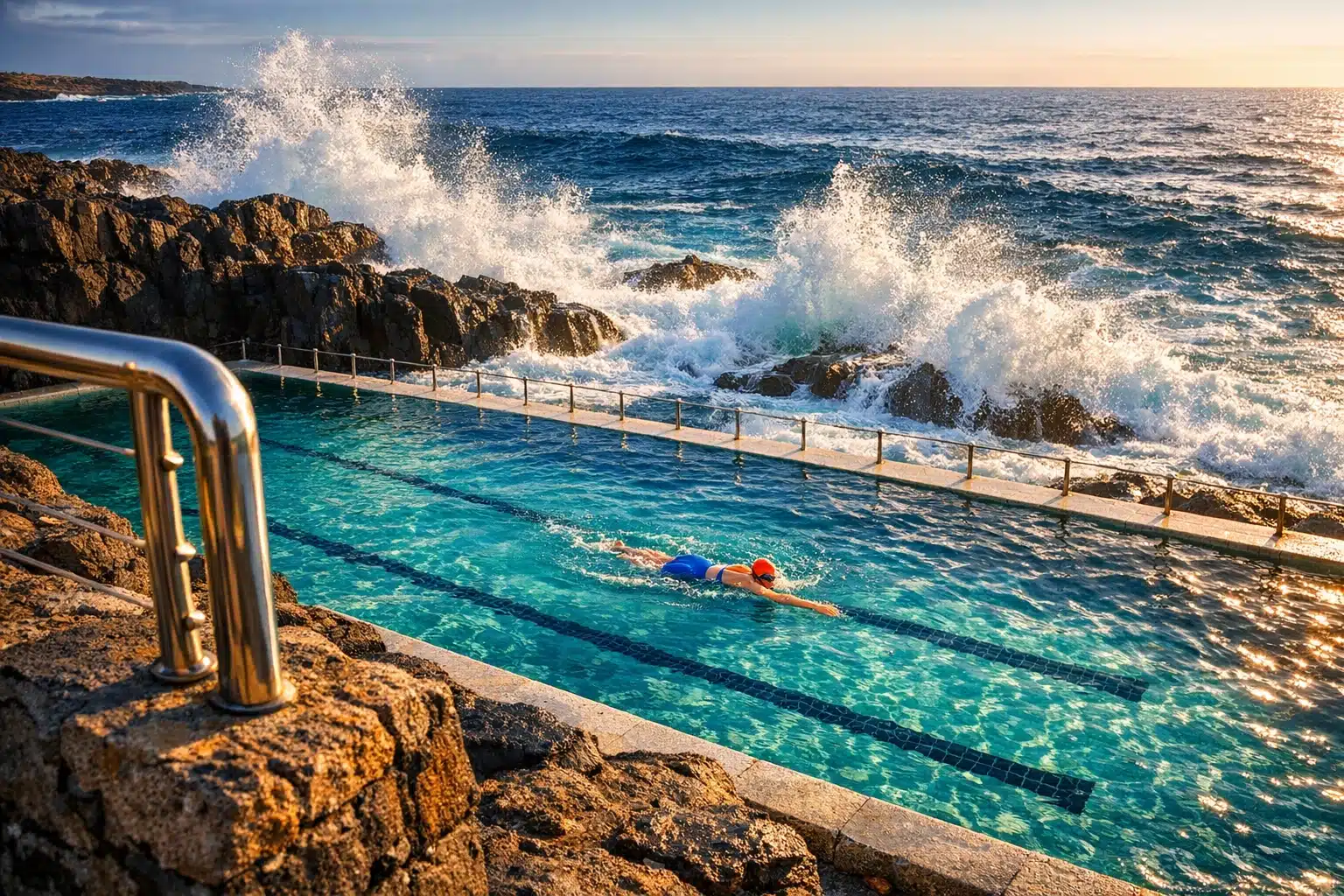
The environment matters as much as the gear. Pools are ideal for structured practice because distances are known and conditions are controlled. They make pacing, interval work, and technical repetition easier. Chlorinated indoor pools, however, can feel warm, busy, or chemically sharp depending on ventilation and maintenance. Outdoor pools offer fresh air and natural light, though weather becomes a factor. Open water introduces a completely different experience. Lakes may appear calm but can hide sudden temperature shifts and uneven visibility. Rivers add current, which changes both effort and safety planning. The sea offers buoyancy from salt water but also brings waves, tides, and navigation challenges.
These settings are not simply harder or easier; they demand different skills. Pool swimmers rely on walls, lane lines, and predictable sight lines. Open-water swimmers must sight forward, stay calm without a visible bottom, and judge conditions before entering. Even the feel of the water changes. Salt water tends to support the body more than fresh water, while cold water can affect breathing control and decision-making almost immediately.
There is also a social side to environment. Lane etiquette matters in pools, especially during busy times. Swimmers may need to circle swim, pass carefully, or match lanes by pace. In open water, group swims, bright caps, tow floats, and local knowledge all add a layer of reassurance. The best environment is usually the one that matches your goal, skill level, and safety preparation. A quiet pool may be ideal for learning the catch in freestyle; a supervised open-water session may be the right next step for adventure-minded swimmers who already have solid basics.
Training, Safety, and a Practical Conclusion for New and Returning Swimmers
Once the basics are in place, progress in swimming depends less on heroic effort and more on steady, structured practice. Many swimmers improve by doing too little planning for too long. They enter the pool, swim until tired, and leave without a clear purpose. That approach can maintain general fitness, but it rarely builds technique or stamina efficiently. A simple plan works better: warm up, complete a focused main set, include some technical work, and finish with an easy cool-down. Even short sessions become more productive when they have a shape.
For beginners, the goal should not be impressive distance right away. It should be confidence, rhythm, and repeatable form. A new swimmer might begin with 20 to 30 minutes of mixed drills and short lengths, resting often enough to preserve quality. Returning swimmers can expand that into interval work, such as repeated 50-meter efforts with controlled rest. More experienced recreational swimmers may use varied sessions across a week, combining endurance sets, stroke work, and speed-focused repeats. Progress can be tracked through time, distance, perceived effort, and how controlled breathing feels at a given pace.
A balanced weekly approach could include:
- One technique-heavy session focused on drills and body position
- One aerobic session with steady intervals
- One mixed session with stroke variety or pace changes
- Optional dryland mobility or strength work to support shoulder and core function
Safety should never sit in the background, especially because swimming can create a false sense of security once someone becomes moderately competent. Pool swimmers still need awareness of fatigue, depth, rules, and other users in the lane. Open-water swimmers need much more: local condition checks, weather awareness, visibility gear, and ideally company. Swimming alone in open water is a poor gamble, even for skilled athletes. Cold water deserves special caution because it can affect breathing and coordination faster than many people expect. Children require close, active supervision around water at all times, not merely nearby adults with distracted attention.
It is also wise to respect the body’s limits. Shoulder discomfort, persistent breathlessness, dizziness, or unusual fatigue should not be brushed aside. Swimming is joint-friendly for many people, but repetitive motion can still overload tissues when technique or training volume is poor. Recovery matters. So does patience.
For new and returning swimmers, the most useful conclusion is a practical one: you do not need elite speed to benefit deeply from this activity. You need safe conditions, consistent practice, and a willingness to learn the language of the water. Start where you are, not where a confident lap swimmer appears to be. Let each session teach one clear lesson, whether that is calmer breathing, cleaner body position, or steadier pacing. Over time, swimming becomes more than exercise. It becomes a dependable skill, a source of fitness, and for many people, a quiet place to think while the world briefly fades behind the next stroke.