Explore the world of tennis
Tennis matters because it blends strategy, movement, patience, and spectacle in a way few sports can match. It can be played on public courts, followed on global television, and enjoyed at almost any age, which gives it unusual reach. From a beginner learning how to rally to a fan tracking Grand Slam drama, the game offers a clear path from curiosity to lifelong involvement. That combination of accessibility and depth explains its enduring appeal.
Outline: • the origins, rules, and surfaces that define tennis • the strokes, footwork, and tactical patterns that win points • the training habits, equipment choices, and injury-prevention basics that support steady improvement • the structure of professional tennis and the events that command worldwide attention • practical reasons the sport remains rewarding for new players and longtime followers.
The Foundations of Tennis: History, Rules, Courts, and Surfaces
Modern tennis carries centuries of evolution in its strings. Its older relatives appeared in Europe long before the current game, but lawn tennis took recognizable form in the 1870s, and Wimbledon staged its first championship in 1877. That moment matters because it helped standardize rules, equipment, and competition. Since then, tennis has traveled far beyond private clubs and royal lawns. Today it lives in city parks, schools, resorts, academies, and major stadiums, proving that a sport with formal roots can still feel open to anyone with a racket and a patch of court.
The court itself is simple, but its measurements quietly shape everything. A standard tennis court is 78 feet long. Singles play uses a width of 27 feet, while doubles extends to 36 feet. The net stands 3 feet high at the center, slightly higher at the posts. Those numbers are not trivia for rule books alone; they influence shot angles, recovery distance, and risk. A player defending a wide forehand in singles solves a different spatial problem than a doubles team protecting the alleys. Even a casual viewer can feel this geometry once the pattern becomes visible.
Scoring gives tennis its distinct rhythm. Points progress from love to 15, 30, 40, and game, with a player usually needing six games to win a set and at least two sets to win a match, depending on format. At deuce, the tension rises because a player must win two consecutive points to close the game. Tie-breaks, commonly played at 6-6 in games, compress pressure into a short burst. A match can swing on a handful of brave returns or one cautious second serve. Few sports stretch suspense in such compact increments.
Surface type changes the sport in ways that even nonplayers can notice:
• Clay generally slows the ball and produces a higher bounce, encouraging longer rallies and heavier topspin.
• Grass tends to stay faster and lower, rewarding quick reactions, crisp serving, and efficient movement.
• Hard courts sit somewhere in the middle, offering a balance that supports many styles.
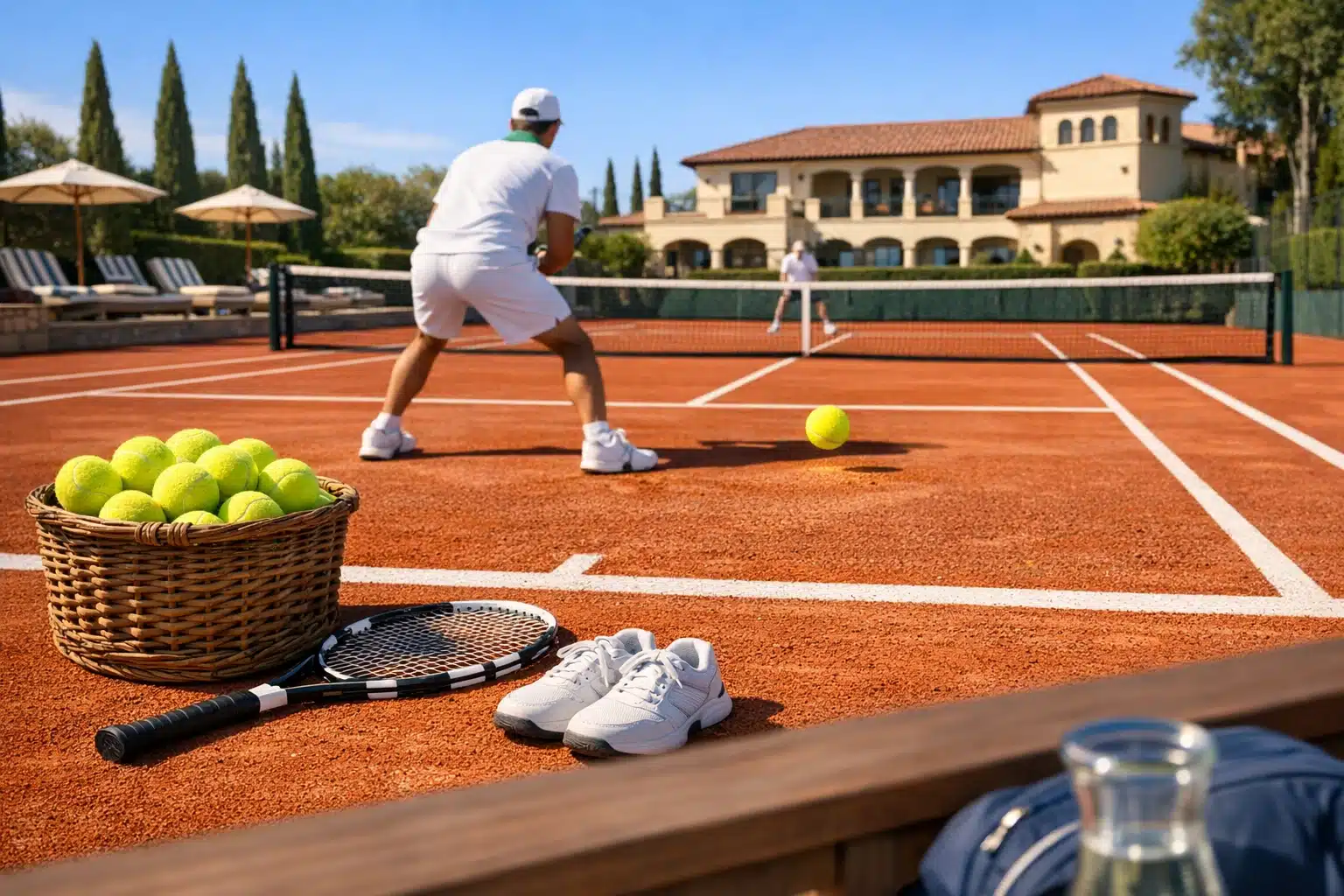
These surface effects are not merely stylistic labels. They influence tournament preparation, footwear, recovery patterns, and even career narratives. Rafael Nadal’s clay-court excellence, for example, is not just about talent; it reflects how his spin, movement, and physical endurance align with the surface’s demands. By contrast, flatter hitters have often found quicker courts more rewarding. Tennis begins, then, as a measured contest governed by lines and rules, yet it opens into a rich variety of tempos and identities the moment the first ball is struck.
How Points Are Won: Technique, Footwork, and Tactical Thinking
Tennis may look like a simple exchange of ball over net, but every rally is built from layers of technique and decision-making. The basic strokes are easy to name and difficult to master: serve, forehand, backhand, return, volley, overhead, slice, and lob. Each carries a different purpose. A heavy topspin forehand can push an opponent back and open the court. A sliced backhand can stay low and break rhythm. A volley shortens time and demands touch. The serve starts the point, yet it also announces intent, because placement, spin, and disguise matter as much as outright pace.
Serve speed often attracts attention, especially in professional tennis, where elite players may deliver first serves well above 120 miles per hour, and some exceed 140. Still, power alone rarely decides matches at the highest level. A wide serve on the deuce side can drag a receiver off court. A body serve can jam clean hitters. A kicker above shoulder height can force a defensive reply. The best servers do not just hit hard; they make opponents uncomfortable before the rally has properly begun.
Footwork is the hidden engine of the sport. Clean strokes often begin with sharp positioning rather than gifted hand-eye coordination. Good players split-step before the opponent strikes, adjust with small balancing steps, and recover toward sensible court positions instead of admiring their last shot. When movement fails, timing collapses. That is why tennis coaches frequently repeat a quiet truth: the feet often decide what the racket can express.
Tactics add another layer of intrigue. A thoughtful player studies patterns rather than isolated highlights. Common ideas include:
• attacking a weaker wing repeatedly until a short ball appears
• changing direction only when balanced enough to absorb risk
• using depth to neutralize aggressive opponents
• mixing pace and spin to disturb timing
• approaching the net behind a shot that forces a predictable response
Mental clarity matters because tennis offers no clock to rescue a drifting competitor. Momentum can turn after one loose game, one brave hold, or one return that lands on the baseline like a dare. The game rewards problem-solvers who can adapt under stress. That is part of its charm. Chess comparisons are common, but tennis is not chess played standing still. It is chess in motion, under fatigue, with the board bouncing at you seventy times a minute. The player who reads space, manages nerves, and chooses the right shot at the right time usually wins more than the player who only swings hardest.
Training for Tennis: Fitness, Equipment, and Injury Prevention
Tennis asks the body to do many things at once. A player accelerates, stops, changes direction, rotates through the trunk, reaches overhead, and repeats the cycle for anywhere from under an hour to several hours. That blend of aerobic and anaerobic effort is one reason the sport can feel so satisfying. Recreational sessions may burn a meaningful number of calories depending on body size and intensity, and regular play can contribute to cardiovascular fitness, coordination, and lower-body strength. Yet the sport rewards preparation. A smooth one-hour hit in the evening often depends on quiet work done long before the first ball is served.
Effective training usually includes four connected elements. First comes movement: short sprints, shuffle patterns, balance drills, and reaction work. Second comes strength: legs for pushing off, core stability for transferring force, shoulders and back for controlling the racket. Third comes endurance: enough base fitness to maintain concentration and mechanics late in a set. Fourth comes mobility: hips, ankles, thoracic spine, and shoulders all need enough range to move safely and efficiently. A player does not need an elaborate performance lab to improve. Consistency usually matters more than complexity.
Equipment choices also shape comfort and progress. Rackets vary in head size, weight, balance, and stiffness, and those differences affect power, control, and feel. Beginners often benefit from a forgiving frame that helps produce depth without perfect timing. Strings matter too. Tension changes response, with lower tension generally offering easier power and higher tension often providing a firmer sense of control. Shoes deserve special attention because court movement punishes poor support. Running shoes are built for straight-line motion, while tennis shoes are designed to manage lateral cuts and sudden stops.
A practical setup often includes:
• a racket that matches strength and experience rather than marketing hype
• shoes suited to the surface being used
• fresh grips for secure handling
• warm-up habits that raise heart rate before explosive movement
• recovery basics such as hydration, sleep, and sensible rest
Injury prevention is not glamorous, but it is part of tennis literacy. Common trouble spots include the elbow, shoulder, knees, calves, and ankles. Many problems stem from overload, rushed technique changes, poor footwear, or playing hard without preparation. A player returning after a long break should increase volume gradually instead of chasing old standards in the first week back. Tennis can be a lifelong sport, and that promise becomes real when enthusiasm is matched by patience. In other words, the smartest training plan is not the one that looks toughest on paper; it is the one that keeps a player healthy enough to return to court again and again.
The Professional Game: Tournaments, Rankings, Rivalries, and Modern Change
Professional tennis gives the sport much of its public drama, but its structure is more complex than four famous tournaments on television. The calendar is anchored by the Grand Slams: the Australian Open, Roland-Garros, Wimbledon, and the US Open. These events carry the greatest prestige because they draw deep fields, command intense global attention, and test players across different surfaces and conditions. Around them sits a wider ecosystem of ATP and WTA events, along with team competitions such as the Davis Cup and Billie Jean King Cup. Rankings are usually calculated over a rolling 52-week period, which means players are not only chasing titles but also defending past results.
This format creates pressure that casual viewers do not always notice. A champion from last year returns with points to protect. A player climbing from injury must rebuild with limited opportunities. A breakthrough run at one tournament can transform a season, while a difficult draw can slow momentum despite strong form. The ranking table therefore reflects both excellence and endurance. It measures not just who can shine for a weekend, but who can sustain quality across changing surfaces, cities, climates, and emotional states.
The professional game has also produced some remarkable benchmarks. The longest match in major history lasted 11 hours and 5 minutes at Wimbledon in 2010, a number so extreme it sounds fictional until you remember tennis has no game clock. Equal prize money at all four Grand Slams marks another important milestone in the sport’s public development, though the path to that standard took decades of advocacy. Technology has changed the viewing and playing experience as well. Electronic line-calling systems, advanced match statistics, and instant highlight distribution have made the sport more transparent, measurable, and accessible to fans.
What keeps people watching, however, is not structure alone. Rivalries animate the calendar. Contrasting styles create narrative tension:
• a relentless baseliner against a creative net-rusher
• a powerful first-strike player against a superb defender
• a veteran reader of patterns against an explosive newcomer
• a clay-court specialist adapting to grass or hard courts
Professional tennis also reveals how thin the margins can be. A match may turn on second-serve percentage, break-point conversion, or unforced errors under pressure. Numbers matter, but they never tell the whole story. The crowd senses something more human: composure after a double fault, ambition on a big point, or the refusal to give up in a fifth set. At its best, the tour becomes a traveling theatre of discipline and nerve, where style meets statistics and personality meets pressure.
Conclusion for New Players and Curious Fans: Why Tennis Rewards Long-Term Interest
If you are new to tennis, the sport can seem crowded with terms, traditions, and technical details. That impression fades quickly once you spend time with it. A rally teaches spacing. A scoreline reveals momentum. A surface explains why one player looks comfortable and another looks hurried. Tennis is generous in that way: the more attention you give it, the more clearly its patterns begin to appear. You do not need to master every rule at once to enjoy the game. You only need a reason to keep watching, playing, or asking the next useful question.
For recreational players, tennis offers a rare balance of individual challenge and social connection. You can practice alone with a basket of balls, hit casually with a friend, join leagues, or play doubles with family members across generations. The learning curve is real, but that is part of the reward. Early improvements are easy to feel, whether they come through cleaner contact, steadier footwork, or calmer decision-making. Even modest progress feels earned because the sport gives honest feedback. The ball lands in or out. The point continues or ends. Excuses do not travel far across a net.
For spectators, tennis remains compelling because every match tells two stories at once. One story is visible: speed, angles, and score. The other is subtler: adaptation, patience, courage, and restraint. A player may abandon a risky pattern, protect a second serve, or test an opponent’s movement until a weakness opens. That ongoing negotiation between skill and judgment makes tennis enjoyable even when the rallies are not flashy. Beauty in this sport is often practical before it is dramatic.
If you want a practical way in, begin with a few simple steps:
• watch a full set rather than only highlight clips
• learn the basic scoring system until it feels natural
• try hitting on a public court or beginner clinic
• notice how footwork shapes shot quality
• follow one tournament from start to finish to understand form and context
Tennis rewards patience more than haste, curiosity more than ego, and regular engagement more than occasional intensity. For beginners, it offers a skill that can grow for decades. For returning adults, it provides challenge without requiring team schedules. For fans, it supplies stories rich with contrast, pressure, and technical nuance. That is the enduring gift of tennis: it meets people where they are, then steadily invites them deeper into the game.