Tennis: Rules, Techniques, and Tips for Beginners
Tennis has a rare ability to look calm from the stands and feel thrillingly complex the moment a racket meets your hand. A new player soon notices that every rally asks for timing, balance, judgment, and confidence, whether the ball skids low or jumps high off the court. That layered challenge is a big reason the sport attracts children, adults, and lifelong competitors alike. Once you understand the rules, the main strokes, and a few smart practice habits, the game becomes far less mysterious and far more rewarding.
It is also one of the few sports that fits many goals at once. Some people play for fitness, others for competition, and many simply enjoy the rhythm of trading shots with a friend on a bright afternoon. Tennis develops coordination, lower-body strength, agility, and concentration, but it also teaches patience in a very direct way: the ball does not care how eager you are, only how well you prepare for it.
Outline
This article follows a practical path for new players. First, it explains the court, scoring system, and basic rules so the structure of a match makes sense. Next, it looks at rackets, balls, shoes, and court surfaces, along with preparation habits that help beginners feel comfortable. The third part breaks down core techniques such as grips, footwork, serves, and groundstrokes. The fourth section focuses on strategy, comparing smarter patterns of play in singles and doubles. The final section covers training, common mistakes, and a beginner-friendly conclusion on how to improve steadily without draining the fun out of the sport.
1. Understanding the Court, the Rules, and the Scoring System
Before a player worries about topspin, placement, or winning a tiebreak under pressure, it helps to understand the shape of the battlefield. A standard tennis court is 78 feet long. For singles, the playing width is 27 feet, while doubles uses the wider 36-foot court. The net divides the court in half and stands 3 feet high at the center. Each side includes a baseline, service line, center service line, and two service boxes. These markings are not decorative details; they determine where serves must land, how wide you can aim, and how court positioning changes from shot to shot.
The most distinctive part of tennis for many beginners is the scoring language. A game progresses from love to 15, 30, and 40. If both players reach 40, the score becomes deuce. From deuce, one player must win two points in a row: one for advantage and one to close the game. A set is usually won by the first player to reach six games with a margin of at least two. If the set reaches 6-6, many formats use a tiebreak, typically first to 7 points with a two-point lead. Matches are commonly played as best of three sets at recreational and many professional events, though formats can vary.
The serve begins every point, and the server must stand behind the baseline and hit the ball into the diagonally opposite service box. If the first serve misses, there is a second attempt. Missing both serves produces a double fault, which means the point goes to the returner. During a rally, the ball must land inside the court boundaries appropriate to singles or doubles. If it lands outside, the shot is out. If a ball clips the line, it counts as in, which often surprises newcomers who assume the line is separate from the playable area.
A few practical rules matter immediately for beginners:
• Players switch ends after the first, third, fifth, and every odd-numbered game after that.
• In most informal play, a ball that hits the net and lands in the correct service box on a serve is replayed.
• Touching the net during a live point loses the point.
• The ball can bounce only once before you must return it.
Tennis is easy to enjoy casually, but its rule structure has real elegance. Every point starts from a defined pattern, then quickly becomes a contest of geometry, movement, and nerve. Once scoring clicks, watching or playing a match becomes much more satisfying because the flow of momentum finally has a clear shape.
2. Equipment, Court Surfaces, and Preparation Before You Play
One of the best things about tennis is that you do not need a mountain of gear to begin, but the few items you do choose can make your first months either smoother or more frustrating. The most important piece is the racket. Beginners are often better served by a racket that offers stability, a generous head size, and moderate weight rather than something built for advanced players with explosive swings. Many entry-level and intermediate rackets fall around the 100 to 105 square inch head-size range, which gives a little more forgiveness on off-center contact. That forgiveness matters because new players rarely strike the ball from the sweet spot every time, and a helpful racket can reduce harsh vibration while making clean contact easier to feel.
Tennis balls also vary more than newcomers expect. Standard yellow balls are used in most adult play, but lower-compression balls, often called green-dot, orange, or red training balls, move more slowly and bounce more predictably for learners. They are not just for children. Adults who are learning can benefit from them because they create extra time to set up properly, which means technique develops with less panic. In that sense, a slower ball is not a shortcut; it is a teaching tool.
Footwear deserves more attention than it usually gets. Running shoes are made primarily for forward motion, while tennis shoes are designed for stopping, shuffling, and changing direction laterally. That difference affects both performance and injury risk. A shoe with proper court grip and side support helps a beginner push off confidently without feeling as if the ankle is being asked to do all the work alone.
Surface type changes the character of the game in visible ways:
• Hard courts are common, fairly consistent, and usually a balanced starting point.
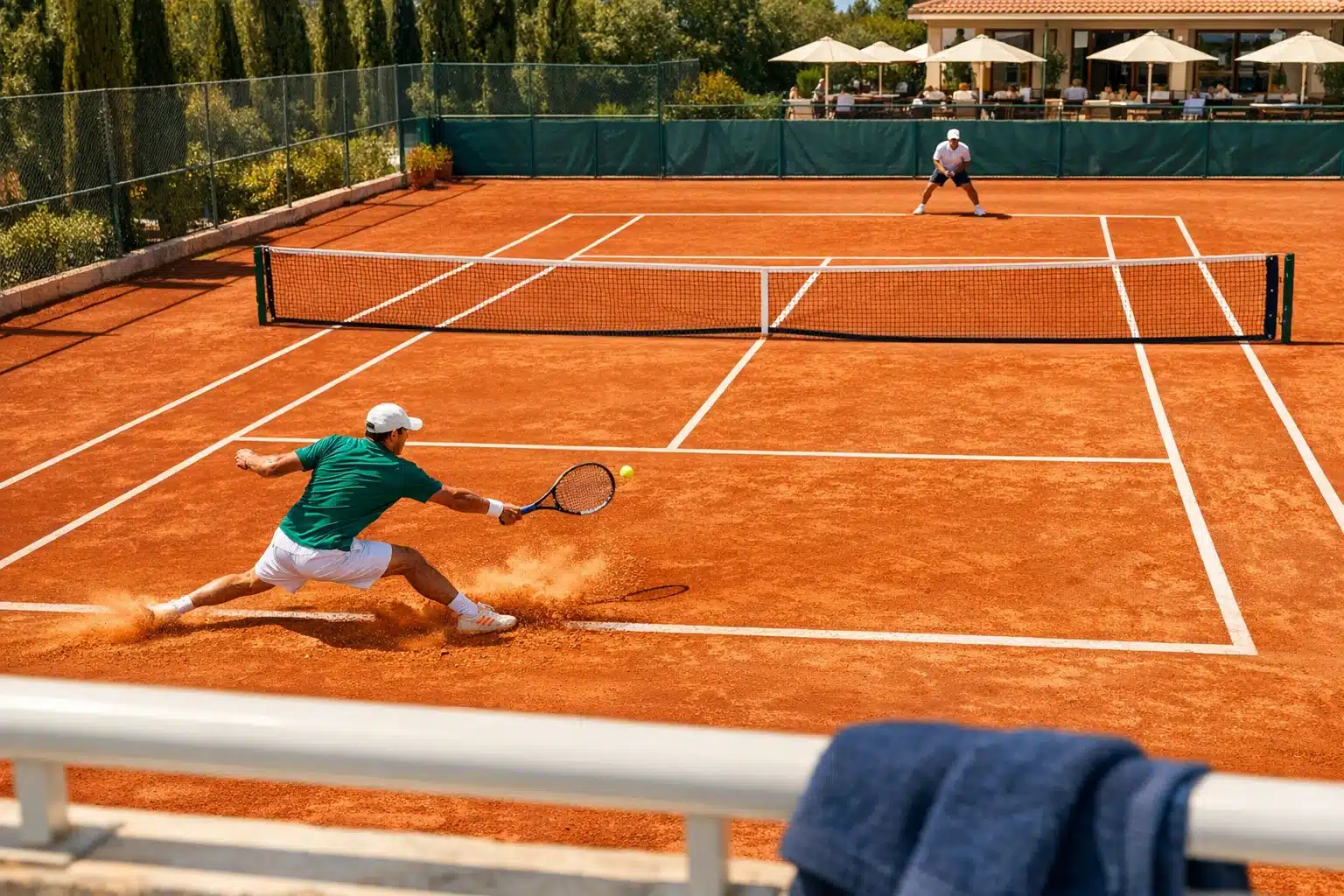
• Clay courts slow the ball and produce a higher bounce, often rewarding patience and point construction.
• Grass courts are faster, lower bouncing, and less common for everyday players.
• Indoor courts remove wind and sun from the equation, which can make timing easier.
Preparation habits matter just as much as gear. A short dynamic warm-up, a few relaxed shadow swings, and several easy mini-court exchanges can wake up the body before full-speed hitting begins. Hydration is also easy to underestimate, especially in hot weather or during long rallies. Tennis may include frequent breaks between points, yet the stop-start rhythm can still be physically demanding. A little planning before stepping onto the court often makes the difference between a session that feels productive and one that feels like survival.
3. Core Techniques: Grips, Footwork, and the Main Strokes
If rules provide the grammar of tennis, technique gives it a voice. Beginners often focus first on the racket swing, but strong tennis starts earlier, with how the player holds the racket and moves into position. Grip choice influences spin, comfort, and the shape of the contact point. On the forehand side, many modern players use a semi-western grip because it supports topspin and helps control the ball. Some beginners prefer an eastern forehand grip at first because it can feel more natural and slightly simpler when learning to make solid contact. Neither choice is magic. What matters most early on is using one grip consistently enough to develop timing.
The backhand usually comes in two common forms: one-handed and two-handed. A two-handed backhand is often easier for beginners to stabilize because both hands help guide the racket through contact. A one-handed backhand can offer reach and elegance, but it generally demands more timing, strength, and technical precision. Recreational players frequently discover that the two-handed version lets them rally sooner with better control, which is a very practical reason to start there.
Footwork is the quiet engine behind every stroke. The split step, a small hop performed as the opponent strikes the ball, helps the body react in the right direction. From there, adjustment steps guide the player into ideal spacing. This is where many newcomers struggle. They may watch the ball closely but stop moving their feet too early, so the swing becomes a rescue attempt. Tennis punishes lazy spacing and rewards players who keep their legs active all the way to contact.
The main strokes each have a clear job:
• The forehand is often the first attacking shot beginners trust.
• The backhand adds balance and keeps opponents from targeting one side.
• The serve starts the point and can range from simple and reliable to aggressive and varied.
• The volley is played before the bounce, usually near the net.
• The overhead finishes lobs that hang too high and too long.
A good beginner forehand usually includes shoulder turn, racket preparation, a forward swing through the ball, and a balanced finish. The backhand follows similar principles, though the body mechanics differ. On the serve, the real goal at first is not speed; it is repeatable rhythm. Toss, reach, and clean contact matter more than trying to impress anyone with power. In fact, many new players improve faster by hitting a slower serve that lands regularly than by swinging hard and missing half the time.
One useful image is to think of tennis strokes as linked rather than isolated. The legs load, the hips rotate, the torso follows, and the arm delivers the racket to the ball. That sequence, often called the kinetic chain, explains why smooth technique can produce more pace than muscling the shot with the arm alone. When a stroke feels effortless yet the ball travels deep, you are beginning to sense real tennis mechanics at work.
4. Smart Beginner Strategy in Singles and Doubles
Strategy can sound intimidating, as if it belongs only to tournament veterans with notebooks full of patterns. In reality, beginner strategy is refreshingly practical. The first rule is simple: keep more balls in play than your opponent. At entry level, many points end because someone misses rather than because someone hits a spectacular winner. That means consistency is not a boring fallback; it is a winning skill. A deep ball hit safely over the net often does more damage than a risky line-hugging shot that misses by inches.
One of the most reliable patterns in tennis is the crosscourt exchange. Hitting crosscourt gives you a longer distance to work with than hitting down the line, and the net is slightly lower in the middle than at the posts. Those two facts make crosscourt shots safer for developing players. Down-the-line shots can be effective, especially as a change of direction, but they require more precision. A helpful beginner mindset is to build the point patiently before trying to finish it. Tennis rewards people who understand sequence, not just ambition.
Court position also shapes outcomes. In singles, recovering toward the center after each shot is usually wise because it helps cover both directions. If you are dragged wide, the court opens up behind you, so a calm recovery step becomes essential. In doubles, positioning shifts because the alley is in play and teamwork matters. The server’s partner often stays active near the net, ready to intercept a floated return, while both players must learn to move as a pair rather than as isolated individuals.
Useful strategic habits for new players include:
• Aim higher over the net when under pressure.
• Prefer depth before sharp angles.
• Attack short balls instead of forcing offense from difficult positions.
• Use the opponent’s weaker side when you can identify it.
• Change direction only when balanced.
There is also a mental side to strategy. Some players lose structure after one bad game and begin attempting low-percentage shots out of frustration. Others panic when a rival pushes the ball back again and again. Patience becomes a tactical edge here. The player who accepts long rallies and keeps making reasonable decisions usually emerges in better shape. That does not mean playing passively forever. It means knowing when to build, when to defend, and when the court finally offers a real invitation to attack.
In this way, tennis resembles chess played at running speed. The ball is moving, your lungs are working, and decisions must be made quickly, yet the smartest choices are often the simplest ones. Beginners improve faster when they treat points as manageable puzzles rather than dramatic tests of bravery.
5. Training, Common Mistakes, and a Practical Conclusion for New Players
Improvement in tennis rarely arrives as one grand breakthrough. It usually shows up in quieter ways: a cleaner contact point, a steadier serve toss, a rally that lasts four shots longer than it used to, or a match in which frustration no longer dictates every decision. For beginners, that is good news. Progress is built from repeatable habits, not from chasing perfect form on every swing. A simple weekly plan often works better than occasional marathon sessions that leave the body tired and the technique scrambled.
A balanced beginner routine might include one technical practice, one point-play session, and one fitness-oriented day each week. Technical sessions can focus on a small number of ideas, such as forehand spacing or serve rhythm, rather than trying to fix the entire game in an hour. Point-play teaches decision-making under pressure, which no basket drill can fully replace. Fitness work does not need to be elaborate. Short sprints, lateral movement drills, core stability, and mobility exercises can support better movement and reduce the chances of overuse problems.
Common beginner mistakes are familiar, and that is actually encouraging because they can be corrected:
• Swinging too hard when consistency would help more.
• Standing flat-footed after hitting instead of recovering.
• Looking up too early and misjudging contact.
• Using only the arm and ignoring the legs and torso.
• Treating every missed shot as a crisis instead of feedback.
Another trap is comparing yourself too quickly with experienced players. Tennis has a steep learning curve, especially with timing-based skills such as returning serve or hitting on the rise. A newcomer may feel awkward for a while, and that is normal. The sport asks the body to coordinate movement, spin recognition, spacing, and decision-making in seconds. Seen from that angle, even a modest rally is a pretty impressive piece of problem-solving.
To improve safely, pay attention to recovery as well as effort. If the shoulder, elbow, wrist, or knee keeps complaining, technique and workload deserve review. Good coaching can shorten the trial-and-error phase because a trained eye often notices one small adjustment that changes everything, such as preparing earlier or moving the feet before the backswing begins. Even without constant lessons, recording a short video of your strokes can reveal patterns that are hard to feel in real time.
For beginners, the most sensible goal is not to play dazzling tennis by next weekend. It is to build a game that is enjoyable, sustainable, and strong enough to keep growing. Learn the scoring until it feels natural, choose equipment that supports rather than fights you, trust patient footwork, and treat strategy as a set of calm decisions instead of a mystery. If you keep showing up with curiosity, the court slowly becomes less intimidating and more inviting. That is when tennis changes from a difficult skill to a lasting companion.