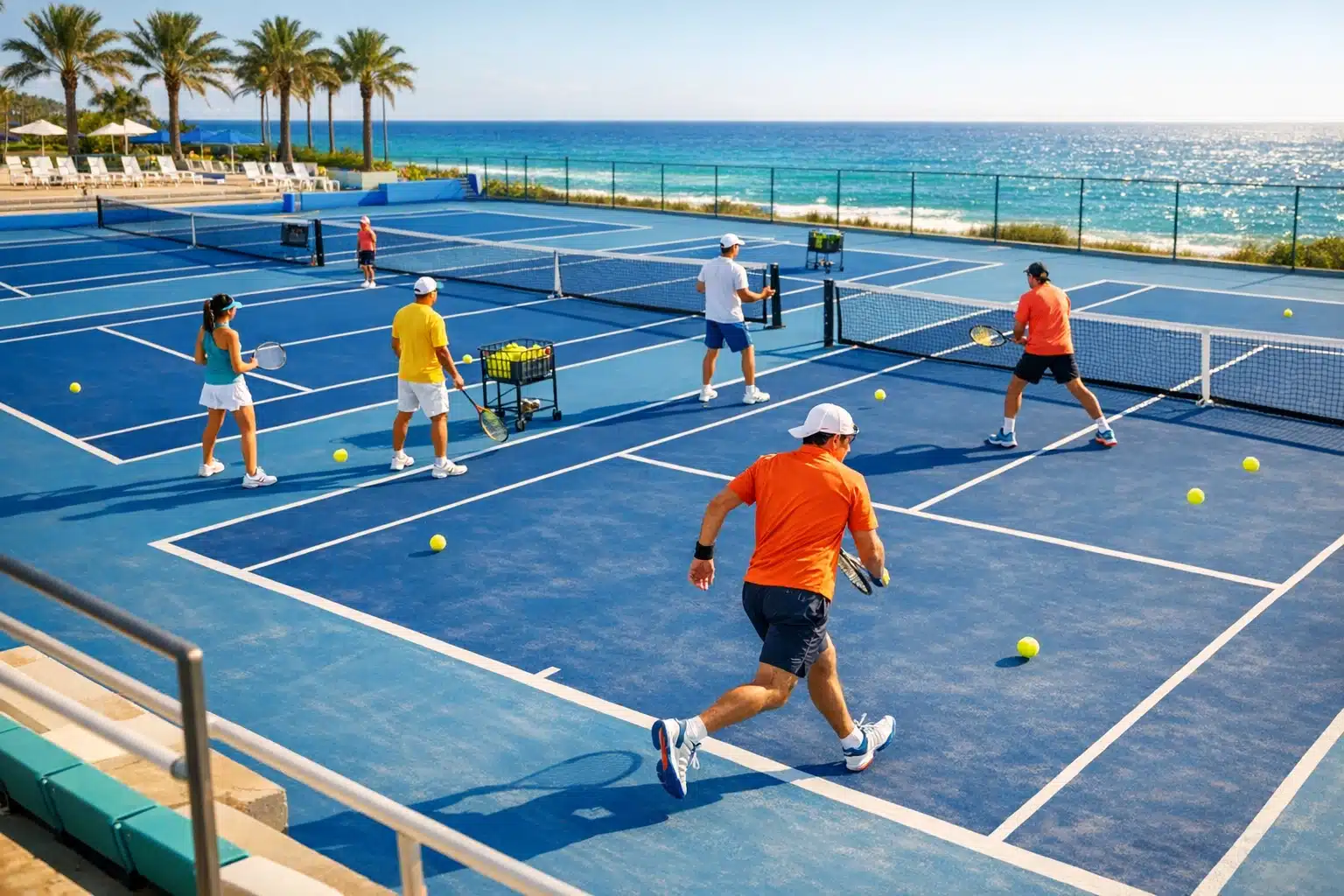
Tennis Basics: Rules, Equipment, and Tips for Beginners
Tennis sits at a rare crossroads: simple enough to start with a borrowed racket, yet layered enough to reward a lifetime of practice. It builds coordination, stamina, and tactical thinking while fitting many goals, from casual exercise to organized competition. For beginners, a little structure turns the sport from intimidating to inviting. This guide explains the essentials so stepping onto court feels less like guesswork and more like the start of a skill worth keeping.
Outline: • How the court, lines, and common match formats work • How tennis scoring, serving, and key rules are applied • What equipment beginners actually need, and how surfaces change play • Which techniques and practice habits help new players improve steadily • How simple strategy, etiquette, and smart next steps make the game more enjoyable
Understanding Tennis: Court Layout, Objective, and Match Formats
At its core, tennis is a contest of placement, timing, and problem-solving. One player or team sends the ball over the net and into the opponent’s side of the court, aiming to force an error or create a shot that cannot be returned legally. That basic objective is easy to describe, but the court’s design gives the sport its personality. A standard tennis court is 23.77 meters long. In singles, the usable width is 8.23 meters, while doubles uses the wider 10.97-meter court that includes the alleys. The net is 1.07 meters high at the posts and 0.914 meters high at the center. Those numbers matter because they influence how much angle a player can create, how hard a ball can be hit safely, and how much ground each competitor must cover.
The painted lines are not decoration; they are the grammar of the game. The baseline marks the back edge of play, the sidelines define width, and the service boxes divide the front half of the court for serves. The center mark on the baseline helps players position themselves correctly before serving. Once a rally begins, the court stops looking like a flat rectangle and starts behaving like a map of pressure. Deep shots push opponents backward, wide balls drag them off the court, and short replies invite attack. Beginners quickly discover that tennis is not only about power. Often, a well-placed moderate shot beats a rushed, ambitious blast.
Tennis can be played as singles or doubles. Singles emphasizes speed, endurance, and one-on-one tactical discipline. Doubles introduces teamwork, sharper angles, and faster exchanges near the net. Match formats vary by level and event, but most recreational matches use the best-of-three-set structure. In some elite events, men may play best-of-five sets, demanding exceptional physical and mental endurance. Many clubs and beginner leagues also use shortened formats, such as a match tie-break instead of a full third set, to save time and keep scheduling practical.
For a new player, it helps to think of tennis in layers:
• The court tells you where the ball may land.
• The format tells you how long the contest may last.
• The opponent forces you to make choices under pressure.
• Your own consistency determines how often those choices work.
That combination is one reason tennis remains globally popular. It can be social, intensely competitive, or quietly personal. A first rally may last only three shots, yet it can spark the same satisfaction as solving a tricky puzzle. The sport rewards patience, and it also rewards curiosity, which makes it especially inviting for beginners who enjoy learning by doing.
Rules and Scoring: What Every Beginner Should Know
Tennis scoring is famous for looking odd before it starts making sense. Points within a game are counted as 15, 30, and 40 rather than 1, 2, and 3. If both players reach 40, the score becomes deuce. From deuce, a player must win two consecutive points to take the game: one point for advantage, and another to close it out. If the player with advantage loses the next point, the score returns to deuce. This structure creates one of tennis’s defining features: momentum can swing suddenly, and a game that looked almost over can stretch into a tense mini-drama.
Games build into sets, and sets build into matches. A player usually wins a set by taking at least six games with a margin of two. If the set reaches 6-6 in many formats, a tie-break is played. A standard tie-break is won by the first player to reach seven points with a two-point lead. Players alternate service in a specific pattern, and they switch ends after every six points, which helps balance factors such as sunlight and wind. Matches are commonly best of three sets at recreational, junior, and many professional levels, while some top-tier events may extend longer.
Serving is the only shot entirely under the player’s control, so its rules matter. The server starts behind the baseline and must hit the ball into the diagonally opposite service box. Each point allows two serve attempts. Missing both results in a double fault, which gives the point to the receiver. The serve must be struck before the ball hits the ground, and the server may not step on or over the baseline before contact, which would be a foot fault. After a successful serve lands in the correct box, the rally is live, and players can hit to almost any part of the opponent’s side within the court boundaries.
Several beginner-friendly rules are worth memorizing early:
• If the ball lands on a line, it is considered in.
• A player loses the point if the ball bounces twice before being returned.
• A shot that hits the net and still goes over can remain in play during a rally.
• In doubles, players may use the wider court after the serve is in play.
• Players should call the score clearly before serving in most casual and organized matches.
These rules do more than organize the game; they shape its psychology. Because scoring is broken into points, games, sets, and matches, tennis constantly offers fresh starts. A player can lose a long rally and still reset for the next point. That is an important lesson for beginners. Improvement in tennis is not a straight staircase. It feels more like learning to steer a small boat: you make adjustments point by point, often in changing conditions, until control becomes more natural than forced.
Equipment and Surfaces: What You Need and How Conditions Change the Game
One reason tennis is accessible is that the starter kit is simple: a racket, balls, proper shoes, and a court. Still, equipment choices have a real effect on comfort and development, especially for beginners. The standard adult racket length is usually 27 inches, but rackets vary in head size, weight, balance, and string pattern. New players often benefit from a racket with a larger head, commonly around 100 to 110 square inches, because it provides a more forgiving sweet spot. A lighter racket, often in the neighborhood of 260 to 300 grams unstrung, can also be easier to swing and less tiring during early practice sessions. That said, the best choice depends on strength, coordination, and how often the person plans to play.
Strings matter more than many beginners expect. Polyester strings are common among advanced players because they can support aggressive topspin and control, but they may feel firmer on the arm. Synthetic gut and multifilament options are often more comfortable and can be a sensible starting point for recreational players. Grip size matters too. If the handle is too small, the racket can twist excessively. If it is too large, the hand may feel cramped and less responsive. A coach or reputable tennis shop can usually help measure grip size in minutes, which makes it one of the easiest upgrades in comfort.
Footwear deserves special attention. Running shoes are designed mainly for forward motion, while tennis demands constant side-to-side movement, stopping, and re-acceleration. Tennis shoes provide more lateral support and court-specific traction, which helps performance and reduces injury risk. Balls also vary. Pressurized balls are common for regular play and have a lively bounce, while pressureless balls last longer and are often used for practice. For children and complete beginners, slower foam or low-compression balls can make rallies easier and more enjoyable because they bounce lower and travel more slowly.
The surface under your feet changes the character of the sport dramatically:
• Hard courts usually offer a medium-to-fast pace and a fairly true bounce.
• Clay courts are generally slower, producing higher bounces and longer rallies.
• Grass courts tend to stay lower and can reward quick reactions and shorter points.
These differences affect strategy and even equipment preferences. Clay encourages patience, sliding skill, and heavy topspin. Hard courts suit all-around play and are common in public facilities. Grass, though less available, asks players to stay low and react quickly. For beginners, the useful lesson is not to chase perfect gear. Choose equipment that supports learning, feels comfortable, and allows consistent practice. In tennis, the right racket helps, but a steady schedule and sound fundamentals help far more.
Technique and Practice: Building Reliable Strokes, Footwork, and Confidence
Beginners often focus first on the racket, but experienced players know the feet quietly run the show. Good tennis starts with balance, spacing, and preparation. If the body arrives late or awkwardly to the ball, even a technically sound swing can break down. That is why coaches spend so much time on footwork, ready position, and recovery steps. A simple split step, the small hop a player makes as the opponent hits the ball, improves reaction time and helps the body move in the correct direction. It is not flashy, yet it is one of the habits that separates rushed hitting from controlled striking.
The forehand is usually the first groundstroke beginners feel comfortable with. A useful starting idea is to turn the shoulders early, move to the ball with small adjustment steps, and make contact slightly in front of the body. The backhand can be hit with one hand or two, and many beginners find the two-handed version more stable at first. The serve is the most complex shot because it combines timing, rhythm, coordination, and body mechanics. New players should not chase speed too early. A dependable serve that starts the point is far more valuable than a dramatic motion that produces double faults.
Volleys, which are hit before the ball bounces, add another dimension. In doubles especially, good volleying creates pressure and shortens points. Unlike groundstrokes, volleys use a compact motion. Think of guiding the ball rather than taking a huge swing. Returns also deserve early attention because every point begins with a serve. A short backswing and good balance often matter more than brute force when sending the ball back into play.
Helpful beginner priorities include:
• Learn to recover toward a neutral position after each shot.
• Aim for clean contact before trying to hit hard.
• Practice rallying cross-court, where the court is longer and safer.
• Use shadow swings and wall drills to repeat movements efficiently.
• Warm up shoulders, hips, calves, and wrists before play.
A productive practice plan is usually simple. Two or three focused sessions per week can be enough for visible improvement. One session might emphasize technique through feeding drills. Another can be based on live rallying and point play. A third, if available, can include serves and returns. Short, regular practice beats rare marathon sessions because the nervous system learns through repetition. There is also a mental side to improvement. Tennis humbles almost everyone in the beginning. Mishits happen, timing comes and goes, and some days the ball seems to have opinions of its own. The key is to measure progress by better habits, cleaner contact, and longer rallies, not by perfection. Confidence in tennis grows quietly, then suddenly feels obvious.
Strategy, Etiquette, and the Smartest Way to Start Playing Regularly
Once beginners can sustain a few shots, strategy becomes the bridge between simply hitting and actually competing. The first strategic lesson is that percentage tennis usually beats heroic tennis. In other words, a player who aims with margin over the net and chooses sensible targets often outlasts someone trying for low-percentage winners from difficult positions. A common guideline is to aim several feet above the net and favor cross-court rallies, because the cross-court path is longer and gives more room for error. Down-the-line shots can be effective, but they are usually riskier and better used with intention rather than impulse.
Positioning matters just as much as shot selection. In singles, players often recover toward the center after each shot, adjusting according to where they have pulled the opponent. In doubles, teamwork and communication become central. Partners should discuss who covers lobs, who takes balls through the middle, and when the net player looks to poach. Beginners do not need advanced tactics on day one, but they should understand that tennis rewards patterns. Serving wide and hitting into the open court, keeping a weaker opponent moving, or using a high, safe ball to reset a rally are all examples of strategy in action.
Etiquette is another important part of the sport and makes the experience better for everyone. Tennis has a long tradition of self-management, especially in recreational play, where players call lines on their own side. Honesty and clarity matter. If there is uncertainty, the fair habit is to give the benefit of the doubt to the opponent. Good etiquette also includes arriving on time, bringing enough balls, keeping conversation respectful, and avoiding unnecessary movement while a point is in progress on an adjacent court.
Useful habits for new players include:
• Call the score clearly before each point.
• Return stray balls safely and at an appropriate moment.
• Offer a short warm-up before starting competitive play.
• Thank opponents and partners after the session.
• Focus on learning, not arguing over marginal calls.
For someone wondering how to begin regularly, the smartest path is usually practical rather than dramatic. Join a beginner clinic, try a local club ladder, book an introductory lesson, or ask a friend for a weekly rally session. Public courts often make the sport more affordable than newcomers expect. A starter setup does not need to be expensive, and group lessons can spread costs while adding structure. Most importantly, let the game unfold over time. Tennis is a conversation between movement, attention, and decision-making. At first, the sentences may be short and clumsy. Then the rhythm improves, the rallies lengthen, and the sport begins to feel less like an obstacle course and more like a language you can actually speak.
Conclusion for Beginners
If you are new to tennis, the main goal is not to master everything at once. Learn how the court is organized, understand the logic of scoring, choose comfortable equipment, and build simple, repeatable technique. Add a few clear strategic ideas, respect the etiquette that keeps play fair, and your experience will improve faster than you might expect. Tennis can challenge your lungs, legs, and patience, but it also gives back in equal measure through fitness, focus, and the joy of a well-struck ball. Start small, play regularly, and let consistency do the quiet work that turns a beginner into a genuine player.