Tennis Basics: Rules, Equipment, and Tips for Beginners
Tennis is one of those sports that seems easy from the seats but becomes wonderfully complex the moment you swing a racket. It combines movement, timing, decision-making, and endurance, so beginners quickly notice that every rally teaches something new. Knowing the basic rules, equipment choices, and early practice habits makes the game more enjoyable and far less confusing. This guide is built to help new players step onto the court with confidence and keep improving after the first few sessions.
Outline of This Guide and Why Tennis Is Worth Learning
Before diving into rules, rackets, and stroke mechanics, it helps to know how this guide is organized and why that order matters. Tennis can feel like several sports stitched together. One part is technical, because you need to learn grips, swing paths, and footwork. Another part is strategic, because placement and anticipation often matter as much as raw power. A third part is practical, because choosing the wrong shoes or an unsuitable racket can make improvement slower and comfort worse. For beginners, a clear sequence turns that complexity into something manageable.
This article follows a simple path from understanding the game to applying it on court. The structure is designed to answer the questions most new players ask in their first weeks: What do all the lines mean? How does scoring work? Which equipment actually matters? What should I practice first? How can I improve without turning every hit into a frustrating struggle?
-
First, the article maps out the sport so you know what to expect and what skills matter most at the beginner level.
-
Second, it explains the rules, scoring system, and court layout, which removes much of the confusion that new players experience during matches.
-
Third, it compares key equipment choices such as rackets, balls, strings, shoes, and court surfaces.
-
Fourth, it covers fundamental techniques and movement patterns that form the base of reliable tennis.
-
Fifth, it closes with a practical plan for improving, avoiding common mistakes, and enjoying the sport for the long term.
Tennis is worth learning because it offers more than competition. It develops coordination, cardiovascular fitness, balance, and concentration. It can be played casually with friends, socially in doubles, or seriously in league formats. Unlike some sports that require a large team, tennis can fit different lifestyles and age groups. A teenager can learn it for school competition, an adult can use it as a social fitness habit, and an older beginner can enjoy it through doubles and controlled drills. In that sense, tennis is less like a closed club and more like a long conversation: the more you participate, the more the game reveals. That is exactly why learning the basics well makes such a difference.
Understanding the Rules, Scoring, and Shape of the Court
Tennis becomes far less intimidating once its geometry and scoring system make sense. The court is 78 feet long from baseline to baseline. In singles, the playing width is 27 feet, while doubles uses the wider 36-foot court. Across the middle stretches the net, which stands 3 feet high at the center and 3 feet 6 inches at the posts. Those measurements are not just trivia; they influence how players aim, move, and construct points.
The main lines tell you where the ball may land. The baseline marks the back boundary. The singles sidelines define the narrower court used for one-on-one play. The doubles alleys, added on each side, count only in doubles. Near the net, the service line and center service line divide the front half of each side into two service boxes. When serving, the ball must travel diagonally into the correct box. If it lands outside that box, it is a fault. A player usually gets two chances to start the point. Missing both serves produces a double fault, which loses the point immediately.
Scoring is famous for sounding unusual: 15, 30, 40, game. If both players reach 40, the score is deuce. From deuce, one player must win two points in a row: the first gives advantage, the second wins the game. Sets are usually won by reaching six games with a margin of two. At 6-6, many formats use a tiebreak, commonly first to seven points with a two-point lead. Recreational matches are often best of three sets, while tournament formats may vary.
A few rules are especially important for beginners:
-
A ball that touches the line is considered in.
-
You may let the ball bounce once on your side before returning it, but not twice.
-
You cannot touch the net during a live point.
-
A serve that clips the net and still lands in the correct service box is replayed as a let.
-
In singles, the doubles alleys are out; in doubles, they are in.
Tennis also has an etiquette side. Players are expected to call lines fairly, keep pace between points, and respect opponents. That culture matters because many matches are played without officials. Imagine the court as a neatly drawn map and the rules as its traffic system. Once you understand where the road lines are and how points are counted, the sport stops feeling mysterious and starts feeling playable.
Choosing the Right Equipment and Understanding Court Surfaces
Beginner improvement is shaped not only by effort, but by equipment that matches current ability. The racket is the obvious starting point, yet many new players assume the most expensive frame will automatically help. In reality, comfort, forgiveness, and control are often more useful than prestige. Most adult beginners do well with a racket head size between about 100 and 105 square inches. That range offers a larger sweet spot, which means slightly off-center contact is less punishing. A common beginner-friendly weight is roughly 270 to 300 grams unstrung, though strength, age, and preference matter.
Grip size matters more than many people expect. If the handle is too small, the racket can twist and encourage over-gripping. If it is too large, wrist freedom becomes harder. A simple check is to hold the racket and see whether there is roughly enough space to fit the index finger of your other hand between your fingertips and palm. Many players also add an overgrip for comfort and moisture control.
Strings change feel dramatically. Stiff polyester strings are popular with advanced players who swing fast and generate topspin, but they can feel harsh for newcomers. Softer options such as synthetic gut or multifilament strings are often more forgiving and arm-friendly. String tension also affects performance: lower tension tends to add power and comfort, while higher tension can provide a firmer response and more control.
Footwear deserves serious attention. Running shoes are built mainly for forward motion, but tennis involves hard stops, side shuffles, and rapid changes of direction. Proper tennis shoes offer better lateral support and sole patterns suited to the court. This is one of the simplest ways to reduce slipping and improve stability.
Court surfaces also shape the game in clear ways:
-
Hard courts are common and relatively predictable, making them practical for learning overall skills.
-
Clay courts slow the ball, create higher bounces, and reward patience, movement, and point construction.
-
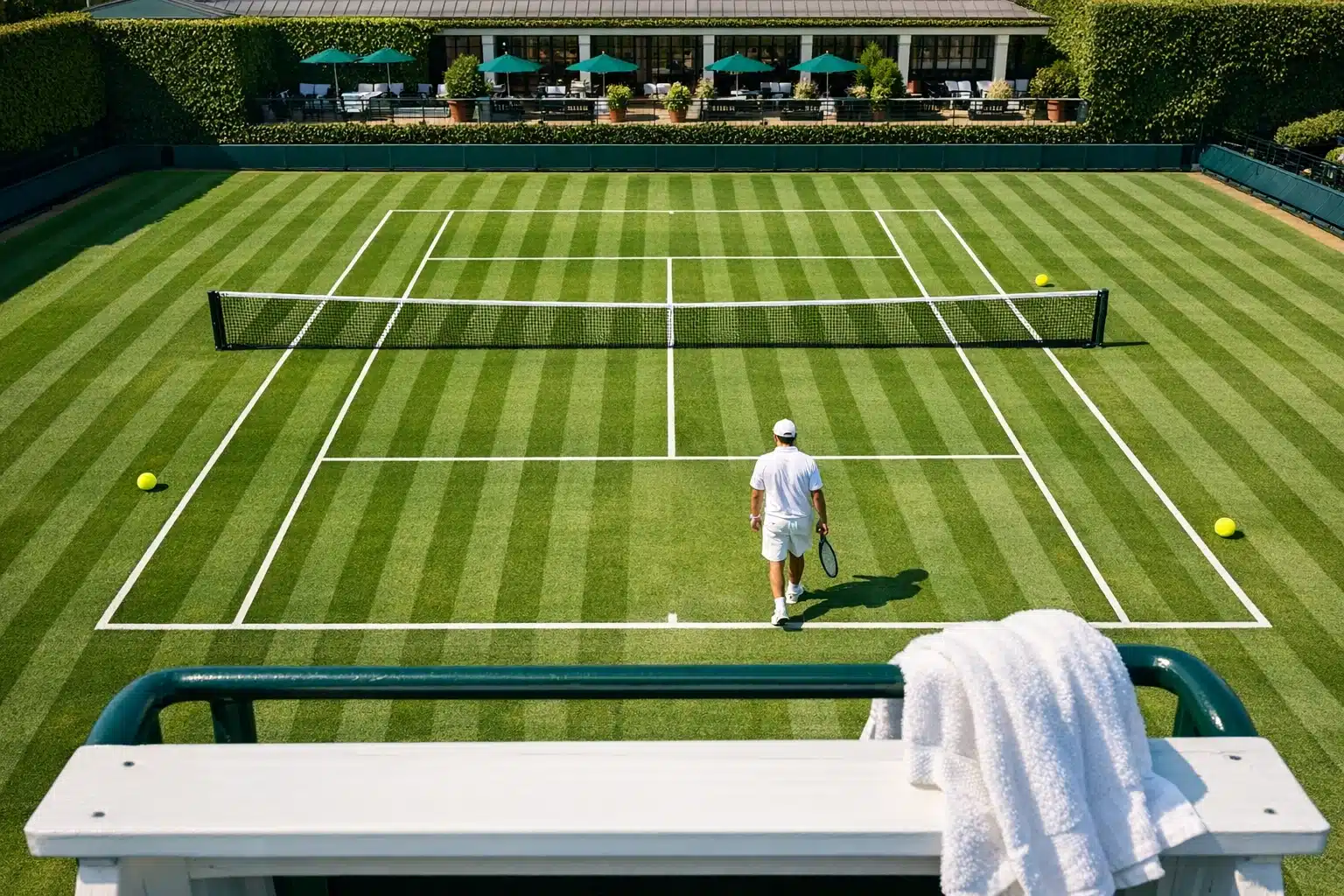
Grass courts are faster and lower-bouncing, often favoring quick reactions and aggressive play.
Even tennis balls vary. Extra-duty felt balls are common on hard courts because they resist wear, while regular-duty balls are often used on softer surfaces. For children and some adult beginners, lower-compression training balls can be extremely helpful because they bounce lower and travel slower, giving the player more time to set up. Good equipment does not perform magic, but it can make the learning curve friendlier. The right setup lets a beginner focus on the game itself instead of wrestling with avoidable discomfort.
Core Techniques: Grips, Strokes, Movement, and Early Shot Selection
Tennis technique can look artistic at full speed, but its foundation is surprisingly practical. At the beginner level, the goal is not to hit glamorous winners. The goal is to build repeatable movement and clean contact often enough to sustain rallies. Once that happens, confidence rises quickly.
A useful place to start is the ready position. Stand with knees slightly bent, racket in front, and body balanced on the balls of the feet. From there, many coaches teach a split step, a small hop just as the opponent makes contact. That brief action helps the body react in either direction. It sounds minor, yet it can transform how quickly a player reaches the ball.
On the forehand, beginners usually learn to turn the shoulders early, set the racket back without overcomplicating the motion, and swing from low to high. That low-to-high path helps create topspin, which makes the ball dip back into the court. The backhand may be one-handed or two-handed, though many newcomers find the two-handed version more stable at first. On both sides, the key is meeting the ball in front of the body rather than letting it crowd the hips.
The serve is the most complex shot because the player starts the point alone, without reacting to an incoming ball. A reliable beginner serve is built from rhythm rather than brute force. A simple toss, shoulder turn, and smooth upward swing are far better than trying to blast the ball flat. Accuracy matters more than speed in early development. Starting points with a legal, controlled serve creates more real practice than swinging wildly for aces that rarely arrive.
Volleys require a different idea. At the net, there is less time, so the swing becomes compact. Think of the racket face as a firm hand redirecting the ball rather than a whip. Good volleys depend on positioning, balance, and a steady wrist.
Several technique reminders help beginners immediately:
-
Track the ball early and move the feet before swinging.
-
Keep the grip pressure relaxed enough to avoid stiffness.
-
Recover toward a sensible court position after each shot.
-
Aim high over the net during rallies to increase margin for error.
-
Use controlled placement before chasing power.
A rally is like a small negotiation between time, space, and balance. If your feet arrive late, your swing has to improvise. If your body stays organized, the stroke becomes simpler. That is why experienced coaches often say tennis is won with the legs before it is won with the racket. For a beginner, learning to move well and contact the ball cleanly is the real gateway to enjoyable play.
A Practical Conclusion for New Tennis Players: How to Improve Without Overcomplicating the Game
For beginners, the fastest progress usually comes from doing ordinary things well and doing them often. Tennis can tempt new players into searching for advanced secrets, but most early improvement grows from consistency, not complexity. If you can track the ball, move into position, make solid contact, and understand basic scoring, you are already building the right foundation. The next step is to practice in a way that keeps that foundation stable.
A simple weekly structure works better than random, exhausting sessions. Two or three purposeful practices are enough for many beginners. One session might focus on feeding and rallying from the baseline. Another can emphasize serves, returns, and short movement drills. A third could be a friendly practice set, where learning how to score, change ends, and manage nerves becomes part of the lesson. Improvement is easier to notice when each session has a modest goal rather than a vague ambition to “play better.”
-
Spend time on short-court rallies to improve control and feel.
-
Practice serves in small sets, focusing on rhythm and placement.
-
Play points that begin with a cooperative feed so rallies last longer.
-
Record a few minutes of video occasionally to spot posture and timing issues.
-
Finish sessions before fatigue destroys technique.
It also helps to avoid common beginner mistakes. Many players swing too hard, stand too upright, or try to hit every ball from the same distance. Others ignore recovery steps after the shot and get surprised by the next ball. Some grip the racket as if they are holding on during a storm, which reduces touch and fluidity. These errors are normal, and they fade with guided repetition. Tennis rewards patience in a very literal way: the player who accepts slow, steady progress often improves faster than the player chasing instant brilliance.
If you are just starting, here is the most important takeaway: learn the rules well enough to enjoy a match, choose equipment that supports comfort, build a few reliable strokes, and practice with realistic expectations. You do not need perfect technique to begin. You need curiosity, repetition, and a willingness to let each session teach you something useful. For new players, that is where tennis becomes truly enjoyable. The court stops feeling like a test and starts feeling like an invitation.