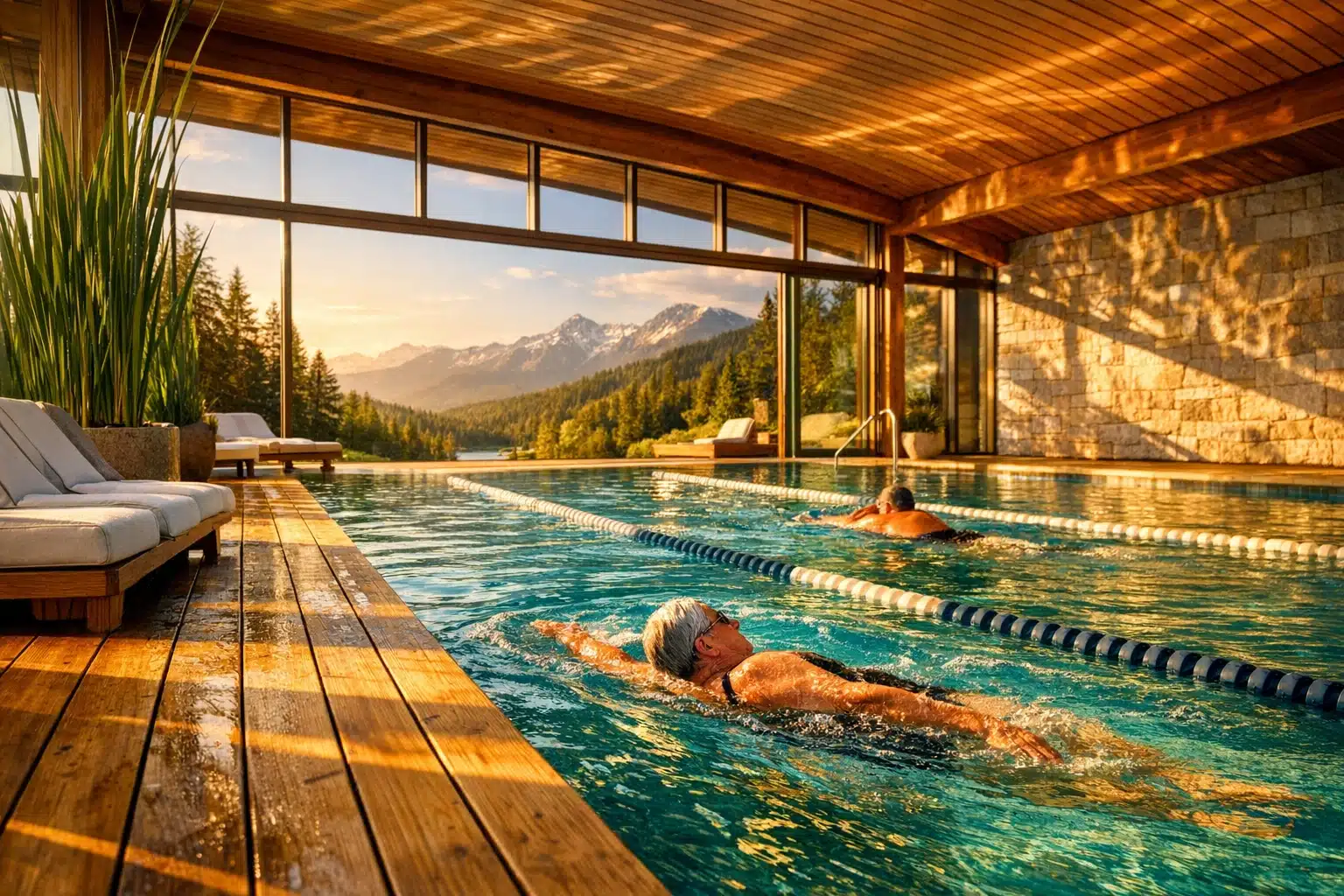
Explore the world of swimming
Swimming sits at the crossroads of sport, skill, safety, and simple joy. It can be a quiet morning workout, a lifesaving ability, or the center of elite competition, which is why it matters to children, adults, and older learners alike. Few activities ask the body to work so fully while sparing the joints so gently. Step into the water, and the ordinary rules of movement change in a way that invites curiosity as much as discipline.
Outline
- The broad value of swimming for health, movement, safety, and daily life
- How beginners learn the basics and how the main strokes compare
- What effective swim training looks like for fitness and performance
- Why safety, etiquette, and open-water awareness are essential
- How swimming fits into community life, rehabilitation, and lifelong wellbeing
Why Swimming Matters More Than Many People Realize
Swimming is often introduced as a recreational activity, yet its real importance stretches much further. It is exercise, transport through water, a competitive discipline, and a practical safety skill all at once. That mix is rare. Many sports improve fitness, and many hobbies build confidence, but very few also reduce the risk of drowning and expand a person’s freedom around lakes, rivers, beaches, and pools. For that reason alone, swimming deserves to be seen not just as a pastime but as a meaningful life skill.
From a physical perspective, swimming offers an unusual combination of resistance and support. Water creates drag in every direction, so the body works continuously even when movements look smooth from the outside. At the same time, buoyancy reduces stress on joints compared with many land-based activities. This makes swimming attractive for a wide range of people, including older adults, those returning from injury, and anyone who wants a vigorous workout without constant pounding on the knees or hips. It can develop cardiovascular endurance, muscular coordination, breathing control, and mobility in a single session.
Mental benefits are part of the picture too. The repetitive rhythm of strokes and breathing can feel almost meditative. A steady lane swim has a different mood from a noisy team sport: there is less collision, more focus, and often a strong sense of personal progress. Even small milestones matter in the pool. The first relaxed exhale underwater, the first full length without stopping, or the first successful tumble turn can feel like opening a locked door.
- Swimming supports full-body movement without heavy impact.
- It combines fitness training with a potentially lifesaving skill.
- It suits recreation, rehabilitation, competition, and stress relief.
Its relevance also appears at the public-health level. The World Health Organization has reported that drowning causes hundreds of thousands of deaths globally each year, with children especially vulnerable in many regions. Better access to swimming education and water-safety instruction can make a measurable difference. In that sense, a swimming lesson is more than a lesson. It is a form of prevention, preparation, and empowerment.
There is also a social dimension. Pools bring together school groups, families, athletes, retirees, and people recovering from illness. Some arrive to race the clock; others arrive simply to move without pain. That broad appeal helps explain why swimming has lasted across cultures and generations. It is one of the rare activities that can be playful at noon, therapeutic in the afternoon, and fiercely competitive by evening. Few environments hold all of that in the same blue space.
Learning to Swim: Foundations, Confidence, and the Four Main Strokes
For beginners, swimming can feel oddly humbling at first. On land, most people trust their balance and breathing without thinking. In water, both must be relearned. That is why good instruction starts with comfort and control rather than speed. Before worrying about elegant strokes, a learner needs to understand buoyancy, body position, floating, kicking, and relaxed exhalation. These basics are not decorative extras; they are the platform on which every advanced skill stands.
A common early mistake is trying to fight the water. New swimmers often lift the head too high, tense the shoulders, or kick frantically. That usually creates more drag and more fatigue. Efficient swimming is built on a calmer principle: align the body, keep movements purposeful, and let the water support you while you move through it. When that idea clicks, progress often accelerates. The water stops feeling like an opponent and starts behaving more like a medium that rewards timing.
The four competitive strokes each teach something different. Freestyle, also called front crawl, is usually the first stroke people learn for distance because it is relatively efficient and can be fast even at a modest skill level. Backstroke allows continuous breathing and can help swimmers understand alignment, though it requires comfort moving without seeing where one is going. Breaststroke feels more intuitive to some beginners because the face can come out of the water regularly, but its timing is technically tricky and poor form can reduce momentum. Butterfly is the most demanding of the four, combining power, rhythm, and coordinated undulation; it is usually introduced after a swimmer has built stronger body awareness.
- Freestyle: efficient, widely used, and ideal for building endurance
- Backstroke: helpful for posture and easier breathing rhythm
- Breaststroke: accessible in feel, complex in timing
- Butterfly: powerful, technical, and physically taxing
Good swim instruction also emphasizes survival skills. Treading water, rolling onto the back to rest, entering and exiting safely, and understanding how to stay calm after an unexpected submersion are just as important as stroke mechanics. Parents sometimes focus heavily on visible progress, such as how far a child can swim. In reality, invisible progress matters just as much: controlled breathing, water confidence, and the ability to pause without panic.
Adults learning later in life should not assume they are at a disadvantage simply because they started late. They may carry more fear, but they often learn concepts quickly because they can listen, reflect, and apply feedback with intention. The path may not always be graceful, and that is fine. Every skilled swimmer once swallowed water, misjudged a breath, or drifted crookedly across a lane. Learning to swim is part science, part repetition, and part trust. With patient practice, awkwardness gradually gives way to fluency.
Swimming as Training: Fitness, Performance, and Smart Practice
Swimming is one of the most adaptable training tools available. A gentle session can support recovery, while a demanding interval set can challenge the heart, lungs, and major muscle groups in a serious way. That flexibility makes it useful for casual exercisers, triathletes, age-group competitors, and elite athletes alike. Still, effective swim training is not just a matter of doing more laps. Progress usually comes from structure, technique, and clear goals.
A well-designed session often includes several parts: a warm-up, drill work, a main set, and a cooldown. The warm-up raises body temperature and eases the shoulders, hips, and ankles into motion. Drill work isolates one part of the stroke, such as catch mechanics, kick timing, or side breathing. The main set targets a specific outcome, perhaps aerobic endurance, sprint speed, pacing, or stroke efficiency under fatigue. The cooldown then helps the body shift gradually out of hard work rather than ending with an abrupt stop. Swimmers who train this way tend to improve more consistently than those who simply swim until they feel tired.
Technique remains central because water punishes inefficiency. In running, a small technical flaw may waste energy; in swimming, it can feel as though someone quietly tied a parachute to your waist. Head position, hand entry, rotation, kick rhythm, and the underwater pull all affect how much resistance the body creates. That is why two swimmers of similar strength can produce very different times. One moves cleanly through the water, while the other spends extra effort overcoming drag.
- Endurance sets improve the ability to sustain effort over time.
- Speed sets sharpen power, reaction, and stroke rate.
- Drills improve efficiency, which often matters more than brute force.
- Rest intervals influence quality and should be chosen deliberately.
Compared with some gym-based workouts, swimming also trains breathing discipline in a more obvious way. The swimmer cannot breathe whenever convenient; breaths must fit the rhythm of movement. That constraint builds awareness and can improve pacing. It also explains why new swimmers sometimes feel breathless despite not moving especially fast. Usually the problem is not poor fitness alone but poor timing, especially breath holding instead of steady exhalation underwater.
For people choosing between swimming and other endurance sports, comparison helps. Running is simpler to access and excellent for bone-loading, yet it can be tough on joints for some individuals. Cycling develops endurance well and allows long outdoor sessions, but it does not train the upper body in the same integrated way. Swimming stands apart because it recruits the whole body, challenges coordination, and limits impact. Its main barrier is technical complexity. In other words, the entry point is harder, but the long-term rewards can be rich.
Technology can help, though it should not replace awareness. Pace clocks, waterproof watches, stroke-count tracking, and video analysis all offer useful feedback. Even so, the most valuable data often remains simple: How smooth did that length feel? Could you hold form when tired? Did your pace fall apart, or stay stable? Strong swimmers learn to read the water almost like a language. It tells them when they are balanced, when they are slipping, and when the stroke begins to sing instead of splash.
Safety, Etiquette, and the Big Difference Between Pools and Open Water
Swimming may look serene, but safe participation depends on habits, judgment, and respect for the environment. This is true in both a heated indoor pool and a cold coastal inlet, although the risks differ sharply. In supervised pools, the main hazards often involve slips, collisions, diving errors, exhaustion, or overconfidence. In open water, variables multiply quickly: current, waves, temperature, visibility, weather shifts, and distance from help all change the experience. A capable pool swimmer is not automatically a capable open-water swimmer.
Basic safety begins before entering the water. Check depth markers, know where lifeguards are positioned, and understand the rules of the facility or venue. Warm up gradually rather than launching into hard effort immediately. If swimming in open water, go with others, tell someone your route, use a visible cap or tow float when appropriate, and learn local hazards. Even strong swimmers can be surprised by chop, cold shock, or a current that quietly pushes them off course.
Water safety has a public-health dimension that should not be understated. According to the World Health Organization, drowning remains a major global cause of accidental death, with hundreds of thousands of lives lost each year. Prevention includes barriers around pools, supervision, swimming lessons, and rescue education. Importantly, supervision does not mean casual observation from far away. Real supervision is active, close, and undistracted, especially where children are concerned.
- Never assume shallow water is safe for diving.
- Do not swim alone in unfamiliar open water.
- Respect lane etiquette to reduce collisions and frustration.
- Leave the water early if you feel cold, dizzy, or unusually fatigued.
Etiquette matters because swimming is often a shared activity. In lap pools, choose a lane that matches your speed, rest in the correct corner if lane sharing is used, and avoid pushing off directly into someone’s path. These details may seem small, but they keep sessions smoother and safer for everyone. Good etiquette is really a form of awareness: you recognize that your workout exists alongside other people’s workouts.
Open water adds another layer of knowledge. Swimmers should learn to sight forward without disrupting stroke rhythm, recognize the effect of tides or river flow, and understand when conditions exceed their ability. Cold water deserves particular respect. It can reduce dexterity, increase breathing stress, and drain energy faster than many people expect. The sea, unlike the pool, does not care that your training last week went well.
There is a simple lesson beneath all this: confidence is useful, but humility keeps people safer. The best swimmers are often the ones who remain attentive, adaptable, and calm. They understand that water can be generous one moment and demanding the next. Safety is not fear. It is preparation joined to clear thinking, and it allows enjoyment to last much longer.
Swimming for Life: Community, Rehabilitation, Access, and Lasting Enjoyment
One reason swimming retains such broad appeal is that it changes with the swimmer. As a child, it may begin with splashing, lessons, and first encounters with independence. In adolescence, it can become a team sport shaped by early mornings, stopwatches, and growing ambition. Later, it may shift again into fitness, rehabilitation, social connection, or personal quiet. Unlike activities that peak sharply and then fade, swimming can stay useful across an entire lifetime.
Its therapeutic value is especially notable. Because water reduces load on the body, many people use swimming or water exercise during recovery from injury, surgery, or periods of reduced mobility. Aquatic therapy is common in rehabilitation settings for this reason. The water offers support while still demanding muscular engagement. For someone who struggles with pain during land exercise, that can be transformative. A pool is not a miracle machine, but it often creates possibilities that feel unavailable elsewhere.
Swimming is also an important space for inclusion. Adaptive aquatics and para swimming demonstrate that the sport can be modified for a wide range of physical needs. Coaches, therapists, and instructors increasingly design sessions around function and confidence rather than narrow ideas of what a swimmer should look like. That matters. Access to the water should not depend solely on age, body type, or athletic history.
- Community pools can support social health as well as physical health.
- Masters programs give adults structured training without requiring elite goals.
- Adaptive and therapeutic approaches widen participation meaningfully.
Still, access is not equal everywhere. Lessons may be expensive, pool time limited, and facilities unevenly distributed across communities. In some places, cultural barriers and historical exclusion have shaped who feels welcome in aquatic spaces. Any honest discussion of swimming should acknowledge that the sport’s benefits are real, but not everyone reaches them under the same conditions. Expanding affordable lessons, improving facility access, and training more instructors can make a lasting difference.
There is also a cultural beauty to swimming that statistics alone cannot capture. Think of dawn light reflecting across a still lane line, the hollow echo of a pool before the first whistle, or the sudden quiet felt underwater when the world turns muffled and distant. Swimming can be demanding, yes, but it can also be deeply pleasant in a way that keeps people coming back for decades.
For many adults, the greatest victory is not a medal or a time standard. It is consistency. It is discovering a form of movement that remains available through changing schedules, changing bodies, and changing goals. A teenager may chase speed, a parent may seek stress relief, and an older swimmer may value mobility and confidence. All of them can belong in the same water. That is part of swimming’s lasting strength: it meets people where they are, then quietly asks if they would like to go a little farther.
A Closing Note for Beginners, Fitness Seekers, and Lifelong Swimmers
Swimming rewards patience more than bravado. If you are new to it, focus first on comfort, breathing, and safety rather than distance or speed. If you already swim for exercise, refine your technique and structure your sessions so the work has purpose. If you return to the pool after years away, remember that progress in water often comes back through rhythm and repetition. The real value of swimming lies not only in performance, but in the freedom, resilience, and calm that grow each time you enter the water with intention.