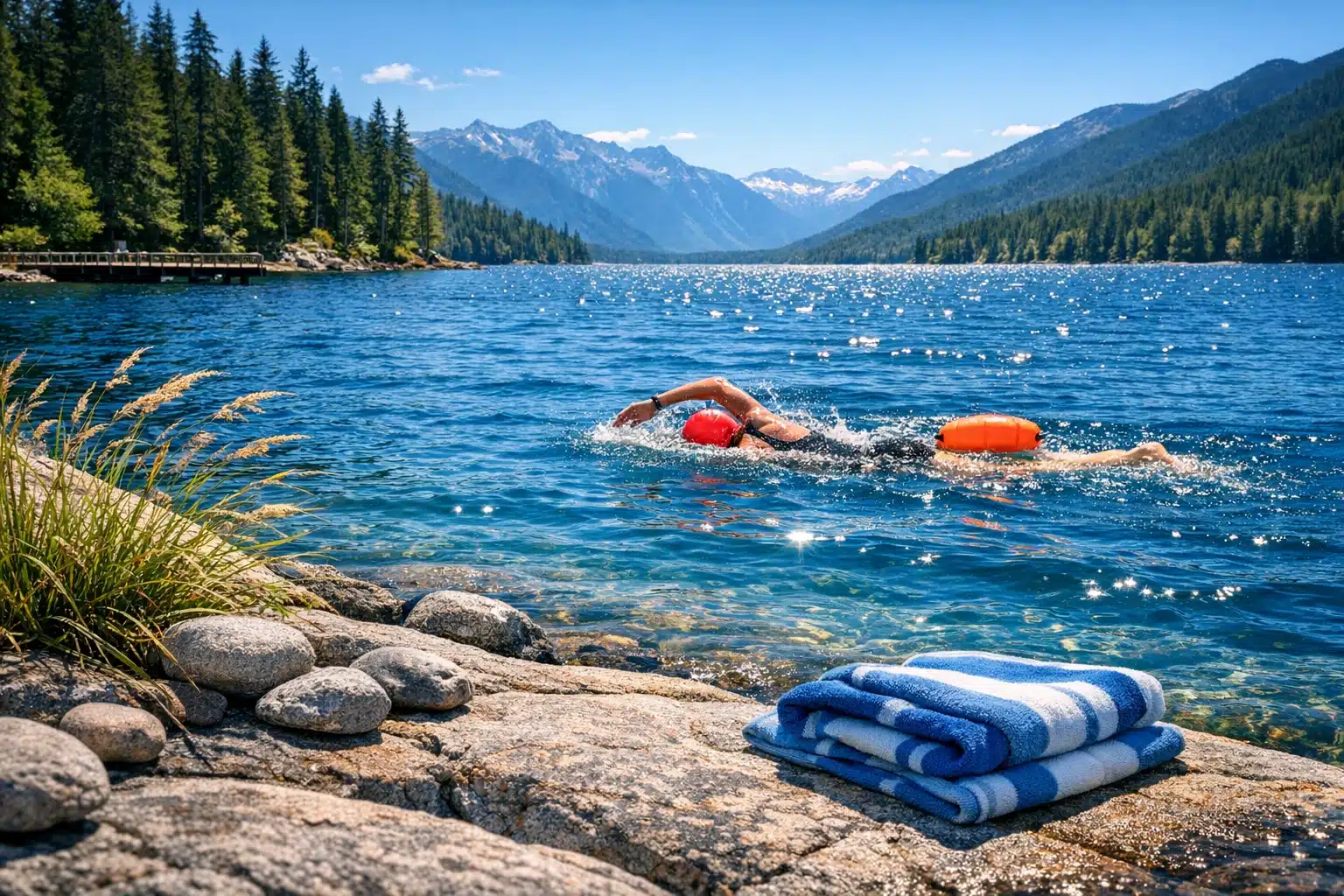
Explore the world of swimming
Swimming is one of the rare activities that feels playful and demanding at the same time, welcoming children in their first lesson, adults looking for low-impact exercise, and athletes training against the clock. Its relevance goes far beyond sport: it improves endurance, teaches a life-saving skill, supports recovery, and creates a direct connection with rivers, lakes, and pools that shape everyday recreation. In water, movement becomes both useful and quietly joyful.
Article Outline
- The unique value of swimming and why it matters across ages and lifestyles
- The main strokes, their differences, and the technical ideas that make movement efficient
- The physical and mental health benefits linked to regular time in the water
- How to begin, train, and stay safe in pools and open water
- Why swimming can become a lifelong habit, community activity, and personal practice
Why Swimming Stands Apart
Swimming occupies a special place among physical activities because it is at once a sport, a survival skill, a form of recreation, and a long-term health habit. Many exercises ask the body to battle gravity with every step, jump, or landing. Water changes that relationship. Buoyancy supports the body, which reduces impact on the joints, while resistance pushes back against every motion. This means a swimmer can work hard without the same kind of pounding that often comes with running on pavement or high-intensity court sports.
That balance makes swimming unusually flexible. A young child can begin with floating and breath control. A busy office worker can use lap sessions to build fitness. An older adult may value the way water allows movement with less strain on knees, hips, and ankles. Someone recovering from injury may use the pool as a bridge back to confident movement, provided a medical professional has cleared that activity. Few sports meet so many people at such different stages of life.
Swimming also matters for practical reasons. Knowing how to stay calm in water, tread, float, and move efficiently can improve safety during travel, boating, beach visits, and everyday recreation. In this sense, swimming is not only about performance. It is about competence. That competence can turn fear into familiarity, and familiarity into enjoyment.
There is also a sensory quality to swimming that sets it apart. Water cools the skin, muffles noise, and gives even simple motion a smooth, almost suspended feeling. In a pool lane, the black line at the bottom can feel like a quiet road stretching forward. In open water, the experience is broader and less predictable, shaped by wind, current, temperature, and light. Both settings ask for awareness, but they reward it differently.
A simple comparison shows why swimming keeps its appeal:
- Compared with running, it is usually gentler on weight-bearing joints.
- Compared with cycling, it involves the upper body more directly.
- Compared with many gym machines, it asks the body to coordinate breath, balance, and rhythm at the same time.
That mix of practicality, challenge, and freedom is why swimming remains relevant in schools, community centers, rehabilitation programs, and elite sport alike. It is not merely exercise done in water. It is a different way of moving through the world.
The Main Strokes and the Craft of Technique
To an untrained eye, swimming can look simple: arms pull, legs kick, and the body moves forward. In practice, technique is the difference between gliding efficiently and fighting the water on every length. Because water is far denser than air, small changes in body position matter. A dropped hip, a rushed breath, or a mistimed kick can create drag and waste energy surprisingly fast.
The four competitive strokes each solve the problem of movement in a different way. Freestyle, usually performed as front crawl, is the fastest and most widely used stroke for fitness swimming. It relies on a streamlined body line, alternating arm recovery, body rotation, and rhythmic breathing. When done well, it looks economical, almost quiet. Backstroke uses similar alternating arm motion but places the swimmer on the back, which changes orientation and breathing. It can feel more relaxed for some people, though it requires strong balance and awareness because the swimmer cannot see the wall ahead in the same way.
Breaststroke is often the easiest stroke for casual swimmers to recognize. Its pull and kick happen in a more symmetrical pattern, and the head may rise more frequently above the surface. It is slower than freestyle, but it can be comfortable for recreational swimmers because the timing is easier to break into steps. Butterfly is the most demanding of the four. It combines a powerful simultaneous arm action with a wave-like body undulation and dolphin kick. Done poorly, it feels exhausting. Done well, it is one of the most striking movements in sport.
Each stroke has strengths:
- Freestyle: efficient for distance and general fitness
- Backstroke: useful for posture, shoulder rhythm, and varied training
- Breaststroke: approachable for many beginners and easy to pace
- Butterfly: powerful for advanced conditioning and coordination
Despite their differences, strong swimmers share a few common habits. They keep the body long in the water. They learn to exhale steadily rather than holding tension in the chest. They align the head with the spine instead of craning upward. They use the kick to support balance, not only to splash. Most importantly, they respect timing. Swimming is less about force than about placing each action at the right moment.
Beginners often assume speed comes from moving harder. Coaches usually teach the opposite lesson first: reduce drag, find rhythm, and let efficiency create speed later. That is why drills matter. Kicking on a board, practicing one-arm freestyle, pausing to feel glide, or working on bilateral breathing may seem repetitive, but these exercises build the technical base that makes later training smoother and safer. In swimming, elegance is not decoration. It is function.
Health Benefits in Body, Brain, and Daily Life
Swimming is often praised as a full-body workout, and that description is fair, but it still undersells what the activity can do when practiced consistently. A swim session challenges the cardiovascular system because the heart and lungs must support continuous movement against resistance. At the same time, the arms, shoulders, back, core, hips, and legs all contribute in shifting proportions depending on the stroke. Even a moderate workout can leave the body pleasantly tired in a way that feels balanced rather than battered.
One of its most practical benefits is low-impact conditioning. Because the water supports much of the body, many people who struggle with joint discomfort find swimming or water exercise more manageable than repetitive land-based training. This does not make it effortless. Water resistance is present in every direction, so movement still requires muscular control. The difference is that the load is distributed more gently. That is one reason pools are widely used for rehabilitation, mobility work, and active recovery, though individual conditions always require proper guidance.
Regular swimming can help improve endurance, muscular stamina, and movement confidence. Energy use varies by stroke, pace, and body size, but lap swimming at a moderate to vigorous level typically burns several hundred calories per hour. More important than the number is the sustainability. Because swimming offers variety in pace and stroke, many people can stay consistent with it for years, and consistency matters more than dramatic short bursts of effort.
The mental side is just as important. Swimming creates a rhythm of breath and movement that many people find calming. Repeating lengths can work almost like moving meditation: count strokes, turn, glide, breathe, repeat. The water narrows attention to the present moment. For readers with busy schedules and crowded thoughts, that alone can be valuable. Some leave the pool physically worked; others leave mentally reset; many leave feeling both.
Additional benefits often mentioned by swimmers include:
- improved posture through stronger back and trunk engagement
- better breath control and awareness of pacing
- a useful option during hot weather, when outdoor exercise can feel harsher
- social connection through clubs, classes, and shared lane time
Swimming is not a miracle cure, and it does not replace all forms of strength or mobility training. Still, as part of a balanced lifestyle, it offers an unusually broad return: fitness, stress relief, practical skill, and a form of movement people can continue long after many other sports become difficult to maintain.
How to Begin, Train Well, and Stay Safe
Starting swimming can feel intimidating, especially for adults who did not learn young. The good news is that progress in the water usually comes from patience, not bravado. Before thinking about speed, distance, or fancy gear, it helps to build trust in the basics: floating, exhaling into the water, standing up calmly, and moving a short distance with control. These early skills are small on paper and enormous in practice because they replace panic with predictability.
For beginners, formal instruction is often the fastest route to confidence. A qualified coach or swim teacher can correct body position, breathing habits, and kick timing before those patterns become hard to change. Even a few lessons can save months of frustration. Once the fundamentals are there, structured practice matters more than random lengths. Instead of swimming until tired, use simple goals: four lengths focused on breathing, four on kick rhythm, then a few easy continuous lengths to connect the pieces.
Basic equipment is minimal, which is another reason swimming is so accessible. Most people need only a swimsuit, goggles, and a cap if required by the facility or preferred for comfort. A kickboard, pull buoy, or fins can be useful training tools, but none are mandatory on day one. The key is not to confuse accessories with improvement. Good habits matter more than a full bag of gear.
Pool safety and etiquette deserve attention too. Shared water works best when everyone follows clear norms.
- Choose a lane that matches your pace instead of your ambition.
- Rest at the wall in a way that leaves room for turning swimmers.
- Look before pushing off to avoid collisions.
- Shower if the facility requests it and respect posted rules.
- Never assume lifeguards replace personal responsibility.
Open-water swimming adds another layer of complexity. Lakes, rivers, and the sea do not offer lane lines, warm shallow ends, or predictable visibility. Conditions can change quickly. Anyone swimming outside a supervised pool should take extra precautions:
- never swim alone
- check weather, currents, and water quality
- use a bright cap or visibility float when appropriate
- enter gradually to assess temperature and footing
- know how you will get out before you go in
Training well also means knowing when to stop. Fatigue can break technique apart, and poor technique in water wastes energy fast. Short, focused sessions often beat long, sloppy ones. For readers beginning or returning after a long break, a realistic plan might be two or three sessions a week, each built around drills, easy aerobic work, and plenty of rest. Swimming rewards humility. The more calmly you learn it, the more generously it gives back.
Swimming as a Lifelong Practice
One reason swimming remains compelling is that it can change roles without losing value. In one decade, it may be a childhood lesson. In another, it becomes a competitive pursuit, a triathlon skill, a way to stay fit after work, or a reliable option during recovery from other sports. Later, it may turn into a gentle but meaningful part of healthy aging. The setting shifts, the pace changes, and the goals evolve, yet the water continues to meet the swimmer where they are.
That adaptability helps explain the wide culture around swimming. At the community level, pools serve as shared spaces where school teams, senior exercise groups, new parents, competitive clubs, and recreational swimmers all cross paths. The sport can be solitary during the lap itself and social a moment later on the deck. It teaches independence, but it also creates quiet forms of belonging. Anyone who has exchanged a nod with a regular in the next lane knows that even brief routines can form a kind of community.
There is also a long-view benefit that deserves more attention: swimming encourages respect for process. Improvement rarely arrives in dramatic leaps. It comes through repeated details such as better breath timing, smoother turns, steadier pacing, and more relaxed shoulders. That can be frustrating at first, but it is also part of the appeal. The sport teaches that progress is often subtle before it becomes visible. One day the length that used to feel chaotic suddenly feels controlled, and the change is deeply satisfying.
For readers deciding whether to begin, return, or commit more seriously, the message is simple. You do not need to swim fast for the sport to matter. You do not need perfect technique to benefit from learning better technique. You do not need competition to enjoy measurable progress. Start with safety, patience, and realistic expectations, then let experience do the convincing.
Swimming offers a rare combination of usefulness and pleasure. It strengthens the body, steadies the mind, and opens access to one of the most fundamental environments on earth. If you want an activity that can serve health, confidence, recreation, and long-term well-being, swimming is an excellent place to begin and an even better habit to keep.