Explore the world of swimming
Swimming sits at the rare crossroads of sport, skill, and simple joy. It can be a quiet morning workout, a lifesaving ability, a competitive pursuit, or a family ritual that turns water into shared confidence. Because the body floats, effort often feels gentler than it does on land, yet the challenge still reaches the heart, lungs, and mind. This article explores technique, training, safety, health benefits, and the lasting appeal that keeps people returning to the pool, lake, or sea.
Outline: 1. Swimming as a life skill and sport. 2. The four main strokes and how they compare. 3. Physical and mental benefits, with realistic context. 4. Training methods, equipment choices, and safety habits. 5. A practical conclusion for beginners, returning swimmers, and anyone curious about making swimming part of everyday life.
Swimming as a Life Skill, Sport, and Cultural Practice
Swimming is far more than a leisure activity reserved for summer afternoons. At its core, it is a practical life skill with direct safety value, a full-body sport with global reach, and a form of movement that can stay with a person from childhood into older age. In many parts of the world, learning to swim is treated almost like learning to ride a bicycle: it represents freedom, confidence, and a basic level of independence around water. That matters because water is part of everyday life, whether it appears in pools, rivers, beaches, lakes, or boat travel.
From a sporting perspective, swimming has unusual breadth. It includes recreational lap swimming, school lessons, elite competition, artistic swimming, triathlon, open-water events, and rehabilitation exercise. Competitive swimming is also deeply structured. Races range from short sprints to long-distance events, and performance depends on technique, pacing, strength, and turns as much as raw effort. The Olympic Games helped make swimming one of the most visible sports in the world, but its wider relevance comes from how many ordinary people can participate without needing expensive team infrastructure.
Water changes the experience of movement in fascinating ways. Because water is roughly 800 times denser than air, the body meets resistance in every direction. That means even simple motions can become meaningful exercise. At the same time, buoyancy reduces the impact placed on joints, which is one reason swimming appeals to people who want a demanding workout without repeated pounding on knees or ankles.
Swimming also has a social and cultural dimension. Public pools often serve as community hubs. Families pass down water confidence from one generation to the next. Coastal communities may connect swimming with identity, weather, tradition, and local pride. In colder regions, indoor pools become year-round spaces where routine outlasts the seasons. There is something quietly democratic about a lane in a pool: once a swimmer enters the water, status matters less than rhythm, breath, and patience.
Several factors explain why swimming remains widely relevant:
– It can be recreational, competitive, therapeutic, or instructional.
– It works for many age groups and fitness levels.
– It builds a practical safety skill as well as physical conditioning.
– It can be done indoors or outdoors, alone or with others.
For beginners, the most important idea is simple: swimming is not only about speed. It is about comfort, control, and competence in an environment that asks the body to move differently. That combination is what gives the sport its lasting value.
The Main Strokes and the Technical Foundations That Shape Good Swimming
To an inexperienced observer, swimmers may seem to glide effortlessly, as if motion in water were instinctive. In reality, efficient swimming is built on technique, and technique begins with body position, breathing, balance, and timing. The four competitive strokes, freestyle, backstroke, breaststroke, and butterfly, each ask the swimmer to solve the same puzzle in a different way: how to move forward while minimizing drag and making each action count.
Freestyle, usually swum as front crawl, is generally the fastest and most commonly taught stroke for fitness training. The body stays long and relatively horizontal, the arms recover over the water, and the flutter kick helps maintain alignment. Breathing happens by rotating the head to the side while the body rolls through the hips and shoulders. Freestyle rewards relaxation more than beginners often expect. Tension makes the legs sink and shortens the stroke, while calm rotation improves reach and flow.
Backstroke shares many principles with freestyle but reverses the orientation. The swimmer lies on the back, uses an alternating arm action, and relies on a flutter kick. For some people, backstroke feels easier because the face remains above the surface. For others, it feels disorienting because seeing the ceiling or sky offers fewer directional cues. Still, it is excellent for understanding body line and shoulder rhythm.
Breaststroke is slower than freestyle for most swimmers, but it is popular because its tempo feels more deliberate and its breathing pattern is straightforward. The stroke uses a pull, breath, kick, and glide sequence. Timing matters greatly. If the pull is too wide or the kick is mistimed, the swimmer creates extra drag and loses momentum. Well-performed breaststroke can look almost mechanical in its precision, like a clock built from lungs and legs.
Butterfly is the most demanding of the four for many learners. Both arms recover together, the body moves with a wave-like undulation, and the dolphin kick must connect seamlessly to the upper body. Butterfly requires power, but power without timing quickly turns into exhaustion. It is less forgiving than the other strokes, which is why coaches often teach it in parts before asking for full, sustained lengths.
Across all strokes, a few technical foundations matter more than flashy effort:
– Streamline reduces drag after push-offs and turns.
– Head position affects balance more than most beginners realize.
– Breathing should support rhythm rather than interrupt it.
– Kicking helps body alignment as much as propulsion.
– A longer, cleaner stroke is often more efficient than hurried splashing.
Comparisons between strokes are useful because they show trade-offs. Freestyle is efficient and versatile. Backstroke is joint-friendly for some swimmers and strengthens positional awareness. Breaststroke allows easier visibility ahead, which some recreational swimmers appreciate. Butterfly develops timing and power but demands more conditioning. Learning them together creates a fuller understanding of water movement. Each stroke teaches a different language, yet all of them describe the same truth: the water rewards precision.
Health, Fitness, and Well-Being: What Swimming Offers the Body and Mind
Swimming is often praised as a complete workout, and that description is fair when used carefully. It engages major muscle groups, challenges the cardiovascular system, and allows training intensity to vary from gentle recovery work to demanding interval sessions. For many adults, it is one of the few activities that can feel accessible on day one and still remain technically rich years later. That rare combination helps explain why it appears in fitness plans, rehabilitation programs, school curricula, and lifelong exercise routines.
From a physical perspective, swimming can improve endurance, muscular coordination, and general aerobic fitness. The heart and lungs work continuously during steady laps, especially when rest periods are short. Public health guidance from organizations such as the World Health Organization commonly recommends at least 150 minutes of moderate aerobic activity per week for adults, and swimming can contribute directly to that target. Calorie expenditure varies by body size, intensity, and stroke choice, but moderate lap swimming often burns a meaningful amount of energy, while vigorous sets raise the demand considerably.
One of swimming’s most practical advantages is its low-impact nature. Because buoyancy supports the body, many swimmers experience less stress on joints than they do in activities like running. That does not make swimming effortless, and it does not make injuries impossible, but it can make regular exercise more manageable for people who want movement without repetitive pounding. Shoulder care still matters, particularly for frequent swimmers, yet the overall impact profile remains one of the sport’s strongest selling points.
Mental benefits are part of the story as well. The repetitive sound of water, the need to control breathing, and the structured rhythm of lap counts can make swimming feel meditative. Many swimmers describe the pool as a place where noise fades and attention sharpens. That experience does not replace professional mental health care when it is needed, but regular exercise is widely associated with improved mood, stress management, and better sleep. Swimming often supports those outcomes because it combines movement with sensory focus.
A balanced comparison with other activities is helpful:
– Running usually develops bone-loading more effectively, which can be useful for skeletal health.
– Cycling can be easier to sustain for long outdoor sessions and often builds leg endurance strongly.
– Strength training is superior when the goal is maximizing muscle mass or lifting capacity.
– Swimming stands out for combining aerobic work, mobility demands, and low-impact resistance.
It is also worth noting what swimming does not automatically do. It does not guarantee perfect technique, instant weight loss, or injury-proof fitness. Progress still depends on consistency, food intake, recovery, and smart instruction. Some beginners feel surprisingly tired after only a few lengths because poor technique creates drag and breathlessness. That is normal. With guidance, efficiency improves, confidence rises, and the sport becomes less of a struggle and more of a conversation between body and water.
In the long term, swimming’s greatest health value may be sustainability. An activity that people can continue for decades is often more meaningful than one that burns brightly and disappears. Swimming has a way of staying useful across changing seasons of life, and that durability is one of its strongest benefits.
Training, Equipment, and Safety in Pools and Open Water
Good swimming progress rarely comes from mindless distance alone. It grows from a mix of structured practice, technical feedback, recovery, and sensible choices about environment and equipment. For beginners, the goal is not to conquer endless laps on day one. It is to build comfort in the water, establish breathing control, and repeat short segments with enough rest to preserve form. A simple session might include easy warm-up lengths, kicking drills, one or two technique exercises, a short main set, and a cool-down. That kind of variety teaches more than unbroken struggle.
Intermediate swimmers often benefit from organizing sessions by purpose. One day may focus on endurance with steady repeats. Another may emphasize speed through short intervals. A third might center on technique, turns, or stroke-specific skills. Competitive swimmers, of course, add more complexity, including race-pace sets, strength training, and periodized plans across a season. Yet even at advanced levels, the fundamentals remain stubbornly simple: better body position, cleaner breathing, and disciplined pacing usually matter more than dramatic gear upgrades.
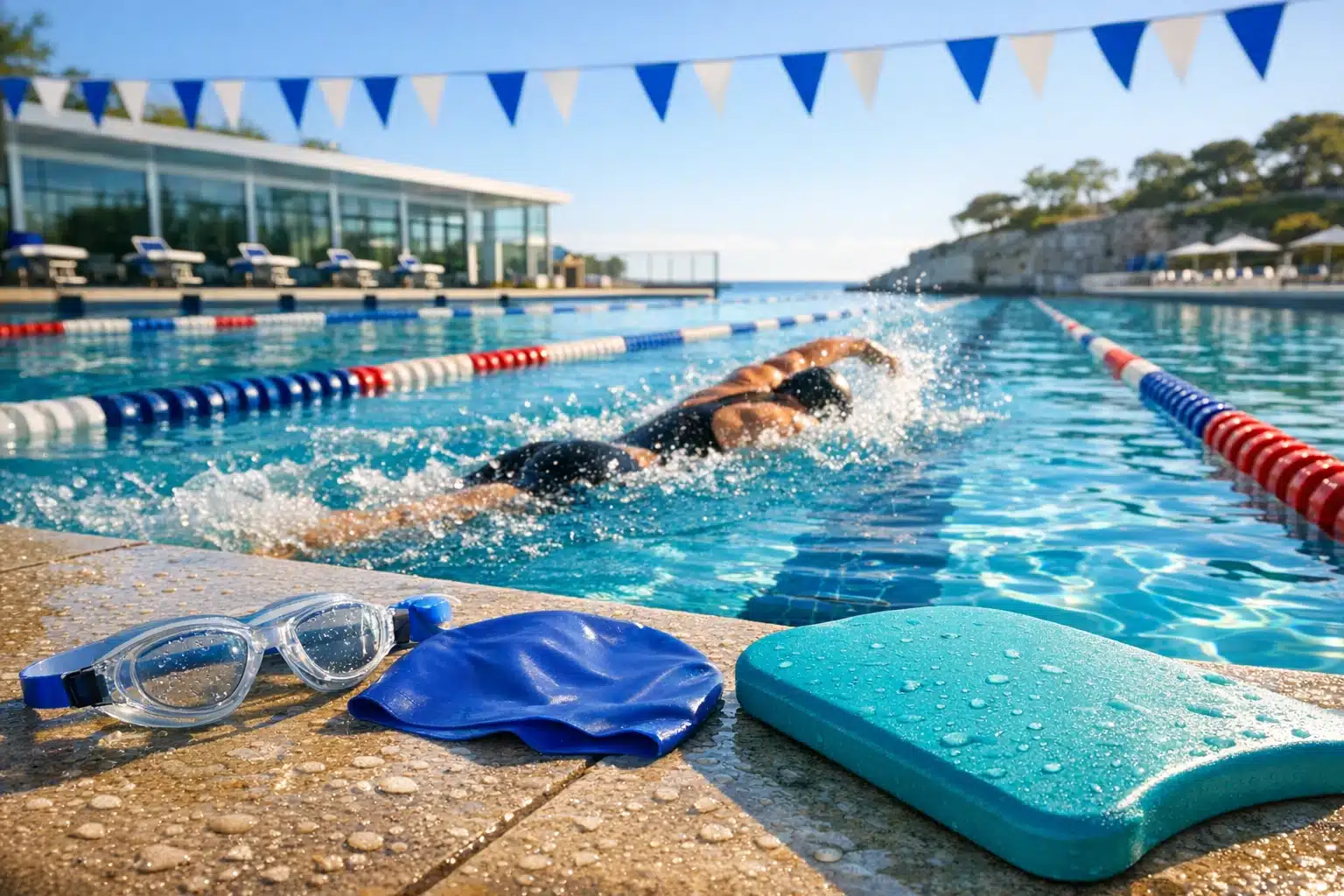
Equipment can help, but it should support skill rather than replace it. Common items include goggles, a comfortable swimsuit, a swim cap, kickboards, pull buoys, fins, and paddles. Goggles protect the eyes and make orientation easier. Fins can highlight body position and add propulsion, though overreliance may mask flaws. Pull buoys isolate upper-body work, while kickboards give beginners a way to concentrate on leg action. Paddles increase resistance and can improve feel for the water, but they should be used carefully to avoid shoulder overload.
Open-water swimming introduces a different world. A pool is predictable: measured lanes, visible walls, and controlled conditions. Lakes, rivers, and the sea are living environments, shaped by current, temperature, waves, visibility, and wildlife. The romance of open water is real, but so is the need for caution. A calm shoreline can conceal cold shock, rip currents, or rapidly changing weather. For that reason, swimmers should never confuse confidence in a pool with automatic readiness for open-water conditions.
Practical safety habits deserve serious attention:
– Learn from qualified instructors when possible.
– Swim where lifeguards or trusted companions are present.
– Respect posted rules, lane etiquette, and local warnings.
– Enter unfamiliar open water gradually and assess temperature first.
– Use bright caps or tow floats in open water when appropriate.
– Stop immediately if you feel dizzy, chilled, cramped, or disoriented.
Children require especially close supervision near water, even when they have had lessons. Adults also benefit from humility. Fatigue, overconfidence, and distraction are poor training partners. The wisest swimmers treat safety as part of the craft, not a footnote. Water can feel inviting, almost like polished glass under early light, but it always deserves respect. That balance, wonder paired with caution, is what turns swimming from a casual activity into a durable and responsible practice.
Conclusion for Beginners and Returning Swimmers: Building a Lifelong Relationship with the Water
If you are curious about swimming but unsure where to begin, the encouraging news is that this is a sport with many entry points. You do not need to chase medals, count perfect splits, or master butterfly before you can claim a place in the water. You only need a starting plan that matches your confidence level, schedule, and reason for showing up. For one person, that reason may be fitness. For another, it may be water safety, recovery from a more jarring sport, stress relief, or the simple wish to feel less uncertain around a pool.
A practical beginning usually works better than an ambitious one. Start with short sessions. Focus on breathing, floating, and relaxed movement before worrying about speed. If possible, take lessons from a qualified coach or join an adult beginner class, because feedback can shorten the learning curve dramatically. Many people who believe they are “bad swimmers” are not lacking effort at all; they are simply missing a few technical cues that would make the water feel less hostile. Once those pieces click, progress often becomes noticeably smoother.
Returning swimmers face a different challenge. Memory may suggest that the body can still perform exactly as it once did, while reality offers a more honest report. That is not failure. It is a normal part of rebuilding capacity. Former swimmers often regain rhythm faster than complete beginners, but they still benefit from patience, especially with shoulders, breathing patterns, and recovery. The smartest comeback is gradual rather than nostalgic.
Here is a useful mindset for almost anyone:
– Measure progress by consistency before intensity.
– Treat technique as a long-term investment.
– Use the stroke you can perform well, not the one that only looks impressive.
– Respect fatigue, weather, and water conditions.
– Let enjoyment remain part of the plan.
Swimming’s greatest gift may be its flexibility. It can meet a teenager chasing competition, an office worker wanting low-impact exercise, a parent prioritizing safety, or an older adult looking for sustainable movement. Few activities adapt so well across age and circumstance. The water does not ask every swimmer to be fast. It asks them to pay attention, breathe with intention, and learn how to move with rather than against resistance.
For the target audience of this article, curious readers, new swimmers, and those considering a return, that is the real takeaway. Swimming is both useful and rewarding. It offers health benefits without demanding a single identity, whether athlete, hobbyist, or cautious learner. Begin with respect, learn the basics well, and give the process time. What starts as effort can slowly become rhythm, and what starts as uncertainty can become one of the most reliable forms of movement in your life.