Explore the world of swimming
Swimming sits at the intersection of survival skill, sport, and simple joy. A quiet pool lane can become a training ground for discipline, while open water turns every stroke into a conversation with waves, wind, and nerve. Because it strengthens the heart, protects joints, and teaches practical safety, swimming matters to children, adults, and older learners alike. This article maps the subject through technique, health, safety, equipment, and the many ways people make water part of life.
A Simple Outline of the Swimming World
Swimming is often introduced as exercise, but that description is too small for what it really is. It is a life skill, a competitive discipline, a form of therapy, a recreational escape, and for many people, a mental reset button. To make sense of such a wide subject, it helps to begin with a practical outline. This article moves through five connected ideas: the place of swimming in daily life, the major strokes and how they differ, the health effects of regular practice, the safety habits that matter most, and the ways people continue swimming through training, travel, and lifelong enjoyment.
Humans have been drawn to water for thousands of years. Historical evidence from ancient Egypt, Greece, and Rome suggests that swimming was known both as a practical skill and as a physical activity. In the modern era, it developed into a structured sport with standardized strokes, race distances, and coaching methods. Today, the swimming world is remarkably broad. One person may swim short laps before work to loosen stiff joints. Another may train for a triathlon, where swimming is only the first test of the day. A child may be learning to float for safety, while an older adult may rely on water exercise because it feels kinder than pounding pavement.
Part of swimming’s appeal lies in the environment itself. Water supports the body, yet it also resists movement in every direction. That combination is unusual. Compared with land-based activities, swimming can feel gentle on impact while still demanding coordination and effort. Water is far denser than air, so even simple arm and leg actions meet steady resistance. At the same time, buoyancy reduces the stress placed on many joints. This is why swimming is often compared favorably with running for people who want cardiovascular work without repeated impact.
There is also an emotional quality to swimming that statistics alone cannot capture. Pools have their own language: the echo of a whistle, the quiet splash at the wall, the black line waiting at the bottom like a sentence that asks to be completed. Open water brings a different mood entirely, replacing tiles with shifting light and measured distances with horizons. Whether approached as sport or leisure, swimming remains relevant because it teaches capability. It asks people to move with intention in an environment that does not automatically support them, and that lesson carries value far beyond the water.
How the Main Strokes Differ and What They Teach
The technical heart of swimming lies in its strokes, and each one teaches a different relationship between balance, propulsion, and breathing. In competitive pool swimming, four strokes dominate: freestyle, backstroke, breaststroke, and butterfly. They are often learned in that order, not because one is superior, but because they place different demands on the swimmer. Understanding these differences helps beginners choose where to start and helps experienced swimmers refine weaknesses instead of repeating the same habits.
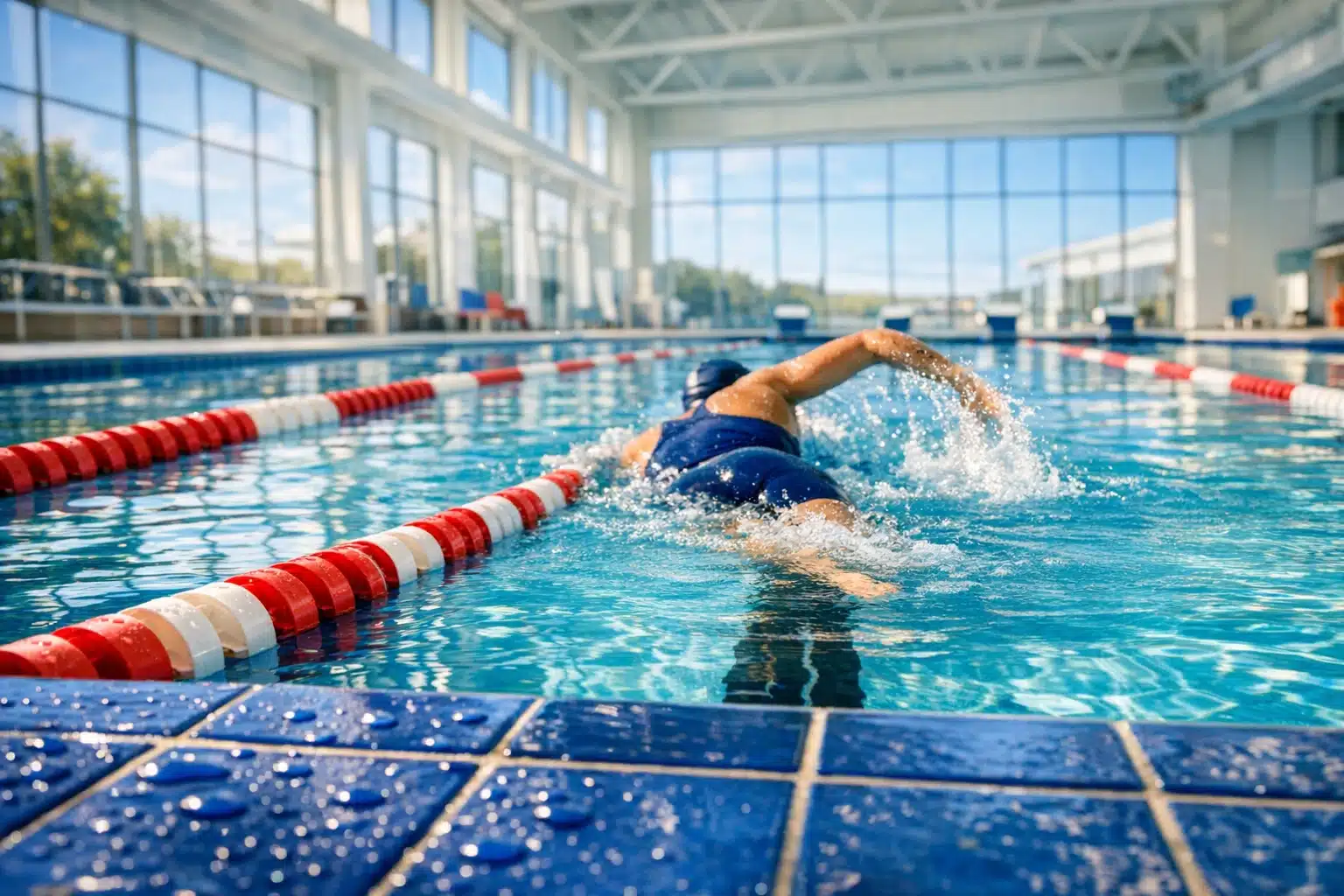
Freestyle, usually swum as the front crawl, is the fastest and most commonly practiced stroke. Its rhythm depends on a long body line, alternating arm recovery, and a flutter kick that helps stabilize the hips. Efficient freestyle rewards patience more than brute force. Swimmers who fight the water by lifting the head too high or crossing the arms in front of the body often feel exhausted early. Swimmers who stay streamlined and rotate through the torso tend to move farther with each stroke. Breathing is usually taken to the side, and that single action reveals a lot about technique. A rushed breath can twist the whole body out of shape, while a calm breath fits into the stroke almost invisibly.
Backstroke is sometimes described as freestyle turned upward, but that comparison only goes so far. Swimming on the back removes the challenge of placing the face in the water, which some beginners appreciate, yet it introduces a new problem: orientation. Without a visible lane line in front, timing and body awareness become essential. Backstroke teaches posture, shoulder mobility, and hip-driven balance. It also reminds swimmers that relaxed breathing does not automatically mean easy swimming.
Breaststroke is slower but technically precise. Its pull, breath, kick, and glide must happen in an orderly sequence. Many casual swimmers enjoy it because the head rises more regularly, making sight and breathing feel natural. However, poor breaststroke timing wastes energy quickly. Butterfly, by contrast, is dramatic, powerful, and demanding. It relies on a wave-like body motion and simultaneous arm recovery. Done well, it looks almost musical; done poorly, it feels like wrestling a storm.
Useful comparisons include:
– Freestyle: fastest, efficient for fitness and distance
– Backstroke: excellent for posture and shoulder awareness
– Breaststroke: highly technical, often comfortable for relaxed swimming
– Butterfly: powerful, advanced, and physically demanding
Learning the strokes is not just about speed. Each one sharpens a different part of water intelligence. Freestyle teaches rhythm, backstroke develops alignment, breaststroke rewards timing, and butterfly exposes any weakness in coordination. Together, they turn swimming from simple movement into a craft.
Why Swimming Is Such a Powerful Form of Exercise
Swimming earns its reputation as a full-body workout because it combines resistance, aerobic demand, and coordinated movement in a single session. Nearly every stroke asks the shoulders, back, core, hips, and legs to work together. Unlike some gym routines that isolate muscle groups, swimming usually trains the body as a connected system. That does not mean it builds strength in the same way as heavy lifting, but it does improve muscular endurance and control in a way many people find practical and sustainable.
One of swimming’s clearest benefits is cardiovascular fitness. Moving through water requires continuous effort, especially when strokes are linked without long pauses. A swimmer may not always notice how hard the heart and lungs are working because the water cools the body and softens the sensation of impact, yet the training effect can be substantial. Public health guidance commonly recommends at least 150 minutes of moderate aerobic activity per week, and swimming can contribute meaningfully to that target. Interval sets, such as alternating faster and easier lengths, allow swimmers to build endurance gradually without making every session feel like a race.
Swimming is also valued because it is low impact. Buoyancy supports the body, reducing the load on hips, knees, and ankles compared with many land-based activities. In deeper water, the apparent body weight can drop dramatically, which is why swimming and aquatic exercise are often recommended for people managing joint discomfort, recovering from certain injuries, or returning to movement after long inactivity. Water does not eliminate effort; it changes its character. Instead of absorbing repeated shocks, the body works against smooth, constant resistance.
Mental benefits matter as well. The repetitive nature of laps can quiet mental noise. Counting strokes, watching the lane line, and timing breaths create a narrow focus that many swimmers describe as calming. For some, the pool is a place to train hard. For others, it feels closer to moving meditation. Research on physical activity regularly shows links between exercise and improved mood, reduced stress, and better sleep, and swimming fits well within that pattern.
Some practical reasons people choose swimming include:
– it trains endurance without heavy impact
– it can be adapted for beginners and advanced athletes
– it suits a wide age range
– it builds confidence as well as fitness
Not every workout needs to happen on dry land under bright mirrors. Sometimes the best training space is a lane of water, where progress is measured not only in distance but in smoother movement, steadier breathing, and the quiet satisfaction of finishing stronger than you started.
Learning Safely: Technique, Lessons, and Water Awareness
Swimming is enjoyable precisely because water can support and challenge the body at the same time, but that truth makes safety non-negotiable. Confidence should grow from skill, not from guesswork. This matters for children learning basic water comfort, adults taking their first lessons, and experienced swimmers moving from pools into lakes, rivers, or the sea. The World Health Organization has long identified drowning as a serious public health issue, which is a reminder that learning to swim is not merely recreational. It is also practical protection.
Formal instruction is one of the smartest starting points. Good lessons do more than teach strokes. They introduce floating, submersion, breathing control, safe entries, exits, and the ability to recover when movement becomes disorganized. Many beginners want to rush toward lap swimming, yet the quieter skills often matter more at first. A swimmer who can float calmly and exhale underwater is already building a safer foundation than someone who thrashes forward in panic.
Pool safety appears simple, but small habits make a large difference. Swimmers should know lane etiquette, check water depth before diving, and avoid training when exhausted or ill. Children need active supervision near any body of water, even shallow areas. Inflatable toys are not substitutes for attention or skill. Lifeguards add an important layer of protection, but they do not replace personal responsibility.
Open water introduces a different level of complexity. There may be currents, weeds, low visibility, cold shock, boat traffic, changing weather, and distances that look shorter than they really are. A calm shoreline can hide difficult conditions just beyond it. That is why experienced open-water swimmers often use bright caps, tow floats, and buddy systems, and why they study the location before entering.
Common beginner mistakes include:
– holding the breath instead of exhaling into the water
– kicking too hard and creating tension
– lifting the head, which drops the hips
– trying to swim too far too soon
– confusing bravery with readiness
Safe progress tends to follow a simple path: learn comfort first, technique second, endurance third. That order may feel slow, but it works. Water rewards patience. The swimmer who respects conditions, practices recovery skills, and accepts coaching is usually the swimmer who stays with the sport long enough to truly enjoy it.
Swimming for Life: Gear, Training Paths, and a Final Word for Readers
Once the basics are in place, swimming opens into many possible paths. Some people remain recreational swimmers, using the pool a few times a week for health and relaxation. Others become masters swimmers, join clubs, train for races, or explore open-water events. There is no single correct version of the sport. That flexibility is one reason swimming lasts. It can meet a teenager chasing speed, a parent seeking stress relief, an office worker correcting a sedentary routine, or an older adult looking for movement that feels sustainable.
Equipment matters, though far less than marketing sometimes suggests. A comfortable swimsuit, a well-fitted pair of goggles, and a cap are enough for many swimmers. Beyond that, tools should support a purpose. Kickboards can isolate leg work, pull buoys shift attention to the upper body, fins help with body position and ankle flexibility, and pace clocks or waterproof watches make training more measurable. None of these items can substitute for sound technique, but they can sharpen a session when used thoughtfully.
Training also becomes more interesting when it gains structure. Instead of swimming aimlessly until fatigue arrives, swimmers often divide a workout into parts: warm-up, drills, main set, and cooldown. A beginner may repeat short distances with generous rest. An intermediate swimmer may alternate easy and moderate efforts. A competitive athlete may follow detailed intervals designed around race pace. The principle is the same in every case: intentional practice beats random effort. Even two or three consistent sessions per week can produce noticeable gains in comfort, endurance, and efficiency.
Pool swimming and open-water swimming deserve a final comparison. Pools offer control, clear distances, and easy feedback, making them ideal for learning and precision. Open water offers variety, adventure, and a strong sense of freedom, but it demands greater judgment. One is like practicing scales on a piano; the other is playing outside where the wind may join the song. Many swimmers enjoy both because each teaches something the other cannot.
For readers wondering where to begin, the answer is refreshingly simple:
– start with lessons if you lack confidence
– choose consistency over heroic workouts
– focus on smooth technique before speed
– respect safety rules every single time
– let enjoyment be part of the plan
In summary, swimming is worth exploring because it combines usefulness, fitness, skill, and pleasure in a rare way. If you are new to it, begin gently and learn well. If you already swim, refine the details that make the water feel easier and the effort more rewarding. The world of swimming is large enough for ambition, recovery, play, and lifelong routine, and there is room in it for almost any kind of reader willing to step in.