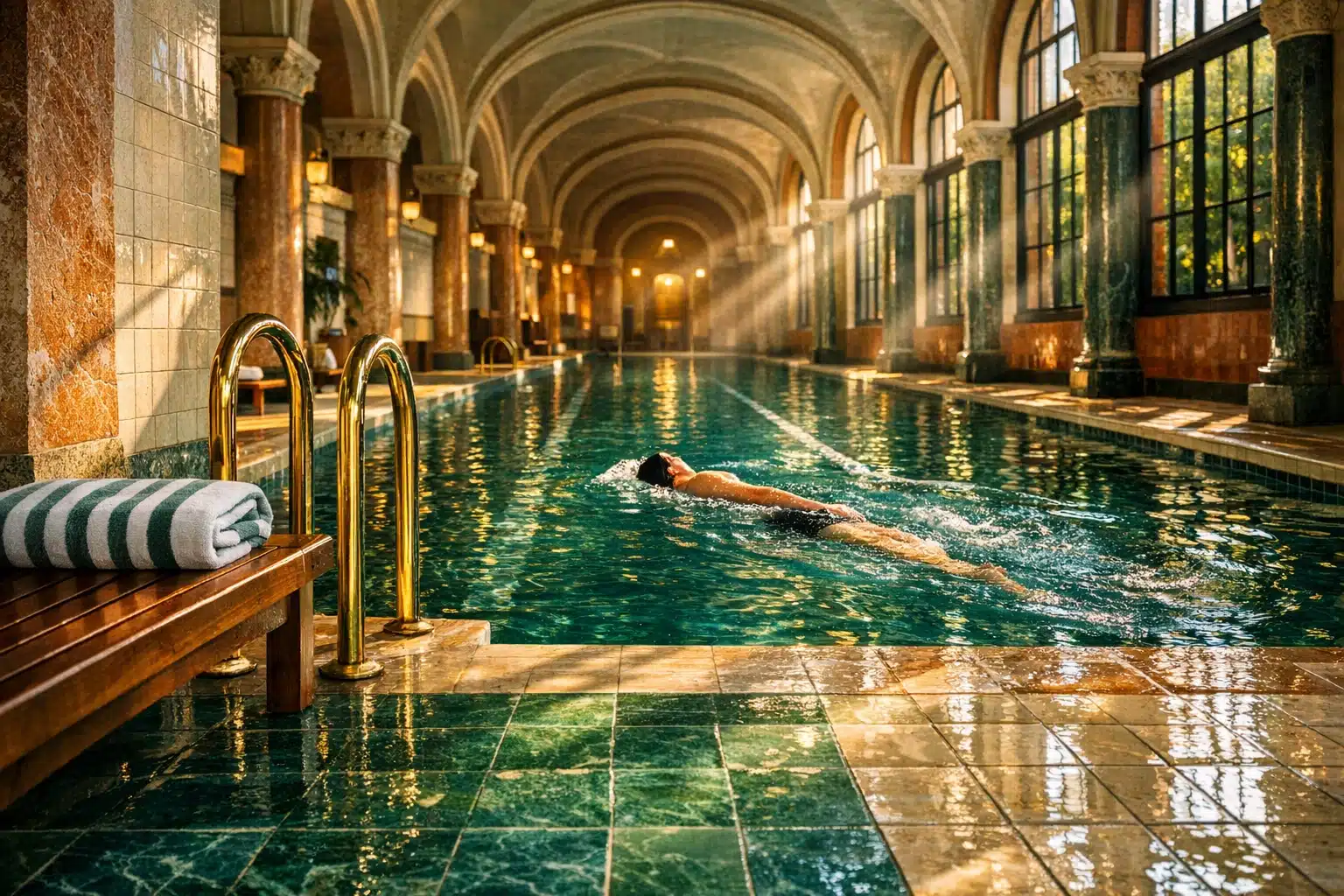
Explore the world of swimming
Swimming holds a rare place in human life because it combines survival, sport, health, and leisure in one activity. It can be playful on a summer afternoon, demanding in a race lane, or calming after a stressful day. Across cultures and age groups, people turn to the water to build strength, protect joints, improve endurance, and gain confidence. The deeper you look, the more swimming reveals itself as both a practical skill and an enduring source of challenge and joy.
Outline
1. Swimming through history and culture: how people learned to move through water and why it mattered.
2. Physical and mental benefits: what swimming does for the body, brain, and long-term wellbeing.
3. Strokes and technique: how major swimming styles differ and what makes them effective.
4. Training, safety, and equipment: how swimmers build skill while reducing risk.
5. Swimming as lifestyle and sport: how pools, open water, and competition shape the modern swimming experience.
Swimming Through History and Culture
Swimming may look simple from the side of a pool, but its story stretches across thousands of years. Long before lanes, stopwatches, and neatly folded towels, people swam because they had to. Rivers needed crossing, coastlines invited fishing and travel, and floods did not wait for lessons. Ancient cave art suggests that humans were familiar with swimming in prehistoric times, while written references from civilizations such as Egypt, Greece, and Rome show that moving through water was already recognized as a useful and sometimes admirable skill. In some societies, swimming was part of military training. In others, it belonged to daily life, trade, or ritual.
Over time, swimming evolved from necessity to organized activity. By the nineteenth century, public baths and swimming clubs helped turn it into a modern sport, especially in Europe. Standardized rules began to appear, competitive strokes were refined, and races drew spectators. Swimming entered the first modern Olympic Games in 1896 for men, while women’s Olympic swimming events were added in 1912. Since then, the sport has grown into a global discipline with world championships, youth development systems, and highly specialized coaching.
Culture has always influenced how swimming is taught and valued. In coastal nations, children may grow up comfortable in open water, learning by imitation before formal instruction. In landlocked or colder regions, swimming often depends more on access to indoor pools and organized classes. Economic differences matter too. A community with safe public facilities can make swimming feel ordinary, while limited access can turn it into a privilege. That gap has real consequences, especially because drowning prevention is strongly linked to swimming education.
Swimming also carries a social dimension that is easy to overlook. It can be solitary, but it rarely exists in isolation. Pools are places where generations overlap: toddlers splash in the shallow end, teenagers push through drills, adults train after work, and older swimmers glide through steady recovery laps. In literature and film, water often symbolizes freedom, danger, renewal, or introspection, and swimming inherits all of those meanings. A swimmer entering cool water is not just exercising; they are stepping into an environment that humans have respected, feared, and celebrated for centuries.
Several turning points shaped swimming’s modern role:
• The rise of public baths and municipal pools made instruction more accessible.
• Competitive rules encouraged the development of efficient strokes.
• Lifesaving programs connected swimming with public safety.
• Olympic success and media coverage turned elite swimmers into widely recognized athletes.
Seen in this wider context, swimming is more than a recreational pastime. It is a skill woven into history, a public health tool, and a cultural practice that continues to adapt as communities rethink fitness, safety, and access to sport.
Why Swimming Benefits the Body and Mind
Few forms of exercise offer as many advantages to as many people as swimming. One reason is the nature of water itself. Buoyancy reduces the stress placed on bones and joints, which makes swimming especially valuable for older adults, people recovering from injury, and those who find high-impact exercise uncomfortable. At the same time, water provides resistance in every direction, so even gentle movement can become meaningful work for muscles. Unlike some land-based activities that emphasize one area of the body, swimming recruits the shoulders, back, chest, core, hips, and legs in coordinated patterns.
Cardiovascular health is one of the clearest benefits. Regular swimming can improve heart efficiency, endurance, and circulation. Public health guidance in many countries recommends at least 150 minutes of moderate aerobic activity each week, and swimming is an effective way to meet that target. A steady session can raise heart rate without the pounding associated with running. For many people, that balance makes it easier to stay consistent over time. Consistency, more than intensity alone, is what often drives lasting results.
Swimming also supports muscular endurance and mobility. Because the body moves against water resistance throughout a stroke cycle, swimmers repeatedly engage stabilizing muscles that are often neglected in daily life. Good technique encourages posture, rotation, and control rather than brute force. That is one reason skilled swimmers can appear calm while working hard; the movement is efficient, not frantic. Flexibility may improve as well, particularly in the shoulders, ankles, and thoracic spine, although proper technique and mobility work remain important to avoid overuse issues.
Mental benefits deserve equal attention. The repetitive rhythm of laps can create a focused, almost meditative state. Breathing patterns slow the mind, and the muffled sound of the pool often provides a break from constant digital noise. Many swimmers describe a session as a reset button. Research on physical activity more broadly supports these experiences, linking regular exercise with improved mood, reduced stress, and better sleep. Swimming adds a sensory element that many people find uniquely calming: the cool pressure of water, the clean line of a glide, the brief hush between strokes.
For children, swimming lessons can build confidence and safety awareness at the same time. For adults, learning later in life often brings a different reward: the satisfaction of overcoming fear. Water has a way of revealing tension immediately, but it also teaches trust and control. That lesson can stay with a person long after they leave the pool deck.
Common benefits of regular swimming include:
• Improved aerobic fitness and stamina.
• Lower joint impact compared with many land exercises.
• Better coordination, balance, and body awareness.
• Stress relief and mental clarity.
• Practical water safety skills that may help prevent accidents.
Swimming is not a magic solution, and like any activity it works best when matched to individual needs, goals, and health conditions. Still, its versatility is hard to ignore. Whether someone wants rehabilitation, general fitness, performance training, or simply a peaceful hour away from routine, the water offers a remarkably adaptable place to begin.
Understanding the Main Strokes and the Craft of Technique
To an untrained eye, all swimming can seem like a blur of arms, splashes, and determined breathing. In reality, each stroke follows its own logic, rhythm, and physical demand. Learning these differences helps beginners progress faster and gives experienced swimmers a better appreciation of how technique shapes speed and efficiency. In swimming, form is not decoration; it is function. A poorly timed kick or a rushed breath can waste energy quickly, while a well-coordinated stroke allows a swimmer to travel farther with less effort.
Freestyle, usually performed as front crawl, is the fastest and most commonly practiced stroke. It relies on alternating arm recovery, a flutter kick, and side breathing. The body position should remain long and streamlined, with rotation through the torso rather than flat, hurried windmilling. Because freestyle is efficient over long distances, it dominates fitness training and distance racing. Yet it is also deceptively technical. New swimmers often lift the head too high to breathe, which causes the hips and legs to sink, creating drag like a parachute in water.
Backstroke shares some features with freestyle, including alternating arms and a flutter kick, but it is performed face up. This makes breathing easier, though navigation becomes harder without lane lines or ceiling markers. Backstroke encourages body alignment and shoulder mobility, and many swimmers find it a useful counterbalance to the forward-facing nature of daily life. It can feel graceful when done well, almost like floating with purpose.
Breaststroke is slower but highly popular because many recreational swimmers find its timing intuitive after practice. The stroke uses simultaneous arm movements and a whip kick, followed by a glide phase. Efficiency depends heavily on timing: pull, breathe, kick, glide. When rushed, breaststroke becomes tiring and choppy. When executed well, it feels economical and smooth. It is also the stroke most distinct from the others because the kick contributes so much propulsion.
Butterfly is the most demanding of the four competitive strokes. Both arms recover together, the body moves in a wave-like pattern, and the dolphin kick powers the rhythm from the core and hips. Butterfly rewards strength, timing, and confidence, but it also punishes tension. Swimmers who fight the water exhaust themselves quickly. Those who learn to ride the stroke’s rhythm make it look almost theatrical, as if the water is briefly giving them back some of the force they put into it.
Good technique in any stroke depends on a few shared principles:
• Streamline the body to reduce drag.
• Coordinate breathing so it supports rhythm instead of disrupting it.
• Use the core to connect upper- and lower-body movement.
• Focus on feel for the water, not just effort level.
• Build skill gradually through drills and feedback.
Comparisons between strokes reveal how different goals shape movement. Freestyle favors speed and efficiency, breaststroke emphasizes timing and glide, backstroke promotes alignment and control, and butterfly tests rhythm under high demand. Together they form a technical language of water movement. Learning that language can be frustrating at first, but once a swimmer starts to feel the difference between fighting water and working with it, the sport becomes far more rewarding.
Training, Safety, and Equipment for Smarter Swimming
Swimming rewards discipline, but it responds poorly to guesswork. Effective training is built on structure, patience, and a realistic understanding of one’s current level. A beginner who tries to swim hard for long distances may end a session discouraged and exhausted, while a trained swimmer who ignores recovery can drift into shoulder pain or stagnation. The best programs match intensity to purpose. Some sessions build aerobic endurance with longer repeats and short rest. Others focus on sprint speed, stroke technique, pacing, or kick development. Even a simple workout becomes more useful when it has a clear aim.
Many swimmers improve by dividing practice into parts. A warm-up raises body temperature and prepares the shoulders. Drills sharpen movement patterns. Main sets target endurance or speed. Cool-down laps ease the transition out of hard work. This structure is common from learn-to-swim classes all the way to elite programs because it organizes effort and reduces the temptation to treat every length the same. Variety matters too. Repeating only one pace or one stroke can limit development and increase overuse strain.
Safety remains essential at every level. Water can be inviting and unforgiving at the same time. Beginners should ideally learn in supervised environments with qualified instruction. Open water swimmers need added caution because lakes, rivers, and oceans bring currents, temperature changes, visibility issues, and navigation challenges that pools do not. Even experienced swimmers can misjudge conditions. Wearing a bright cap, swimming with others, and understanding local safety guidance are simple measures that can make a significant difference.
Equipment, while not the heart of swimming, can support learning and comfort. A well-fitted pair of goggles improves visibility and confidence. Swim caps help reduce drag and keep hair manageable, though not every recreational swimmer uses one. Kickboards isolate lower-body work, pull buoys shift focus to the upper body, and fins can help swimmers experience body position and propulsion more clearly. Paddles are useful for strength and catch awareness, but they should be used carefully because poor technique with extra load can stress the shoulders.
Helpful training habits include:
• Set one main goal for each session.
• Increase distance or intensity gradually rather than suddenly.
• Prioritize technique early, before fatigue distorts movement.
• Rest when pain suggests more than normal exertion.
• Respect pool rules, lane etiquette, and lifeguard instructions.
Nutrition, hydration, and recovery also deserve attention. Because swimmers are surrounded by water, they do not always notice sweat loss, yet dehydration can still affect performance. Sleep supports adaptation, and dryland mobility or strength work can improve resilience outside the pool. In other words, good swimming is not built only in the water.
There is a quiet satisfaction in a well-run swim practice. The clock moves, sets unfold, and each repeat tells a small truth about effort and progress. Improvement may come a fraction of a second at a time or through one cleaner breath every three strokes. That slow accumulation is part of the appeal. Swimming teaches that smart repetition, not drama, is often what carries a person forward.
Swimming as Recreation, Community, and Competitive Sport
Swimming has an unusual ability to belong to different worlds at once. For one person, it is a weekend family activity at a local pool. For another, it is a demanding competitive pursuit shaped by training plans, race splits, and championship calendars. Between those extremes lies a wide middle ground where swimming serves as a social habit, a therapeutic outlet, a travel experience, or a lifelong hobby. This range is one reason the activity remains relevant across ages and backgrounds. It does not require everyone to want the same thing from it.
Recreational swimming often provides the first gateway. Children may begin by splashing, playing games, and learning how to float. Adults may return to the water after years away, rediscovering the pleasure of movement without impact. Hotel pools, beaches, lakes, and community centers all contribute to the public image of swimming as refreshment and freedom. Yet recreation still carries important lessons. Knowing how to tread water, enter safely, and remain calm in deep water can matter far beyond leisure. Fun and safety are not opposing ideas; in swimming, they strengthen each other.
Community also plays a powerful role. Masters clubs welcome adult swimmers who want fitness, coaching, or camaraderie without needing elite status. School teams introduce younger athletes to structured competition and shared goals. Local meets create an atmosphere unlike many other sports: loud cheering on deck, intense concentration behind the blocks, and then the odd silence of the race itself once the swimmers disappear into their own lanes. Success is measurable in time, but the experience is often social at heart.
At the competitive level, swimming becomes a precise performance sport. Races can be decided by hundredths of a second, and details such as starts, turns, underwater phases, and pacing strategies become crucial. World-class swimmers train for years to produce moments that may last under a minute. Their performances often look effortless on screen, but behind that image are countless technical corrections, conditioning sessions, and recovery routines. The margin between finalist and medalist is frequently tiny, which is why discipline and efficiency are so highly valued.
Swimming’s modern landscape includes several distinct branches:
• Pool swimming, centered on standardized distances and controlled conditions.
• Open water swimming, where strategy must adapt to currents, sighting, and temperature.
• Artistic and synchronized disciplines, which blend precision with performance.
• Triathlon swimming, where energy management matters as much as speed.
What unites these forms is the relationship between human movement and water. Swimming can thrill, comfort, humble, and inspire, sometimes within the same week. One day it feels light and effortless; the next it reminds you how technical and demanding it really is. That unpredictability is part of its pull. It keeps beginners curious and gives experienced swimmers a reason to keep refining what they know. In a noisy world, the clean geometry of a lane line and the honest feedback of water can feel refreshingly direct.
Conclusion for Readers Interested in Swimming
Swimming offers something rare: an activity that is practical, physically rewarding, mentally refreshing, and adaptable across an entire lifetime. If you are new to it, start with comfort, supervision, and technique rather than speed. If you already swim, there is value in refining the small details that make movement smoother and more efficient. The sport can support fitness goals, reduce stress, expand social connections, and build confidence in and around water. For readers looking for an activity that blends discipline with enjoyment, swimming is not just worth trying; it is worth returning to again and again.