Explore the world of swimming
Introduction and Outline: Why Swimming Still Matters
Swimming occupies a rare place in sport because it can be playful, practical, and physically demanding at the same time. It serves children learning confidence around water, adults searching for low-impact exercise, and athletes chasing efficiency measured in fractions of a second. From public pools to open lakes, it connects recreation with survival, fitness with technique, and discipline with the simple pleasure of moving through water. That unusual range is exactly why swimming remains relevant in schools, rehabilitation clinics, community centers, and elite competition.
Few activities cross as many boundaries as swimming does. It can be a life skill, a leisure habit, a medical recommendation, a competitive pursuit, or a quiet form of stress relief at the end of a crowded day. Unlike many land-based exercises, it asks the body to cooperate with resistance in every direction while also demanding rhythm, breath control, and body awareness. A runner battles gravity with each step; a swimmer learns to negotiate buoyancy, drag, and timing. That difference gives swimming its own logic, and once you understand that logic, the water stops feeling like an obstacle and starts behaving like a training partner.
This article is organized to move from the big picture to practical application. It begins by explaining why swimming matters today, then moves into technique, health benefits, training habits, and finally the different ways people of various ages and goals can make the sport part of their lives.
- How swimming developed into both a survival skill and a modern sport
- The four main strokes and the mechanics behind efficient movement
- Physical, mental, and long-term health advantages
- Training structure, safety habits, and useful equipment
- How beginners, families, fitness swimmers, and competitors can each find their place
Swimming also has a social reach that is easy to underestimate. It appears in school lessons, summer traditions, Olympic broadcasts, triathlon training plans, and retirement fitness classes. Competitive pools are commonly 25 or 50 meters long, yet the meaning of swimming is not confined to lanes and clocks. For some people it is about learning not to fear deep water. For others it becomes a methodical search for better turns, cleaner strokes, or steadier breathing. In every case, the appeal comes from the same source: the water gives immediate feedback. If you tense up, it tells you. If you rush, it tells you. If you relax into a better line, it rewards you with effortless glide. That conversation between body and water is where the fascination begins.
The Language of the Water: Strokes, Breathing, and Efficiency
To understand swimming, it helps to start with its four main competitive strokes: freestyle, backstroke, breaststroke, and butterfly. Each one solves the same problem, moving the body through water, but each solves it in a distinct way. Freestyle, usually swum as front crawl, is the fastest and often the first stroke taught for fitness laps. It relies on a long body line, alternating arm recovery, a steady flutter kick, and side breathing that fits into the stroke without lifting the head too high. When done well, freestyle looks almost quiet, as if the swimmer is slipping forward rather than wrestling the water.
Backstroke mirrors some front crawl mechanics, yet it changes orientation completely. Because the swimmer is face-up, breathing is less restricted, but maintaining a straight course becomes harder. Good backstroke depends on hip rotation, shoulder mobility, and a kick that remains active without becoming frantic. Breaststroke is different again. Its pull, kick, and glide create a stop-and-go rhythm that many beginners find intuitive, though efficient breaststroke is surprisingly technical. Timing matters more than force. Butterfly, with its simultaneous arm recovery and dolphin kick, is the most demanding stroke for many swimmers. It punishes poor timing quickly, but when rhythm clicks into place, butterfly resembles a wave being shaped by the body itself.
Technique rests on several principles that apply across strokes.
- Body position should remain balanced and streamlined
- Breathing should support rhythm instead of interrupting it
- Propulsion works best when the hands and feet press water with purpose, not panic
- Relaxation is not laziness; it is energy conservation
Many new swimmers assume speed comes mainly from strength. In water, efficiency often matters more. A powerful athlete with poor alignment can create enormous drag, while a smaller swimmer with refined mechanics may move faster using less visible effort. This is one reason coaches spend so much time on drills. A fingertip drag drill can teach a cleaner recovery in freestyle. Single-arm work can reveal whether a swimmer rotates effectively. Kick sets can expose whether propulsion is coming from the hips or just the knees. Improvement sometimes feels less like adding horsepower and more like removing friction.
Breathing deserves special attention because it shapes confidence. Lifting the head too high tends to sink the hips, disturb balance, and increase resistance. Exhaling steadily in the water and inhaling quickly during the available window keeps movement smoother. Once breathing settles, many other pieces improve. The swimmer stops reacting and starts flowing. That shift, from effortful survival to intentional movement, is one of the most satisfying breakthroughs in the sport.
Why Swimming Supports Health, Fitness, and Recovery
Swimming earns its reputation as a full-body exercise because it asks multiple systems to work together at once. The heart and lungs must deliver oxygen, the arms and legs must coordinate propulsion, the core must stabilize position, and the nervous system must manage timing in an environment that changes how movement feels. Unlike a weight machine that isolates a single pattern, swimming links muscular work with breath control and posture from the first lap onward. That is one reason a moderate session can feel demanding even when it appears graceful from the pool deck.
From a fitness perspective, swimming can improve cardiovascular endurance, muscular stamina, and general work capacity. Public health guidance commonly recommends at least 150 minutes of moderate aerobic activity per week for adults, and lap swimming can contribute meaningfully to that target. The exact training effect depends on pace, duration, and skill level, but even steady recreational sessions can challenge circulation and breathing. Water is much denser than air, so every stroke meets resistance. That resistance is not the same as lifting heavy external loads, yet it does create a whole-body demand that many people find both efficient and joint-friendly.
Low-impact exercise is one of swimming’s strongest advantages. Buoyancy supports body weight, which often reduces stress on the knees, hips, and spine compared with repetitive land-based impact. For older adults, people returning from injury, and individuals managing certain mobility limitations, this can make exercise feel possible again. Rehabilitation professionals often use aquatic settings because the water allows movement that might feel uncomfortable on land. That does not mean swimming is automatically safe for every condition, but it does explain why doctors, physiotherapists, and fitness specialists frequently include it in broader recovery plans.
The mental side matters too. A swim can narrow attention in a useful way: count strokes, hold form, breathe, turn, repeat. That rhythm gives the mind something clear to do. For many swimmers, the lane becomes a place where outside noise fades and internal clutter settles. There is also a sensory element that is difficult to imitate elsewhere: the cool surface on entry, the muffled sound underwater, the small satisfaction of a clean push off the wall. Exercise science often measures outcomes in heart rate and training load, but regular swimmers also talk about sleep, mood, and concentration.
Several practical benefits help explain swimming’s long-term appeal.
- It can be adapted for beginners, older adults, and trained athletes
- Intensity can range from gentle movement to demanding interval work
- It builds water confidence, which has safety value beyond fitness
- It fits solo practice, coached sessions, and family recreation
Not every person will love chlorine, caps, or lane etiquette, and not every body takes to the water quickly. Still, swimming offers an unusual combination of challenge and support. It can push the cardiovascular system while sparing the joints, sharpen technique while calming the mind, and remain useful from childhood through later life. Few activities manage that range so convincingly.
Training, Safety, and Equipment: Turning Effort into Progress
Swimming rewards consistency far more reliably than occasional heroic effort. Many beginners make the mistake of treating every pool visit as a test, pushing too hard, losing technique, and leaving discouraged. A better approach is to think in layers: comfort in the water first, then rhythm, then endurance, and only later higher speed or complex sets. In practical terms, this means short repeats with rest are often more productive than one long struggle. A swimmer who can complete eight controlled lengths with good form is usually building a better foundation than someone who survives twenty lengths with a collapsing stroke.
A simple session structure works well for most recreational swimmers. Start with an easy warm-up to raise body temperature and settle breathing. Follow that with drills or short technique-focused repeats, then complete a main set aimed at endurance or moderate speed, and finish with a gentle cooldown. This sequence helps the body prepare gradually while keeping attention on quality.
- Warm-up: easy swim plus light kicking or pulling
- Skill block: drills for balance, rotation, or breathing timing
- Main set: repeat distances matched to current fitness
- Cooldown: relaxed lengths to lower intensity
Equipment should support learning rather than distract from it. Goggles improve visibility and reduce irritation, making practice far more comfortable. A well-fitted swimsuit reduces drag and allows free movement. Swim caps help manage hair and are often required in training environments. Kickboards isolate leg work, while pull buoys emphasize upper-body mechanics and alignment. Fins can help beginners experience body position and propulsion more clearly, though they should not become a crutch. Paddles, snorkels, and pace clocks enter the picture as training becomes more structured.
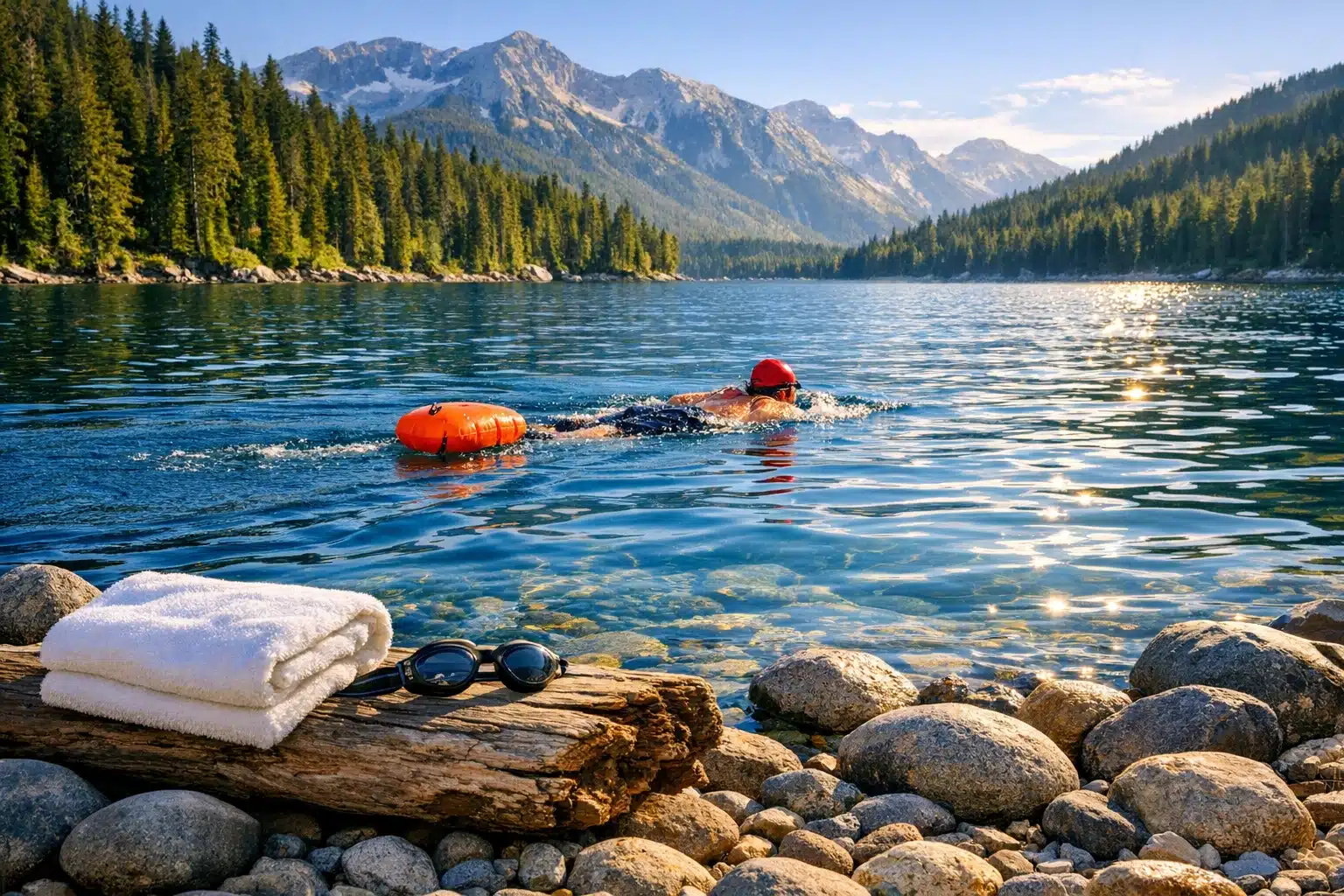
Safety deserves at least as much attention as technique. Pool swimmers should understand lane etiquette, depth markings, and posted rules. Open-water swimmers need an even more cautious mindset because lakes, rivers, and the sea introduce currents, temperature shifts, visibility limits, and navigation challenges. A calm shoreline can hide cold water shock or changing weather. Swimming with a partner, using a brightly colored tow float where appropriate, and checking local conditions are sensible habits, not signs of inexperience.
There is also a practical difference between knowing how to move in water and being prepared for real aquatic environments. Pools are controlled spaces. Open water is not. In a pool, the wall is predictable, the depth is marked, and help is nearby. Outdoors, direction can blur, waves can disrupt breathing, and distances can feel longer than they appear. That contrast is why transition training matters for triathletes and recreational open-water swimmers alike.
Progress comes from patience. Better turns, smoother breathing, and longer relaxed sets often arrive before dramatic speed gains. If training is built around repeatable habits, small improvements accumulate almost invisibly. Then one day the lane that once felt endless becomes manageable, and the swimmer realizes that skill, not struggle, has been doing the heavy lifting.
Conclusion: Finding Your Own Lane in Swimming
Swimming is not a single experience with a single audience. It changes shape depending on who enters the water and why. A child may meet it first as a safety lesson and a game. A busy adult may discover it as an efficient, low-impact workout before work. A recovering patient may use it to restore movement with less discomfort. A competitor may treat the pool as a laboratory where turns, stroke counts, and split times are refined with near-mathematical care. The same body of water can host all of these goals, which is part of what makes swimming unusually durable as a lifelong activity.
For beginners, the most important step is not speed but familiarity. Learning to float, exhale underwater, and move with composure creates the base everything else stands on. For parents, access to swimming lessons can be one of the most practical gifts they provide because water confidence carries both recreational and safety value. For fitness seekers, swimming offers a training option that can challenge the heart and muscles without constant pounding on the joints. For former athletes returning to exercise, it can reopen the door to disciplined movement without demanding an immediate return to high-impact routines.
Readers who are curious about taking swimming further have several pathways available.
- Join adult learn-to-swim or technique classes for structured guidance
- Use public lap sessions to build endurance at a comfortable pace
- Explore masters swimming for coached training and community
- Try open-water events or triathlon only after developing strong safety habits
- Keep a simple training log to track distance, drills, and how each session feels
The deeper appeal of swimming goes beyond exercise metrics. It teaches patience because progress is technical. It teaches humility because water exposes tension and poor timing immediately. It teaches economy because the smoothest swimmer is often not the one working hardest on the surface. There is something quietly memorable about pushing off the wall and feeling, for a brief stretch, that movement has become cleaner than thought. That sensation keeps many people returning long after their original reason for starting has changed.
If this article is written for anyone in particular, it is for the reader standing at the edge deciding whether swimming is worth the effort. The answer is yes, provided you approach it with curiosity, realism, and consistency. You do not need elite ambitions to benefit from the water. You only need a safe place to begin, enough patience to learn its language, and the willingness to let steady practice turn uncertainty into skill.