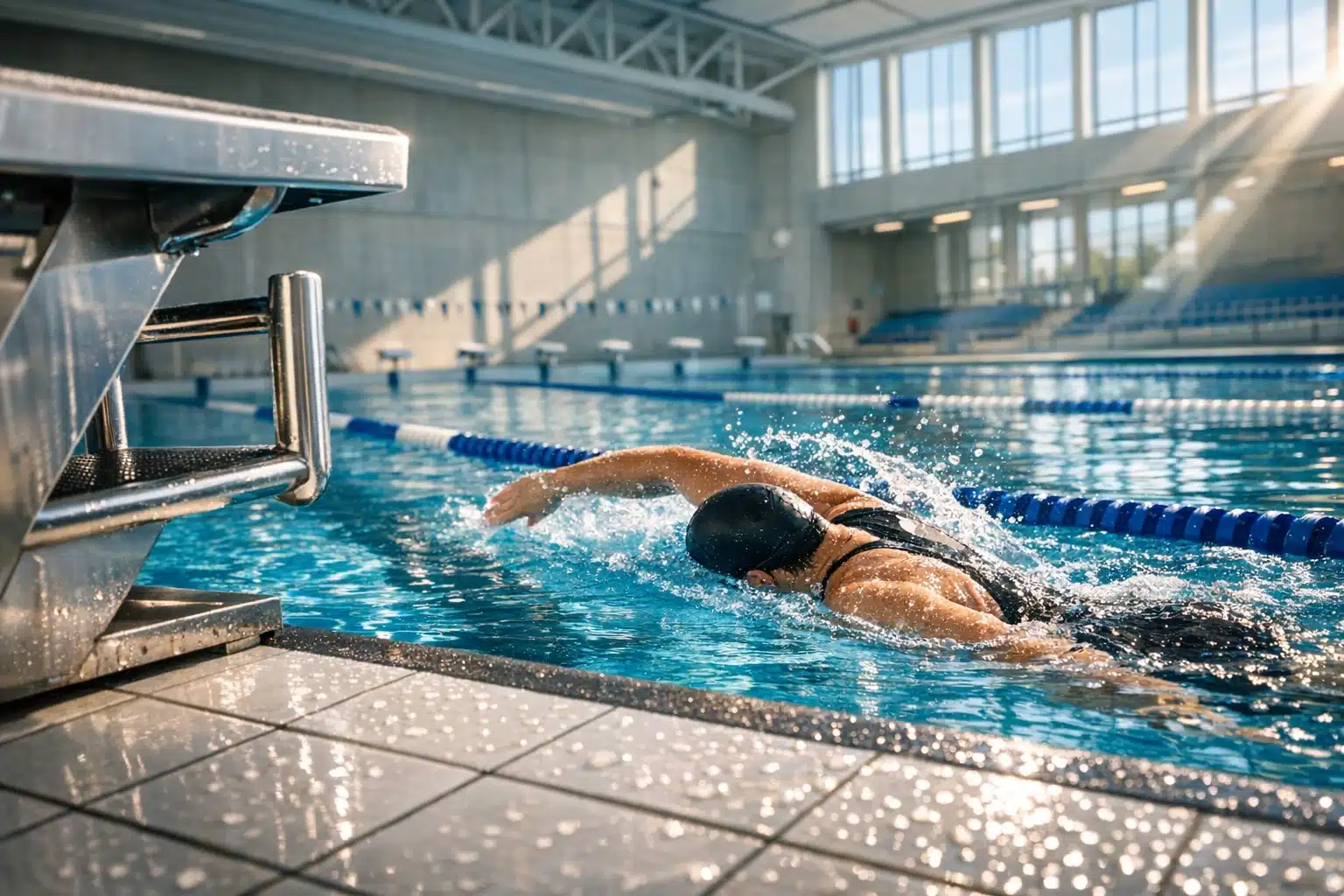
Explore the world of swimming
Swimming sits at a rare crossroads where sport, survival skill, and everyday wellbeing meet. A quiet pool lane can hold fierce training, gentle rehabilitation, or a beginner’s first lesson in trust and balance. Because water supports the body while adding constant resistance, swimming attracts children, older adults, competitive athletes, and people easing back after injury. That unusual range of uses makes it one of the most relevant physical activities to understand well.
Article Outline
This article begins by explaining what makes swimming distinct from land-based exercise and why its environment changes the way the body moves. It then examines the physical and mental benefits linked to regular practice, before moving into technique, training structure, and common learning hurdles. After that, it compares pool and open-water swimming, covers safety and equipment, and closes with a practical conclusion for beginners, families, fitness-focused readers, and lifelong athletes.
- The nature of swimming and the aquatic environment
- Health, fitness, and mental wellbeing benefits
- Technique, strokes, and training progression
- Safety, equipment, and pool versus open-water realities
- A concluding guide for readers who want to make swimming part of real life
The Nature of Swimming: Why Water Changes Everything
Swimming looks simple from the deck. Arms rise, legs kick, ripples spread, and a swimmer moves forward as if the water has agreed to cooperate. The reality is more interesting. Water is far denser than air, so every movement meets resistance from every side. That single fact changes the experience completely. On land, motion often feels segmented: step, push, recover. In the water, motion becomes continuous. A slight change in head position can alter body alignment, increase drag, and make a short distance feel surprisingly long.
This is one reason swimming is both humbling and rewarding. It does not rely only on strength. Technique matters immediately. A smaller swimmer with efficient form often moves better than a stronger swimmer who fights the water. In that sense, swimming resembles cycling or rowing more than a casual jog; good mechanics save energy, while poor mechanics multiply effort. Water is an honest teacher. It does not flatter bad habits for very long.
Swimming also has a long human story behind it. People have swum for transport, survival, fishing, military training, and sport for thousands of years. Today, it exists in several overlapping worlds: recreation, education, rehabilitation, competition, and endurance adventure. A child learning to float, a triathlete training intervals, and an older adult doing gentle laps may all share the same pool, even though their goals are completely different.
The main strokes illustrate how broad the discipline is:
- Freestyle, usually swum as front crawl, is the fastest and most energy-efficient stroke for many people.
- Backstroke allows easier breathing because the face stays above water, but body position and direction control become more important.
- Breaststroke is often more intuitive for beginners, though timing and knee movement require care.
- Butterfly is powerful and technically demanding, relying on rhythm, coordination, and upper-body strength.
Compared with many popular sports, swimming is unusual because it can be intensely individual without feeling isolating. A swimmer may train alone in a lane, yet still belong to a team, a class, or a routine shared by others. It can be measured precisely through time, distance, stroke count, and pace, but it also invites a more reflective experience. Some people count laps; others listen to bubbles and breath and emerge feeling as if the mind has been rinsed clean.
That combination of science and sensation is the core of swimming’s appeal. It is technical enough to study for years, practical enough to matter in emergencies, and flexible enough to suit many ages and ability levels. Before discussing fitness and health, it is worth recognizing this broader truth: swimming is not only exercise in water. It is a conversation with an environment that constantly answers back.
Health and Fitness Benefits: A Full-Body Workout with Broad Appeal
Swimming is frequently described as a full-body workout, and that phrase is accurate for a simple reason: propulsion in water rarely comes from one area alone. The arms pull, the shoulders stabilize, the core helps hold position, the hips transfer force, and the legs support balance or drive the kick. Even easy lap swimming asks the body to coordinate across multiple muscle groups. This makes it different from exercise that concentrates stress more narrowly, such as isolated strength machines or impact-heavy activities focused on the lower body.
From a cardiovascular point of view, swimming can help adults work toward widely recognized physical activity goals. Public health guidance from organizations such as the World Health Organization recommends that adults aim for at least 150 minutes of moderate aerobic activity per week, or 75 minutes of vigorous activity, along with muscle-strengthening work. Swimming can contribute meaningfully to that total. A steady session raises heart rate, challenges the lungs, and can be scaled from gentle movement to demanding interval training.
One of its strongest advantages is low impact. Because buoyancy reduces load on joints, swimming often feels more accessible than running for people with knee discomfort, extra body weight, or a history of overuse injuries. That does not mean it is effortless or risk-free; poor technique can still strain shoulders, neck, or lower back. Still, compared with repetitive pounding on hard surfaces, lap swimming can offer a kinder entry point for many bodies.
The energy cost can also be substantial. Calorie expenditure varies with body size, stroke choice, and intensity, but a moderate 30-minute session may burn roughly 180 to 300 calories, while harder efforts can go higher. Butterfly and fast freestyle generally demand more energy than easy breaststroke or relaxed backstroke. Yet calories tell only part of the story. Swimming builds work capacity, coordination, posture awareness, and movement confidence, all of which matter beyond the pool.
Mental wellbeing is another major reason people stay with it. Repetitive movement, controlled breathing, and the muted sensory world of water can create a calming effect. Many swimmers describe the pool as a place where attention narrows in a useful way. Instead of juggling screens, noise, and errands, they focus on length, breath, turn, and timing. That rhythm can reduce stress and sharpen mood, especially when training becomes a regular habit rather than an occasional event.
Its broad appeal becomes clearer when compared across life stages:
- Children gain water familiarity, confidence, and a valuable safety skill.
- Adults can use swimming for fitness, stress management, or cross-training.
- Older adults may appreciate the reduced joint impact and the emphasis on mobility.
- Athletes in other sports often use it to improve aerobic conditioning without constant impact.
Few activities serve so many groups at once. Swimming does not solve every fitness problem, and it should not replace all forms of strength or mobility work. But as a durable, adaptable, and efficient form of exercise, it earns its reputation honestly.
Learning to Swim Well: Technique, Breathing, and Smart Training Progression
Many beginners assume swimming improves mostly by doing more laps. Volume does help, but only after a foundation is in place. In early learning, technique matters more than mileage. A swimmer who understands body position, breathing, and timing often improves faster than someone who simply pushes harder. The water magnifies inefficiency, so thoughtful practice usually beats stubborn effort.
Body position is the first big lesson. Efficient swimmers try to stay long and balanced near the surface, reducing drag rather than muscling through it. When the hips drop or the head lifts too high, the body acts more like a plow than a vessel. That is why coaches often begin with floating, gliding, and kicking drills before long sets. These may look basic, but they teach the feel of water support and streamline.
Breathing is the second turning point. On land, breathing is automatic and unconstrained. In swimming, it has to fit the stroke. New swimmers often hold their breath too long, lift the head, and lose alignment. A better pattern is usually to exhale into the water and inhale quickly when the stroke creates space. In freestyle, rhythmic side breathing helps maintain balance. In breaststroke, breath naturally pairs with the front-end lift. In backstroke, the issue is not access to air but establishing a steady pattern instead of gasping randomly.
Each stroke teaches something slightly different:
- Freestyle develops rotation, streamline, and continuous propulsion.
- Backstroke improves body alignment and shoulder rhythm while removing the anxiety of face-down breathing.
- Breaststroke highlights timing, patience, and the idea that recovery should not create excess drag.
- Butterfly teaches wave motion, core connection, and precise rhythm, though it is usually introduced later.
Training progression works best when it is layered. A complete session may include a warm-up, a drill set, a main set, and a cooldown. For example, a beginner might swim short lengths with generous rest, focusing on exhaling underwater and keeping the head still. An intermediate swimmer may add pace control, turns, and mixed strokes. A more advanced swimmer might structure work around threshold intervals, sprint sets, or stroke-count efficiency.
Common mistakes are predictable and fixable. Rushing the stroke, kicking from the knees only, crossing the hands over the center line, and lifting the face forward too often are classic examples. Video analysis, even from a basic phone recording, can be useful because swimming feels different from how it looks. A swimmer may think the body is flat and streamlined while actually twisting too much or dropping one elbow on the catch.
Technique should not make swimming feel stiff or joyless. Good form is not a cage; it is a way of spending effort wisely. As comfort grows, the swimmer begins to notice a satisfying shift. Distances that once felt chaotic become measurable. Breaths settle. Turns become cleaner. Water that once seemed resistant starts to feel readable, almost conversational. That is the moment when a lesson becomes a practice, and a practice becomes a skill worth keeping.
Safety, Equipment, and the Difference Between Pool and Open Water
Swimming brings freedom, but it also demands respect. Water can be generous one moment and unforgiving the next, especially outside controlled settings. That is why safety is not a side topic; it is part of swimming literacy. Knowing a stroke is valuable, yet recognizing conditions, limits, and risk matters just as much. A confident swimmer in a pool may still be inexperienced in surf, cold water, or low-visibility conditions.
Pools are the most structured environment. Distances are marked, water quality is monitored, lane lines guide direction, and lifeguards may be present. For learning technique, building fitness, and tracking pace, pools are ideal. They support repetition and controlled progression. Open water, by contrast, removes many of those certainties. Lakes, rivers, and oceans introduce currents, waves, weather, temperature shifts, unclear depth, and limited visibility. The psychological difference alone can be striking. Without a visible black line on the bottom or a nearby wall every 25 or 50 meters, distance can feel longer and orientation more difficult.
That does not make open water inferior. Many swimmers love it precisely because it feels expansive and less mechanical. It can be beautiful, meditative, and adventurous. Still, the skills transfer only partly from the pool. Sighting, pacing without turns, entry and exit technique, and comfort in variable conditions must be learned deliberately.
Basic equipment is simple, but each piece serves a purpose:
- A well-fitted swimsuit reduces distraction and drag.
- Goggles protect the eyes and improve visibility.
- A swim cap can keep hair contained and may reduce minor resistance.
- A kickboard, pull buoy, paddles, and fins are training tools, not mandatory starter items.
- In open water, a brightly colored tow float can improve visibility to others.
Safety habits are more important than gear alone:
- Never overestimate your ability, especially in unfamiliar water.
- Check weather, water temperature, and local advisories before open-water sessions.
- Swim with a partner or under supervision when possible.
- Learn how to float, tread water, and rest calmly if tired.
- For children, formal lessons and close adult attention remain essential, even in shallow areas.
There is also an etiquette side to swimming that improves safety and enjoyment. In pools, sharing lanes, circling correctly, and allowing faster swimmers to pass reduce collisions and frustration. In open water, respecting other users such as paddlers, boaters, and anglers helps prevent conflict. Hygiene matters too: showering before entering a pool and avoiding swimming when ill supports public health and facility quality.
Seen clearly, safety does not shrink the sport. It enlarges it. The more a swimmer understands about conditions, equipment, and good judgment, the more places and purposes swimming can serve. Confidence built on knowledge is sturdier than confidence built on luck, and in water that distinction matters more than anywhere else.
Conclusion: Making Swimming Part of Real Life
For most readers, the real question is not whether swimming is impressive. It is whether it fits into ordinary life. The answer is usually yes, though the form it takes can vary widely. A parent may see swimming first as a safety skill for a child. A desk-bound professional may value it as low-impact exercise after long workdays. An older adult may appreciate the sense of mobility that water restores. A runner or cyclist may use it to train aerobically while giving joints a break. The same activity opens different doors depending on who steps toward the pool.
That flexibility is swimming’s quiet advantage. You do not need to become a competitive athlete to benefit from it. A practical starting point can be very modest: one or two sessions a week, a beginner lesson, ten careful lengths with rest, or a short period devoted only to floating and breathing control. Progress in swimming often feels slow at first because technique and comfort develop together. Still, small gains accumulate. The swimmer notices less panic in deep water, smoother exhalation, easier recovery between lengths, and greater trust in the body.
If you are deciding how to begin, a few priorities help:
- Choose safety before speed and instruction before guesswork.
- Build consistency first, because irregular sessions make skills fade quickly.
- Treat technique as a practical tool, not a perfection contest.
- Use the setting that matches your goal: pool for structure, open water for experience, or both for variety.
In the end, swimming offers something increasingly rare: effort that feels restorative. It can challenge the heart and lungs while easing stress on joints. It can sharpen focus while calming the mind. It teaches discipline without demanding noise, and it rewards patience more reliably than bravado. For beginners, families, fitness seekers, and lifelong learners, that combination is hard to ignore. If you give swimming regular time, it often gives back more than better endurance. It offers competence, confidence, and a lasting sense of ease in an element that many people admire from the shore but never fully learn to enter.