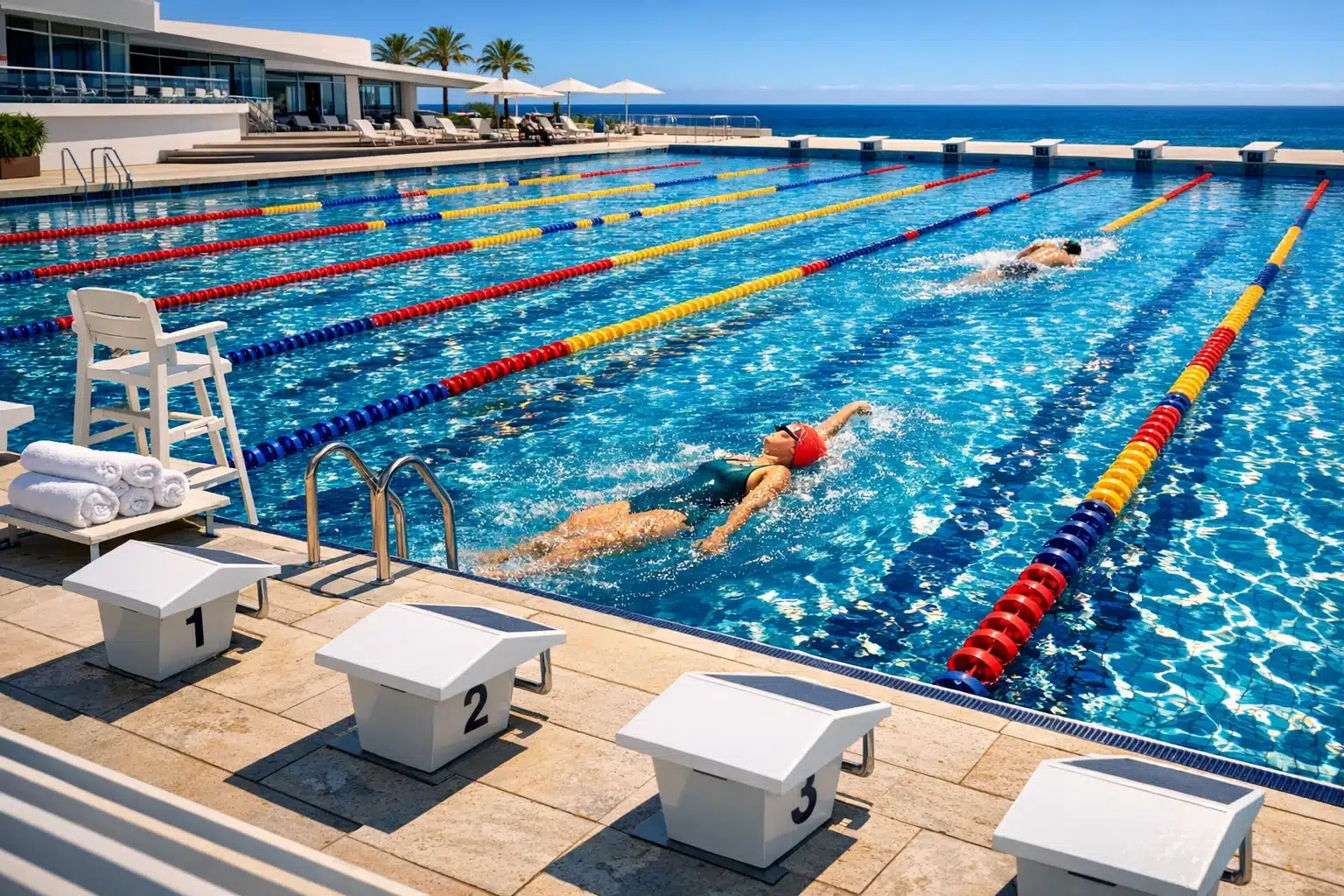
Explore the world of swimming
Swimming is one of those rare activities that works as a life skill, a competitive sport, a low-impact workout, and a source of calm all at once. It matters because it can be learned early, practiced for decades, and adapted to very different bodies and goals, from health recovery to elite performance. In a world crowded with complicated fitness advice, the simple act of moving through water remains practical, measurable, and deeply refreshing.
Outline
- The role of swimming as a lifelong skill, fitness tool, and sport
- The main swimming strokes and how they differ in movement, difficulty, and purpose
- The core techniques that improve efficiency, speed, and comfort in the water
- The physical and mental benefits supported by everyday practice and research
- Training habits, safety principles, and a realistic path for beginners and returning swimmers
Swimming as a Lifelong Skill, Sport, and Form of Exercise
Swimming occupies a special place among physical activities because it is both practical and aspirational. At the most basic level, it is a safety skill. Knowing how to float, breathe calmly, and move through water can reduce drowning risk and increase confidence around pools, lakes, and coastlines. At another level, swimming is a demanding sport that asks for discipline, coordination, pacing, and technical control. Between those two poles lies a huge middle ground where millions of people use swimming for health, recreation, rehabilitation, and stress relief.
One reason swimming remains widely relevant is that it works across age groups. Children often begin through water familiarization and basic stroke lessons. Teenagers may encounter swimming through school teams or casual exercise. Adults are frequently drawn to it because it offers a full-body workout without the repeated impact associated with running or jumping. Older adults often appreciate the support that water provides to joints, which can make movement feel freer and less intimidating. Buoyancy changes the experience of exercise; the body is still working, but the water shares part of the load.
Its training value is also substantial. Swimming challenges the cardiovascular system, but it also develops muscular endurance, breath control, posture awareness, and coordination between the upper and lower body. A single session can involve aerobic effort, technical repetition, sprint work, and recovery, all in the same lane. Because water creates resistance from every direction, even smooth and relaxed movements require meaningful effort. That is one reason many swimmers leave the pool with the satisfying fatigue of a complete workout rather than the narrow strain of an isolated one.
There is also a mental dimension that should not be underestimated. Pools have their own rhythm: the soft splash at the wall, the silence under the surface, the counted laps that turn effort into structure. For some people, swimming feels like meditation with motion. For others, it is a disciplined challenge measured in split times and distance totals. Both experiences are valid, and that flexibility helps explain swimming’s lasting appeal.
Public health guidance often recommends at least 150 minutes of moderate aerobic activity per week for adults, and swimming can contribute meaningfully to that target. A moderate lap swim can also burn several hundred calories in an hour, depending on pace, technique, and body size. Still, the most important benefit is often consistency. Swimming does not have to be dramatic to be valuable. Two or three steady sessions per week can improve stamina, support heart health, and make the body feel capable in a way that carries beyond the pool deck.
Understanding the Main Swimming Strokes and What Sets Them Apart
To the casual observer, swimming may seem like a single activity performed at different speeds, but the major strokes create very different experiences in the water. Freestyle, backstroke, breaststroke, and butterfly each ask the body to solve the same problem, forward movement through resistance, in a different way. Learning their differences helps beginners choose where to start and helps experienced swimmers understand how technique shapes effort.
Freestyle, commonly swum using the front crawl, is usually the first stroke associated with lap swimming. It is generally the fastest and most efficient over long distances because its alternating arm action allows continuous propulsion. A steady flutter kick supports balance and momentum, while side breathing lets swimmers maintain rhythm without lifting the head too much. For fitness swimmers, freestyle is often the default choice because it combines speed, economy, and accessibility. It is not necessarily easy at first, however. Breathing timing can feel awkward, and poor body position quickly creates drag.
Backstroke offers a useful contrast. Swimmers remain on their backs, which keeps the face out of the water and can make breathing feel more natural. The alternating arm motion resembles freestyle in broad structure, but orientation changes everything. Because the swimmer cannot see the direction of travel easily, spatial awareness becomes important. Backstroke can be excellent for posture and shoulder coordination, yet it demands control to keep the hips from dropping and the body from weaving through the lane.
Breaststroke is slower than freestyle for most swimmers, but it has a distinct rhythm that many people find approachable. The arm pull and whip kick occur in a coordinated cycle with a glide phase between efforts. That glide can feel graceful, almost like the water briefly agrees to carry you. Breaststroke is often easier for casual swimmers who prefer keeping the head higher, although good breaststroke technique is more technical than it first appears. Timing errors can make it inefficient and tiring.
Butterfly is often viewed as the most physically demanding stroke. It uses simultaneous arm recovery and a wave-like body action supported by a dolphin kick. When done well, it looks powerful and fluid, but it requires strong timing, mobility, and endurance. Even competitive swimmers usually train butterfly in smaller doses than freestyle.
- Freestyle: fastest for most swimmers, efficient, widely used for fitness and racing
- Backstroke: easier breathing, strong posture demands, useful for stroke variety
- Breaststroke: slower pace, clear rhythm, often comfortable for recreational swimmers
- Butterfly: highest technical and physical demand, excellent for power and coordination
No stroke is automatically “best” for everyone. The right choice depends on comfort, goals, physical condition, and interest. A beginner may build confidence with backstroke and breaststroke before refining freestyle. A competitive swimmer may rotate all four strokes to build versatility. The beauty of swimming is that each stroke offers its own conversation with the water, and every swimmer gradually learns which language feels most natural.
Technique, Efficiency, and the Small Details That Change Everything
In swimming, effort alone does not guarantee improvement. Two swimmers may work equally hard, yet the one with better technique often travels farther, faster, and with less fatigue. That is because water punishes inefficiency with immediate honesty. Lift your head too high, and your hips sink. Rush the stroke, and the catch weakens. Kick wildly, and energy disappears without much forward gain. Technique is not decoration in swimming; it is the engine room.
Body position is the first major principle. Efficient swimmers try to stay long and balanced in the water, with the head aligned and the hips close to the surface. This reduces drag and allows propulsion to do its job. Imagine sliding through a narrow hallway rather than barging through a crowded room. The more streamlined the body, the less resistance it creates. That is why coaches often spend so much time on drills that look simple from the deck. A few meters of well-aligned movement can teach more than a rushed set of random laps.
Breathing is the second major turning point. Many new swimmers think of breathing as a pause from swimming, but good swimmers integrate it into the stroke. In freestyle, for example, exhaling underwater and turning the head just enough to inhale can preserve balance. Holding the breath usually leads to tension, and tension is expensive in the pool. Relaxed breathing supports relaxed movement, which supports efficiency. This is one of swimming’s quiet paradoxes: the faster route often begins with becoming less frantic.
Propulsion depends on the combined work of the pull and the kick, but they are not always equal partners. In many distance freestyle situations, the arm stroke contributes more direct propulsion than the kick, while the kick helps stabilize rhythm and position. In butterfly and breaststroke, the kick plays a more prominent role in timing and power. The exact balance changes by stroke, pace, and swimmer.
- Body line: keep the head neutral and the torso long
- Breathing: exhale underwater and inhale without lifting excessively
- Catch and pull: press water backward, not downward
- Kick: use it to support balance and timing, not just to splash
- Turns and push-offs: free speed comes from good walls and streamline
Practical drills can help convert theory into habit. Kick sets with a board teach leg rhythm, though they should not replace whole-stroke work. Single-arm freestyle can improve awareness of rotation and catch. Sculling drills help swimmers feel pressure on the hands and forearms, a detail that often separates efficient swimmers from tired ones. Video feedback is especially useful because swimming sensations can be misleading. What feels flat may look twisted, and what feels rushed may actually be slow.
Technique improvement also benefits from patience. Swimming is not like lifting a weight once and knowing whether it moved. It is closer to learning an instrument: timing, posture, breathing, and repetition slowly blend into something smoother. When that happens, the water stops feeling like an obstacle and starts acting like a partner.
The Physical and Mental Benefits of Swimming
Swimming is often praised as a full-body workout, and that description is accurate, but it barely captures the range of its benefits. A well-structured swim session trains the heart and lungs, builds endurance, strengthens multiple muscle groups, and improves mobility through repeated movement patterns. Because the water supports body weight, many people who struggle with high-impact exercise find that they can train more comfortably in the pool. For individuals managing joint pain, returning from certain injuries, or simply looking for a gentler path into fitness, that difference can be decisive.
From a cardiovascular perspective, swimming can be highly effective. Continuous lap swimming, interval work, and stroke drills all raise the heart rate in different ways. The result can be improved aerobic capacity and better stamina in daily life. Someone who once felt winded climbing stairs may notice steady progress after several weeks of regular sessions. Because water also cools the body efficiently, some swimmers can sustain exercise longer than they expect, though this should not be mistaken for the absence of fatigue. A challenging set still taxes the system; the water simply disguises sweat and changes the sensory experience.
Muscularly, swimming is broad rather than narrow. The shoulders, back, chest, core, glutes, and legs all contribute, though emphasis varies by stroke. Freestyle and backstroke highlight alternating shoulder action and trunk rotation. Breaststroke calls on inner leg strength and precise timing. Butterfly demands coordinated power through the torso and hips. Over time, consistent swimming can improve muscular endurance and postural control, especially when technique is sound.
The mental side is equally important. Many swimmers describe the pool as one of the few places where attention narrows in a healthy way. There is the black line, the next breath, the next wall. That structured repetition can reduce mental clutter and help regulate stress. Exercise in general is associated with improved mood and better sleep, and swimming adds the sensory effect of immersion, which many people find calming. The water muffles noise, cools overheated thoughts, and invites focus without demanding constant external stimulation.
- Supports heart and lung fitness through steady aerobic work
- Offers low-impact exercise that may feel easier on joints
- Builds endurance and strength across several major muscle groups
- Encourages concentration, stress relief, and routine
- Can be adapted for recreation, training, therapy, or social activity
There are social and emotional benefits too. Swim clubs, masters groups, school teams, and community lessons can create belonging without requiring the same personality type. Some swimmers thrive in team energy; others value the private challenge of individual improvement. Either way, progress in swimming tends to be tangible. A lap completed without stopping, a cleaner breath pattern, a more confident deep-water float, these are not small gains. They change how a person relates to effort, fear, and possibility.
Training Smart, Staying Safe, and Finding Your Own Way in the Water
A good swimming journey does not begin with expensive gear or heroic mileage. It begins with a realistic plan and an honest starting point. Some people enter the pool after years away, unsure whether they remember the basics. Others arrive with fitness but little technique. A few are eager and confident on land yet surprisingly tense in deep water. All of these beginnings are normal. The smartest approach is to build skill, comfort, and workload together rather than chasing speed too early.
For beginners, short and structured sessions are often more productive than long, exhausting ones. A useful starting workout might include a warm-up, a small technique block, several short repeats with rest, and an easy cool-down. This format teaches pacing and prevents the common mistake of turning the first session into a battle against breathlessness. Adult learners may also benefit greatly from lessons, even if they feel self-conscious about taking them. Good instruction can correct habits that would otherwise consume energy for months.
Safety matters in every setting, but especially in open water. Pools offer lane lines, walls, and a controlled environment. Lakes, rivers, and the ocean add currents, temperature shifts, waves, limited visibility, and navigation challenges. Open-water swimming can be beautiful, almost cinematic at sunrise, but it requires judgment. Swimming with a partner, checking conditions, using visible gear when appropriate, and respecting local guidance are essential habits. Confidence should be earned, not assumed.
- Start with manageable sessions and increase distance gradually
- Prioritize technique before chasing intensity
- Use rest intervals instead of swimming every lap at one pace
- Learn pool etiquette, including circle swimming and lane awareness
- In open water, never ignore weather, currents, or visibility
Equipment can help, but it should support learning rather than replace it. A comfortable swimsuit, goggles that fit well, and a cap if desired are enough for many swimmers. Kickboards, pull buoys, fins, and paddles have clear training uses, yet they work best when introduced with purpose. Fins can improve body position and allow better drill practice, but they can also mask technical flaws if overused. Paddles increase resistance and can sharpen awareness of the catch, though careless use may stress the shoulders. The simplest tools are often the most effective when paired with intention.
For the target audience of everyday readers, whether you are curious, cautious, or already committed, swimming offers an unusually flexible path forward. You do not need to become a racer to benefit from the water. You only need a reason to begin and the patience to let skill grow over time. If your goal is better fitness, less joint stress, improved confidence, or a calmer mind after busy days, swimming can meet you where you are. The pool has room for ambition, recovery, play, and discipline, and that is exactly why it continues to matter.