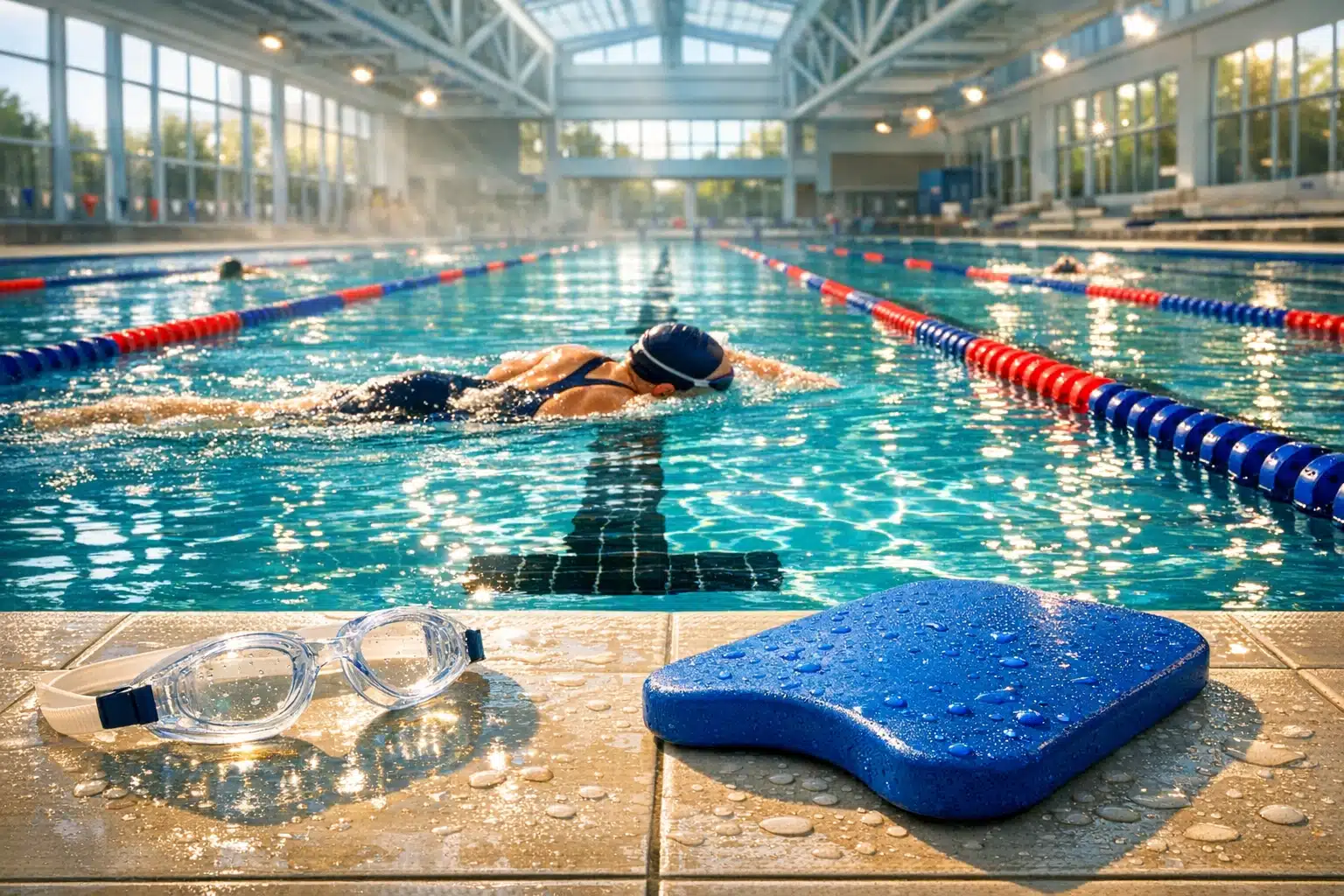
Explore the world of swimming
Swimming sits at a rare crossroads where survival skill, recreation, fitness, and sport all meet in the same body of water. It welcomes children learning their first float, adults rebuilding strength after injury, and athletes chasing fractions of a second in the lane beside them. Because water supports the body while still demanding coordination, breathing control, and endurance, swimming remains one of the most versatile activities available today.
Outline
- The broad value of swimming as a life skill, exercise, and global sport
- The four main strokes, how they differ, and why technique matters so much
- The physical and mental benefits of swimming, with practical training principles
- Safety, equipment, and the step-by-step process of becoming a confident swimmer
- How swimming fits into modern life through competition, community, aging, and inclusion
Why Swimming Matters: Skill, Sport, and Everyday Value
Swimming is one of the few physical activities that can be described as useful before it is ever described as competitive. A person may swim to cool off, to travel across water, to recover after an injury, to train for a race, or simply to feel lighter than the day outside the pool. That unusual range gives swimming a special place in human life. Unlike sports that depend on a field, a racket, or a team, swimming begins with a direct relationship between the body and the environment. The water does not care about age, profession, or previous medals; it asks only whether the swimmer can breathe calmly, balance well, and move with purpose.
Its relevance is practical as well as athletic. Learning to swim is widely recognized as an important safety skill, especially in places where beaches, rivers, lakes, or backyard pools are common. Drowning prevention programs around the world emphasize that basic water competence can reduce risk, particularly for children. At the same time, swimming has developed into a highly structured sport, from local lessons and school competitions to world championships and the Olympic Games. A standard Olympic pool measures 50 meters in length, yet the meaning of swimming is much larger than the lane line. For one person it is emergency preparedness; for another it is a daily ritual that clears the mind before work.
Swimming also stands out because it welcomes many levels of participation. A beginner can start with kicking drills, supported floating, and short lengths using a kickboard. A recreational swimmer may enjoy steady laps for general fitness. A skilled athlete might analyze stroke rate, split times, and turn efficiency with near-scientific precision. Few activities offer such a smooth ladder of progression. The pool can be a classroom, a gym, a playground, and on certain quiet mornings, a moving mirror.
Several factors explain why swimming continues to appeal across cultures and age groups:
- It develops a real-world survival skill alongside fitness.
- It can be adapted for beginners, older adults, and elite competitors.
- It offers both solitary focus and social participation.
- It places low impact on joints compared with many land-based activities.
- It can happen indoors or outdoors, in pools or open water, in lessons or races.
Compared with activities such as road running or contact sports, swimming usually involves less repeated impact on the ankles, knees, and hips. Compared with gym machines, it often feels more immersive and less mechanical. Compared with team games, it can be easier to schedule because one person can train effectively alone. This does not mean swimming is automatically simple. In fact, its challenge is part of its charm. Air is forgiving; water is exact. A small mistake in breathing or body position can slow a swimmer immediately, which is why skill development matters so much. That exactness makes swimming rewarding. Progress may come in small pieces, but each piece is tangible: a smoother exhale, a quieter entry, a less frantic kick, a turn that finally feels clean. Over time, those details add up to confidence, speed, and genuine enjoyment.
Understanding the Main Strokes and the Logic of Technique
Swimming often looks graceful from the deck, but that grace is built from dozens of technical decisions made in motion. Body position, timing, hand entry, kick rhythm, and breathing pattern all affect efficiency. This is why two swimmers can cover the same distance with very different levels of effort. In water, technique is not decoration; it is economy. Since water is far denser than air, poor alignment creates drag quickly, and drag behaves like an invisible brake. A swimmer who lifts the head too high, crosses the hands over the center line, or kicks wildly may feel as if the pool has become heavier. The opposite is also true. When posture, rotation, and breathing line up well, moving forward feels surprisingly smooth.
The four competitive strokes each solve the problem of moving through water in a different way. Freestyle, usually swum as front crawl, is generally the fastest and most efficient for long continuous swimming. The alternating arm action and flutter kick allow a steady rhythm, and side breathing helps many swimmers maintain a sustainable pace. Backstroke mirrors some front crawl principles but turns the swimmer face-up, making breathing easier while demanding strong balance and awareness. Breaststroke is often slower, yet it is popular because the stroke allows clear forward visibility and a gentler rhythm. Butterfly is the most physically demanding for many people, combining simultaneous arm recovery with a wave-like body action and a dolphin kick that requires timing, mobility, and power.
A useful comparison looks like this:
-
Freestyle: fastest for most swimmers, ideal for fitness laps and endurance sets.
-
Backstroke: good for posture awareness and shoulder control, with easy access to air.
-
Breaststroke: slower but approachable for many learners, especially when pacing is moderate.
-
Butterfly: powerful and dramatic, often used in shorter repeats because of its high demand.
Technique matters in every stroke, but the core ideas repeat. A streamlined body reduces resistance. A well-timed kick stabilizes the stroke rather than fighting it. Controlled exhalation prevents panic and reduces the urge to lift the head. Rotation in freestyle and backstroke allows stronger pulling mechanics and easier breathing. In breaststroke and butterfly, timing is everything; when the arms, legs, and breath drift out of sync, the stroke loses momentum fast.
Beginners often assume strength is the main key to swimming faster. In reality, skilled coaches usually start with balance, rhythm, and breath control. Consider a common example: a new swimmer may try to force speed by kicking harder in freestyle, only to become breathless within one length. A more technical approach would improve body line, teach a relaxed exhale underwater, and refine the catch phase so the hand and forearm press water backward rather than downward. That swimmer may then travel farther with less fatigue.
There is also a strong contrast between pool swimming and open-water swimming. In a pool, the environment is measured, walled, and predictable. In open water, sighting becomes important, conditions may change, and pacing requires judgment rather than reliance on the black line at the bottom. The skill set overlaps, yet the feeling differs. A pool asks for precision; a lake asks for composure. In both settings, technique acts like quiet engineering beneath the surface, turning effort into movement instead of noise.
Health Benefits, Training Principles, and Performance
Swimming is often praised as a full-body workout, and that description is accurate without being complete. The body does not merely move in water; it works against resistance in every direction. Arms pull, legs kick, the core stabilizes, and the respiratory system learns to coordinate breathing with motion. Because of that combination, swimming can improve cardiovascular fitness, muscular endurance, coordination, and mobility in a single session. Public health guidance from organizations such as the World Health Organization recommends that adults get at least 150 minutes of moderate-intensity aerobic activity per week, and swimming is one effective way to meet that goal.
One reason swimming remains attractive for fitness is its low-impact nature. Water supports part of the body’s weight, which can make exercise feel more manageable for people with joint discomfort, those returning after time away from training, or older adults who want movement without repeated pounding on hard surfaces. That does not mean swimming is easy. A slow, relaxed set may feel gentle, while a structured interval session can be extremely demanding. The difference lies in pace, stroke choice, rest intervals, and technical efficiency.
The benefits extend beyond the heart and muscles. Many swimmers describe a mental reset that comes from lap training. Repetitive movement, controlled breathing, and the filtered sound of water can create a meditative effect. The pool narrows attention in a productive way. There is no inbox at the bottom of the lane, only distance, timing, and the next breath. For people who find some forms of exercise overstimulating, swimming can provide a rare blend of effort and calm.
Training principles still matter. Random laps may feel good, but improvement usually follows structure. A balanced swim session often includes:
- A warm-up to raise body temperature and ease into rhythm
- Drills to improve one technical element, such as catch, kick timing, or rotation
- Main sets that target endurance, speed, or pacing
- Recovery swimming to reinforce relaxed movement
Performance also varies by stroke. Butterfly typically demands the most energy over short distances, while freestyle is the most common choice for continuous conditioning. Breaststroke may be easier to pace for some swimmers, although its timing can be technically tricky. Backstroke offers a distinct training stimulus because the body is supine and the shoulders move through a different pattern.
Compared with cycling or running, swimming often produces a lower perceived impact but a high technical requirement. Compared with strength training, it usually offers longer continuous aerobic work but less maximal loading. That is why many athletes use swimming as cross-training. Runners may use it during recovery weeks. Team-sport players may add it for conditioning without extra collisions. Triathletes depend on it as one of three core disciplines, yet even they know the water has its own rules. Fitness alone does not guarantee efficiency.
For readers considering swimming as exercise, the practical lesson is simple: consistency beats occasional heroics. Two or three sessions per week, even if modest, can build skill and stamina better than one exhausting effort followed by long gaps. Progress in swimming is often quieter than progress in the gym, but it is deeply measurable. You notice it when the warm-up feels easier, when your breathing stays calm after several lengths, or when a stroke that once felt chaotic begins to glide.
Safety, Equipment, and the Learning Curve
No article about swimming is complete without addressing safety, because competence in water is built on judgment as much as physical ability. People sometimes assume that being comfortable near water is the same as being safe in it. Those are not identical. A confident person can still misread fatigue, depth, current, temperature, or supervision needs. Good swimming habits begin with respect for the setting. A calm lap pool, a hotel pool, a surf beach, and a mountain lake are not interchangeable environments. Each has its own risks, and the body experiences them differently.
For beginners, formal instruction remains one of the most effective ways to learn. A qualified teacher can correct breathing problems early, build floating skills in a logical order, and reduce the fear that often appears when a face goes underwater for the first time. Lessons usually move through core milestones such as breath control, front and back floating, kicking with support, gliding, coordinated arm actions, and eventually independent lengths. That progression matters because rushed swimmers often develop tension-heavy habits that later become difficult to fix. In water, panic wastes energy quickly. Preparation saves it.
Basic equipment can help, although it should support learning rather than replace it. Common items include:
- Swimsuit designed for free movement and secure fit
- Goggles to improve vision and reduce eye irritation
- Swim cap for comfort, hygiene, or hair management
- Kickboard for leg drills and body-position practice
- Pull buoy for isolating upper-body work in training
- Fins for building feel for the water and ankle mobility, when used appropriately
Each tool has a purpose, but none is a shortcut to water competence. For example, fins can make a swimmer feel faster and more stable, yet they can also disguise body-position problems. A pull buoy may improve focus on the catch, but it can reduce attention to kicking and alignment if overused. Wise coaching treats equipment as a teaching aid, not a permanent crutch.
Safety becomes even more important in open water. Unlike pools, open-water settings may involve waves, currents, poor visibility, temperature changes, and uncertain footing. Even experienced swimmers often use brightly colored caps or tow floats to increase visibility. Swimming with a partner, checking local conditions, and entering the water gradually are sensible steps. Cold water deserves special respect because it can affect breathing and coordination far faster than people expect.
There is also a social dimension to safe swimming. Pool etiquette helps prevent collisions and frustration. Circle swimming rules, awareness at the wall, and honest lane choice all contribute to a better experience. Joining a lane that matches your pace is not a small courtesy; it protects flow and reduces risky overtaking.
The learning curve in swimming can feel humbling. Progress is rarely linear, and some breakthroughs come only after repeated practice of one subtle skill. Yet that is part of what makes success meaningful. The moment a beginner floats without gripping the wall, or completes a length with steady breathing, often feels bigger than the distance itself. It marks a change from resistance to cooperation. The water has not become easier; the swimmer has become wiser.
Swimming Beyond the Pool: Competition, Community, and Lifelong Practice
Swimming does not belong to a single age group or identity. It can be a child’s first organized sport, an adult’s return to movement, a para-athlete’s high-performance arena, a retiree’s preferred form of exercise, or a traveler’s favorite way to begin the day. This breadth gives swimming a cultural and social reach that extends beyond medals and lap times. In one lane you may find a teenager training for a meet; nearby, someone else is doing careful rehabilitation exercises after surgery. Both are legitimate swimmers, and both are making use of water in ways land-based activity may not offer.
Competitive swimming brings structure, measurable goals, and technical depth. Events range from explosive 50-meter sprints to grueling longer distances, and training may include pace sets, race-pace work, underwater skills, turns, starts, and strength preparation outside the pool. The sport rewards discipline because improvements are often measured in tenths or even hundredths of a second. That precision can be thrilling. A race may last under a minute, yet reflect months of training decisions. For some athletes, that clarity is addictive in the best sense: work, recover, refine, repeat.
Recreational swimming offers different rewards. It can be social without being chaotic, disciplined without being rigid, and restorative without being passive. Masters swimming groups, community center classes, and open-water clubs often create welcoming spaces for adults who want guidance but not necessarily competition. These groups also help with accountability. It is easier to skip a solo plan than a lane where friends expect to see you at dawn, goggles in hand, joking through the steam above the water.
Swimming is also significant because it supports lifelong participation. Many sports become difficult to continue with intensity as joints age or injuries accumulate. Swimming often remains accessible longer, especially when stroke choice, duration, and intensity are adjusted. Adaptive swimming programs further widen access for people with physical, sensory, or neurological differences. The sport’s inclusive potential is one of its strongest qualities. With the right instruction and facilities, many individuals who feel limited on land can discover freedom in water.
The setting itself shapes the experience. Pools offer predictability, coaching access, and clean measurement. Open water offers scenery, challenge, and a sense of adventure that can feel almost literary. A lake swim at sunrise does not resemble a timed interval session under fluorescent lights, yet both can be deeply satisfying. One is like writing with a ruler; the other feels closer to sketching in wind.
For modern readers balancing work, family, and health goals, swimming’s greatest strength may be its flexibility:
- It can serve performance goals, stress management, or general fitness.
- It suits solo routines and organized communities.
- It works for short sessions, long sessions, technical practice, or active recovery.
- It can remain meaningful across decades rather than only a brief athletic window.
That combination is rare. Swimming can be serious without becoming joyless, and enjoyable without becoming trivial. It asks for patience, then gives back capability.
Conclusion: A Practical Invitation to Get in the Water
For beginners, recreational swimmers, and athletes alike, swimming offers more than exercise; it builds confidence, body awareness, and a relationship with movement that can last for life. The key ideas are straightforward: learn sound technique, respect safety, train with patience, and choose goals that fit your stage rather than someone else’s highlight reel. Whether you want a survival skill, a low-impact workout, a competitive challenge, or a peaceful routine, swimming can meet that need with unusual depth. Start small if needed, stay consistent, and let skill grow one length at a time.