Explore the world of swimming
Swimming is one of the few activities that feels equally at home in a lesson, a workout, a race, or a quiet hour of recovery. It matters because it combines movement, breath control, safety skills, and low-impact conditioning in a single practice. Whether you want better fitness, more confidence in water, or a lifelong sport, swimming offers a practical path that rewards patience and curiosity.
1. Why Swimming Matters and How This Article Is Organized
Before getting into technique, training, and health, it helps to begin with a simple outline. This article moves through five connected ideas: the importance of swimming, the logic of the main strokes, the health and fitness effects of water-based exercise, the practical side of learning and training, and the role of safety and access. That structure matters because swimming is not just a sport with medals and lap times. It is also a life skill, a rehabilitation tool, a recreational habit, and for many people, one of the most approachable forms of exercise after injury or long periods of inactivity.
- Why swimming remains relevant across ages and goals
- How freestyle, backstroke, breaststroke, and butterfly compare
- What regular swimming can do for endurance, strength, and mental well-being
- How to build a useful routine with the right equipment and realistic expectations
- Why water safety, access, and confidence deserve as much attention as performance
Swimming occupies a special place among physical activities because the water changes the rules. On land, gravity dominates every step. In water, buoyancy reduces the load on joints, while resistance meets the body from many directions at once. That combination is rare. A person who finds running too harsh on the knees may still swim comfortably. Someone recovering from strain may use the pool for gradual movement long before returning to impact-based exercise. At the same time, elite swimmers can push their cardiovascular system to extreme levels, proving that gentler on the joints does not mean easier overall.
There is also a cultural reason swimming matters. Across the world, rivers, lakes, beaches, and public pools shape childhood memories, summer routines, school programs, and competitive pathways. A swim lesson can be a safety measure, a family tradition, or the first step toward sport. Competitive swimming, synchronized disciplines, triathlon, water polo, and open-water events all grow from the same basic human negotiation with water: learn how to move through it, and a new environment opens up.
In a practical sense, swimming is relevant because it serves multiple audiences at once. Beginners may want confidence and comfort. Fitness-minded readers may want efficient conditioning. Parents may care about water competence. Older adults may be looking for sustainable exercise. Athletes may want a training method that develops lungs, discipline, and body awareness. This article is written for that broad audience. The goal is not to treat swimming as mysterious or reserved for experts, but to explain why it remains one of the most useful and rewarding physical practices available.
2. Understanding the Main Strokes and the Mechanics of Movement in Water
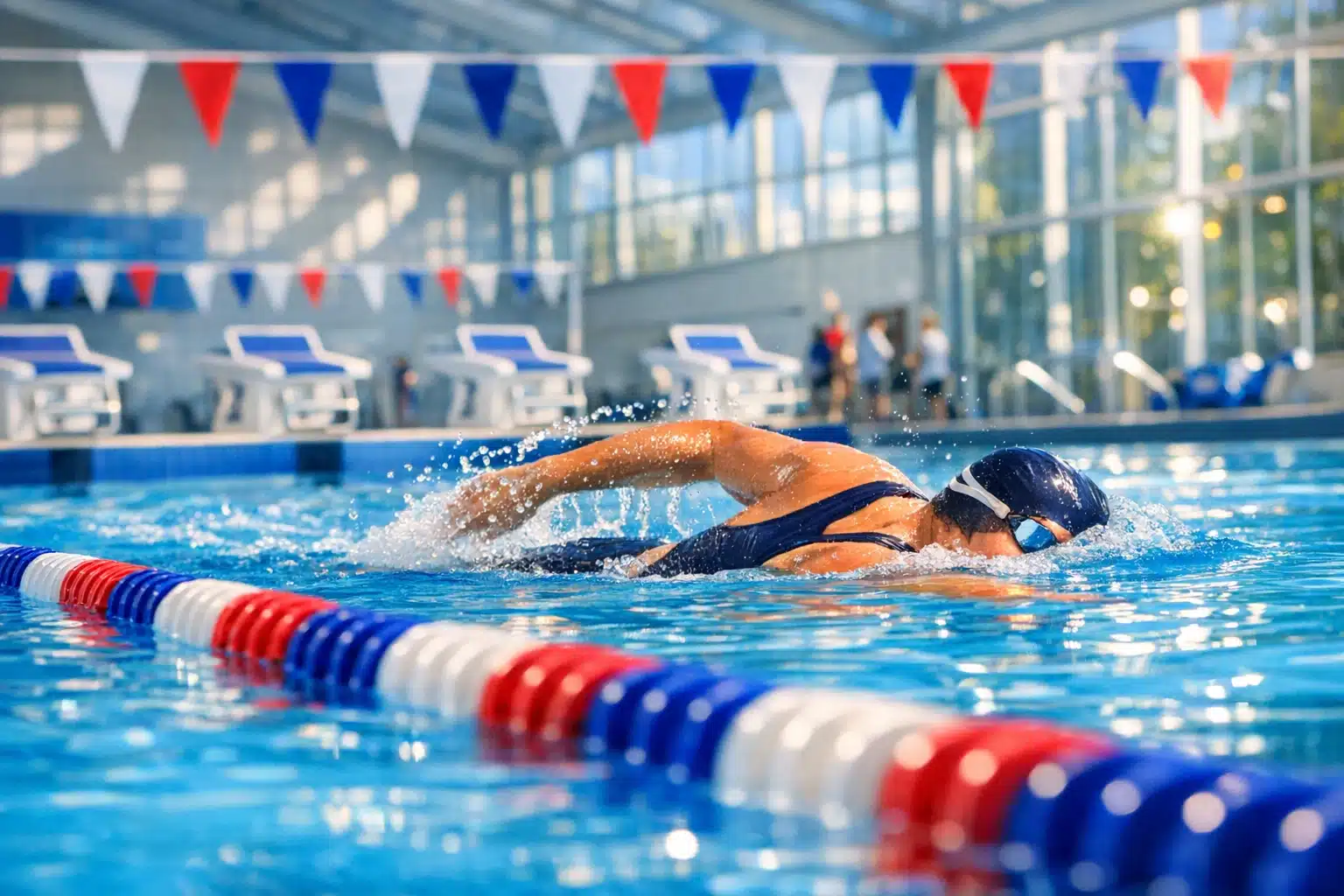
To understand swimming, it helps to see each stroke as a different conversation with the water. The four competitive strokesfreestyle, backstroke, breaststroke, and butterflyshare the same medium, yet they feel remarkably different because they distribute effort in different ways. Freestyle, often called front crawl in technical contexts, is usually the fastest and most efficient for covering distance. Its alternating arm action, flutter kick, and side breathing create a rhythm that can be sustained over long periods. For beginners, freestyle often becomes the default image of swimming, but good freestyle is more than windmilling arms. Body rotation, a stable head position, and relaxed exhalation underwater are what make it fluid rather than frantic.
Backstroke reverses the orientation while keeping an alternating pattern. Because the swimmer remains on the back, breathing is less constrained than in freestyle. That makes it feel freeing to some learners, though maintaining direction can be tricky when the ceiling replaces the lane line as a visual reference. Backstroke also highlights posture. If the hips sink, the stroke becomes inefficient quickly. In a well-executed backstroke, the swimmer appears to travel almost flat across the surface, with the kick acting like a steady engine rather than a splashy afterthought.
Breaststroke is different in both timing and mood. Its pull and kick happen in a more symmetrical cycle, often described as pull, breathe, kick, glide. It is usually slower than freestyle and backstroke, but it can feel intuitive because the breathing moment is built into the stroke. The frog-like kick, however, requires coordination and mobility that not every beginner finds easy. Butterfly is the most dramatic of the four. It uses a simultaneous arm recovery and a dolphin kick driven from the core. When performed well, it looks almost theatrical, like the body is rising and folding in waves. When performed poorly, it becomes exhausting within seconds.
A useful comparison is to think about efficiency versus power. Freestyle tends to reward economy. Breaststroke rewards timing. Backstroke rewards alignment. Butterfly rewards strength, rhythm, and technical precision. Across all strokes, propulsion depends on pressing against the water with control rather than brute force. Water is about 800 times denser than air, so sloppy movement is quickly punished. That is why skilled swimmers often look calmer than beginners even when they are moving faster. They reduce drag, hold a better line, and use the catch phase of the stroke to grip the water instead of merely slapping at it.
- Freestyle: generally the fastest, often the most practical for fitness and distance
- Backstroke: open breathing, useful for posture and shoulder balance when done correctly
- Breaststroke: slower but accessible to many learners, strongly dependent on timing
- Butterfly: powerful and demanding, excellent for advanced coordination and conditioning
The deeper lesson is that swimming is not simply about staying afloat and moving forward. It is about efficiency, timing, and feel. Land sports often forgive tension; water magnifies it. The swimmer who learns to streamline, breathe without panic, and coordinate motion with patience begins to understand why technique is the true language of the pool.
3. Health, Fitness, and Mental Benefits: What Swimming Does Beyond the Pool Deck
Swimming earns praise as a full-body exercise for good reason. It recruits large muscle groups, challenges the heart and lungs, and does so without the repeated pounding found in running or many court sports. Public health guidance commonly encourages adults to accumulate at least 150 minutes of moderate-intensity aerobic activity per week, and swimming can contribute meaningfully to that goal. Depending on pace and stroke, it can function as moderate exercise, vigorous conditioning, recovery work, or technique-centered movement. That flexibility is one reason it remains popular across age groups.
Physically, swimming builds endurance in a distinctive way. The cardiovascular system must adapt not only to sustained effort but also to controlled breathing patterns. Unlike walking or cycling, where breath can be adjusted freely from moment to moment, swimming often asks the body to work within a rhythm: exhale underwater, inhale quickly, resume effort. Over time, that can improve breathing efficiency and overall aerobic capacity. It also develops muscular endurance in the shoulders, back, core, hips, and legs. Even relaxed recreational swimming asks the body to stabilize against continuous resistance, because water pushes back on every movement, not just the obvious ones.
Another major advantage is its low-impact nature. Buoyancy reduces body weight loading, which can make the pool attractive for older adults, people with joint discomfort, and those returning to exercise after injury. This does not mean swimming is risk-free. Poor technique or too much volume can irritate shoulders, neck, or knees. Yet compared with high-impact training, it often offers a more forgiving route to regular activity. That is why pools are frequently used in rehabilitation settings and why aqua exercise classes remain common in community programs.
The mental side is just as important. Many swimmers describe the water as a place where noise softens. The face enters a quieter world, the breath falls into pattern, and attention narrows to stroke count, body line, and the next wall. That combination can reduce mental clutter. Some people experience it almost like moving meditation. Others enjoy the simple clarity of measurable progress: one more length without stopping, cleaner turns, smoother breathing, or a slightly faster pace over the same distance.
- Cardiovascular conditioning without repetitive impact
- Improved muscular endurance across the whole body
- Useful support for mobility, recovery, and gradual return to exercise
- Structured breathing that can encourage focus and stress reduction
Swimming also compares well with other activities in terms of longevity. A person may not want to sprint, jump, or tackle long runs deep into later adulthood, but many continue swimming comfortably for decades. That long horizon changes the value of the sport. It is not only about short-term fitness gains; it is about finding a form of movement that can remain available across different stages of life. For readers who want exercise that is demanding yet sustainable, swimming stands out as one of the clearest options.
4. Learning to Swim, Building a Routine, and Choosing Useful Equipment
One of the biggest misconceptions about swimming is that improvement depends mostly on toughness. In reality, progress usually comes from repetition, feedback, and calm consistency. For beginners, the first milestones are rarely speed-based. They involve floating, exhaling underwater, pushing off the wall, and learning how to remain composed when water touches the face. That last point matters more than many people expect. Confidence in water is not just physical ability; it is emotional steadiness. A learner who can pause, reset, and breathe calmly will progress much faster than someone who attacks every drill with tension.
A sensible routine starts small. Two or three sessions per week are enough for meaningful improvement if each session has a purpose. One day might focus on technique, another on easy endurance, and a third on drills plus short intervals. New swimmers often benefit from sets that alternate effort and rest rather than one long, exhausting swim. For example, several short lengths with recovery between them can teach form more effectively than struggling through a continuous distance with failing technique. Intermediate swimmers often add structure through pacing, kick sets, pull work, and stroke-specific drills.
Equipment should support skill rather than distract from it. A comfortable swimsuit, a well-fitted pair of goggles, and a swim cap for longer hair are the essentials. Beyond that, training tools can help when used deliberately. Kickboards isolate the legs, pull buoys reduce the kick so swimmers can focus on upper-body mechanics, and fins can improve body position while giving learners a clearer sense of propulsion. None of these tools replaces technique. They are best treated as temporary amplifiers of awareness.
- Beginners benefit most from short, focused practice sessions
- Good goggles are not a luxury; they reduce irritation and help concentration
- Drills work best when they have a specific purpose, not just as filler
- Rest intervals are part of training, especially when learning form
It is also useful to compare swimming progress with progress in other sports. In running, early gains often show up quickly in distance or pace. In swimming, improvement can feel slower because efficiency matters so much. A small change in head position or hand entry can transform how hard a length feels, even if the stopwatch barely moves at first. That can be frustrating, but it is also one of the sport’s most satisfying features. Gains compound quietly. The swimmer may not notice day by day, then one week realize that ten lengths now feel easier than four did a month earlier.
Coaching can accelerate this process because swimming hides errors beneath the surface. A friend may notice whether you are cycling faster or lifting more weight, but poor balance, dropped elbows, or mistimed breathing in the pool can go unseen without knowledgeable eyes. Even a few lessons can reshape progress. The key message for readers is simple: swim training works best when it is patient, structured, and technically aware. Effort matters, but direction matters more.
5. Safety, Access, Open Water, and the Broader Culture of Swimming
No discussion of swimming is complete without safety. Unlike many sports, swimming takes place in an environment that can shift rapidly from enjoyable to dangerous when skill, supervision, or judgment is missing. Pool safety begins with familiar basics: understanding depth, respecting lane rules, avoiding breath-holding contests, and recognizing fatigue before it becomes a problem. For children and inexperienced swimmers, supervision remains essential even in shallow water. Confidence should never be mistaken for competence. A person may feel comfortable splashing and playing yet still lack the breathing control, float recovery, or directional awareness needed in unexpected situations.
Open-water swimming introduces another level of complexity. Lakes, rivers, and the sea are often more beautiful than any pool, but they are less predictable. There may be currents, waves, changing temperatures, uneven visibility, boat traffic, and no wall to grab when the body suddenly needs reassurance. That is why open-water swimmers plan differently. They study conditions, use visible safety gear such as bright caps or tow floats, swim with partners when possible, and treat the weather as part of the workout rather than background scenery. The romance of open water is real, but so is the need for caution.
Access is another major issue. Not everyone grows up with reliable swim lessons, safe facilities, or a family culture that includes water confidence. In many communities, the barriers are practical: cost, transportation, pool availability, schedule limitations, or limited local instruction. In others, the barriers are historical and social. This matters because water competence is not only about sport participation; it is also about safety, inclusion, and public health. When communities invest in lessons, public pools, adaptive programming, and welcoming environments, swimming becomes more than an activity for the already confident. It becomes a shared resource.
- Learn emergency basics such as floating, treading water, and safe exits
- Respect fatigue, temperature, and conditions instead of trying to outmuscle them
- Treat open water as a separate discipline with its own rules
- Support access to lessons and inclusive facilities whenever possible
There is also a broader culture around swimming worth appreciating. Some people love the order of lane lines and interval sets. Others prefer the freedom of a lake at sunrise. Some chase records; others seek relief from stress or stiffness. The beauty of swimming is that it can contain all of these motives without losing its identity. It remains a technical sport, a practical skill, and a deeply personal experience. For many, the first moment of genuine ease in water feels memorable in an almost literary way: the panic recedes, the body lengthens, and the surface stops being an obstacle. It becomes a place you know how to inhabit.
That is why safety and access are not side notes. They are central to the meaning of swimming itself. A sport that can protect life, improve health, and create joy deserves to be taught well, supported widely, and approached with respect.
Conclusion for New, Returning, and Curious Swimmers
Swimming rewards readers who want more than a workout. It offers a rare blend of fitness, skill, resilience, and practicality, whether your goal is to learn basic water confidence, build endurance, or reconnect with movement in a low-impact way. The best starting point is not perfection but consistency: learn the fundamentals, respect safety, and let technique grow over time. If you stay with it, swimming can become less like a task and more like a language your body gradually learns to speak.