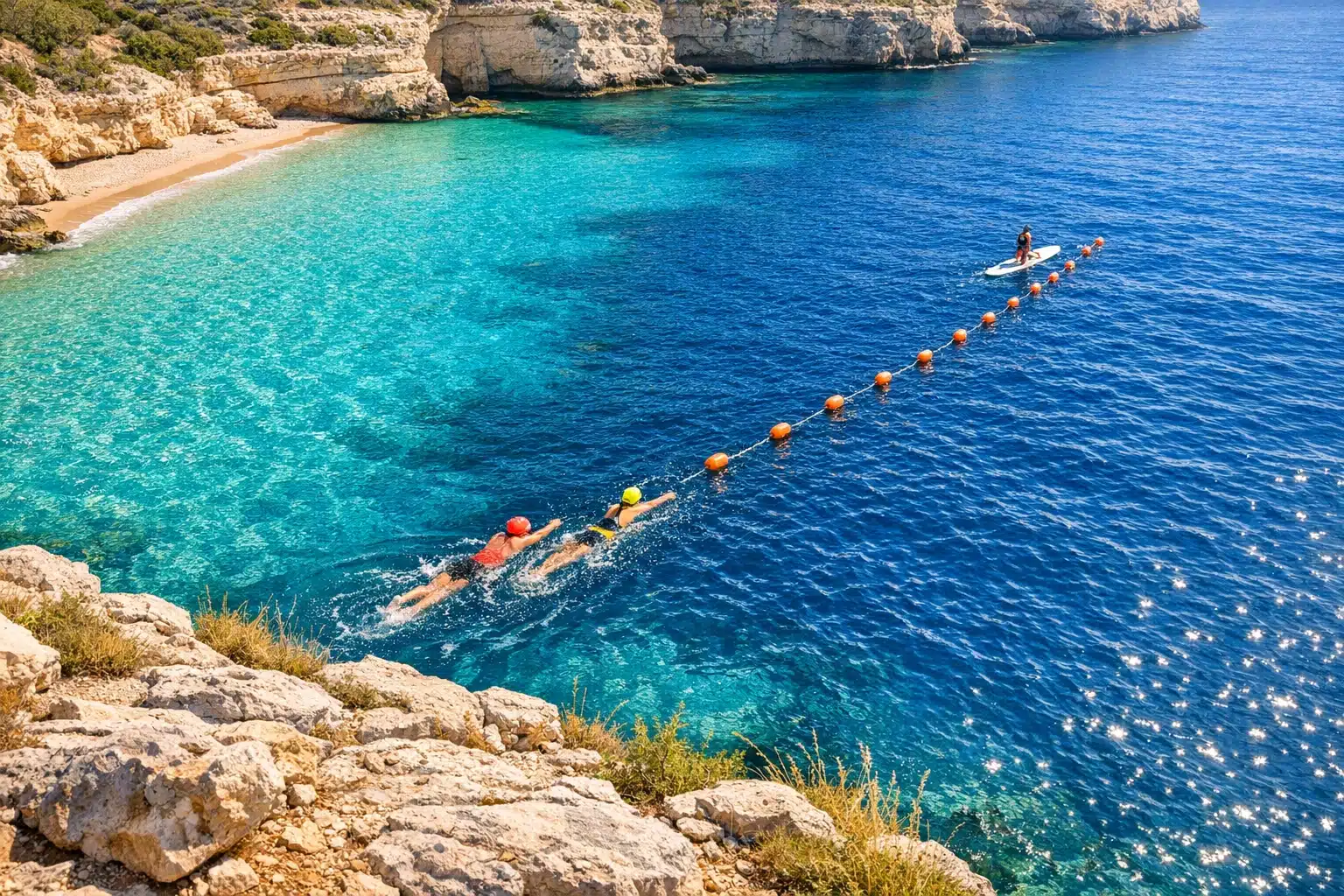
Explore the world of swimming
Swimming sits at a rare intersection of sport, survival, and simple enjoyment. A beginner can enter the water for calm movement, while an athlete can use the same lane to build speed, stamina, and discipline. Because it challenges the heart, lungs, muscles, and mind without the repeated impact common in many land sports, it attracts children, older adults, and everyone in between. This article explores technique, training, safety, and the lifelong value of becoming comfortable in the water.
Article outline:
- The value of swimming for health, confidence, and everyday life
- The main strokes and how they differ in rhythm, efficiency, and difficulty
- Training methods that improve technique, endurance, and enjoyment
- Safety principles, learning pathways, and access for different ages and abilities
- Swimming as a lifelong practice shaped by sport, community, and personal goals
Why Swimming Matters: Fitness, Confidence, and a Skill That Can Last a Lifetime
Swimming matters for reasons that go far beyond exercise. It is one of the few activities that combines recreation, athletic development, physical literacy, and personal safety in a single practice. A person may start swimming to cool off on a hot day, then discover that the water quietly teaches breath control, balance, patience, and self-awareness. That wide reach helps explain why swimming appears in school programs, rehabilitation plans, elite sport systems, and family holidays alike.
From a fitness perspective, swimming is often praised as a full-body workout, and that description is justified. Water is far denser than air, so every stroke asks muscles to push against meaningful resistance. At the same time, buoyancy supports the body and reduces the jarring impact felt in activities such as running on pavement. This combination is especially useful for people who want cardiovascular training but need a lower-impact environment for joints. Public health guidance commonly recommends at least 150 minutes of moderate aerobic activity per week for adults, and swimming can contribute directly to that target. Depending on pace, stroke, and body size, an hour in the pool can also use a substantial amount of energy, often in the range of several hundred calories.
Its value is not limited to numbers. Swimming teaches confidence in a setting that many people enjoy but do not fully control. Lakes, rivers, beaches, and pools may look friendly from the edge, yet water demands respect. Learning how to float, breathe calmly, and move efficiently can change the way a person approaches travel, family outings, and emergencies. In that sense, swimming is both a sport and a practical life skill.
There is also a mental dimension that regular swimmers describe with unusual consistency. The repetitive sound of splashing, the measured breathing, and the narrow focus of moving from one wall to the next can create a rhythm that feels almost meditative. The pool is rarely silent, but it often produces a kind of selective quiet: worries do not disappear, yet they lose their grip for a while.
- It strengthens the heart and lungs through steady aerobic work.
- It recruits major muscle groups in the arms, back, core, and legs.
- It offers a lower-impact option for many people with joint sensitivity.
- It builds water safety knowledge that can matter outside the pool.
That range of benefits is what makes swimming so relevant. It can be gentle without being trivial, demanding without being punishing, and useful whether a person wants fitness, confidence, competition, or simple pleasure.
Understanding the Strokes: Freestyle, Backstroke, Breaststroke, and Butterfly
To watch skilled swimmers from the stands is to see four different conversations with water. Each stroke has its own rhythm, logic, and personality. Freestyle, usually swum as front crawl, is the fastest and most commonly taught for fitness. Backstroke turns the body upward and makes breathing easier because the face remains out of the water. Breaststroke trades speed for timing and efficiency, using a pull-and-kick pattern that many recreational swimmers find intuitive at first, though technical mastery is harder than it looks. Butterfly is the most physically demanding of the four competitive strokes, requiring precise coordination, a strong core, and controlled power rather than sheer force.
Freestyle is often the gateway stroke because it is practical and versatile. Good freestyle depends on body position more than beginners expect. When the hips sink, drag increases, and every meter becomes harder. A streamlined line from head to heel helps the swimmer travel forward with less wasted effort. The arm stroke should not resemble frantic windmilling; the most effective swimmers extend, catch the water, and pull with purpose. Breathing also matters. Turning the head too high can disrupt balance, while exhaling steadily underwater makes the next inhale faster and calmer.
Backstroke shares some structural ideas with freestyle, especially rotation through the torso, but the experience feels very different. Because the swimmer faces upward, many learners relax more quickly, yet navigation becomes a challenge. Staying straight in the lane requires spatial awareness and practice. Backstroke can be excellent for developing shoulder control and body alignment, though proper technique is essential to avoid strain.
Breaststroke is unique among the four because the kick supplies a large share of propulsion. The sequence must be timed carefully: pull, breathe, kick, glide. If these elements overlap at the wrong moment, the stroke turns choppy and exhausting. When coordinated well, breaststroke looks almost economical, like a small machine with few moving parts and very little drama.
Butterfly is where swimming reveals its uncompromising side. Two arm recoveries, two dolphin kicks, and one brief window for breath must fit together in a repeating wave. It is spectacular when done well and punishing when done poorly. Still, even learning basic butterfly drills can improve body awareness and power.
- Freestyle is generally the fastest and most efficient for long training sets.
- Backstroke allows easier breathing but requires strong alignment and orientation.
- Breaststroke rewards timing and can feel sustainable at moderate pace.
- Butterfly develops power and rhythm, though it demands the most coordination.
Knowing the differences between the strokes helps swimmers choose the right tool for the right goal. Speed, comfort, endurance, rehabilitation, and technical challenge each point toward a different answer.
How to Train for Swimming: Technique, Endurance, and Smarter Practice
Many people assume improvement in swimming comes mainly from swimming farther. Distance certainly has value, but smart training is more layered than that. Progress usually depends on three factors working together: technical efficiency, aerobic conditioning, and consistency. If one of those pieces is missing, performance tends to stall. A swimmer with strong fitness but poor form wastes energy. A technically polished swimmer who trains irregularly lacks endurance. Someone who attends every session but never changes intensity or structure often stops improving after the early gains.
Technique should come first, especially for beginners and returning swimmers. In the water, small errors become expensive very quickly. A dropped elbow in freestyle, a rushed breath in breaststroke, or an unstable core in backstroke can turn a manageable set into a tiring struggle. Drills help isolate those problems. Kick sets improve leg control, single-arm work highlights imbalance, and sculling teaches how the hands actually hold water rather than merely slap at it. This is why coaches often say that swimming is not only about working hard; it is about learning to move cleanly.
A balanced session usually includes a warm-up, skill work, a main set, and a cool-down. That structure helps both performance and safety.
- Warm-up: easy laps that raise body temperature and loosen the shoulders
- Drills: short repeats focused on breathing, alignment, or catch mechanics
- Main set: intervals designed for endurance, speed, or pace control
- Cool-down: relaxed swimming that lowers effort gradually
For a beginner, a session might include 200 to 400 meters of easy swimming, several short drill repeats, and a main set of manageable intervals such as 8 x 50 meters with rest between efforts. An intermediate swimmer may work through longer aerobic blocks, for example 5 x 200 meters at a steady pace, followed by shorter faster repeats to sharpen technique under fatigue. Competitive athletes add specialized work, including race-pace sets, turns, starts, and stroke-specific conditioning.
Equipment can support training when used thoughtfully. Kickboards are useful for isolating the legs, though overuse can place the body in an awkward position. Pull buoys reduce the kicking load and help highlight upper-body mechanics. Fins can improve ankle flexibility and speed through drills, while paddles increase resistance and demand careful shoulder awareness. None of these tools replaces sound basics.
Tracking effort matters as well. Swimmers often use a pace clock, a watch, or simple set notes to monitor rest intervals and repeat times. Improvement may show up as faster splits, steadier breathing, fewer strokes per length, or the ability to finish sets with better control. That last point is important. Good training is not only about being tired; it is about becoming more capable. The strongest swimmers make the water look less like an obstacle and more like a surface they have learned to negotiate intelligently.
Safety, Access, and Learning to Swim at Any Age
Swimming can be joyful, but it should never be casual about risk. Water changes conditions quickly, and the line between comfort and difficulty can be thinner than people expect. For that reason, safety is not a side topic within swimming; it is part of the foundation. Formal instruction, supervised environments, and realistic self-assessment are all central to becoming a confident swimmer. This matters in pools, and it matters even more in open water, where currents, temperature, visibility, waves, and distance from help create extra layers of complexity.
Global health organizations have long identified drowning as a major public health concern, with hundreds of thousands of deaths occurring worldwide each year. That fact gives swimming lessons a significance beyond sport. Learning how to float, tread water, roll onto the back, and breathe calmly can improve survival odds in emergencies. For children, close supervision remains essential even after lessons begin. For adults, the biggest danger is often overestimating ability, especially in unfamiliar natural settings.
Basic pool safety habits are simple, but they matter because simple habits prevent common mistakes.
- Never swim alone in unsupervised conditions.
- Read depth markers and respect posted rules.
- Enter unknown water carefully instead of diving impulsively.
- Use bright caps or visibility gear in open water.
- Stop early if cold, fatigue, cramps, or dizziness appear.
Access is another important issue. Not everyone grows up with regular exposure to pools, lessons, or coastal environments. Cost, transportation, cultural barriers, disability access, and lack of nearby facilities can all limit participation. Good swim programs respond to these realities by offering beginner classes for different age groups, adaptive instruction, family education, and clear pathways from first lessons to independent practice. Swimming should not be treated as a talent reserved for the lucky; it is a learnable skill, and communities benefit when more people can learn it safely.
Adults who start late often carry embarrassment into the water, which is unfortunate because adult learning can be highly effective. Mature beginners tend to understand instructions well and can make rapid progress once fear is addressed. The first victories may seem small from the deck: putting the face in the water, floating without panic, completing one width without stopping. In truth, those steps are major thresholds. Confidence in water is built the way strong walls are built, one stable layer at a time.
Inclusive swimming also means recognizing different bodies and needs. Older adults may prefer warmer pools and gentler entry points. People recovering from injury may need modified drills. Adaptive aquatics programs can help swimmers with physical, sensory, or cognitive differences participate fully. When facilities, instructors, and families treat access as a design priority rather than an afterthought, swimming becomes broader, safer, and far more representative of the people it is meant to serve.
Swimming Beyond the Pool: Competition, Community, Recovery, and Lifelong Practice
Swimming has a public face shaped by competition, but its deeper value often appears in ordinary routines. Elite races draw attention because they are measurable, dramatic, and visually clear: start, split, turn, finish. Yet most swimmers meet the sport in quieter ways. A masters group gathers before sunrise. A parent takes slow evening laps after work. A triathlete uses the pool to prepare for open water. A retiree swims for joint comfort and social connection. The same body of water can host ambition, recovery, discipline, and relief in adjacent lanes.
Competitive swimming offers useful lessons even for people who never intend to race. It highlights pacing, technical precision, and the importance of marginal gains. A better streamline off the wall, a cleaner turn, or a more controlled breathing pattern can save more energy than brute effort alone. That is one reason swimming remains fascinating to coaches and athletes: performance depends on details. Water gives immediate feedback and little forgiveness. It magnifies inefficiency the way bright daylight exposes dust on glass.
Outside formal racing, swimming is widely used as cross-training. Runners, cyclists, and field-sport athletes often turn to the pool for aerobic work that places less repetitive stress on the body. Rehabilitation professionals also use aquatic environments because buoyancy can reduce loading while allowing controlled movement. This does not make swimming a miracle cure, nor does it fit every condition equally, but it can be a valuable part of a broader training or recovery plan when guided appropriately.
The social side deserves attention too. Swim clubs, local pools, school teams, and community centers create networks that matter. People return not only for exercise but for structure, accountability, and belonging. A lane partner who nods hello every Tuesday can become part of a person’s routine in a meaningful way. In that sense, swimming is an individual activity carried out in a shared environment, which gives it a distinctive balance of solitude and companionship.
For readers thinking about starting, returning, or becoming more serious, the path forward does not need to be dramatic. It can be practical.
- Begin with lessons or technique feedback if the basics feel uncertain.
- Choose a schedule that is realistic enough to sustain for several months.
- Use simple goals, such as smoother breathing or one extra continuous lap.
- Respect safety rules before chasing speed or distance.
Conclusion for New and Returning Swimmers
Swimming rewards patience more reliably than bravado. If you are new, start with comfort, breath, and trust in the water. If you are returning after years away, focus on rhythm before performance and let consistency rebuild what memory alone cannot. The beauty of swimming is that it remains useful at nearly every stage of life: as exercise, as skill, as recreation, and as a way to feel capable in an element that asks for calm attention. The next good session does not require perfect technique or elite fitness; it only requires a safe start, a little curiosity, and the willingness to keep moving forward one length at a time.