Explore the world of swimming
Swimming sits at a rare crossroads: it is a sport, a practical life skill, and a form of exercise that welcomes many ages and abilities. In one lane, people chase medals and split times; in another, someone is simply learning to float with confidence for the first time. Water changes the body’s relationship with gravity, effort, and fear, which makes swimming both demanding and strangely calming. That mix gives the subject lasting relevance, whether your goal is fitness, safety, competition, or quiet enjoyment.
Outline:
• Swimming as a human skill, sport, and survival education
• Physical and mental benefits of regular time in the water
• The main strokes, technique basics, and how they compare
• Safety, equipment, and sensible ways to learn
• Why swimming can become a lifelong practice for beginners, families, and athletes
Swimming as a Human Skill, Sport, and Survival Tool
Swimming matters because it reaches far beyond the pool deck. It is one of the few physical activities that can be framed in three equally important ways: a life-saving skill, a competitive discipline, and a form of recreation. Ancient cultures used swimming for transport, fishing, and military training long before it became an organized sport. Modern racing, with standardized strokes and timed events, took shape in the nineteenth century, yet the basic human challenge has not changed much at all: how to move through water with efficiency, calm, and control.
What makes swimming different from many land-based activities is the environment itself. Water is supportive, but it is never passive. It reduces impact on joints while constantly resisting movement, which means every action asks for coordination. A beginner often discovers this quickly. Kicking harder does not always create speed, and holding tension usually makes the body sink or fight the water. Good swimming is less like brute force and more like a conversation with physics. The better your timing, body position, and breathing, the smoother the conversation becomes.
Swimming also carries a public safety dimension that is easy to overlook when the focus is only on fitness. Drowning remains a major global public health concern, which is why swim lessons are not merely extracurricular; in many communities, they are a meaningful protective skill. Knowing how to float, tread water, and reach safety can matter just as much as knowing how to complete laps. For children, older adults, and people living near lakes, rivers, or coastlines, water competence is practical knowledge with real-world value.
Its range of uses is unusually broad:
• for children, it builds confidence and basic safety habits
• for adults, it can be exercise with less joint stress than high-impact sports
• for athletes, it offers technical challenge and measurable progression
• for families, it creates a shared activity that can be both playful and disciplined
That breadth explains why swimming attracts such different people. One person wants rehabilitation after injury, another wants a new hobby, and someone else is counting strokes before sunrise training. The same body of water can host all of them. A pool lane may look simple from a distance, but inside it live stories of effort, caution, courage, and improvement. Swimming is not just about crossing from one wall to another; it is about learning how to trust yourself in a place where solid ground disappears.
The Physical and Mental Benefits of Regular Swimming
Swimming earns its reputation as a full-body workout because it combines aerobic effort, muscular endurance, breath control, and coordination in one activity. The arms pull, the legs drive, the core stabilizes, and the lungs work in a deliberate rhythm. Unlike many exercises that isolate a few muscle groups, swimming asks the body to move as a connected system. Even an easy session can train posture, timing, and balance in ways that are hard to replicate on land.
One of its strongest advantages is low impact. Because buoyancy reduces how much body weight the joints must bear, many people who find running uncomfortable can still train effectively in the water. This does not mean swimming is easy; it means the stress is distributed differently. The shoulders, back, hips, and core still work hard, but the pounding that often comes with repetitive land exercise is largely absent. That makes swimming appealing for older adults, people managing certain injuries, or anyone wanting variety in a weekly routine.
From a cardiovascular perspective, lap swimming can contribute meaningfully to widely accepted exercise targets, such as the common recommendation of at least 150 minutes of moderate aerobic activity per week for adults. Intensity varies a great deal by stroke, pace, and fitness level. A relaxed backstroke set feels very different from fast butterfly repeats, and a short recovery swim is not the same as a hard interval session. Calorie use also depends on body size and effort, so it is better to think in terms of training quality rather than chasing a single number on a chart.
The mental benefits deserve equal attention. Many swimmers describe the sport as structured relief. The repetitive sound of breathing, the visual simplicity of the lane line, and the absence of constant phone notifications create a rare pocket of focus. Water can quiet mental clutter without demanding stillness. That matters in a world where attention is frequently pulled in ten directions at once.
Some of the most practical benefits include:
• cardiovascular conditioning without impact-heavy foot strikes
• muscular endurance developed through continuous resistance
• improved breathing control and body awareness
• a calming routine that can support stress management
Compared with gym circuits or road running, swimming often feels less visible and more internal. There is no clatter of equipment and no scenery racing past. Progress arrives through smoother technique, steadier pacing, and the satisfying moment when a distance that once seemed intimidating becomes manageable. In that sense, swimming can be quietly rewarding. It teaches the body to work, but it also teaches the mind to settle, adapt, and keep moving when the water pushes back.
Understanding the Main Strokes and the Basics of Technique
The four competitive strokes, freestyle, backstroke, breaststroke, and butterfly, each create a distinct relationship between speed, rhythm, and effort. Freestyle, usually swum as front crawl, is the fastest and most common stroke for fitness swimmers. Its alternating arm action and flutter kick allow continuous forward motion, and once the timing clicks, it often becomes the most efficient way to cover distance. The challenge for beginners is breathing. Many people lift the head too high, which disrupts body position and makes the legs sink. The better habit is to rotate with the body and take air to the side with minimal lift.
Backstroke shares some mechanical ideas with freestyle, especially long body alignment and a steady kick, but the face stays above water. That can make breathing easier, although swimming straight becomes harder because the swimmer cannot see where they are going without visual cues from the ceiling or lane markers. Backstroke is often a useful teaching stroke because it helps people feel a long spine and open chest, yet it also exposes weaknesses in balance. If the hips drop, progress slows immediately.
Breaststroke is slower than freestyle but popular because the breathing pattern feels more intuitive to many newcomers. The stroke uses a pull, breath, kick, and glide sequence, and timing matters more than raw power. When the kick is mistimed or too wide, momentum leaks away. Done well, breaststroke feels almost like punctuation in water: gather, press, glide, repeat. Butterfly, by contrast, is the most explosive and technically demanding of the four. It uses simultaneous arm recovery and a dolphin kick, requiring strength, flexibility, and precise wave-like timing through the torso. For spectators it looks dramatic; for swimmers it is honest work.
Across all strokes, a few fundamentals apply:
• body position should stay long and balanced
• breathing should support rhythm rather than interrupt it
• propulsion works best when technique is efficient, not rushed
• relaxation matters, because excess tension creates drag
Technique is often the dividing line between effort and output. Two swimmers can work equally hard, yet the one with better alignment and timing will travel farther per stroke. That is why drills matter. Kicking drills improve body position, sculling builds feel for the water, and pull sets help swimmers notice how the catch phase generates movement. Good coaching often returns to simple questions: Are you streamlined? Are you breathing calmly? Are your movements connected? In swimming, small corrections can produce large gains. The water notices everything, and that is exactly why the sport remains so fascinating.
Safety, Equipment, and the Smart Way to Learn
For all its beauty, water demands respect. Safe swimming starts before anyone pushes off the wall. A suitable environment, basic supervision, awareness of depth, and honest self-assessment matter more than confidence alone. In a pool, hazards are relatively controlled, but that does not eliminate risk. Slippery decks, fatigue, poor lane awareness, and overestimating ability can still lead to accidents. In open water, the list grows: currents, waves, sudden temperature shifts, limited visibility, and changing weather make oceans, lakes, and rivers far less predictable than a marked lane.
Learning safely is usually a staged process rather than a single leap into deeper water. Most strong programs begin with comfort and orientation: blowing bubbles, submerging the face, floating on front and back, and learning to recover balance. Only after those basics feel dependable does propulsion become the main task. This order matters. A person who can kick but cannot relax while breathing is not yet truly comfortable in the water. Confidence built too quickly can be shaky; confidence built through repetition tends to last.
Equipment can help, but it should support skill rather than replace it. Goggles improve visibility and reduce irritation, which makes practice easier. Caps keep hair contained and reduce drag slightly, although they are more about practicality than major speed gains for casual swimmers. Kickboards, pull buoys, fins, and paddles each have training uses, but they work best when chosen for a reason. Fins can help a learner experience body position and propulsion, while paddles can strengthen the pull for advanced swimmers who already understand stroke mechanics. Used carelessly, gear can hide problems instead of fixing them.
Practical safety habits include:
• swim where lifeguards or knowledgeable adults are present when possible
• never assume shallow-looking water is safe for diving
• respect signs, lane rules, and local conditions
• build distance gradually instead of testing limits too early
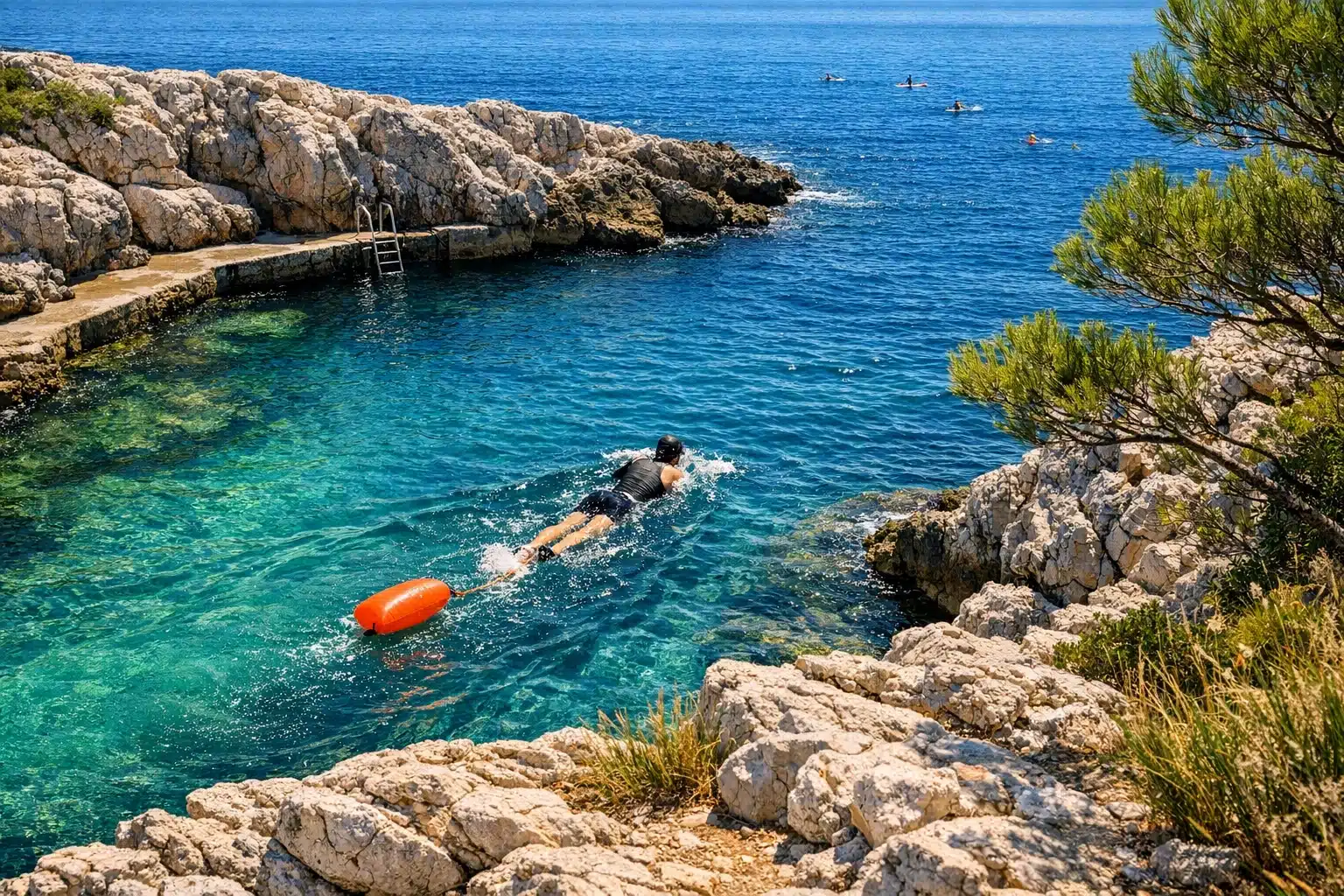
• use bright caps and, in open water, visible safety buoys when appropriate
There is also a social side to safe swimming. Pool etiquette, such as choosing the correct lane speed, resting at the wall corners, and passing responsibly, keeps sessions smoother for everyone. For children, lessons should combine structure with reassurance. For adults who feel embarrassed about starting late, the best message is simple: plenty of skilled swimmers began well after childhood. Water does not care when you start. It cares whether you learn patiently, practice attentively, and respect the environment you are entering.
Conclusion: Making Swimming Part of Your Life
If you are the kind of reader who wants an activity to do more than burn calories, swimming deserves serious consideration. It can improve fitness, teach a practical safety skill, and offer a rare combination of focus and freedom. For beginners, the first goal does not need to be speed. It can be something much more meaningful: comfort in the water, a calm exhale, a reliable float, or the first uninterrupted length of the pool. Those milestones may look modest from the bleachers, yet they often change how a person sees both exercise and personal capability.
For parents, swimming has another layer of value. It introduces children to discipline without removing the element of play. Games in shallow water can build confidence, while structured lessons develop habits that may one day protect them in an emergency. For adults with demanding schedules, swimming can become a compact reset button. A thirty-minute session before work or after a long day often delivers more than physical movement; it creates a small stretch of time in which the mind has room to breathe.
For athletes, the sport offers endless refinement. There is always a cleaner turn, a better catch, a steadier pace, or a smarter training cycle. For older swimmers, the appeal often shifts from competition to continuity. Water remains a place where movement can stay available even when certain land activities become less comfortable. That long-term accessibility is one of swimming’s quiet strengths. It adapts to ambition, age, and circumstance without losing its essential challenge.
If you are wondering how to begin, keep the approach simple:
• choose a safe pool or supervised venue
• start with lessons or basic guidance if you need them
• set one clear, realistic goal for the first month
• focus on consistency before intensity
• let technique improve step by step instead of chasing instant performance
Swimming does not ask for perfection at the start. It asks for patience, repetition, and a willingness to learn in an environment that feels unfamiliar until, gradually, it does not. That is why so many people stay with it. What begins as a lesson can become a habit, then a source of strength, then a part of identity. Whether you want exercise, confidence, competition, or simple enjoyment, the water offers a place to begin, and often a reason to come back.