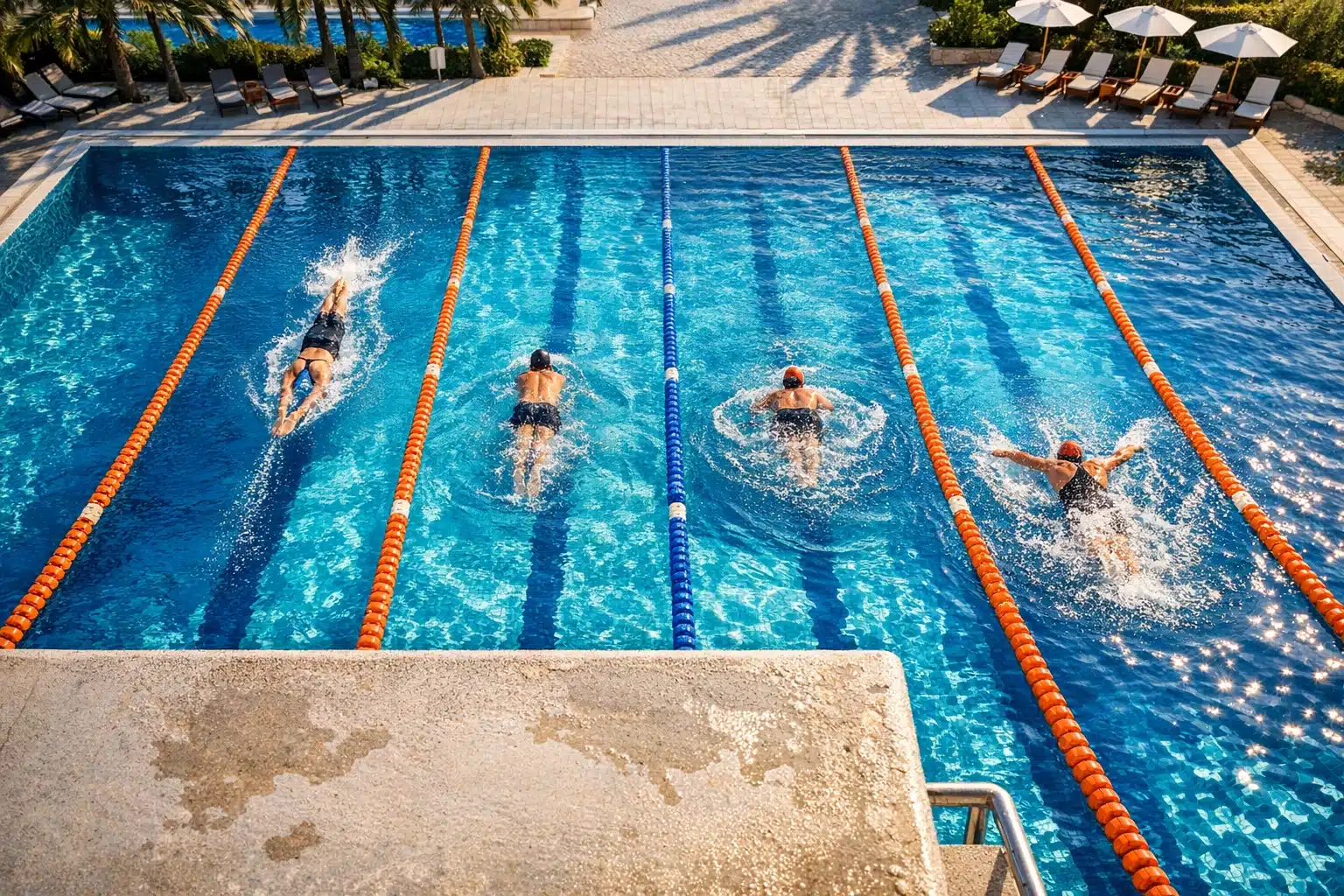
Explore the world of swimming
Swimming asks the body to work hard while letting the mind settle, which is one reason it has remained popular from school lessons to elite sport. It teaches survival skills, supports cardiovascular fitness, and offers a gentler option for people who dislike the pounding of land-based exercise. Whether you are watching races, learning your first stroke, or returning to the pool after years away, understanding how swimming works makes every length more meaningful.
Outline:
- The value of swimming for health, confidence, and everyday life
- The major strokes and the ways they differ in speed, rhythm, and difficulty
- Training principles that help swimmers improve efficiently
- Safety, equipment, and the contrast between pool and open-water swimming
- How to build a lasting swimming habit and enjoy the sport over time
Why Swimming Matters: Health, Confidence, and Practical Value
Swimming holds a rare place in sport because it is both a life skill and a form of exercise. A person may step into the water for fitness, fun, rehabilitation, competition, or simple curiosity, yet the activity rewards each of those motives differently. Unlike many land-based exercises, swimming combines buoyancy and resistance at the same time. Water supports body weight, which can reduce impact on joints, while still making muscles work through continuous resistance. Because water is around 800 times denser than air, even a modest session can become a serious whole-body workout without the noisy, repetitive impact of running on pavement.
From a health perspective, swimming can contribute meaningfully to the general recommendation of at least 150 minutes of moderate aerobic activity per week for adults. The pace matters, of course, but even steady recreational laps can raise heart rate, improve breathing efficiency, and build muscular endurance. Many swimmers also appreciate the balanced nature of the effort. Arms pull, legs kick, the core stabilizes, and breathing becomes part of the technique rather than something taken for granted. For that reason, swimming often feels more integrated than activities that emphasize only one major movement pattern.
- It can improve cardiovascular endurance without heavy impact on knees and ankles.
- It develops coordination because breathing, kicking, and arm timing must work together.
- It offers practical safety benefits by increasing comfort and competence in water.
- It can suit a wide age range, from children in lessons to older adults seeking steady movement.
Swimming also compares favorably with other forms of exercise in terms of accessibility of intensity. A short, easy set with frequent rests can suit a novice, while interval training, sprint work, and long endurance sessions can challenge advanced athletes. In one lane you may find someone recovering general fitness; in another, a triathlete counting split times to the second. That broad spectrum helps explain the sport’s lasting appeal. It is not locked to one identity.
There is another dimension that numbers alone do not capture: confidence. Learning to float, breathe calmly, and move with purpose in water changes how people relate to beaches, pools, lakes, and even travel. The water stops feeling like a barrier and starts feeling like a place you can understand. For parents, that confidence has obvious safety value. For adults, it can open a door that seemed closed for years. Swimming is exercise, yes, but it is also a quiet form of self-reliance, earned one lap at a time.
Understanding the Main Strokes and How They Compare
To watch skilled swimmers is to see four different answers to the same question: how do you move efficiently through water? The main competitive strokes are freestyle, backstroke, breaststroke, and butterfly, and each one teaches a different relationship between rhythm, balance, and power. Freestyle, often swum as front crawl, is usually the fastest and most widely practiced. Its alternating arm action, flutter kick, and side breathing pattern make it efficient for distance, fitness swimming, and racing. Because the body remains relatively streamlined, freestyle is often the first stroke adult beginners learn for lap swimming, even though breathing technique can initially feel awkward.
Backstroke turns the swimmer upward, changing not only orientation but also confidence. Many beginners like the fact that the face stays out of the water, which removes some anxiety around breathing. At the same time, the stroke demands body awareness because swimmers cannot see where they are going without special lane markers or careful counting. Good backstroke relies on hip rotation, a steady flutter kick, and a clean hand entry. Compared with freestyle, it is often slightly slower, but it can feel smoother for swimmers who enjoy a more open chest position.
Breaststroke is different again. Instead of constant alternation, it uses a simultaneous arm pull and frog-like kick, followed by a glide. Its rhythm is distinct: pull, breathe, kick, glide. That pause makes the stroke look calmer, yet breaststroke is technically demanding. Timing errors are obvious, and the kick requires flexibility and precision. Recreational swimmers often find it comfortable at easy speeds because the head rises naturally for breathing, but in competition it becomes a highly specialized stroke where small improvements in timing can make a large difference.
Butterfly is the dramatic one, the stroke that seems to roll forward on waves of force. Both arms recover together over the water while the legs perform a dolphin kick. It is beautiful when done well and brutally honest when done poorly. Butterfly asks for strong core control, shoulder mobility, and efficient undulation. It is usually the most physically demanding of the four strokes, which is why beginners tend to encounter it later.
-
Freestyle: fastest, efficient, excellent for fitness and distance.
-
Backstroke: face-up position, useful for posture awareness and steady breathing.
-
Breaststroke: rhythmic and technical, often popular recreationally.
-
Butterfly: powerful, advanced, and energy intensive.
These strokes also interact in the individual medley, where swimmers race all four in sequence. That format reveals an important truth: no stroke exists in isolation. Skills learned in one stroke can support another. Freestyle teaches alignment, backstroke improves rotation awareness, breaststroke sharpens timing, and butterfly strengthens body rhythm. If swimming were a language, these strokes would be its dialects—distinct voices, related grammar, and endless room for refinement.
Training Principles: Technique, Endurance, and Smart Progression
One of the biggest misunderstandings about swimming is the idea that improvement comes mainly from trying harder. Effort matters, but technique matters first. A cyclist can still move forward with clumsy form, and a runner can sometimes muscle through bad mechanics for a while. Water is less forgiving. Poor body position creates drag, mistimed breathing disrupts rhythm, and rushed strokes waste energy quickly. That is why many swimmers, especially beginners, improve faster by becoming more efficient rather than simply more determined. In practical terms, a smoother swimmer often beats a stronger one over longer distances because less energy leaks away with every stroke.
Training usually begins with the fundamentals: floating, balance, kicking control, streamlined body line, and relaxed breathing. From there, drills help isolate specific skills. A kickboard can focus attention on the legs, though overreliance on boards may hide body-position issues. Side-kicking drills can improve balance. Single-arm freestyle drills can highlight catch mechanics. Pull buoys can reduce leg involvement temporarily so a swimmer can feel how the upper body moves through the water. The best sessions alternate between skill work and whole-stroke swimming so technique transfers into real movement rather than remaining a collection of disconnected exercises.
Endurance comes next, but it should be built in layers. Swimming 25 meters with clean form is not the same as swimming 400 meters while hanging onto control. Structured sets help bridge that gap. For example, a new swimmer might complete repeated short lengths with generous rest, while an experienced lap swimmer may use intervals that challenge pace discipline. A useful progression looks like this:
-
Start with short repeats, such as 8 x 25 meters, focusing on relaxed breathing.
-
Move to moderate repeats, such as 6 x 50 meters, with consistent rest periods.
-
Add longer efforts, such as 4 x 100 meters, once technique remains steady under fatigue.
-
Introduce occasional faster sets to build speed without turning every workout into a sprint.
Training frequency matters as much as session length. Two shorter practices per week often produce better technical retention than one marathon workout followed by six dry days. Many recreational swimmers make visible progress with two to three sessions weekly, especially if one session emphasizes drills, another endurance, and a third mixed pacing. Recovery also deserves respect. Shoulders, neck, and calves can tighten when workload rises too quickly, so mobility work and gradual volume increases are wise.
Perhaps the most encouraging fact for newcomers is that swimming improvement is rarely linear. Some days the water feels silky and generous; other days it feels like you are negotiating with a stubborn river. That is normal. Progress often appears as reduced effort at familiar distances, steadier breathing, and better control under fatigue long before it appears as dramatic speed. Smart training treats those signs as real wins, because in swimming, efficiency is not a side quest. It is the game itself.
Safety, Equipment, and the Difference Between Pool and Open Water
Swimming may look serene from the deck, but safety is never optional. Water changes conditions quickly, and the risks vary significantly between a controlled pool and open water. In a supervised pool, the environment is measured and predictable. Lanes are marked, depth is posted, visibility is clear, and lifeguards may be present. That does not make a pool risk-free, yet it does reduce uncertainty. Open water introduces currents, temperature shifts, limited visibility, uneven surfaces, boat traffic, and a psychological factor many pool swimmers underestimate: the feeling of exposure when the bottom disappears from view.
For beginners, the safest route is simple. Learn with instruction, practice in monitored settings, and never confuse comfort in shallow water with full swimming competence. Even strong pool swimmers should respect unfamiliar lakes, rivers, and sea conditions. Cold water can affect breathing and muscle control very quickly. Waves can disrupt timing. Currents can carry a swimmer sideways even when forward effort feels strong. The safest open-water swimmers are often the least casual about their preparation.
-
Swim with a buddy or in an organized group whenever possible.
-
Check weather, visibility, and water conditions before entering open water.
-
Use designated swimming areas and respect local safety flags or warnings.
-
Wear a brightly colored cap in open water to improve visibility.
-
Know your exit points before you start, not after you become tired.
Equipment can support both safety and performance, although it is best seen as assistance rather than magic. Good goggles are essential; comfort and clear vision matter more than fashionable color. Swim caps reduce drag slightly and help keep hair away from the face, but in open water they also improve visibility when bright colors are chosen. Well-fitted swimwear allows freedom of movement. For colder outdoor conditions, a wetsuit can add warmth and buoyancy. Training tools such as fins, paddles, pull buoys, and snorkels can be valuable, but they should be used purposefully. Paddles, for instance, can strengthen feel for the water, yet overuse may stress the shoulders if technique is poor.
Pool swimming and open-water swimming also differ mentally. A pool offers walls, lap counts, and visual structure. Open water removes those familiar checkpoints. The result can be liberating or unsettling. Some swimmers love the sense of distance and landscape, while others miss the reassuring geometry of lane lines. Neither preference is more authentic. They are simply different forms of the same craft. The common lesson is this: confidence should grow from preparation, not from guesswork. In water, caution is not a sign of weakness. It is a sign that you understand the setting well enough to respect it.
Building a Lifelong Swimming Habit: A Practical Conclusion for New and Returning Swimmers
If the idea of swimming feels attractive but slightly intimidating, that is more common than many experienced swimmers realize. Adults often assume everyone else learned early, and children sometimes think they must become fast immediately to belong in the pool. Neither idea is true. The most durable swimming habits usually begin modestly: one lesson, one quiet session, one lap completed without panic, one technical correction that suddenly makes breathing easier. Because progress is measurable in small units, swimming can reward patience in a very visible way. A length that once felt endless eventually becomes warm-up.
For beginners, formal instruction can shorten the learning curve dramatically. A coach or qualified teacher can spot flaws that feel invisible from inside the water, such as dropping hips, lifting the head too high, or holding the breath too long. For returning swimmers, the smartest move is usually to rebuild gently rather than chase past standards. Fitness often returns faster than finesse, so technique deserves renewed attention. A short session with good form is more useful than a long session spent reinforcing awkward habits.
To make swimming sustainable, goals should be specific but flexible. Some people thrive on distance targets, others on consistency, and others on variety. A practical starter plan may include:
-
Choose two regular swim times each week and protect them like appointments.
-
Track one meaningful metric, such as total lengths, comfort with breathing, or time spent swimming continuously.
-
Mix easy sessions with occasional structured sets so the routine stays fresh.
-
Celebrate technique milestones, not only speed or calories.
Community can help too. Masters groups, local clubs, triathlon teams, and adult lessons all give swimmers a reason to return when motivation fades. Even informal habits matter, such as meeting a friend for a morning swim or keeping a simple training log. The water has a way of reflecting mood: some days it energizes, other days it settles the noise of a crowded week. That emotional usefulness is one reason many swimmers stay connected to the sport for decades, even if they never race seriously.
For readers wondering whether swimming is worth the effort, the answer depends less on ambition than on curiosity. You do not need to become a competitor to benefit from the sport. You only need a willingness to learn, practice, and respect the environment. Swimming can improve fitness, build confidence, sharpen discipline, and open doors to travel, recreation, and recovery in equal measure. If you are new, start small and start safely. If you are returning, let technique lead the way. Either way, the next meaningful step is not far away; it may be waiting at the shallow end, quiet and unassuming, until you push off the wall and discover how much water can teach.