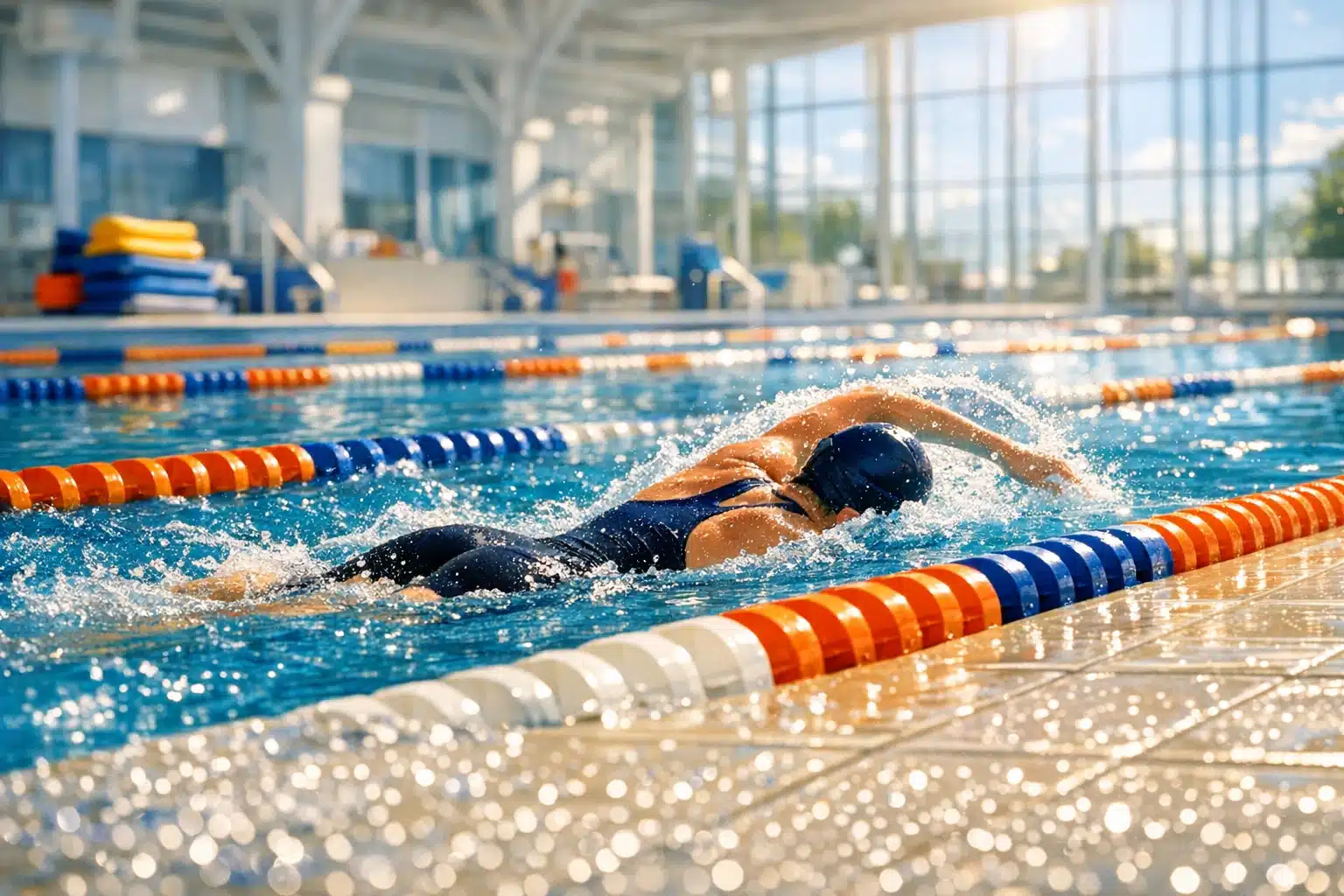
Explore the world of swimming
Swimming sits at an unusual crossroads: it is a sport watched on the world stage, a practical safety skill, and an accessible form of exercise that can stay with a person for decades. In water, the body meets resistance from every direction, so each length of the pool becomes a lesson in timing, breathing, and control. That blend of challenge and freedom is exactly why swimming remains relevant for beginners, athletes, and anyone looking for a durable way to move well.
Outline
- The importance of swimming as a sport, life skill, and form of exercise
- The major strokes and the technical habits that shape efficiency
- How training plans, drills, and conditioning improve performance
- The relationship between swimming, health, recovery, and water safety
- A practical conclusion for beginners, fitness swimmers, parents, and aspiring competitors
Why Swimming Matters: More Than a Sport
Swimming matters because it operates on several levels at once. It is a competitive sport with rules, records, and elite performance standards, but it is also a basic life skill that can improve personal safety around water. On top of that, it is one of the few exercises that combines cardiovascular effort, muscular endurance, mobility, and coordination in a low-impact setting. For many people, that combination is the main reason swimming remains appealing long after trends in fitness come and go.
One of the clearest advantages of swimming is the way water changes the physical experience of exercise. Buoyancy reduces the stress placed on joints, which can make movement more comfortable for older adults, people returning from certain injuries, and those who find repetitive impact difficult. At the same time, water is far denser than air, so moving through it requires steady effort. That means a swimmer can challenge the heart and lungs while also asking the shoulders, back, core, hips, and legs to work together. Few activities train the whole body so continuously without the pounding associated with running or jumping.
Swimming also has social and practical value. A child who learns to swim gains more than a hobby; that child gains confidence in pools, lakes, and beaches. An adult who returns to the water after years away often discovers a form of exercise that feels both structured and calming. Competitive swimmers, meanwhile, learn discipline through split times, pacing, and technical repetition. The lane line can be a strict teacher, but it is rarely a dull one.
Its importance becomes even clearer when viewed through different goals:
- For fitness, swimming can build aerobic capacity and muscular stamina.
- For safety, it improves water awareness, floating ability, and calm decision-making.
- For rehabilitation and longevity, it offers a lower-impact option than many land-based sports.
- For competition, it rewards precision, consistency, and resilience.
There is also something distinct about the atmosphere of the sport. Swimming asks for concentration because the environment changes how sound, breathing, and movement are experienced. A runner can talk through a session; a swimmer often works in a quieter rhythm, counting strokes, feeling the catch of the hand, and timing each breath. That inward focus is part of the attraction. The pool is not silent, exactly, but it does create its own compact world of splashes, turns, and measured effort. In that world, progress is visible one lap at a time, and that makes swimming both humble and deeply satisfying.
Understanding the Main Strokes and the Logic of Good Technique
The four competitive strokes, freestyle, backstroke, breaststroke, and butterfly, each demand a different pattern of movement, yet all of them depend on the same basic principles: body position, balance, timing, and efficient propulsion. Beginners often think speed comes mainly from strength, but experienced swimmers know that technique is what makes strength useful. A powerful stroke applied at the wrong angle wastes energy. A smoother stroke, even from a less muscular swimmer, can produce better results because it reduces drag and keeps momentum flowing.
Freestyle, often called front crawl, is usually the first stroke swimmers learn for distance and speed. It is typically the fastest because the body remains streamlined and the kick supports a steady rotation from side to side. Good freestyle relies on a high elbow catch, a relaxed recovery over the water, and a breath that does not lift the head too far. When swimmers look forward instead of down, the hips tend to sink, and the water quickly exposes the mistake.
Backstroke shares many mechanical ideas with freestyle, especially rotation and alternating arm action, but the face stays above the surface. That changes breathing demands while introducing new orientation challenges, since swimmers must travel straight without looking ahead in the usual way. Breaststroke is different again. Its pull, kick, and glide form a rhythm that rewards timing more than pure tempo. If the kick is too early or the glide too long, the swimmer stalls. Butterfly is the most physically demanding stroke for many people, not because it is impossible, but because it punishes poor timing. When the body wave, arm recovery, and dolphin kick line up, butterfly looks almost airborne. When they do not, it feels like wrestling the water.
A helpful comparison looks like this:
- Freestyle: efficient, fast, ideal for fitness and distance work
- Backstroke: useful for posture awareness and balanced shoulder rotation
- Breaststroke: technical, rhythm-based, often easier for casual swimmers to learn at a basic level
- Butterfly: powerful, demanding, and highly dependent on timing
Across all strokes, strong technique begins with a streamlined body. The head should generally stay in a neutral position, the core should stay engaged, and the kick should support movement rather than create turbulence. Turns, starts, and finishes also matter more than many newcomers expect. In a 25-meter pool, every wall arrives quickly, which means pushing off well can save valuable energy and time. Technique is not decoration in swimming; it is the engine room. The better a swimmer understands how water responds to hand placement, body angle, and timing, the more every lap starts to feel intentional rather than accidental.
Training for Improvement: Endurance, Speed, Drills, and Structure
Improving in swimming rarely happens through random laps alone. Casual pool time has value, especially for confidence and general movement, but real progress usually comes from structured training. Swimmers improve when sessions have a purpose, whether that purpose is aerobic endurance, speed, stroke efficiency, pacing, or recovery. Even short practices can be effective if they are designed with intention.
A balanced training plan typically includes several ingredients. Warm-ups prepare the shoulders, hips, and breathing pattern for work. Drill sets isolate specific skills, such as body rotation in freestyle or kick timing in breaststroke. Main sets challenge energy systems through repeated distances at controlled effort levels. Cool-downs help bring the heart rate down and allow technique to settle back into a calmer rhythm. Competitive swimmers may also include race-pace work, underwater training, and detailed split tracking, while fitness swimmers often focus on consistency and stroke variety.
For beginners, the biggest mistake is often doing too much too soon. Because water supports the body, a session can feel gentler than it really is, especially on the shoulders and upper back. That is why progression matters. A new swimmer may start with short repeats and generous rest, perhaps 8 x 25 meters with attention to breathing and form, rather than forcing nonstop laps with poor mechanics. Intermediate swimmers can begin linking distances, using sets like 6 x 100 meters or mixed-stroke workouts to build capacity and prevent monotony.
Useful training elements include:
- Technique drills, such as catch-up drill, fingertip drag, or kickboard work
- Endurance sets, built from repeat distances with steady pacing
- Speed sets, using short repeats with full or near-full effort
- Pull and kick sets, which isolate parts of the stroke
- Dryland strength and mobility work, especially for shoulders, core, and hips
Measurement is another reason swimming training feels satisfying. Progress can be tracked in time, stroke count, rest intervals, and perceived effort. A swimmer might notice that 100 meters once felt chaotic but now feels controlled, or that a 50-meter split has dropped by two seconds without extra strain. These are meaningful gains. They reflect better mechanics, better conditioning, or both.
There is also a mental side to training that deserves attention. Swimming teaches patience because improvement is often incremental. A single breakthrough may arrive after weeks of awkward practice. One day the breath fits the stroke, the catch starts to hold water, and the body line finally feels long instead of hurried. That moment is part of the sport’s quiet magic. It reminds swimmers that repetition is not mindless when it is guided by feedback. It is craft. And like any craft, it rewards people who return to the work with curiosity rather than impatience.
Health Benefits, Recovery, and the Essential Role of Water Safety
Swimming has a strong reputation as a healthy activity, and for good reason. As an aerobic exercise, it can support cardiovascular fitness, improve stamina, and help people maintain regular physical activity across different stages of life. Because it recruits large muscle groups and demands rhythmic breathing, it can also sharpen body awareness and breathing control. Many swimmers describe the sport as tiring in the best possible way: not just exhausting, but organizing, as if the body has been asked to work in a more coordinated pattern than usual.
The low-impact nature of swimming is often highlighted, but that point deserves nuance. Low impact does not mean effortless. It means the forces on joints are generally reduced compared with activities that involve repeated ground contact. For people with joint sensitivity, for older adults, or for those cross-training between harder sessions on land, that can be extremely useful. Yet swimmers still need recovery, especially when volume rises or technique breaks down. Shoulders, neck, and lower back areas can become irritated if stroke mechanics are poor or if training loads increase too quickly.
Recovery habits matter here. Sleep, hydration, and nutrition support adaptation in the same way they do in other sports. Easy swims, mobility work, and rest days can prevent small aches from becoming chronic problems. Pool temperature, session length, and intensity also shape how demanding a workout feels. Water can make effort deceptive; the heart may be working hard while the environment still feels cool and controlled.
Health benefits should never overshadow safety, however. Swimming is rewarding precisely because water is powerful, and that power must be respected. Pool swimmers need to understand lane etiquette, depth changes, and fatigue signals. Open-water swimmers must consider current, visibility, temperature, weather, and entry and exit points. A calm lake on the shoreline can behave very differently farther out.
Basic safety priorities include:
- Learning floating, treading water, and controlled breathing before attempting harder sessions
- Never overestimating ability in deep or unfamiliar water
- Using lifeguarded areas when possible
- Swimming with a partner in open water
- Stopping when dizziness, cramping, or unusual shortness of breath appears
For parents, safety education is especially important. Lessons can build familiarity, but supervision remains essential. For adult beginners, pride is sometimes the biggest hazard; people may hide discomfort rather than ask for instruction. The smartest swimmers do the opposite. They respect the environment, build skill gradually, and treat water confidence as something earned through practice. In that sense, safety is not separate from swimming culture. It is one of its foundations, and it allows the health benefits of the sport to be enjoyed with far greater confidence.
Conclusion: How Different Swimmers Can Make the Most of the Water
Swimming offers different rewards to different people, and that is one of its greatest strengths. A beginner may value basic comfort in the water above all else. A fitness-focused adult may care more about steady aerobic work that is kind to the joints. A parent may see swimming as a practical skill every child should have. A competitive swimmer may chase fractions of a second through technical refinements that outsiders barely notice. The remarkable thing is that the same pool can serve all of them.
For readers wondering where to start, the best approach is usually simple: choose consistency before ambition. Learning to exhale calmly in the water, float without panic, and swim short distances with control is far more useful than forcing speed too early. Once those pieces are in place, progress becomes easier to build. Stroke lessons, coached sessions, and well-designed drills can then turn basic movement into efficient swimming.
For those already comfortable in the water, the next step is often purpose. Instead of swimming the same easy pace every visit, vary the training. Mix endurance with technical work. Try different strokes. Track times on repeat distances. Pay attention to how many strokes it takes to cross the pool. Small measurements reveal large patterns, and those patterns help swimmers improve without guesswork.
If you are choosing swimming mainly for health, it can be an excellent long-term option, especially when paired with mobility and light strength work outside the pool. If you are choosing it for sport, patience will matter as much as effort. Swimming has a way of rewarding details: a better push-off, a quieter breath, a more balanced kick. Gains can seem modest until, suddenly, they are not.
A useful final checklist for almost any swimmer looks like this:
- Learn or revisit the basics of breathing, floating, and body position
- Choose realistic session lengths and increase volume gradually
- Prioritize technique before chasing speed
- Respect recovery and shoulder health
- Treat safety as part of skill, not as an afterthought
In the end, swimming is both exacting and generous. It asks for attention, but it gives back range, endurance, confidence, and a rare sense of movement that feels at once disciplined and freeing. Whether your goal is fitness, safety, competition, or simple enjoyment, the water has room for you, provided you meet it with patience and respect. That is the enduring appeal of swimming, and it is why so many people keep returning to the lane, the shoreline, or the quiet blue rectangle waiting at the end of the day.