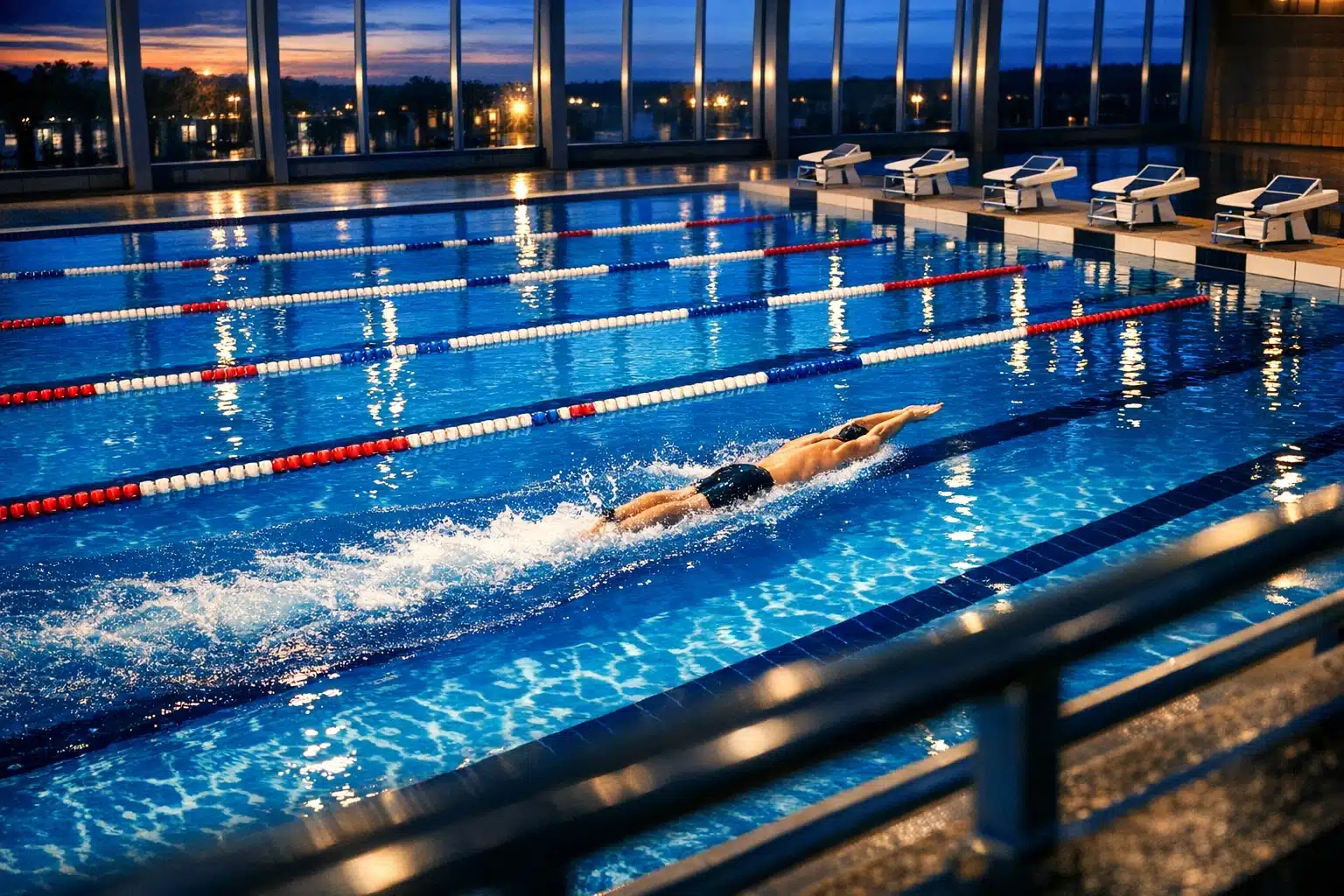
Explore the world of swimming
Step onto a pool deck before sunrise and swimming reveals its character immediately: quiet focus, echoing water, and effort hidden beneath a smooth surface. Few activities blend survival skill, exercise, sport, and recreation so naturally. Children learn confidence through it, adults use it to protect joints while staying active, and elite athletes turn it into a precise science of rhythm and efficiency. Understanding swimming matters because it supports health, safety, and lifelong enjoyment in equal measure.
Outline
- The nature of swimming and why it remains relevant across ages and settings
- The physical and mental benefits that make swimming distinct from many land-based activities
- The main strokes, core technique, and how efficient movement is built in water
- Safety, learning progression, and practical training advice for beginners and improving swimmers
- A conclusion on swimming as a lifelong sport, community activity, and personal habit
Swimming as a Human Skill and a Modern Sport
Swimming is both ancient and current, simple and technical. At its most basic level, it is the ability to move through water with control. That sounds modest until you consider how unusual water is as an environment. On land, people rely on stable footing, predictable balance, and easy breathing. In water, buoyancy lifts the body while resistance pushes back against every movement. The result is a physical conversation between the swimmer and the element itself. One careless motion wastes energy, while one well-timed stroke can make the body glide forward with surprising ease.
Its importance begins with safety. Knowing how to float, tread water, and move toward an exit can reduce risk around pools, lakes, rivers, and coastlines. Many national and local public health organizations treat water competency as a fundamental life skill rather than a luxury. Swimming also matters because it is unusually adaptable. A child learning to blow bubbles in a shallow pool, an adult returning to exercise after injury, and an Olympic athlete refining a turn all belong to the same broad world of swimming, even though their goals differ dramatically.
As a sport, swimming developed into a highly measured discipline. Competitive races test speed over set distances, often in strokes such as freestyle, backstroke, breaststroke, and butterfly. Timings are recorded down to fractions of a second, which means tiny improvements in technique can matter as much as raw fitness. Compared with sports that rely heavily on contact, swimming is more internal. The contest often feels quiet from the outside, but inside each lane there is a storm of calculation: pacing, breath control, body position, and timing.
Swimming also exists far beyond competition. Recreational swimmers use pools for exercise and relaxation. Open-water swimmers cross lakes, coastlines, and channels, where currents, temperature, and visibility become part of the challenge. Triathletes combine swimming with cycling and running, making the water leg a test of composure as much as conditioning. In rehabilitation settings, water is used because buoyancy can reduce stress on joints while still allowing meaningful movement.
Several features explain why swimming keeps its relevance:
- It can be practiced for safety, health, recreation, or sport.
- It suits many age groups and fitness levels when properly supervised.
- It develops body awareness in a setting unlike everyday movement.
- It offers both solitary focus and strong social or team-based experiences.
That range is rare. Running, cycling, and strength training each have clear strengths, but swimming occupies a wider emotional and practical spectrum. It can feel like play, discipline, therapy, travel, and competition depending on the moment. Few activities move so easily between those roles.
Why Swimming Is So Valuable for Health, Fitness, and Well-Being
Swimming is widely respected because it challenges the body without demanding the same impact that many land-based exercises do. When a person runs, each stride creates force through the feet, ankles, knees, and hips. In the water, buoyancy changes that equation. The body is supported, which can make swimming attractive for older adults, people managing joint discomfort, and individuals returning to movement after time away. Low impact, however, does not mean low effort. Water is far denser than air, so every stroke must work against resistance. That gives swimming a rare combination: gentler loading on joints paired with meaningful muscular and cardiovascular demand.
From a fitness perspective, swimming can improve heart and lung function when practiced regularly. Public health guidance commonly recommends at least 150 minutes of moderate aerobic activity per week for adults, and lap swimming can contribute to that goal. Intensity varies widely. A slow, continuous session may support endurance and recovery, while interval training can raise the heart rate sharply and challenge aerobic capacity. Depending on body size, stroke choice, and pace, swimming can also use a substantial amount of energy, often in a range comparable to or greater than brisk walking and similar to other vigorous endurance activities.
The muscular benefits are also broad. Freestyle relies heavily on shoulders, back, core, and hips. Breaststroke brings in a distinctive pulling-and-kicking rhythm, while butterfly demands coordinated power. Even a basic flutter kick asks the legs to stay engaged. Because water resists movement in multiple directions, the body is rarely passive. Good technique turns the torso into a stable platform, the arms into anchors, and the legs into propulsive tools. In that sense, swimming is not just exercise for separate body parts; it is practice in linking them effectively.
Mental benefits deserve equal attention. Many swimmers describe a session as both stimulating and calming. Repeated strokes and controlled breathing can create a steady rhythm that feels almost meditative. Pools often remove some of the noise and distraction found in other workout spaces. Open water adds a different psychological effect: alertness mixed with awe. A lake at dawn or a calm stretch of sea can make effort feel expansive rather than confined.
Some common reasons people choose swimming include:
- Improving cardiovascular fitness without repeated impact on joints
- Building muscular endurance through full-body movement
- Managing stress through rhythmic breathing and focused repetition
- Maintaining activity during rehabilitation or later life, with medical guidance where needed
Swimming is not a magic solution, and it is not automatically easy. Shoulder overuse, poor technique, or overly ambitious training can create problems. Yet when approached sensibly, it offers one of the most balanced packages in physical activity: strength, endurance, mobility, coordination, and mental refreshment working together in the same session.
Understanding Strokes, Technique, and the Craft of Moving Efficiently
To an untrained eye, swimming can look like simple forward motion. In reality, technique determines almost everything. Two swimmers with similar fitness can produce very different results depending on how well they align the body, catch the water, time the kick, and breathe. Efficiency matters because water punishes drag immediately. Lift the head too high, cross the arms awkwardly, or kick without rhythm, and the body slows down as if someone quietly added weight to every meter.
Freestyle, often called front crawl, is usually the fastest and most commonly taught stroke for fitness swimming. Its alternating arm action and flutter kick allow continuous propulsion, and side breathing can make it sustainable over long distances. A good freestyle stroke is not about slapping the surface with speed alone. It depends on a long body line, a relaxed but firm recovery of the arms, and a catch phase that presses water backward rather than downward. The best swimmers appear smooth because they reduce wasted motion, not because the work is easy.
Backstroke uses a similar alternating rhythm, but the swimmer faces upward. Many people find the breathing simpler because the face stays out of the water, though body alignment can be harder to maintain. Breaststroke is different again: symmetrical arm and leg actions, a glide phase, and a timing pattern that rewards patience. It is often considered approachable for beginners because the head may rise regularly, but efficient breaststroke is highly technical. Butterfly, with its paired arm recovery and dolphin kick, is the most dramatic stroke to watch and among the most demanding to sustain. When done well, it resembles controlled force traveling in waves from chest to hips to feet.
Each stroke teaches something distinct:
- Freestyle emphasizes efficient rotation and sustained rhythm.
- Backstroke develops balance and body position awareness.
- Breaststroke highlights timing, glide, and coordination.
- Butterfly teaches power transfer and whole-body sequencing.
Beyond the strokes, swimmers must learn starts, turns, streamlining, and pacing. Streamlining after pushing off the wall can save major energy over the course of a set. Flip turns keep momentum alive in freestyle and backstroke, while open turns are common in breaststroke and butterfly. Breathing patterns also change training quality. Breathing every two strokes may support speed, while bilateral breathing in freestyle can improve balance and adaptability.
Technique is often compared to engineering because small adjustments create large effects. A slightly improved hand entry can reduce drag. Better hip rotation can unlock a stronger pull. More relaxed exhalation underwater can make breathing less frantic. The pleasure of swimming often deepens at this stage, because the athlete stops fighting the water and starts negotiating with it. That shift is where craft begins.
Learning to Swim Safely and Building a Training Routine That Lasts
For beginners, swimming can feel humbling. Water changes balance, muffles sound, and exposes tension quickly. That is exactly why structured learning matters. A strong start usually begins not with racing strokes but with comfort in the water: submerging the face, exhaling underwater, floating on front and back, kicking with support, and learning how to recover to a standing position. These basic skills build confidence and reduce panic. Instructors often call this water competency, and it forms the foundation for both safety and later technique.
Safety deserves more than a passing mention because it is central to the subject. Even good swimmers can misjudge conditions. Pools introduce concerns such as slippery decks, fatigue, and diving into shallow water. Open water adds variables that demand respect, including temperature, currents, waves, limited visibility, and distance from help. A person who swims strong laps indoors may still struggle in a cold lake because breathing, orientation, and muscle control change dramatically outside the pool. That is why experienced swimmers treat environment as seriously as fitness.
Practical safety habits include:
- Learning with qualified instruction whenever possible
- Swimming where lifeguards or trained companions are present
- Checking depth before diving or jumping in
- Using bright caps or tow floats in open water for visibility
- Entering unfamiliar water gradually, especially when it is cold
- Stopping when pain, dizziness, or severe breathlessness appears
Once basic confidence is in place, training should progress gradually. Many new swimmers make one of two mistakes: they either drift without structure or push too hard too early. A better approach is to combine technique work, endurance, and recovery. For example, a beginner session might include a warm-up, kick practice, short freestyle drills, a few easy lengths with rest, and a cool-down. Intermediate swimmers may add intervals such as repeated 50- or 100-meter swims, using rest to maintain form rather than collapse into sloppy movement.
Equipment can help, though it should not replace skill. Kickboards isolate leg work, pull buoys support the hips during arm-focused sets, and fins can improve body position when used thoughtfully. Goggles increase comfort and orientation, while a well-fitted cap reduces drag slightly and keeps hair managed. In open water, wetsuits may provide warmth and buoyancy where appropriate.
Consistency is more important than heroic effort. Two or three thoughtful swims per week can produce clear improvement in endurance and confidence. Keeping a simple log of distance, drills, and how the session felt makes progress visible. Over time, the swimmer learns an important lesson: training is not only about going harder. It is about learning when to push, when to refine, and when to leave the water wanting one more good length instead of one last exhausted struggle.
Conclusion for New and Returning Swimmers: Why the Water Keeps Calling People Back
Swimming lasts because it meets people where they are. For some, it begins as a necessary safety lesson. For others, it becomes a way to protect health, manage stress, train for competition, or reconnect with movement after injury or long inactivity. That flexibility is one of its greatest strengths. A person does not need to choose a single identity in the water. It is possible to be a cautious beginner in one season, a recreational lap swimmer in the next, and later someone who joins a masters group, tries a triathlon, or takes on an open-water event.
The culture around swimming also gives it staying power. Pools can be quiet places of private discipline, yet they also create community. Teammates share lanes, coaches refine details others cannot see, and families gather for lessons that carry real practical value. Competitive swimming teaches precision and patience, while casual swimming reminds people that exercise does not always need a scoreboard. Even watching the sport can deepen appreciation, because the smoothness seen in elite performances is built on thousands of repetitions that most spectators never notice.
There are, of course, challenges. Access to safe facilities is unequal in many regions. Lessons may be expensive, and historical barriers have limited participation for some communities. These issues matter because swimming should not be treated as an exclusive skill. Wider access to instruction, public facilities, and community programs can support safety and health on a meaningful scale. In that sense, swimming is not only an individual pursuit; it is also a public good.
For readers considering a start or a return, the most useful mindset is simple: begin with respect for the water and patience with yourself. Progress may arrive in small moments rather than dramatic breakthroughs. The first relaxed exhale underwater, the first length completed without stopping, the first session that leaves the body tired but the mind clearer than before, these are real milestones. They matter because they turn swimming from an idea into a lived skill.
If the topic feels broad, that is because swimming genuinely holds many worlds at once. It is science in motion, exercise without pounding, technique disguised as grace, and recreation that can carry serious life value. For beginners, the message is encouraging: start slowly and learn well. For experienced swimmers, the message is equally clear: there is always another layer to refine, another environment to understand, and another reason to keep coming back to the water.