Explore the world of swimming
Swimming sits at the rare intersection of survival skill, lifelong sport, and quiet recreation, which is why it matters far beyond the lane rope. It can challenge elite athletes, welcome nervous beginners, and offer older adults a form of movement that feels gentle yet demanding. In one setting, water becomes gym, classroom, and refuge. That mix of practicality and pleasure makes swimming relevant to health, safety, community, and everyday confidence.
Outline: 1. Why swimming matters, including its broad appeal, practical value, and place in daily life. 2. The core strokes and techniques, with comparisons that make movement in water easier to understand. 3. Health and fitness benefits, from cardiovascular training to mobility and recovery. 4. Safety, equipment, and learning pathways for beginners and improving swimmers. 5. Competitive, recreational, and social sides of swimming, ending with guidance for readers who want to make it part of life.
Why Swimming Matters: More Than a Sport
Swimming is easy to underestimate until you step into deep water and feel how much the environment changes the rules. On land, gravity dominates almost every movement. In water, buoyancy lifts part of the body, resistance slows every action, and breathing must be timed instead of taken for granted. That unusual combination is one reason swimming matters so much: it teaches people to move competently in a setting that can be enjoyable, demanding, and occasionally dangerous. A person who learns to float, tread water, and move calmly through a pool gains far more than a recreational pastime. They gain practical confidence.
Its value also comes from its reach across age groups and abilities. A child may enter swimming through play, splashing toward a floating toy while learning balance without realizing it. A teenager may use it for conditioning in another sport. An adult with joint pain may turn to the pool because running feels jarring but water feels forgiving. An older swimmer may keep returning because laps offer rhythm without the hard impact associated with many forms of exercise. Unlike some activities that peak early or demand specialized strength, swimming can remain useful through many stages of life.
There is also a cultural and geographic reason to take swimming seriously. Millions of people live near coastlines, rivers, lakes, or public pools, and water is woven into travel, recreation, and family routines. Knowing how to behave around it is part of modern life. Swimming lessons often teach more than propulsion. They teach orientation, breath control, safe entry, exit strategies, and emotional regulation under stress. Those skills matter when a pool day turns chaotic, when a boat trip becomes rough, or when a child panics after losing footing.
Swimming also stands apart from other physical activities because it is both solitary and social. One person can swim laps in a near-meditative silence, counting strokes while the ceiling tiles slide past like a metronome. At the same time, clubs, teams, masters groups, and family sessions make it a shared experience. Its range is wide:
• survival skill
• fitness practice
• competitive sport
• rehabilitation tool
• leisure activity
That range explains why swimming stays relevant. It is not only about speed or medals. It is about competence, health, composure, and the ability to feel at home in a place where many people feel uncertain. Few skills offer such a practical mix of freedom and responsibility.
Understanding the Strokes: Technique, Breathing, and Efficiency
Swimming looks smooth when done well, but the smoothness is built from technical details that matter more than many beginners expect. Water is roughly 800 times denser than air, so small flaws become noticeable very quickly. A dropped elbow, a tense neck, or a rushed breath can waste energy within seconds. That is why learning to swim is not simply about “trying harder.” It is about reducing drag, improving alignment, and coordinating movement so the body slips forward instead of fighting the water.
The four main competitive strokes are freestyle, backstroke, breaststroke, and butterfly, and each teaches a different lesson. Freestyle, commonly performed with the front crawl, is usually the fastest and most efficient over long distances for most swimmers. It rewards body rotation, steady kicking, and a relaxed recovery over the water. Backstroke shares rotational mechanics with freestyle but changes orientation; the swimmer faces upward, which can make breathing easier while demanding stronger directional awareness. Breaststroke is slower for most people, yet it is often approachable because the face can come forward regularly for air. Butterfly is powerful and graceful, but it is also technically demanding, requiring coordinated timing between the kick, pull, and undulating body motion.
Breathing deserves special attention because it is one of the first barriers new swimmers encounter. On land, people inhale and exhale without planning. In water, poor timing creates tension. A common coaching cue is simple: exhale underwater, inhale briefly when the mouth clears the surface. That pattern prevents breath-holding, which often causes stiffness and panic. Efficiency grows when breathing becomes a rhythm instead of an emergency.
Several principles apply across almost every stroke:
• keep the head in a neutral position rather than lifting it high
• lengthen through the spine so the hips stay near the surface
• use the core to connect upper and lower body movement
• finish each stroke with control instead of rushing the next one
Technique is also a story of comparison. A strong cyclist can rely on power for a while; a swimmer who relies only on force usually tires early. A runner may survive with uneven form over a short distance; a swimmer with poor alignment creates constant resistance. That is why lessons, video feedback, and drill work are so valuable. In the pool, elegance is not decoration. It is economy. When the stroke begins to click, the water changes character. What felt heavy starts to feel supportive, and the swimmer moves from merely staying afloat to traveling with intention.
Health and Fitness Benefits: What Swimming Does for the Body and Mind
Swimming offers a rare training blend: it can challenge the cardiovascular system, develop muscular endurance, and reduce impact stress at the same time. That combination explains why it attracts such varied participants, from casual exercisers to rehabilitation patients to endurance athletes. When a swimmer moves through water, the body works against resistance on every stroke. Unlike lifting a weight for a single motion, that resistance remains present through repeated cycles, which turns even moderate swimming into a whole-body effort.
For cardiovascular health, swimming can help people meet widely recommended physical activity goals, such as the general guideline of at least 150 minutes of moderate-intensity aerobic movement per week for adults. The exact training effect depends on pace, stroke choice, rest intervals, and individual fitness, but regular sessions can improve endurance and exercise capacity. Freestyle sets with short rest may feel like continuous aerobic training, while sprint repeats can raise intensity in a way that resembles interval work on a track or bike. The pool gives coaches and self-directed swimmers many ways to structure effort.
Muscularly, swimming engages the shoulders, back, chest, core, glutes, and legs in coordinated patterns. The emphasis changes by stroke. Butterfly and freestyle demand strong upper-body pulling and trunk stability. Breaststroke asks for precise leg timing and hip mobility. Backstroke encourages posterior chain engagement and postural awareness. Because the body is supported by water, many people find they can work hard without the pounding that often comes with land-based exercise. That makes swimming especially attractive for those managing joint discomfort, returning after injury, or balancing heavy training in another sport.
Mental benefits matter too. Lap swimming can be repetitive in the best sense of the word. The sound of the splash, the pattern of breathing, and the visual rhythm of lane lines create a kind of moving focus. For some people, the pool acts like active meditation. Others enjoy the problem-solving side of training: counting splits, refining turns, or feeling a stroke become cleaner over weeks of practice. Progress is easy to notice because the feedback is immediate. If technique improves, movement feels easier. If pacing improves, distance becomes less intimidating.
A practical approach to training usually includes:
• easy aerobic swims for endurance
• drill sets for form
• faster intervals for speed and fitness
• recovery sessions with relaxed effort
• rest days, because water does not remove the need for recovery
Swimming is not magic, and it is not automatically suitable in the same way for every person. Shoulder overuse can happen, poor technique can create frustration, and beginners may need patient instruction before fitness gains appear. Still, when practiced consistently and sensibly, swimming offers a durable, adaptable path to better health that feels less like punishment and more like skilled movement.
Safety, Equipment, and Learning the Right Way
Swimming is enjoyable precisely because water can feel freeing, but that freedom should never be confused with harmlessness. Safety is the foundation that makes every other benefit possible. A confident swimmer is not the person who takes the biggest risk. It is the person who understands conditions, respects limits, and stays calm when something unexpected happens. In pools, that may mean recognizing lane etiquette, depth markers, and signs of fatigue. In open water, it expands to currents, visibility, temperature, weather shifts, and the simple fact that there is no wall to grab every few seconds.
For beginners, the safest learning path is structured and gradual. The first milestones are usually comfort-based rather than distance-based: putting the face in the water, exhaling steadily, floating on the front and back, kicking with support, and learning how to stand up calmly after submersion. These steps may seem small, yet they are the architecture of real confidence. A swimmer who can float, recover balance, and manage breathing is far better prepared than someone who can thrash through one fast length in panic.
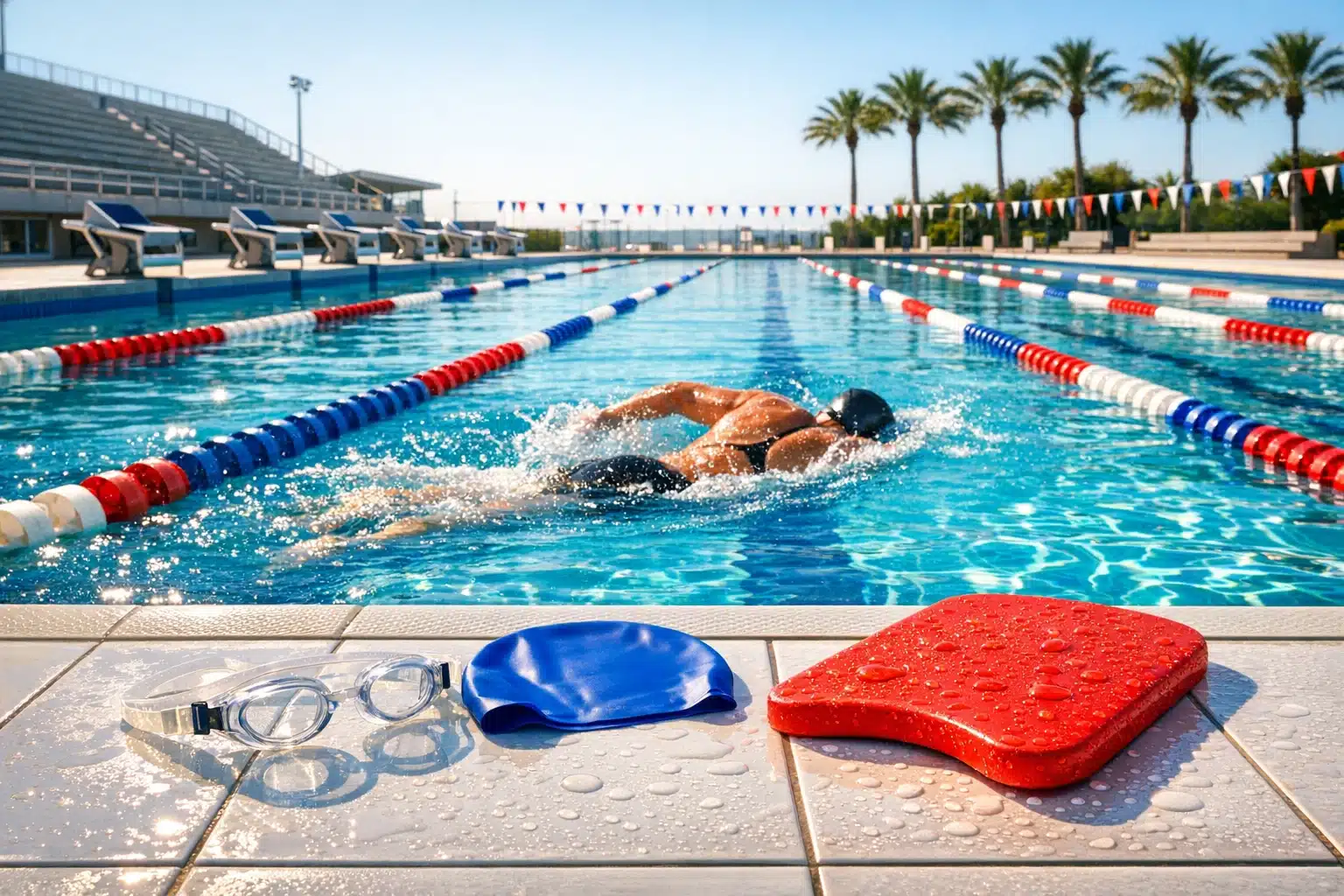
Equipment can help, although it should support learning rather than replace it. A well-fitted swimsuit and goggles are the usual basics. Swim caps reduce drag and keep hair contained, especially in training settings. Kickboards, pull buoys, fins, and snorkels are common tools in lessons and coached practice. Each has a purpose. A kickboard isolates the legs, a pull buoy reduces the role of the kick so the arms can be emphasized, fins can improve body position and propulsion awareness, and a snorkel allows attention to technique without constant turning to breathe. None of these tools is a shortcut to skill; they are teaching aids.
Open-water swimmers need an even more cautious approach. Bright caps improve visibility. Tow floats can make a swimmer easier to spot and provide temporary support during rests. Wetsuits may help with warmth and buoyancy when appropriate for conditions. A buddy system is wise, and local knowledge matters. Cold water, in particular, deserves respect because it affects breathing, coordination, and decision-making.
Useful safety habits include:
• never assuming shallow water is safe for diving
• entering unfamiliar water carefully
• resting before exhaustion becomes distress
• supervising children closely and actively around any water
• choosing instruction from qualified teachers or reputable programs
Good learning often feels modest at first, then suddenly transformative. One week a person clings to the wall; a month later they glide across the pool with a face relaxed enough to notice the blue tiles below. That change is not luck. It is the result of method, patience, and an environment where safety is treated as part of skill, not as a separate lecture.
Swimming for Life: Recreation, Competition, Community, and a Practical Conclusion
One of swimming’s greatest strengths is that it does not force people into a single identity. You do not have to become a racer to belong in the water. Some swimmers chase times, some prefer distance, some use the pool for recovery, and some simply want an hour where phones are locked away and thought becomes quieter. That flexibility makes swimming unusually sustainable. It can be serious without becoming joyless, and leisurely without becoming pointless.
Competitive swimming offers one clear path. It brings structure, measurable progress, and the excitement of comparison. Swimmers track splits, streamline turns, stroke rate, and race strategy. A standard long-course pool measures 50 meters, while many training pools are 25 meters, and even that difference changes rhythm and pacing. Competition can teach discipline, patience, and emotional control because results depend on details most spectators barely notice: the timing of a breakout, the efficiency of a turn, or the ability to hold form during the final meters when the arms begin to feel heavy.
Recreational swimming follows a different logic, but it is no less valuable. Family pool sessions build familiarity. Open-water swims can turn exercise into exploration, with shorelines replacing lane markers and sunlight shifting across the surface like moving glass. Aqua fitness classes give group energy to people who may not want formal lap training. Masters groups, community clubs, and adult lessons also show that learning does not expire after childhood. Many adults return to swimming after years away and discover that progress feels deeply satisfying precisely because it was not easy.
For readers who want to make swimming part of life, the most useful goal is not perfection but continuity. Start with a purpose that fits your reality. You might want safer holidays near the sea, gentler weekly exercise, a sport that complements cycling or running, or a new challenge that requires technique rather than sheer force. From there, build a simple plan:
• learn or refresh fundamentals
• swim consistently, even if sessions are short
• focus on relaxed breathing before speed
• add variety through drills, strokes, or intervals
• measure improvement by comfort and control as well as distance
The audience for this article is broad because swimming itself is broad. If you are hesitant, let that hesitation be a starting point rather than a verdict. If you are already swimming, refinement is always possible. Water has a way of rewarding patience: the calmer you become, the more it reveals. In the end, swimming is not only about crossing a pool. It is about gaining a skill that can protect you, strengthen you, steady your mind, and remain useful for decades.