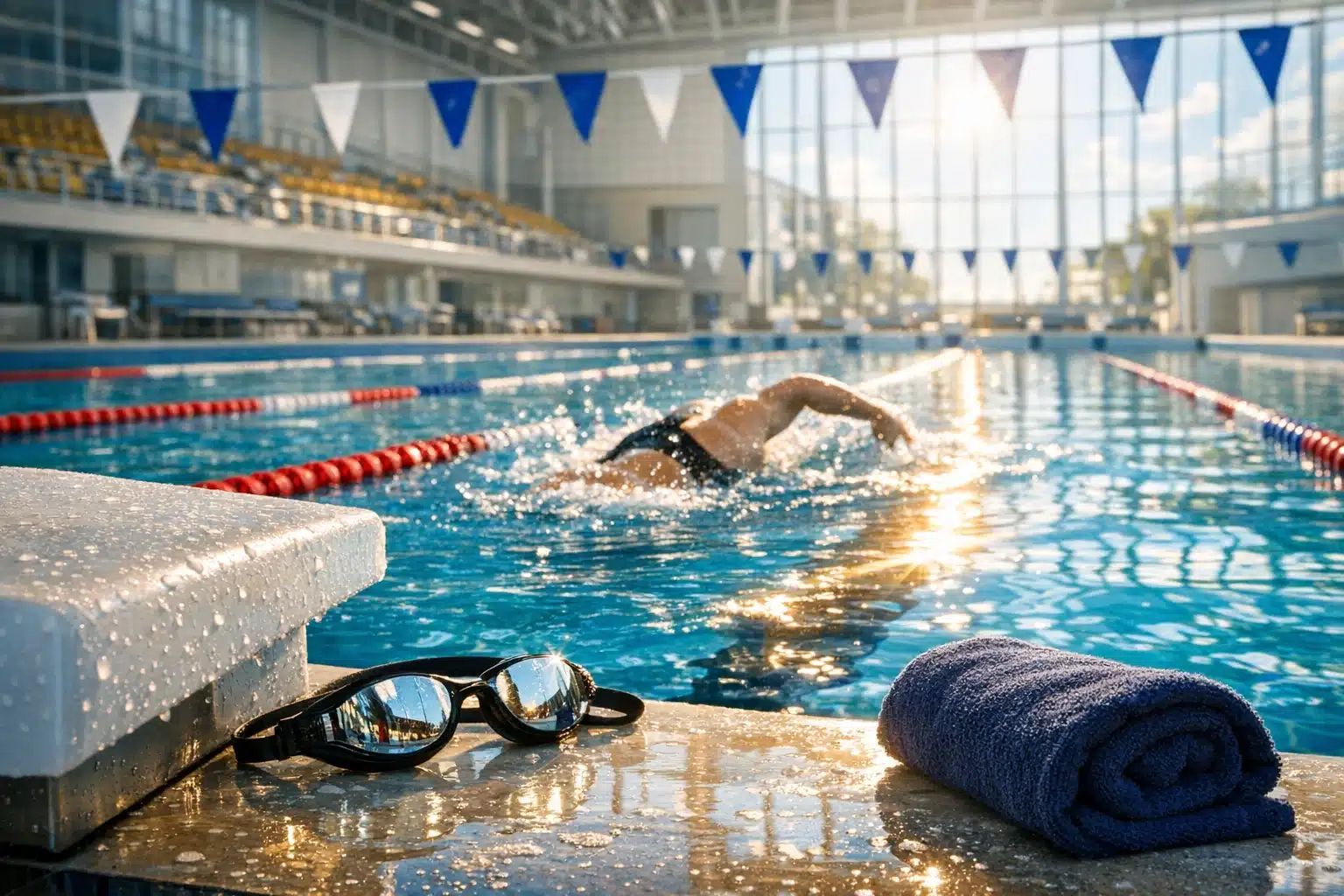
Explore the world of swimming
Swimming is one of the few activities that can feel playful, technical, calming, and demanding all at once. It helps children build confidence, gives adults a sustainable form of exercise, supports older people who want low-impact movement, and offers athletes a precise test of endurance and control. Because water supports the body while resisting every action, swimming sits at a useful crossroads of recreation, sport, and health. That unusual range makes it relevant far beyond the lane rope.
Outline
This article follows five main themes to explain swimming in a clear and practical way.
- The importance of swimming as a life skill, sport, and form of exercise
- The major strokes and how they differ in technique, rhythm, and difficulty
- The physical and mental benefits of training in water
- How beginners and regular swimmers can learn, improve, and stay safe
- The culture, competitive pathways, and lifelong appeal of the sport
Swimming as a Life Skill, Sport, and Everyday Advantage
Swimming matters for reasons that stretch far beyond medals, stopwatches, and neatly painted lane lines. At its most practical level, it is a safety skill. Around the world, drowning remains a major public health concern, and international health organizations have repeatedly reported that it causes hundreds of thousands of deaths each year. That fact alone gives swimming a special place among physical activities. Learning how to float, breathe calmly, and move through water can turn panic into control, which is not a small difference when conditions become unpredictable.
Yet the value of swimming does not stop at safety. It also stands out because it welcomes a wide range of people. A teenager training for a school meet, a parent looking for exercise after work, an older adult managing stiff joints, and a patient in rehabilitation can all use the same pool in completely different ways. Few sports are that flexible. Running, for example, is accessible and effective, but it places repetitive impact on hips, knees, and ankles. Strength training is highly adaptable, yet some beginners find the learning curve intimidating. Swimming offers an alternative environment where the body feels lighter while the work remains real.
The sport also has a rare emotional texture. Water changes sound, pace, and perception. A hard set can leave the lungs burning, but between laps there is often a quiet, almost meditative pause. That combination of effort and calm explains why many swimmers stay with the activity for decades. It can be social in a crowded lesson program or deeply personal during an early morning solo session.
A few qualities make swimming especially distinctive:
- It combines recreation with a genuine survival benefit.
- It can be adapted for beginners, fitness seekers, and elite athletes.
- It offers resistance in every direction, which makes even simple movement productive.
- It remains usable across many life stages, including periods of injury recovery.
In schools, community centers, holiday resorts, and Olympic venues, swimming appears in many forms, but the thread connecting them is simple: it teaches people how to function confidently in an environment that demands respect. That is why swimming deserves to be seen not merely as a hobby, but as a foundational ability with lifelong relevance.
Understanding the Major Strokes and What Makes Each One Unique
To an untrained eye, swimming can look like a smooth blur of splashes and arm swings. In reality, each stroke follows a specific logic, and learning that logic changes everything. The four major competitive strokes are freestyle, backstroke, breaststroke, and butterfly. Each asks the body to solve the same problem, moving efficiently through water, in a very different way.
Freestyle, usually swum as front crawl, is the fastest and most commonly taught stroke for fitness swimming. The swimmer lies face down, rotates through the torso, alternates the arms, and uses a steady flutter kick. Because the body stays relatively streamlined and propulsion is continuous, front crawl is efficient over short and long distances. Breathing, however, can be a stumbling block. New swimmers often lift the head too high, which drops the hips and creates drag. Good freestyle feels less like muscling forward and more like sliding through a narrow tube with well-timed rotation.
Breaststroke is slower, but many beginners find it easier to understand because the breathing pattern is more direct. The arms move together, the legs perform a frog-like kick, and each cycle includes a visible glide. Timing is the real challenge. If the pull, breath, kick, and streamline fall out of order, the stroke quickly becomes tiring. Competitive breaststroke is highly technical, and small details, such as ankle position during the kick or head movement during the breath, can change speed dramatically.
Backstroke flips the visual world upside down. Swimmers travel face up, alternating their arms and using a flutter kick much like freestyle. The obvious advantage is breathing freedom, since the mouth and nose remain clear of the water. The difficulty lies in balance and direction. Because the ceiling offers a different kind of reference than the black line on the pool floor, backstroke requires strong body awareness. It also uses a distinctive start from the wall rather than a dive from the block.
Butterfly is the most dramatic stroke and often the most feared by newcomers. Both arms recover together, the legs perform a dolphin kick, and the body undulates in a coordinated wave. It is powerful and beautiful when executed well, but costly when rushed or forced. Butterfly punishes poor timing quickly, which is why coaches usually teach it after a swimmer has built rhythm, core strength, and confidence in the water.
A simple comparison helps clarify their personalities:
- Freestyle: fastest, versatile, efficient for fitness and racing
- Backstroke: continuous and rhythmic, with easier breathing but harder navigation
- Breaststroke: slower, technical, often comfortable for casual swimmers
- Butterfly: explosive, demanding, and highly dependent on timing
Across all four strokes, the same fundamentals still matter. A streamlined body position reduces drag. Controlled breathing prevents wasted motion. A purposeful kick supports balance rather than replacing technique. The arms should catch and hold water rather than slap at it. Once swimmers understand these principles, the strokes stop looking like separate tricks and start feeling like variations on a shared language.
Why Swimming Works So Well for Fitness, Health, and Mental Reset
Swimming has a strong reputation as a full-body workout, and that reputation is well earned. Water is far denser than air, which means every stroke, kick, turn, and push meets resistance. Unlike many land-based activities, resistance arrives from multiple directions at once. The result is a form of exercise that can challenge the shoulders, back, chest, hips, core, and legs in a single session without requiring impact from repeated pounding on hard surfaces.
Buoyancy is the other half of the story. Because the body is partially supported in water, stress on joints is reduced. That makes swimming appealing for people managing arthritis, recovering from certain injuries, returning to exercise after a long break, or carrying extra body weight. It is not effortless, but it can feel more forgiving. The pool often becomes a place where movement returns before confidence does, and then confidence follows.
From a cardiovascular perspective, lap swimming can help people work toward widely recommended physical activity targets, such as the general guideline of at least 150 minutes of moderate aerobic movement per week for adults. Intensity is flexible. A gentle technique session, a steady endurance set, and a hard interval workout do not demand the same output, yet all can contribute to health. Energy expenditure also varies by body size, stroke choice, and pace, but even moderate swimming commonly burns several hundred calories per hour. That makes it useful for people who want to improve conditioning while maintaining variety.
The benefits extend beyond heart rate and muscle tone. Water has an unusual effect on attention. With every lap, the swimmer tracks breath timing, line position, arm entry, and the wall approaching ahead. Daily noise has less room to intrude. Many people describe the experience as mentally clearing, not because the workout is easy, but because it is absorbing. In a world built on alerts, tabs, and interruptions, a lane can feel almost monastic.
There are also practical advantages worth noting:
- Different strokes shift the load across muscle groups and reduce monotony.
- Sessions can be scaled easily by changing rest time, distance, or pace.
- People of very different fitness levels can share the same pool environment.
None of this means swimming is a magic solution. Shoulder overuse can happen if technique is poor or volume rises too quickly. Chlorinated water can irritate some eyes or skin. Access to safe facilities is uneven in many places. Even so, few activities combine aerobic training, muscular engagement, mobility, and mental decompression with the same balance. That is why swimming remains a mainstay in fitness plans, therapy settings, and long-term wellness routines.
Learning to Swim, Improving Technique, and Staying Safe in the Water
Learning to swim is often imagined as a single milestone, but in practice it is a ladder made of many small steps. The first rung is not speed. It is comfort. A beginner who can exhale into the water, float on the front and back, and recover calmly after losing balance is building a far more durable foundation than someone who rushes toward messy laps. Confidence grows from repeated, manageable experiences, and in swimming that progression matters more than bravado.
Most effective instruction starts with body position and breathing. Swimmers who hold their breath tend to tense the neck and shoulders, which makes everything harder. Exhaling steadily into the water keeps the body softer and prepares the next inhale. Floating drills teach balance. Kicking drills introduce propulsion and alignment. Short glides help beginners feel what streamline actually means. Only then do arm actions begin to fit into a sensible pattern.
For improving swimmers, technique should stay ahead of ego. It is tempting to measure every session by total distance, but sloppy yardage can teach bad habits as efficiently as good yardage teaches skill. A swimmer who practices a cleaner catch, steadier kick rhythm, and more relaxed breath timing may look slower for a week and swim much faster a month later. Water rewards precision eventually, even if it refuses to flatter impatience in the moment.
Useful tools can make learning more efficient:
- Goggles improve visibility and reduce hesitation.
- A kickboard isolates leg work and body line awareness.
- A pull buoy helps focus on arm mechanics and balance.
- Fins can support body position and make drill work easier to feel.
Safety deserves equal attention. In pools, swimmers should understand lane etiquette, depth markers, and how to rest without blocking others. Children and weak swimmers need active supervision, not casual glances from afar. In open water, the demands multiply. Currents, temperature, visibility, weather, and boat traffic all matter. A confident pool swimmer can still struggle in a lake or sea if they have never practiced sighting, pacing without walls, or managing waves.
A practical beginner pathway might look like this:
- Week 1 to 2: breathing, floating, wall support, and gentle kicking
- Week 3 to 4: short front crawl and backstroke lengths with rest
- Week 5 onward: longer repeats, simple drills, and smoother turns
Coaches, adult learn-to-swim classes, and even well-structured community programs can speed up progress dramatically. The biggest breakthrough often arrives quietly. One day the water stops feeling like an obstacle and starts feeling like a place you can negotiate. That shift is where real swimming begins.
Competition, Community, and the Lifelong Appeal of Swimming
Swimming can be intensely personal, but it is also tied to a wide and lively culture. At the competitive level, the sport ranges from local club meets to world championships and the Olympic Games. Races test sprint power, pacing discipline, underwater efficiency, starts, turns, and nerve. In a 50-meter event, a poor reaction can matter enormously. In an 800-meter or 1500-meter race, strategy and restraint become central. The stopwatch may seem cold, but the stories behind it are not. Years of repetitive training often hide inside a result displayed for only a few seconds.
Outside elite competition, swimming branches into many pathways. Masters programs welcome adults who want structured training without needing professional ambitions. Open-water events attract people drawn to lakes, rivers, and seas rather than tiled pools. Triathletes use swimming as the first puzzle of a three-part endurance challenge. Para swimming expands access and showcases extraordinary skill across a range of physical classifications. Artistic swimming and water polo, while distinct disciplines, also reveal how broad the aquatic world can be.
Community plays a larger role than many outsiders realize. Swim teams often become ecosystems of shared routines: early alarms, packed bags, poolside jokes, volunteer timers, and conversations that happen while hair is still dripping. For children, that environment can build discipline and friendship. For adults, it can provide accountability and relief from isolated exercise habits. Even the simple structure of lane-sharing teaches negotiation, awareness, and respect for other people’s pace.
There is also a public dimension to the sport. Access to safe pools, qualified instructors, and affordable lessons is uneven, and that inequality shapes who gets to benefit from swimming. Communities that invest in aquatic facilities are not only supporting recreation; they are supporting public health, skill development, and water safety. The social return can be larger than the construction project suggests.
The sport’s staying power comes from its range. A swimmer can chase personal bests at sixteen, return for stress relief at thirty-five, and swim gentle recovery laps at seventy. Goals change, but the water keeps offering useful work. Some people come for competition, others for rehabilitation, others for the quiet rhythm of breath and stroke. The pool asks something different from each of them, yet it remains open to all. That rare combination of challenge and adaptability is what makes swimming not merely a sport to try, but a practice people can carry for life.
Conclusion for Readers Ready to Get in the Water
If you are curious about swimming, the best reason to begin is not that it looks elegant from the bleachers or impressive on a fitness tracker. It is that swimming offers a rare mix of usefulness, challenge, and longevity. You can approach it as a safety skill, a conditioning tool, a competitive pursuit, or a way to clear your mind after a difficult day. Start with patience, learn the basics well, respect the environment, and let technique grow before speed. For beginners, that means focusing on comfort and consistency. For regular swimmers, it means refining details that make each lap smoother and more efficient. Either way, the reward is the same: a stronger relationship with water and a form of movement that can stay valuable for years.