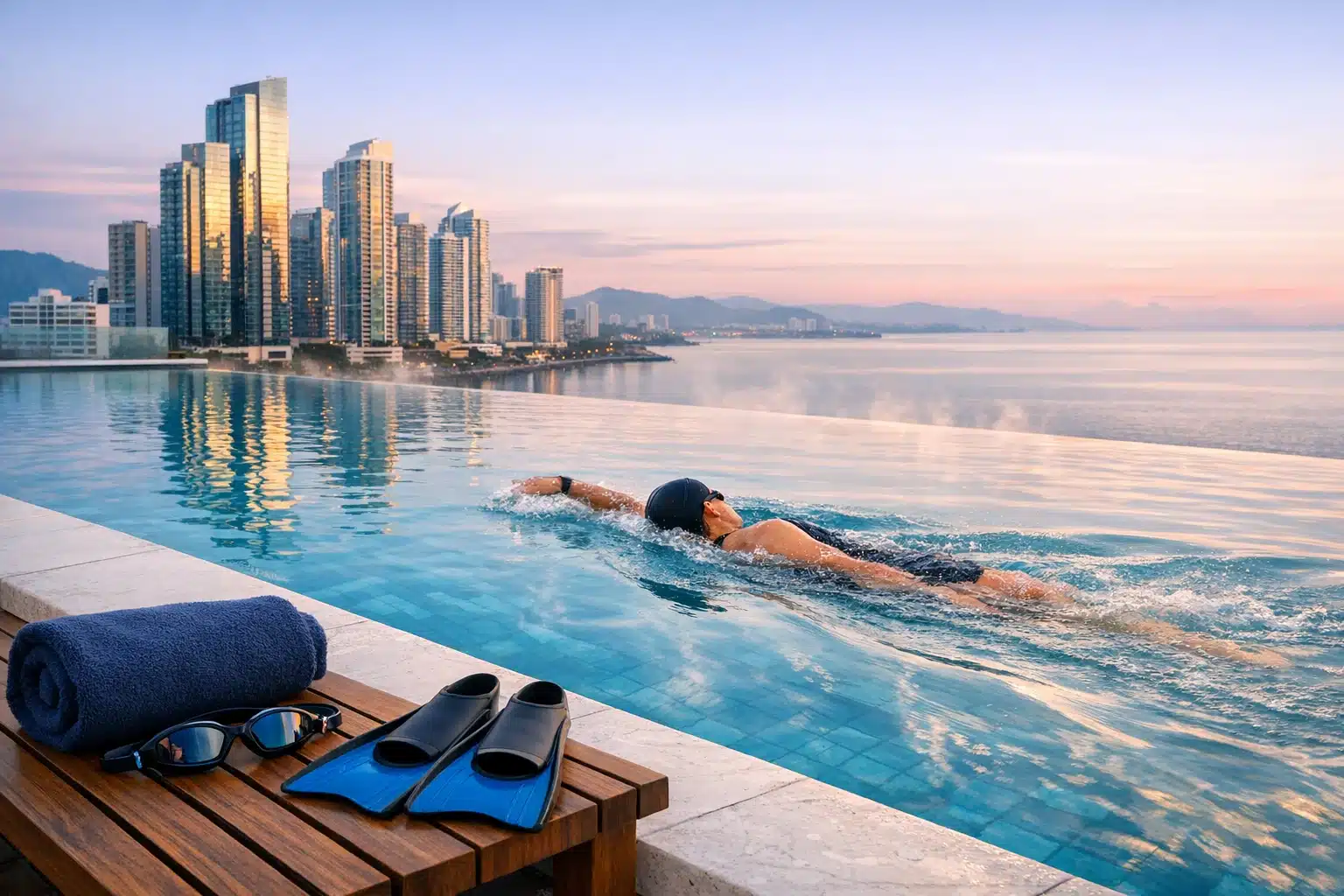
Explore the world of swimming
Swimming stands at a rare meeting point between survival skill, sport, and restorative exercise. It trains the heart, recruits nearly every major muscle group, and offers a low-impact workout that many people can enjoy across decades. Whether someone wants better fitness, safer water confidence, or a new competitive challenge, the subject remains practical and timely. This article breaks the topic into clear parts, helping readers see how technique, safety, and consistency turn time in the water into lasting value.
Outline
- The broad value of swimming for health, movement, and mental balance
- The main strokes and how they differ in speed, rhythm, and technical demand
- How to learn, train, and stay safe in pools and natural water
- Equipment choices and the strengths of different swimming environments
- Ways to make swimming a lasting habit, from recreation to competition
Why Swimming Matters: Fitness, Function, and Mental Reset
Swimming is often described as a full-body workout, but that phrase only tells part of the story. In practice, swimming asks the body to coordinate breathing, balance, timing, propulsion, and endurance in one continuous chain. Water supports a large portion of body weight, which is why swimming is frequently recommended as a lower-impact option for people who find running or jumping uncomfortable. That does not make it easy. The resistance of water is far greater than the resistance of air, so even a short session can feel demanding in a productive way. For many adults, this combination is ideal: the joints experience less pounding, while the heart and lungs still receive a serious challenge.
Public health guidance also helps explain swimming’s relevance. Organizations such as the World Health Organization and the US Centers for Disease Control and Prevention recommend that adults get at least 150 minutes of moderate-intensity aerobic activity each week. Swimming can clearly contribute to that target. Depending on body size, technique, and pace, 30 minutes of steady lap swimming can burn roughly 200 to 350 calories, with faster efforts and strokes such as butterfly often exceeding that range. Beyond calories, regular swimming may support cardiovascular health, muscular endurance, and mobility. It is especially useful for people who want exercise without the repeated impact forces common in court sports or road running.
The mental side is just as compelling. Water narrows attention in a helpful way. You notice your breath, the position of your hands, the sound of bubbles, the line at the bottom of the pool, the next wall. Many swimmers describe this as meditative, not because the work is easy, but because the environment filters out noise. A busy mind has less room to wander when the body is organizing each stroke. This can make swimming valuable for stress management, routine building, and emotional reset.
- It develops aerobic fitness and muscular endurance at the same time.
- It can be adapted for children, older adults, and people returning from injury.
- It teaches practical water confidence, which has clear safety value.
- It offers recreational, therapeutic, and competitive pathways in one activity.
In that sense, swimming is not only exercise. It is a useful life skill wrapped in a sport. Some people enter the pool to lower stress, others to improve race times, and many simply to feel more at home in the water. The remarkable part is that one activity can serve all three goals without losing its identity.
Understanding the Strokes: Technique, Efficiency, and Comparison
Swimming becomes far more enjoyable once the main strokes stop looking like a blur and start making mechanical sense. Competitive swimming traditionally centers on four strokes: freestyle, backstroke, breaststroke, and butterfly. Each one asks for a different relationship with the water. Freestyle, often called front crawl, is usually the fastest and most economical for longer efforts. Swimmers lie face down, rotate through the torso, alternate arm recovery over the water, and use a flutter kick. The rhythm feels continuous, almost like a moving conveyor belt. Small improvements in body position can make a big difference here; when the hips drop or the head lifts too much, drag rises and speed falls.
Backstroke is essentially the only competitive stroke performed on the back, which changes breathing and orientation. Since the face stays above the surface, many beginners find the breathing pattern less stressful than freestyle. The challenge is directional control and maintaining a stable body line while the arms alternate overhead. It rewards calm timing and a confident flutter kick. Breaststroke is slower, but it has a distinct pull-breathe-kick-glide pattern that many recreational swimmers enjoy. It can feel intuitive because the head comes forward regularly, yet good breaststroke is highly technical. The kick must sweep correctly, and the glide should be patient rather than rushed. Butterfly, by contrast, is the most physically demanding of the four for most swimmers. Both arms recover together, the body undulates, and the dolphin kick drives the motion. When done well, it looks almost theatrical, like the swimmer is rising and folding with the water itself. When done poorly, it is exhausting within a single length.
Comparing the strokes highlights an important truth: swimming is not just about strength. Efficiency matters at least as much. Freestyle tends to suit distance and fitness work because it balances speed and sustainability. Backstroke is excellent for posture awareness and shoulder rhythm. Breaststroke often appeals to learners because of its visibility and pause points, though it can stress the knees if technique is poor. Butterfly builds power and timing but usually requires a solid technical base before it becomes comfortable.
- Fastest for most swimmers: freestyle
- Easiest breathing access: backstroke
- Most stop-and-go rhythm: breaststroke
- Most demanding coordination: butterfly
For beginners, one of the smartest approaches is to treat the strokes like dialects of the same language. They all depend on streamlining, breath control, and balance. Water gives honest feedback: if a movement is rushed, wide, or stiff, it resists you immediately. If it is aligned and timely, the body suddenly feels longer, lighter, and more capable.
Learning to Swim Well: Training Principles, Progression, and Safety
Learning to swim is not just about staying afloat. It is about becoming competent, relaxed, and predictable in the water. That process works best when it is broken into manageable pieces. New swimmers often make the mistake of trying to complete laps before they are comfortable with breathing, floating, or pushing off the wall. A better path begins with water familiarity: exhaling underwater, rolling from front to back, holding a streamlined position, and practicing simple kicks with support. Once those pieces are stable, arm actions and breathing patterns become much easier to connect. This layered approach is common in quality swim instruction because it builds confidence and reduces panic.
Training, even at a basic level, also benefits from structure. A session does not need to look elite to be effective. Most useful swims contain a warm-up, a focused main set, and a short cool-down. For example, a beginner might swim easy lengths, then alternate one lap of practice drilling with one lap of steady swimming. An intermediate swimmer may add intervals, such as 8 x 50 meters with controlled rest, to improve pacing and recovery. Good swim training often feels technical before it feels heroic. If the body line improves, effort produces more speed instead of more splashing.
Safety deserves equal attention. The World Health Organization has repeatedly identified drowning as a major public health problem worldwide, with hundreds of thousands of deaths recorded over time across many regions. That fact alone explains why basic swimming ability is more than a leisure skill. Pool safety includes supervising children closely, respecting lane direction, avoiding breath-holding contests, and staying out of the water when ill or severely fatigued. Open water requires even more caution because currents, temperature, visibility, and depth can change rapidly.
- Start with breath control, floating, and streamlining before worrying about speed.
- Use short repeats and rest intervals to maintain technique.
- Never swim alone in open water without planning and visible support.
- Learn how cold water, waves, and fatigue affect judgment.
There is also a psychological side to learning. Many adults carry embarrassment about starting late, but swimming is a technical skill, not a talent lottery. A child may look fearless in a pool, yet adults often learn more deliberately and understand instructions better. Progress is rarely linear. One week the water feels awkward; the next week, a breath lands smoothly and a full lap suddenly seems natural. That is one of swimming’s quiet rewards: improvement often arrives like dawn, not fireworks.
Gear and Environment: What You Need and Where You Swim Matters
Swimming does not require a mountain of equipment, which is part of its appeal, but the right gear can dramatically improve comfort and learning. At the most basic level, swimmers need a suit that stays secure and allows a full range of motion, plus goggles that fit well enough to prevent constant leaking. Good goggles are not a luxury; they help with orientation, reduce irritation, and allow the swimmer to relax the face rather than squint through every lap. A cap is optional for some recreational swimmers, though it can reduce drag, keep hair more manageable, and make group swimmers easier to identify in a lane or open water setting.
Training tools come next. Kickboards isolate leg work, pull buoys shift the emphasis toward the upper body, fins help swimmers feel body position and ankle motion, and front-mounted snorkels remove the breathing challenge so technique can be refined. None of these tools are magic shortcuts. Used thoughtfully, they teach sensations that are otherwise difficult to notice. Used carelessly, they can create dependency or hide flaws. A swimmer who only feels balanced with fins, for example, still has a balance problem.
Environment is just as important as gear. Pools offer predictability: measured distances, lifeguards, lane lines, and controlled temperature. That makes them ideal for instruction and precise training. Open water, whether in a lake, river, or sea, provides a very different experience. There are no lane ropes, no black line on the floor, and often no wall every 25 or 50 meters to provide a reset. Some swimmers love that freedom. Others find it disorienting at first. Salt water increases buoyancy, cold water increases stress, and waves can disrupt breathing rhythm. Visibility may also vary from crystal clear to nearly opaque.
- Choose goggles based on seal and comfort, not just style.
- Use training tools to learn specific skills, not to avoid weaknesses.
- Prefer pools for measured improvement and open water for adaptability and adventure.
- Account for temperature, currents, and visibility before entering natural water.
In practical terms, the best environment depends on the goal. A beginner who wants reliable progress will usually thrive in a pool. A triathlete needs open-water practice because sighting, drafting, and wave management cannot be fully learned indoors. A casual swimmer may enjoy both, treating the pool as a workshop and the lake as a wider stage. Water changes character with the setting, and skilled swimmers learn to change with it.
Making Swimming a Lifelong Habit: Recreation, Competition, and Final Takeaways
One of swimming’s greatest strengths is that it scales beautifully across different ambitions. A child learning to float, a parent squeezing in 30 minutes before work, a masters athlete chasing a personal best, and an older adult using water exercise to stay mobile may all share the same pool. Few activities bridge those worlds so naturally. Recreational swimmers can build a routine around consistency rather than performance, aiming for two or three sessions per week and gradually extending total distance or time. Competitive swimmers, by contrast, measure pace, turns, starts, stroke count, and race-specific conditioning. Both approaches are valid, and each can borrow something from the other. The recreational swimmer benefits from a little structure; the serious racer benefits from remembering that enjoyment supports longevity.
Swimming also fits well with modern cross-training. Runners use it for aerobic work with less joint impact. Cyclists use it to improve breathing control and overall conditioning. People recovering from physical setbacks often find that water allows movement patterns that feel too uncomfortable on land, though medical guidance is important when injuries are involved. Community matters too. Swim clubs, masters groups, local lessons, and lane-sharing culture can turn a solitary workout into a social rhythm. That social layer often helps people stay consistent long after novelty fades.
For readers thinking about where to begin, the most useful mindset is simple: start smaller than your ego wants and more regularly than your motivation alone can sustain. Technique improves through repetition with attention. Fitness improves through accumulated sessions. Confidence improves through safe exposure. If progress feels slow, remember that swimming hides growth until enough pieces click together. Then one day the water that once felt heavy begins to hold you differently.
- If you are new, prioritize lessons, breath control, and comfort over distance.
- If you are returning, focus on rhythm and patience before chasing old times.
- If you are experienced, refine efficiency because wasted motion compounds quickly in water.
Conclusion for new and returning swimmers: Swimming rewards patience more than bravado. It can improve fitness, expand practical safety, and offer a rare kind of mental quiet, all while remaining adaptable to age, experience, and personal goals. If you want an activity that can challenge you on difficult days and restore you on tired ones, the pool is a sensible place to begin. Start with sound instruction, respect the environment, and let steady practice do the work that shortcuts never can.