Explore the world of swimming
Introduction and Article Outline
Swimming is one of those rare activities that can feel playful on the surface while delivering serious benefits underneath. It supports fitness, technique, safety, and mental calm all at once, whether you are gliding through laps, learning to float, or splashing beside your children on holiday. Because it suits beginners, athletes, older adults, and people recovering from impact-heavy routines, swimming remains relevant far beyond the pool deck.
Outline of this article:
• Why swimming matters in modern life
• The physical and mental benefits that make it stand out
• A comparison of the main strokes and the basics of efficient technique
• Practical training methods, safety habits, and beginner progression
• A concluding guide for readers who want to make swimming part of everyday life
What gives swimming its unusual power is range. It can be a life skill, a sport, a rehabilitation tool, a family pastime, and a demanding endurance practice depending on how it is used. Few activities move so comfortably between these roles. A child may begin by learning to blow bubbles and float; years later, the same person may use the pool to cross-train for running, manage stress after work, or prepare for a triathlon. Water becomes a classroom, a gym, and sometimes a quiet refuge.
Swimming also matters because it teaches a relationship with an environment that cannot be taken for granted. Unlike walking, the water asks for cooperation. Good body position, controlled breathing, relaxed balance, and steady rhythm are not optional extras; they are the language of movement in the pool. That learning process can be humbling, but it is also deeply rewarding. Improvement often arrives in small breakthroughs: the first smooth length without stopping, the first confident deep-water tread, the first time breathing feels timed instead of rushed.
In the sections that follow, the article moves from broad importance to useful detail. It examines health benefits with realistic comparisons, explains why one stroke feels easier than another, and gives practical guidance for people who want to start or improve. Whether you are a total beginner, a returning adult swimmer, or someone simply curious about what makes this sport so enduring, swimming offers more than exercise. It offers capability, resilience, and a different way of understanding your own body.
The Physical and Mental Benefits of Swimming
Swimming is often praised as a full-body workout, and in most cases that description is fair. The water creates resistance in every direction, so even steady, moderate swimming asks the shoulders, back, chest, core, hips, and legs to work together. At the same time, buoyancy reduces the pounding that many land-based exercises place on the joints. This combination helps explain why swimming attracts such a broad audience, from competitive athletes to older adults looking for a sustainable form of movement.
From a cardiovascular perspective, swimming can be highly effective. Public health guidance commonly recommends at least 150 minutes of moderate aerobic activity each week, and swimming is one practical way to meet that target. Depending on body size, stroke choice, and intensity, an hour of swimming may burn roughly 400 to 700 calories for many adults, sometimes more during harder sessions. Freestyle and butterfly usually demand more energy than gentle breaststroke or easy backstroke, but even relaxed laps can improve endurance when practiced consistently. The heart and lungs adapt to repeated effort, while the body learns to use oxygen more efficiently.
There is also a strong argument for swimming as a low-impact alternative to other workouts. Running has excellent benefits, but it can be hard on the knees, ankles, and hips for some people. Cycling builds endurance, yet it does not challenge the upper body in the same way. Swimming sits in an interesting middle ground:
• It raises the heart rate without repeated foot strikes
• It develops muscular coordination across the whole body
• It can be scaled from gentle recovery work to intense interval training
The mental side deserves equal attention. Many swimmers describe the pool as a place where noise fades and focus sharpens. The repetition of strokes, the rhythm of breathing, and the sensory feel of water can create a calm, almost meditative effect. This does not mean every session is serene; hard training can be brutally honest. Still, swimming often provides a rare kind of concentration in which everyday distractions lose volume. For people managing stress, busy schedules, or digital fatigue, that matters.
Swimming can also improve confidence in a very practical way. Learning how to float, tread water, and move efficiently in deep water changes how a person experiences beaches, lakes, holidays, and pool visits. Fitness is valuable, but competence is valuable too. When exercise also builds safety and self-trust, it offers more than a better workout. It becomes a skill that follows you into real life.
Strokes, Technique, and the Art of Moving Efficiently
One reason swimming stays interesting over time is that it is not a single movement repeated forever. It is a collection of strokes, rhythms, and technical decisions. Each stroke asks different questions of the body, and each rewards a different kind of patience. To new swimmers, all four competitive strokes may look equally difficult. In practice, they vary greatly in speed, energy demand, and learning curve.
Freestyle, usually performed as front crawl, is the fastest and most widely used stroke for fitness and racing. It tends to be efficient once the swimmer learns body rotation, a relaxed recovery, and well-timed breathing. Backstroke shares some structural similarities with freestyle but places the swimmer face-up, which helps some people breathe more comfortably. Breaststroke is often popular with recreational swimmers because the head can stay above water more often, though the timing of the kick and pull is more technical than it first appears. Butterfly is the most demanding of the four, requiring strength, timing, and a strong undulating rhythm.
A simple comparison makes the differences clearer:
• Freestyle: fastest for most swimmers, efficient over long distances, but breathing technique is crucial
• Backstroke: easier breathing pattern, useful for posture and shoulder awareness, harder to navigate in open water
• Breaststroke: comfortable for casual swimming, slower pace, technical kick mechanics
• Butterfly: powerful and dramatic, excellent for strength and timing, very tiring for beginners
Technique matters because water punishes waste. A cyclist can sometimes grind through poor form, and a runner can survive an awkward mile, but in the pool small inefficiencies are magnified. Lifting the head too high can drop the hips. A rushed kick can create splash without propulsion. Crossing the hands over the center line can disrupt balance. Good swimming often looks smooth not because it is easy, but because the swimmer has learned to reduce friction and direct force well.
Several fundamentals apply to nearly every stroke. First, body position should be long and balanced, with the hips near the surface rather than trailing low. Second, breathing should fit the stroke instead of interrupting it. Third, propulsion comes from coordination, not isolated effort; arms, legs, and core must work as a system. Many coaches teach this through drills such as side kicking, catch-up freestyle, or single-arm backstroke. These exercises may feel less glamorous than hard laps, but they are often where real progress begins.
There is a quiet beauty in this process. A pool can sound loud with splashes, whistles, and lane ropes tapping the surface, yet the technical breakthrough often arrives in silence. One length suddenly feels lighter. The water stops fighting every move. For a few seconds, the swimmer is not wrestling the pool but traveling through it. That sensation is part of what keeps people coming back.
Training, Safety, and How Beginners Can Improve with Confidence
Swimming rewards consistency more than heroics. Many new swimmers assume progress requires long, exhausting sessions, but that approach usually backfires. Technique falls apart when fatigue arrives too early, and frustration follows close behind. A better starting point is short, repeatable practice with a clear focus. Instead of trying to conquer the pool in one dramatic effort, it is smarter to build comfort, skill, and endurance in layers.
A beginner-friendly session might include a gentle warm-up, one technical drill, a short main set, and an easy cooldown. For example, someone learning freestyle could swim 4 x 25 meters easily, practice 4 x 25 meters of kicking or side-balance drills, then complete 6 x 25 meters at a steady pace with 20 to 30 seconds of rest. That structure does two useful things: it keeps quality high and makes improvement measurable. Over time, the swimmer might progress from 25-meter repeats to 50s, then to longer continuous efforts.
Training plans also depend on purpose. Someone preparing for a sprint triathlon may prioritize freestyle endurance and sighting skills. A recreational swimmer may care more about comfort, variety, and general fitness. A former athlete returning after years away might need patience more than intensity. In every case, a few principles tend to help:
• Practice two or three times per week if possible rather than cramming everything into one long session
• Increase total distance gradually instead of making sudden jumps
• Keep at least one part of each workout technically focused
• Rest enough to maintain form, especially when learning
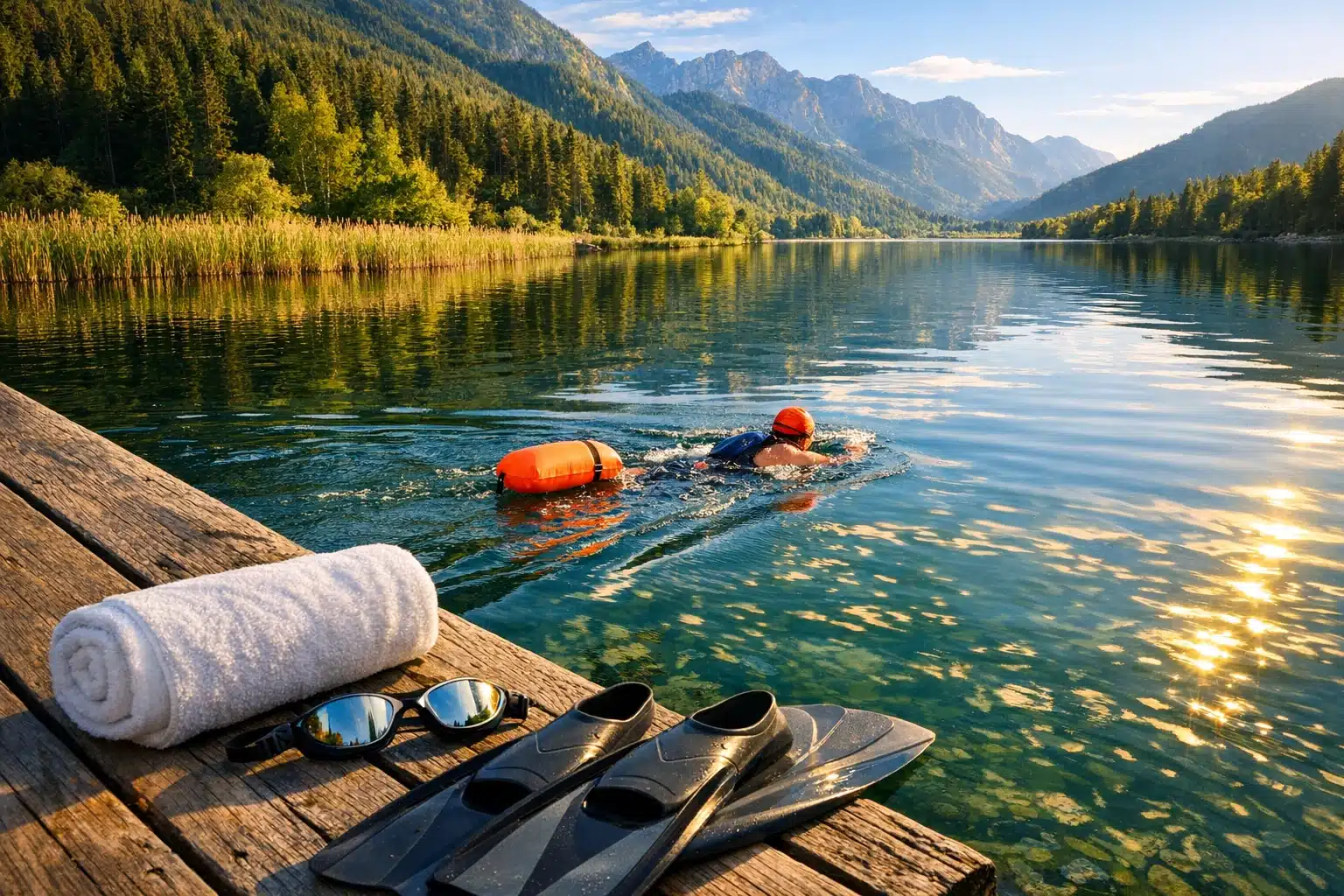
Safety deserves its own spotlight. Swimming is enjoyable precisely because water changes the rules, but those changed rules demand respect. Pool swimmers should learn lane etiquette, pay attention to lifeguards, and avoid diving into unknown depths. Open-water swimmers face additional variables such as temperature, currents, visibility, and weather. Even experienced people should avoid swimming alone in unfamiliar conditions. Bright caps, tow floats, and a partner or group can add an important margin of safety, particularly in lakes or the sea.
Equipment can help, but it should support learning rather than replace it. Well-fitting goggles improve comfort and visibility. A kickboard or pull buoy can isolate parts of the stroke, though overusing them may hide technical weaknesses. Fins can teach body position and add fun, but they should not become a permanent crutch. The goal is not to collect gear. The goal is to become more capable in the water.
For beginners, the most important message is simple: slow progress is still real progress. Comfort comes before speed, rhythm before power, and confidence before performance. Once those foundations are in place, swimming stops feeling like a test and starts feeling like a skill you can keep for life.
Conclusion for Beginners, Fitness Seekers, and Lifelong Swimmers
Swimming deserves its reputation not because it is fashionable, but because it remains useful across so many stages of life. For children, it can begin as a safety skill and grow into confidence. For adults with crowded schedules, it offers efficient exercise that trains the heart, lungs, and muscles without the constant impact of running. For older swimmers, it can remain a realistic and enjoyable way to stay active. Few activities travel so well across age, ability, and purpose.
If you are new to swimming, the best next step is not perfection; it is regular contact with the water. Start with manageable sessions, learn basic breathing and floating skills, and treat technique as something built over time rather than won in a single week. If you already swim occasionally, consider giving your sessions more structure. Even small changes, such as tracking distance, practicing one drill per workout, or learning a second stroke, can make the pool feel fresh again.
For readers who are choosing between exercise options, swimming offers a compelling balance. It can be social or solitary, playful or competitive, gentle or physically demanding. It can support weight management, endurance, recovery days, cross-training, and stress relief, all within the same broad activity. That flexibility is one of its greatest strengths. A swimmer does not need to chase medals to benefit from the sport. Steady laps before work, a calm evening session, or a weekly lesson can all be meaningful.
It may help to think of swimming in three layers:
• First, it is a practical life skill that improves safety and confidence around water
• Second, it is a form of exercise that can support long-term health and mobility
• Third, it is a craft, with enough technique and variety to remain interesting for years
The world of swimming is larger than many people expect. It includes lap pools and open water, structured training and playful recreation, disciplined practice and moments of pure ease. For the target audience of this article, especially beginners and returning adults, the main message is encouraging: you do not need to be fast to belong in the water. You only need a willingness to learn, a respect for safety, and the patience to let skill grow one length at a time. That is where real progress begins, and often, where enjoyment begins too.