Explore the world of swimming
Swimming sits at a rare crossroads where movement, focus, and calm meet. A single session can feel like exercise, meditation, and skill practice woven together, which helps explain why people return to the water across every stage of life. Children learn trust, adults discover low-impact training, and athletes chase efficiency measured in seconds and strokes. In that bright rectangle of blue, progress is visible, physical, and surprisingly satisfying.
Article Outline
- Why swimming matters for health, mobility, and daily life
- The four main strokes and the techniques that make them effective
- How beginners and improving swimmers can train safely and consistently
- What swimming looks like beyond pool lanes, from open water to competition
- A practical conclusion for readers who want to make swimming part of their routine
Why Swimming Matters for Health and Everyday Life
Swimming is often praised as a full-body workout, but that phrase only becomes meaningful when you look at what the body is actually doing in the water. The arms pull, the legs kick, the core stabilizes, and the lungs learn to work to a controlled rhythm. Unlike many land-based activities, swimming asks several systems to cooperate at once: strength, mobility, endurance, timing, and breath control. That is part of its appeal. It does not isolate one quality of fitness; it trains a conversation between them.
One of swimming’s clearest advantages is reduced impact. Water supports a large portion of body weight, which can make exercise more comfortable for people with joint sensitivity, older adults, and those returning to activity after a long break. This does not mean swimming is easy. Water is roughly 800 times denser than air, so every stroke meets steady resistance. The result is a form of exercise that can be gentle on the knees and hips while still challenging the heart and muscles. That balance is hard to find elsewhere.
Public health guidance commonly recommends that adults get at least 150 minutes of moderate aerobic activity each week, and swimming can contribute directly to that target. For some people, it becomes the activity they can stick with because it feels less punishing than running and less repetitive than some indoor cardio machines. For others, it adds variety to an existing fitness routine. A swimmer may leave the pool with tired shoulders and elevated heart rate, yet without the pounding sensation associated with high-impact exercise.
Swimming also carries a practical value that goes beyond fitness. Learning how to float, tread water, and move efficiently can increase personal safety in and around water. In that sense, swimming is not just recreation; it is a life skill. Parents often enroll children in lessons for exactly this reason, but adults benefit as well. Many people who return to swimming later in life are not chasing medals. They are chasing confidence: the confidence to join friends at the beach, to supervise children more safely, or to stop feeling uneasy in deep water.
Its broad usefulness can be summed up in a few points:
- It combines cardiovascular work and muscular endurance
- It can be adapted for different ages and ability levels
- It supports mobility while placing less stress on joints
- It builds water safety alongside fitness
Perhaps that is why swimming has such an unusual emotional range. Some people treat the pool like a training ground, counting intervals and splits. Others treat it like a reset button after a hard day. Either way, the water asks for attention, and attention has its own quiet reward.
Understanding the Four Main Strokes and the Technique Behind Them
To someone watching from the deck, swimming can appear smooth and effortless. In reality, efficient swimming is a sequence of small technical decisions. Where the head sits, how the hand enters, when the body rotates, and whether the kick supports or disrupts the stroke all matter. This is why two swimmers with similar fitness can move through the water at very different speeds. Swimming rewards technique with unusual generosity. A minor improvement in form can save energy over every lap.
The four competitive strokes are freestyle, backstroke, breaststroke, and butterfly, and each teaches something different about movement in water. Freestyle, often called front crawl, is usually the fastest and most commonly taught for fitness. Its alternating arm action and flutter kick make it efficient over long distances, especially when the swimmer learns to rotate the body rather than muscle through each pull. Good freestyle is less about thrashing and more about alignment. The body should feel long, stable, and narrow, like a vessel cutting cleanly through the lane.
Backstroke shares the alternating arm rhythm of freestyle but flips the body onto the back. Many beginners appreciate that breathing is less restricted because the face stays above water. Yet backstroke introduces its own challenges, especially balance and straight-line control. Without visual reference, swimmers can drift across the lane like carts with one loose wheel. Core engagement and a consistent kick help keep the stroke organized.
Breaststroke is often considered approachable because the head can rise more frequently, but technically it is more intricate than it first appears. The timing of pull, breath, kick, and glide must be coordinated carefully. An effective breaststroke uses a whip-like leg action and a moment of streamlined stillness after each cycle. Poor timing turns it into a stop-start struggle. Well-executed breaststroke, by contrast, has a deliberate elegance, almost like a sentence with perfect punctuation.
Butterfly is the most demanding of the four for many swimmers. It uses a simultaneous arm recovery and a dolphin kick driven from the hips and core. When done well, butterfly looks dramatic and fluid, but it punishes inefficiency quickly. It is less a stroke you overpower than one you synchronize with.
A simple comparison helps clarify their uses:
-
Freestyle: best for endurance, speed, and general fitness
-
Backstroke: useful for posture awareness and varied shoulder work
-
Breaststroke: popular for recreational swimming and rhythm-based pacing
-
Butterfly: excellent for power, timing, and advanced technical development
No matter the stroke, several fundamentals matter across the board: body position, breathing control, balance, and streamlining. The fastest swimmers are not fighting the water every second. They are reducing drag, managing effort, and moving with intention. That is the hidden beauty of the sport. Progress is not only about getting stronger. It is about becoming more economical, more aware, and more precise.
Training, Safety, and the Beginner-to-Intermediate Journey
Starting swimming can feel intimidating because pools have their own language and etiquette. There are lanes, pace differences, kickboards, pull buoys, interval clocks, and the quiet pressure of not wanting to hold anyone up. The good news is that improvement in swimming responds well to structure. A beginner does not need a heroic workout. A beginner needs repeatable sessions, patience, and a willingness to treat technique as part of the training rather than a separate subject.
A practical early goal is comfort. Before chasing distance or speed, a new swimmer should learn to exhale into the water, float in different positions, push off the wall, and complete short lengths without panic. Comfort creates control, and control creates room for learning. Once that base exists, workouts can become more organized. A simple session might include a warm-up, a few technique drills, a main set of shorter repeats, and an easy cool-down. That pattern teaches pacing and prevents the common mistake of swimming the first few laps too hard and fading quickly.
For fitness-focused adults, two or three sessions a week can be enough to build visible progress. Early gains often come from efficiency rather than conditioning alone. A swimmer who learns better breathing timing or a cleaner catch may suddenly find that 25 meters feels easier than it did a month earlier. That is motivating in a very concrete way. The clock confirms it, but so does the body.
Safety should remain central at every stage. Even strong athletes from other sports can overestimate their ability in water. Pool environments require attention to depth, lane traffic, fatigue, and breathing control. Open water adds further variables such as currents, temperature, visibility, and navigation. A few practical habits make a major difference:
- Choose a lane that matches your pace rather than your ambition
- Rest when technique breaks down sharply
- Hydrate, even though you may not feel sweaty in the water
- Use bright swim caps and swim with others in open water
- Learn basic pool etiquette, including circle swimming where required
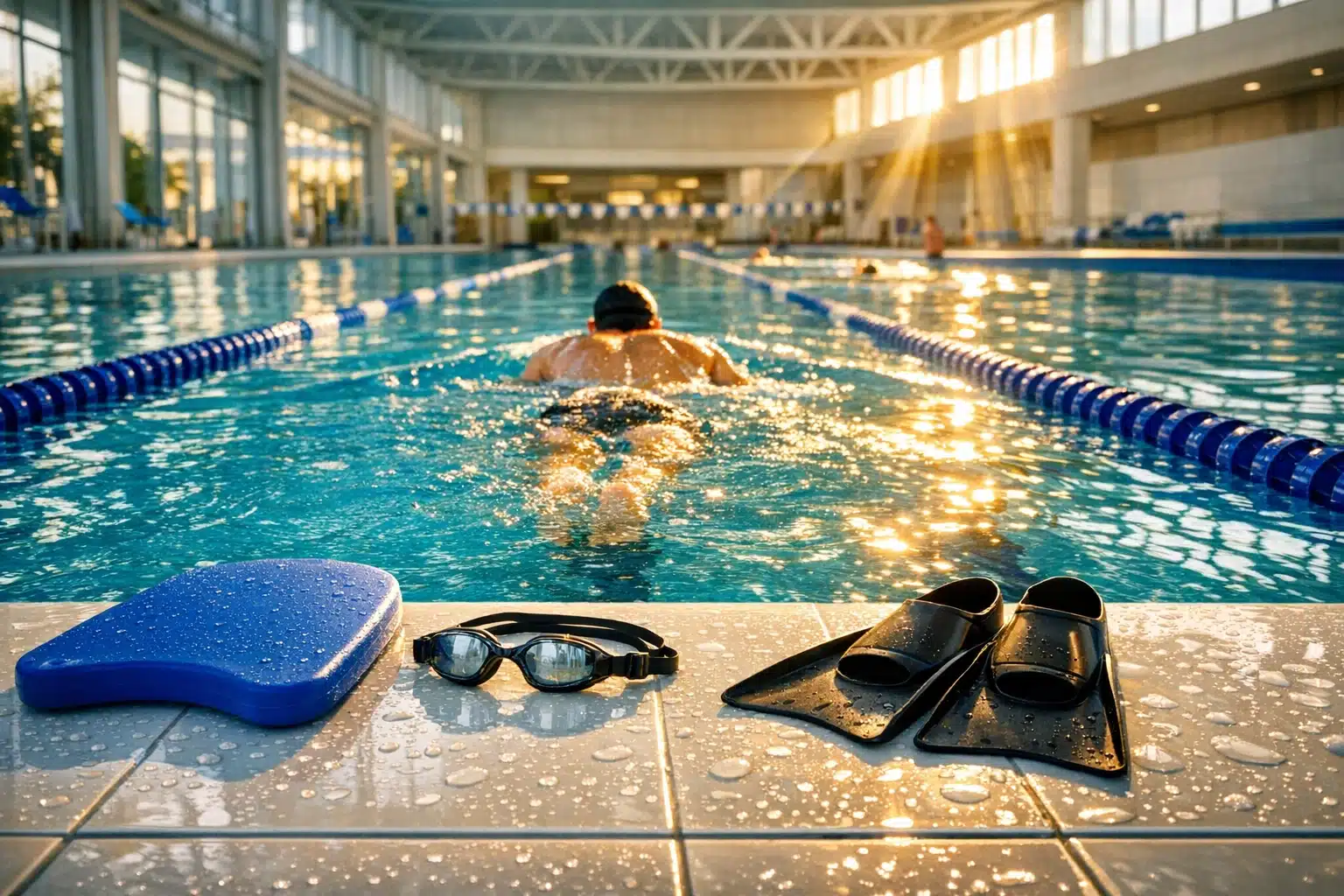
Training tools can help when used thoughtfully. Kickboards isolate leg work, pull buoys reduce kicking so swimmers can focus on the upper body, and fins can improve body position and feel for the water. None of these tools replace sound technique, but they can highlight weaknesses and reinforce better habits. Many coaches also use drills such as fingertip drag for freestyle recovery or single-arm work for balance and timing.
The journey from beginner to intermediate swimmer is rarely dramatic. It is built lap by lap, correction by correction. One day you stop dreading the deep end. Another day you finish a set that once seemed impossible. Swimming improvement often arrives quietly, like dawn spreading across a pool before the first splash.
Swimming Beyond the Pool: Open Water, Competition, and Community
Although many people meet swimming through indoor lanes and tiled walls, the sport extends far beyond the standard pool session. Open-water swimming, masters programs, school teams, triathlon training groups, and community learn-to-swim classes all give the activity a wider identity. This matters because swimming is not only an exercise format. It is also a social environment, a competitive discipline, and, for some, a way of experiencing places that look entirely different from the shoreline.
Open-water swimming offers a striking contrast to pool swimming. In a pool, distances are measured, turns are predictable, and the black line on the bottom keeps you honest. In open water, there are no lane ropes to separate you from the wider world. Lakes, rivers, and oceans bring variables that can make the experience thrilling, humbling, or both. Sighting becomes important because swimmers must periodically lift their gaze to stay on course. Water temperature influences performance and safety. Wind, waves, and currents can turn a calm plan into a more demanding effort. For that reason, open-water swimming is best approached gradually and with proper safety measures.
Competition also changes how swimming is understood. At the recreational level, progress may mean better breathing or less fear of deep water. In competitive settings, details become measurable: stroke rate, turn speed, reaction time, and split consistency. Race distances vary widely, from short sprints to long endurance events. Yet even at the highest levels, swimming remains a sport where refinement matters as much as raw effort. Spectators may notice power first, but coaches often notice line, timing, and efficiency.
Just as important as formal competition is the sense of community swimming can create. Masters clubs welcome adults who may be returning to the sport after years away. Local pools become familiar social spaces where lifeguards, coaches, and regular swimmers recognize one another. Parents gather for lessons. Older adults share lanes with younger athletes. The pool can be one of the few public places where different generations train side by side with a common, practical goal: move better through water.
Swimming communities often revolve around shared habits and values:
- Respect for safety rules and lane etiquette
- Encouragement across different skill levels
- A strong appreciation for steady, visible improvement
- An understanding that consistency usually beats occasional intensity
There is also a quiet democracy to swimming. Expensive gear matters less here than in many sports. A suit, goggles, a cap in some facilities, and access to water are usually enough to begin. The water does not care about status. It responds only to movement, rhythm, and skill.
Conclusion: Making Swimming Part of Your Life
For readers deciding whether swimming deserves a real place in their week, the answer depends less on ambition and more on fit. If you want an activity that develops endurance without constant impact, swimming is worth serious consideration. If you want a skill that carries practical value outside the gym, it offers that too. If you need a form of exercise that can scale from gentle recovery to demanding training, few options are as adaptable. Swimming meets people where they are, then quietly asks them to improve.
The most effective way to begin is to keep the first steps simple. Find a local pool with beginner-friendly hours or lessons. Choose basic, comfortable gear rather than chasing specialist equipment too early. Set a modest target, such as two sessions a week for a month, and treat consistency as the main goal. Early progress may come in forms that are easy to miss unless you pay attention: calmer breathing, longer glides, fewer rests, more confidence. These changes matter because they create momentum.
Readers returning to swimming after a long gap should give themselves permission to start below their former level. Water has a way of exposing rust, but it also rewards patience. Parents thinking about lessons for children can view swimming as both recreation and preparation, a skill that supports safety as well as fun. Fitness-minded adults can use it as primary cardio or as a joint-friendly complement to strength work, cycling, or running. Older readers may value the freedom of movement that water provides when land exercise feels harsher than before.
A sustainable approach often comes down to habits rather than inspiration:
- Schedule sessions like appointments instead of waiting for motivation
- Alternate easier swims with more focused technique days
- Track small wins, such as total distance, smoother breathing, or fewer stops
- Ask for feedback from a coach or experienced swimmer when progress stalls
In the end, swimming offers something many activities struggle to combine: usefulness, challenge, and enjoyment. It can be a workout, a calming ritual, a competitive pursuit, or a bridge back into movement after time away. For beginners, the invitation is simple: start with one lane, one lesson, or one careful session. For experienced swimmers, the message is just as clear: there is always another layer of refinement waiting beneath the surface.