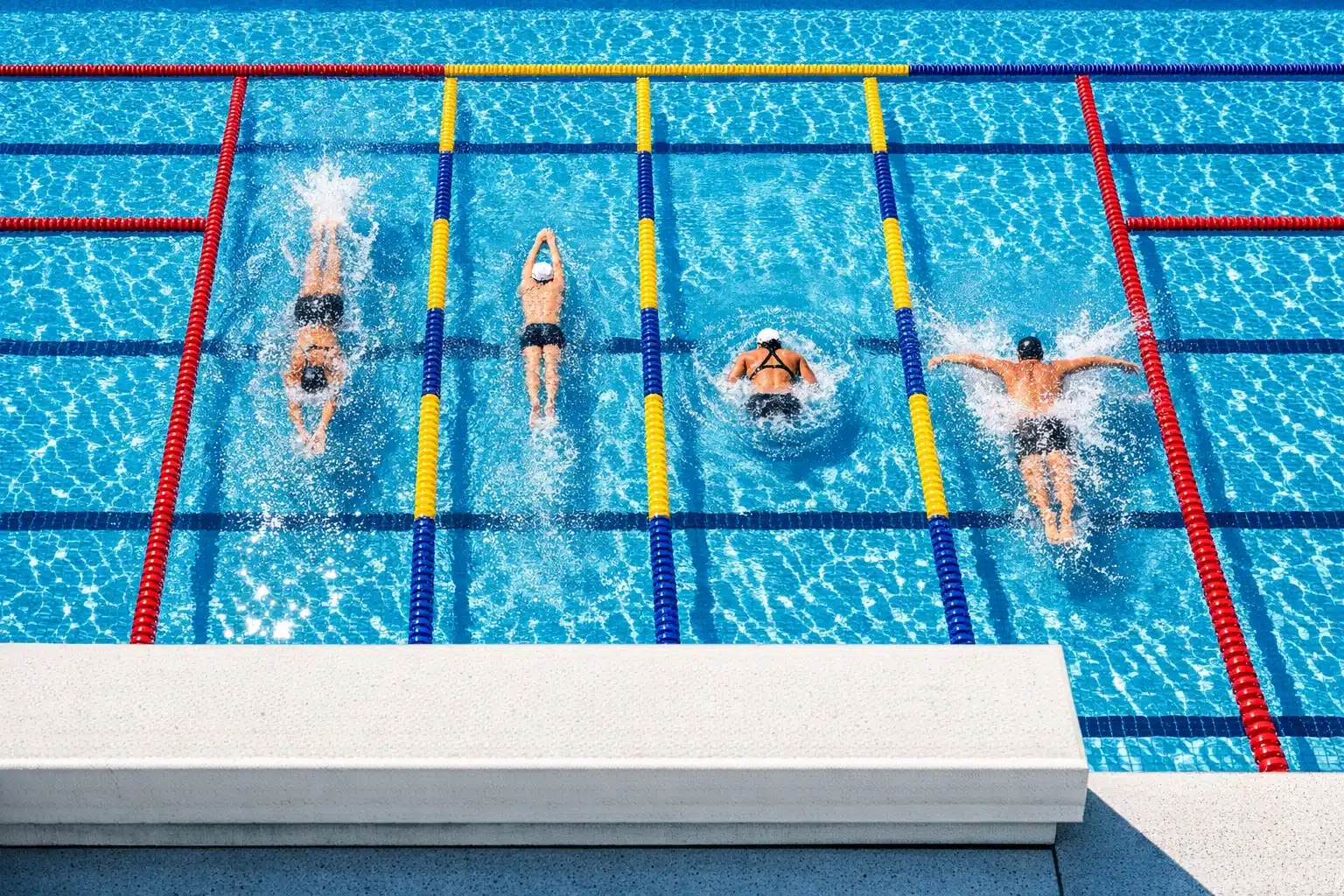
Explore the world of swimming
Swimming matters because it is more than exercise: it is movement, confidence, and water safety rolled into one skill. A calm pool can teach patience, while a hard set of laps can humble even a seasoned athlete. For children, adults, and older swimmers alike, it offers a way to build endurance without asking the joints to absorb constant pounding. That mix of usefulness and enjoyment is why swimming remains relevant in schools, clubs, therapy settings, and everyday life.
Outline
- The broad value of swimming for health, access, and everyday life
- The four main strokes and what makes each one unique
- Training methods that improve endurance, speed, and technique
- Safety principles, basic equipment, and the contrast between pools and open water
- How swimming fits into recreation, competition, and lifelong wellness
Why Swimming Matters: Health, Skill, and Accessibility
Swimming stands out because it combines physical conditioning with a practical life skill. Plenty of sports build strength or stamina, but fewer teach people how to move safely in an environment that can be both inviting and dangerous. Water has a strange honesty to it. It supports the body, yet it never lets sloppy technique hide for long. If posture collapses, breathing becomes rushed, or rhythm breaks, the swimmer feels it immediately. That direct feedback is one reason swimming can be so rewarding for beginners and advanced athletes alike.
From a health perspective, swimming checks many boxes. It can contribute to the World Health Organization guideline of at least 150 minutes of moderate aerobic activity per week for adults, and it does so with relatively low impact on knees, hips, and ankles. Compared with running, swimming usually places less repetitive stress on the joints. Compared with cycling, it engages the upper body more directly while also demanding coordinated breathing. Because water is much denser than air, even simple movements meet steady resistance, which helps turn technique drills and easy laps into meaningful exercise.
The benefits are not only physical. Many swimmers describe the pool as a place where mental clutter starts to settle. Repeating strokes, counting laps, and focusing on exhalation can create a rhythm that feels almost meditative. For some people, swimming is a break from noise and screens; for others, it is a social routine built around masters groups, school teams, or weekend lane sessions.
- It improves cardiovascular endurance through sustained whole-body movement.
- It can support muscular endurance in the shoulders, back, core, and legs.
- It often suits people seeking lower-impact exercise options.
- It develops confidence around water, which has safety value far beyond fitness.
Accessibility, of course, depends on location, cost, and available instruction. A public pool, a school program, or a community center can make a huge difference in whether someone sees swimming as an option rather than a distant skill. That matters because swimming is not just a sport for elite competitors in racing caps. It can be recreation, rehabilitation, exercise, transport in some settings, and a foundation for other activities such as surfing, triathlon, rowing support, and lifesaving. In that sense, swimming is both humble and expansive: one person chases medals, another simply learns to float, and both are doing something deeply worthwhile.
The Four Competitive Strokes and the Craft of Efficient Movement
To outsiders, swimming can look deceptively simple: get in, move forward, repeat. In reality, each stroke has its own mechanics, timing, and personality. The four competitive strokes are freestyle, backstroke, breaststroke, and butterfly, and learning their differences reveals how technical the sport really is. Freestyle, usually swum as front crawl in competition, is generally the fastest. Its alternating arm recovery, flutter kick, and side breathing pattern make it efficient over short and long distances. When freestyle clicks, the swimmer seems to slide over the surface with quiet urgency, like a zipper closing across the water.
Backstroke flips that world over. The swimmer is face-up, which removes the stress of turning to breathe, but adds the challenge of staying straight without looking forward. Timing, shoulder rotation, and body alignment matter a great deal. Backstroke often feels friendlier to some beginners because breathing is more relaxed, yet it demands strong spatial awareness and trust in lane markings and flags.
Breaststroke is different again. It is usually the slowest of the four strokes in competition, but that does not make it easy. Its whip kick, arm pull, glide phase, and precise timing make it highly technical. Small errors in rhythm can cause major loss of momentum. Many casual swimmers assume breaststroke is restful; in practice, efficient breaststroke requires patience and exactness. Done well, it looks economical. Done poorly, it feels like trying to push a shopping cart through mud.
Butterfly is the most dramatic and, for many, the most intimidating. It uses a dolphin kick and simultaneous arm recovery that place heavy demands on timing, mobility, and upper-body endurance. Yet butterfly is not just about brute force. Skilled swimmers rely on body wave mechanics, rhythm, and a well-timed catch to avoid fighting the water on every stroke.
- Freestyle rewards streamlined body position and controlled breathing.
- Backstroke emphasizes alignment, rotation, and directional awareness.
- Breaststroke depends on timing and a technically sound kick.
- Butterfly requires rhythm, coordination, and efficient body undulation.
Across all strokes, efficiency is the hidden engine. A strong swimmer is not merely someone who works hard, but someone who wastes less energy per meter. That is why coaches obsess over details such as head position, hand entry, kick tempo, and turns. In swimming, water amplifies flaws but also rewards refinement. A small adjustment can make the difference between feeling stuck and feeling smooth.
How to Train Smarter: Endurance, Speed, and Technique
Good swim training is not just endless lap counting. It is a blend of aerobic work, speed practice, technical correction, and recovery. Many new swimmers believe improvement comes mainly from doing more distance, but volume alone often hardens bad habits. A better approach is to train with purpose. One session may focus on technique, another on steady endurance, and another on short, faster efforts with generous rest. That variety helps swimmers improve without turning every workout into the same gray blur.
Endurance sets build the capacity to hold form over time. For example, repeated 100-meter or 200-meter swims at a controlled pace can teach a swimmer how to manage effort, breathing, and rhythm. Speed sets, by contrast, train explosive power and sharper mechanics under pressure. Short repeats such as 25s or 50s often reveal whether technique falls apart when pace rises. If it does, that is useful information, not failure. In swimming, honest feedback is part of the bargain.
Technique work deserves special respect because it saves energy and lowers frustration. Drills can isolate specific parts of the stroke: catch-up drill for freestyle timing, single-arm backstroke for body position, kick sets for propulsion awareness, or sculling for feel of the water. The phrase “feel for the water” can sound mystical, but it really refers to something practical: sensing how to press against water effectively instead of slipping through it without purchase.
Rest and recovery matter as much as hard intervals. Shoulders, in particular, can become overworked when swimmers rush volume or ignore strength imbalances. Dryland training can help by building stability in the core, upper back, and hips. Mobility work also matters, especially for ankles, shoulders, and thoracic spine movement.
- Technique sessions improve efficiency and reduce wasted motion.
- Aerobic sets build stamina for longer swims and better recovery between efforts.
- Sprint work sharpens power, stroke rate, and race-specific speed.
- Dryland strength supports posture, shoulder health, and kicking mechanics.
Beginners usually benefit from shorter, focused sessions rather than heroic marathons. Intermediate swimmers often improve by tracking pace, stroke count, and perceived effort. Competitive swimmers may structure training into seasons with clear goals, taper periods, and race preparation. No matter the level, progress in swimming rarely arrives as a dramatic leap. It is more often a quiet accumulation of better breaths, cleaner turns, steadier pacing, and one lovely lap where the water suddenly feels less like resistance and more like partnership.
Safety, Gear, and the Difference Between Pool and Open Water
Swimming may look serene, but safety is never optional. Even strong swimmers should respect water conditions, personal limits, and the simple truth that fatigue can arrive quickly. Pool swimming offers controlled conditions: lane lines, known depth, stable temperature, and often lifeguard supervision. Open water replaces that predictability with currents, waves, cold, reduced visibility, and navigation challenges. The difference is not small. A swimmer who feels comfortable in a pool may find a lake, river, or ocean far more demanding within minutes.
Basic safety starts with modest habits that prevent unnecessary risk. Swim with supervision when possible. Learn the rules of the facility. Do not assume that being fit on land guarantees confidence in deep water. For children, formal instruction and active adult attention matter enormously. For adults returning to swimming after years away, it is wise to rebuild gradually instead of chasing old performance too quickly.
Equipment can help, though it should support skill rather than replace judgment. Goggles improve visibility and comfort. Caps reduce drag and keep hair out of the face. Kickboards, pull buoys, fins, and paddles can all be useful training tools when used correctly. In open water, bright caps and tow floats can improve visibility to others. Wetsuits may help with buoyancy and warmth where permitted, but they do not remove the need to understand conditions.
- In pools, pay attention to lane etiquette, wall traffic, and posted rules.
- In open water, check currents, weather, water temperature, and entry and exit points.
- Use visible gear and never overestimate your ability in unfamiliar conditions.
- If in doubt, choose the safer option and shorten the session.
Another key area is emergency awareness. Swimmers should know how to stop, rest, roll to the back if needed, and call for help. Those spending time near natural water benefit from learning basic rescue principles, including avoiding impulsive entries that put rescuers at risk. In many safety contexts, the idea is “reach or throw, don’t go” unless properly trained.
The beauty of swimming should never distract from respect. Water can feel playful one moment and punishing the next. The smartest swimmers are not the ones who act fearless; they are the ones who prepare well, notice changes early, and understand that caution is not weakness. It is part of mastery.
Swimming for Life: Recreation, Competition, and a Practical Conclusion
One of swimming’s greatest strengths is that it can grow with a person over time. A child may begin by blowing bubbles and learning to float. A teenager might join a school team and discover the thrill of racing. An adult may return years later for stress relief, rehabilitation, triathlon training, or simple enjoyment. Older swimmers often value the sport because it remains challenging without demanding the same joint impact as many land-based activities. Few activities move this gracefully across life stages.
Recreational swimming and competitive swimming can look like distant relatives, yet they share the same foundations: comfort in water, efficient movement, and respect for technique. Recreational swimmers often focus on consistency and enjoyment. They may swim for thirty minutes before work, join a community class, or use the pool as active recovery. Competitive swimmers, by contrast, measure time obsessively, refine starts and turns, and chase marginal gains with surprising seriousness. Both paths are valid. The lane does not care whether the goal is a podium or a peaceful workout; it rewards attention all the same.
There is also a social dimension that deserves mention. Swim clubs, masters teams, and local facilities create communities built around shared effort. Unlike some sports that are noisy by nature, swimming balances solitude and camaraderie. Training sets can be intensely personal, but the deck before and after a session often becomes a place for advice, humor, and mutual encouragement. In that sense, the sport teaches independence without isolation.
For readers considering swimming more seriously, the most practical next step is a simple one: start where your current ability honestly is. If you are new, learn breathing, floating, and basic stroke mechanics before chasing speed. If you already swim, refine technique before adding more volume. If you are experienced, keep curiosity alive, because improvement often hides in details you once ignored.
- Start with realistic goals and build frequency before intensity.
- Invest in instruction if technique or confidence is holding you back.
- Use swimming as both exercise and a lifelong safety skill.
- Measure progress by comfort, control, and consistency, not just by time.
In conclusion, swimming is relevant to a wide audience because it offers more than a workout. It builds fitness, skill, confidence, and a deeper understanding of how the body moves through resistance. Whether your interest is health, recreation, competition, or family water safety, the sport has room for you. The water may feel demanding at first, but for those who stay with it, it often becomes one of the most rewarding places to learn, train, and keep growing.