Explore the world of swimming
Swimming occupies a rare place among physical activities because it builds fitness, teaches survival, and invites people of nearly every age into motion without the pounding many land sports demand. A quiet lane can feel meditative, yet the same water can host fierce races, careful rehabilitation, or a child’s first lesson in confidence. That range makes swimming relevant in schools, communities, and public health. Understanding how it works helps readers enjoy it more wisely and practice it more safely.
Article outline:
- The value of swimming for health, confidence, and everyday life
- The main strokes and how they differ in technique, rhythm, and purpose
- Training methods that help beginners and experienced swimmers improve
- Safety, equipment, and the important contrast between pool and open-water swimming
- How swimming fits into modern life, from recreation and therapy to competition and community
Why Swimming Matters: Fitness, Function, and Lifelong Relevance
Swimming stands out because it combines exercise, skill, and safety in one activity. Many sports improve fitness, but fewer also teach a practical response to an emergency situation around water. That makes swimming valuable far beyond leisure. A person who learns to swim gains not only a workout option but also a form of physical literacy, much like learning to ride a bicycle or cross a busy street safely. In communities with beaches, rivers, lakes, or public pools, that literacy can be especially important.
From a health perspective, swimming offers a compelling balance of cardiovascular work and muscular engagement. The water supports the body, which can reduce impact on joints compared with many land-based activities. That is one reason swimming is often recommended for people who want exercise without repeated pounding from running or court sports. At the same time, water creates resistance in every direction, so even simple movements ask the arms, shoulders, trunk, hips, and legs to contribute. A slow lap may look graceful and easy from the deck, yet in the lane it is a conversation between breath, balance, and force.
Swimming also supports public health goals in familiar ways. Health authorities commonly recommend at least 150 minutes of moderate aerobic activity per week for adults, and swimming can help meet that target. Depending on pace and body size, lap swimming can demand substantial energy while remaining gentler on the joints than many high-impact options. For older adults, people recovering from certain injuries, or beginners who find gyms intimidating, the pool can become a more welcoming place to start.
The mental side matters too. Repeating laps can calm the mind because the rhythm of breathing and movement narrows attention. Many swimmers describe the water as both demanding and quiet: you cannot drift mentally for long, but the environment strips away noise. That can make swimming feel different from crowded fitness spaces filled with mirrors and loud music.
- It builds aerobic endurance and muscular coordination at the same time.
- It can suit children, adults, older people, and many returning exercisers.
- It teaches a safety skill with obvious real-world value.
- It offers both solitary focus and social participation through lessons, clubs, and teams.
Perhaps the deepest reason swimming matters is its adaptability. One person enters the pool to race. Another arrives to recover confidence after surgery. A third simply wants half an hour away from screens and noise. Water accommodates all three. Few activities can honestly claim that range without stretching the truth, and swimming earns it every day.
Understanding the Main Strokes: Technique, Efficiency, and Feel in the Water
To the casual observer, swimming may seem like a matter of moving arms and legs until the wall arrives. In reality, the main strokes are distinct systems of timing, body position, and energy use. Learning how they differ helps swimmers choose the right stroke for their goals and understand why some feel natural while others feel almost theatrical in their complexity.
Front crawl, often called freestyle in everyday conversation, is usually the first stroke associated with speed. The body stays relatively streamlined, the kick is continuous, and the arms alternate in a rolling pattern that allows regular breathing to one side or both sides. It is the fastest common stroke in competition because it minimizes frontal resistance while maintaining continuous propulsion. For fitness swimmers, front crawl is often the default choice because it covers distance efficiently and develops aerobic capacity well. Yet its apparent simplicity can be misleading. Beginners often lift the head too high, kick from the knees instead of the hips, or rush the arms while neglecting body rotation.
Backstroke uses a similar alternating arm rhythm, but the swimmer faces upward. That shift changes everything. Breathing becomes easier because the face stays out of the water, yet navigation becomes harder because the swimmer cannot see forward. Backstroke rewards balance and body alignment; if the hips sink or the stroke becomes too wide, progress slows quickly. Many swimmers enjoy it as a contrast to front crawl because it opens the chest and gives the neck a different workload.
Breaststroke is slower for most swimmers, but it is widely loved because the head can rise naturally during each cycle and the rhythm feels less hurried. Timing is crucial: pull, breathe, kick, glide. When that sequence breaks down, breaststroke can become exhausting. It is also a stroke where flexibility, especially in the hips and ankles, influences comfort and efficiency. Recreational swimmers often choose it for relaxed pacing, although poorly executed breaststroke can place stress on the knees.
Butterfly is the most dramatic and, for many people, the most demanding. Both arms move together, the legs deliver a dolphin kick, and the stroke depends on wave-like timing through the body. When performed well, butterfly looks powerful and fluid, almost like the swimmer is briefly negotiating with gravity itself. When performed poorly, it feels brutally expensive in energy. That contrast explains why butterfly is admired even by people who do not swim it often.
- Front crawl: generally fastest and most efficient for distance
- Backstroke: excellent for balance and varied shoulder movement patterns
- Breaststroke: accessible rhythm, but highly dependent on timing and mobility
- Butterfly: powerful and technical, with a high energy cost
Technique matters more in water than many beginners expect. Because water is far denser than air, small flaws in alignment create noticeable drag. A tense neck, a sinking hip line, or a mistimed breath can make one length feel twice as hard. That is why skilled swimmers do not simply work harder; they learn to move cleaner. In swimming, efficiency is not a bonus added after strength. It is the foundation that allows strength to matter at all.
How Swimmers Improve: Lessons, Drills, Endurance, and Smart Practice
Improvement in swimming rarely comes from mindless distance alone. New swimmers often believe they must simply endure more laps, but progress usually appears faster when practice has structure. The body has to learn technical patterns while the lungs and muscles adapt to repeated effort. Put differently, swimming improvement is part fitness training and part skill acquisition. Ignore either side, and advancement slows.
For beginners, formal instruction can save months of frustration. A coach or qualified teacher can spot habits that are hard to notice from inside the water, such as crossing the midline on entry, holding the breath too long, or kicking with unnecessary stiffness. One short correction can transform how a length feels. This is one reason adult beginners should not feel embarrassed about taking lessons. In swimming, efficient habits matter early, and unlearning poor ones can be more difficult than learning correctly in the first place.
Drills are one of the most useful tools in practice because they isolate a specific skill. Catch-up drill can slow front crawl enough to highlight body rotation and reach. Kick sets help swimmers feel body line and propulsion from the hips. Single-arm work can reveal asymmetry between sides. Pull-buoy sets reduce the role of the legs and draw attention to the catch and pull phase. These exercises may seem repetitive, but they are like musical scales: not the performance itself, but the discipline that makes good performance possible.
A balanced training plan often includes several ingredients:
- Technique work for stroke mechanics and breathing control
- Easy aerobic swimming for comfort and base endurance
- Shorter, faster efforts to improve speed and power
- Recovery intervals that teach pacing rather than panic
- Optional dryland work for shoulders, core strength, and mobility
More experienced swimmers learn that pacing is a major dividing line between struggle and progress. Starting every set too hard creates sloppy technique and unreliable endurance. Swimming rewards measured effort. A well-paced set of 10 x 100 meters with consistent splits can build more useful capacity than a chaotic session filled with heroic first laps and fading finishes. Coaches often emphasize negative splitting, where the second half of an effort is swum slightly faster than the first, because it teaches control under fatigue.
Rest also has a place in good training. Shoulders, in particular, can become irritated when volume rises too quickly or technique deteriorates. Recovery does not mean laziness; it is part of adaptation. So is variety. Alternating stroke focus, changing interval structures, and mixing skill days with endurance sessions keep training productive.
The strongest long-term approach is surprisingly modest: swim consistently, learn patiently, and track progress in small increments. One cleaner turn, one calmer breathing pattern, one more repeat held at the same pace, these are the real building blocks. Swimming improvement seldom arrives like a sudden splash. More often, it gathers quietly, lap by lap, until a distance that once felt impossible becomes part of an ordinary Tuesday.
Safety, Equipment, and Environment: What Changes Between Pool and Open Water
Swimming is enjoyable and beneficial, but it asks for respect. Water can support the body beautifully while also punishing overconfidence. That dual nature is why safety should never be treated as an afterthought, especially for beginners, children, and anyone moving from a controlled pool into open water. Being fit is helpful, yet fitness alone does not guarantee safety. Conditions, supervision, and decision-making matter just as much.
In a swimming pool, many variables are controlled. Depth markings are visible, lanes create order, water temperature is usually managed, and lifeguards may be present. For instruction and technical development, this makes the pool an ideal classroom. Swimmers can focus on breathing, stroke timing, and interval training without also reading waves, tides, or changing visibility. Still, even pools require attention. Slippery decks, diving into shallow water, swimming beyond current skill level, or pushing through exhaustion can all lead to preventable accidents.
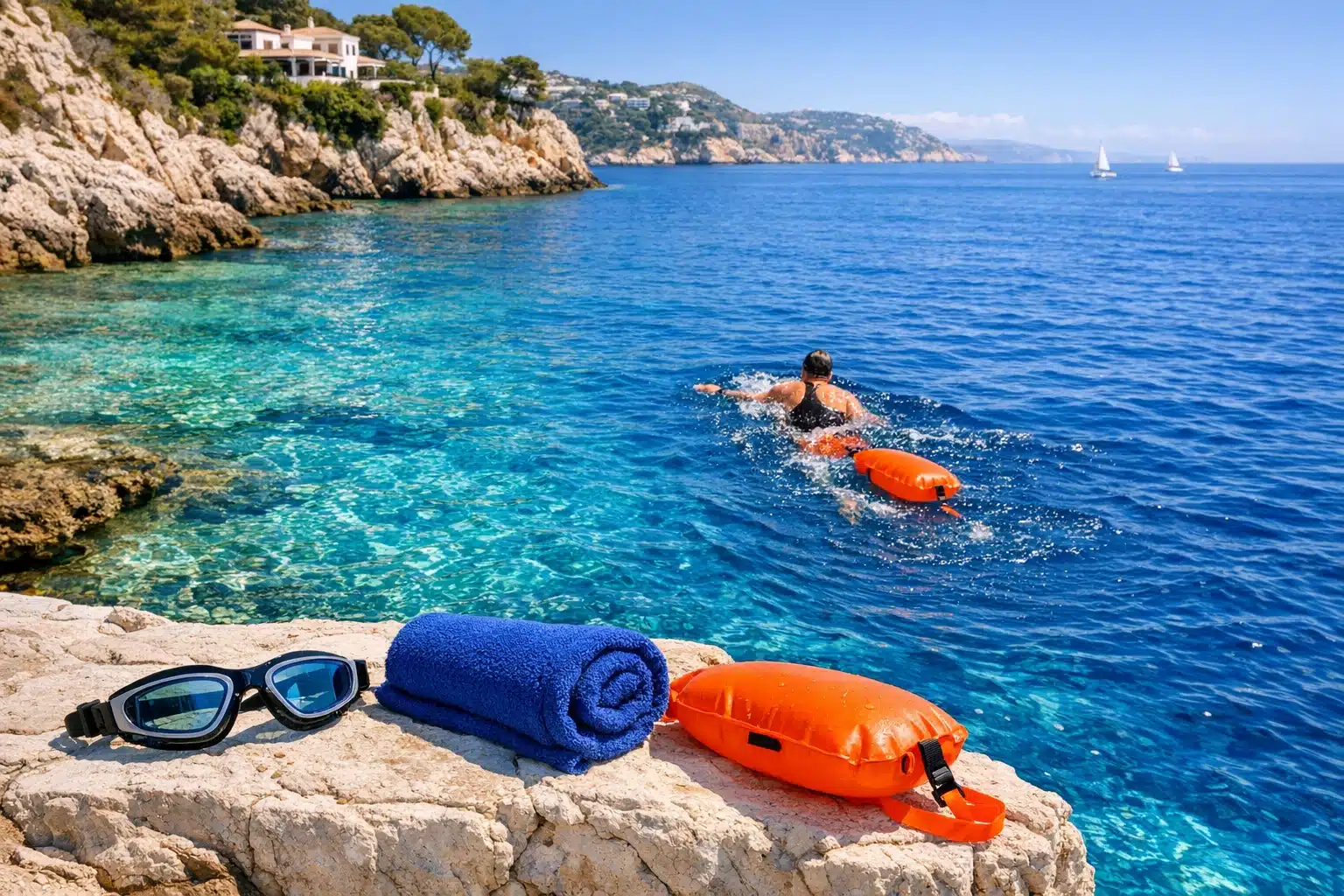
Open water introduces a different world. A lake may appear calm from shore while hiding cold pockets, weeds, drop-offs, or limited visibility. The sea adds currents, tides, surf, and shifting weather. Rivers bring flow, debris, and uneven footing. Unlike a pool wall, open water offers no easy pause every 25 or 50 meters. That is why experienced coaches advise gradual exposure. Start with supervised environments, use visible safety markers, and learn local conditions before swimming far from shore.
Basic equipment can improve comfort and focus, though no item replaces sound judgment. Common tools include:
- Goggles for clearer vision and eye comfort
- A swim cap for warmth, reduced drag, and visibility in some settings
- A kickboard or pull buoy for targeted practice
- Fins for drill work and body-position awareness
- In open water, a brightly colored tow float for visibility and emergency support
Water temperature deserves special mention. Cold water can affect breathing and coordination quickly, even in strong swimmers. Warm water, on the other hand, may feel pleasant at first but can make hard efforts uncomfortable over time. In open water, weather shifts can also change the risk picture fast. Wind can turn a manageable swim into a difficult return, and poor visibility can disrupt orientation.
For families and casual swimmers, the safest habits are simple and effective: supervise children closely, learn local rules, avoid solo swims in unfamiliar places, and never assume shallow skill will hold up under stress. For athletes, preparation should include navigation practice, knowledge of entry and exit points, and a plan for what to do if cramps, panic, or fatigue appear.
The key lesson is not to fear water, but to meet it honestly. Pools reward routine; open water rewards humility. Both can be deeply rewarding, yet each asks the swimmer to pay attention in a different way. When people do that well, safety stops feeling like a restriction and starts acting like freedom.
Swimming Across a Lifetime: Recreation, Competition, Therapy, and Community
One of swimming’s greatest strengths is that it changes meaning without losing value. A child may experience it as play. A teenager may discover competition. An adult may return to it for fitness, stress relief, or recovery after years away. An older person may find in the pool a form of movement that still feels possible, dignified, and even joyful. That adaptability gives swimming unusual staying power in modern life.
As recreation, swimming offers a kind of freedom that few activities match. It can be social without requiring direct conversation, structured without feeling rigid, and challenging without always becoming aggressive. A family visit to a community pool, an early-morning masters session, and a seaside holiday swim all belong to the same broad world, yet each serves a different emotional purpose. Water can turn exercise into play and play into a skill almost without announcing the transition.
In competition, swimming becomes a precise and highly measured sport. Small details matter enormously: the quality of the start, the underwater phase, the efficiency of turns, and the ability to hold technique when fatigue rises. Races are won by margins so small that a mistimed breath can influence the result. This precision is part of swimming’s appeal. Progress can be tracked in seconds, stroke counts, split times, and training consistency. For many athletes, that clarity is motivating because it converts effort into visible evidence.
Swimming also has an important role in therapy and rehabilitation. Because water supports body weight, it can allow movement patterns that feel difficult on land. Aquatic exercise is often used in programs aimed at restoring mobility, confidence, or general conditioning, depending on a person’s needs and medical guidance. The pool can become a bridge between inactivity and fuller movement. There is something quietly encouraging about discovering that the body can do more in water than it believed possible on solid ground.
Community is another reason swimming endures. Local clubs, school teams, learn-to-swim programs, and masters groups bring together people with different ages and goals. A fast lane and a beginner lane may sit side by side, each full of effort, each worthy of respect. That shared environment can be surprisingly democratic. Water does not care much about job titles, social media presence, or polished talk. It responds to rhythm, patience, and practice.
- For children, swimming can build confidence and safety awareness.
- For adults, it can provide sustainable exercise and stress management.
- For athletes, it offers measurable performance goals.
- For older swimmers, it can preserve mobility and routine.
In the end, swimming remains relevant because it meets people where they are. It can be serious, playful, restorative, lonely in a good way, or shared with others. Few pursuits move so comfortably between those roles. That is why people leave it, return to it, and often keep some version of it in their lives for decades.
Conclusion for Readers: Starting Well, Improving Gradually, and Enjoying the Water
If you are new to swimming, the most useful first step is not speed but comfort. Learn how to breathe calmly, float, and move with control before worrying about long distances or difficult sets. If you already swim, the clearest path to progress is usually cleaner technique, steadier pacing, and safer decisions rather than endless effort for its own sake. And if you are returning after time away, remember that water often rewards patience faster than pride.
Swimming can serve different readers in different ways. Some will approach it as a sport, chasing time drops and sharper turns. Others will value it as exercise that feels kinder to the joints than many alternatives. Many will simply want confidence in the water for travel, family life, or peace of mind. All of those goals are valid, and the encouraging part is that the early steps often overlap. Better body position, smarter breathing, and regular practice help almost everyone.
The broad lesson of swimming is simple: skill and awareness create enjoyment. When people understand the strokes, train with purpose, respect the environment, and choose goals that fit their lives, the water becomes less mysterious and more welcoming. Start where you are, learn steadily, and let progress build one length at a time. Swimming does not ask you to become someone else; it asks you to become more at ease in a place that can challenge, restore, and reward you for years.