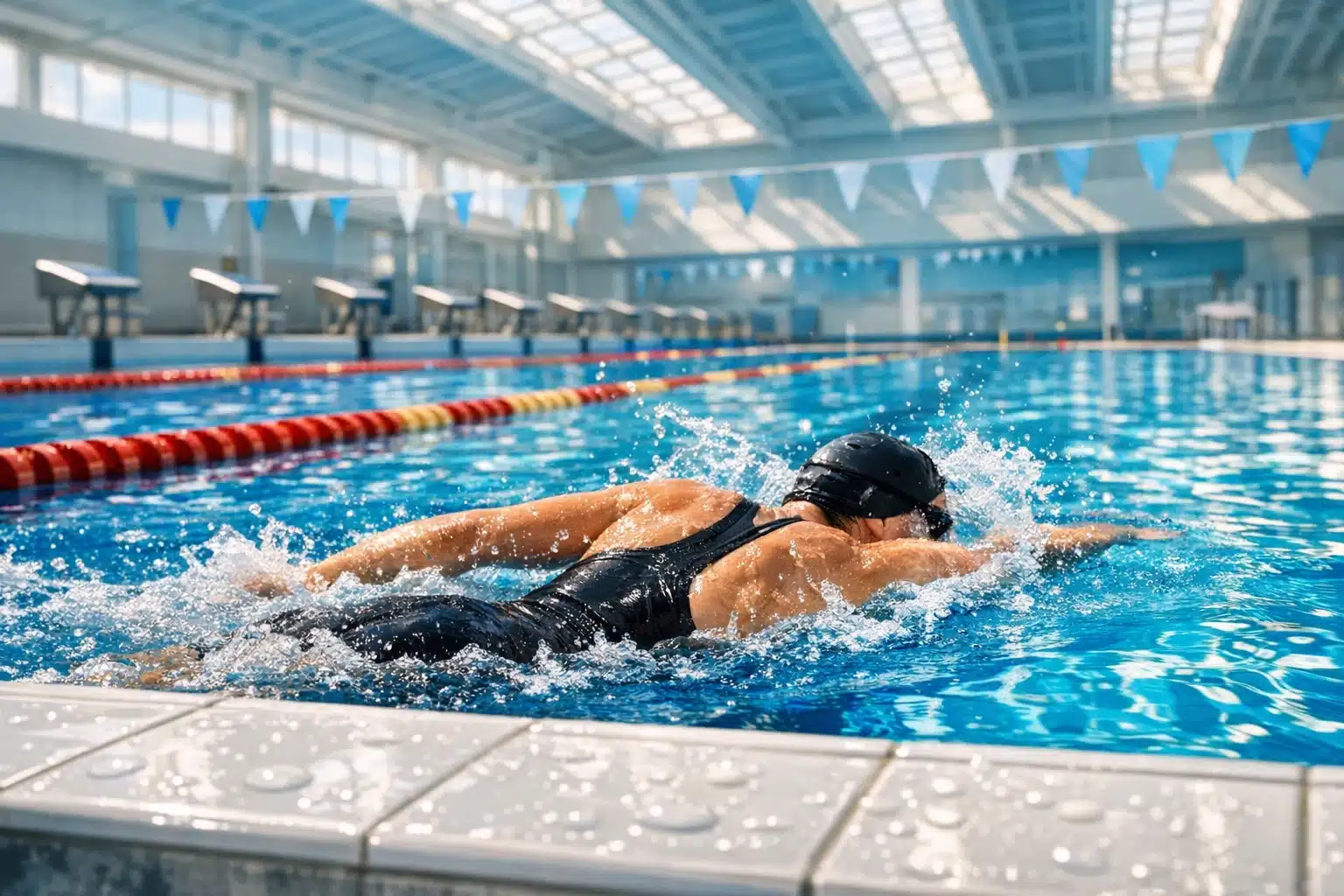
Explore the world of swimming
Swimming sits at a rare intersection of sport, life skill, and quiet pleasure. A person can enter the water to race, recover from injury, manage stress, or simply feel lighter for a while, yet the same activity also teaches breath control, coordination, and respect for the environment. Because it is accessible in pools, lakes, rivers, and oceans, swimming remains relevant across ages and goals, from early childhood lessons to masters competition and healthy aging.
Outline
- The physical and mental value that makes swimming distinct from many other activities
- The four major strokes and the technique principles that shape efficient movement
- How beginners and experienced swimmers can train with structure and purpose
- Water safety, equipment choices, and the differences between pools and open water
- Why swimming works as a competitive sport, a social activity, and a lifelong habit
Why Swimming Matters: Fitness, Health, and the Feel of Water
Swimming matters because it combines movement, breathing, coordination, and environmental awareness in a way few activities can match. On land, exercise often asks the body to absorb repeated impact. In water, buoyancy changes the equation. The body feels lighter, joints experience less stress, and motion becomes smoother even when the work is demanding. That is why swimming is often recommended for people who want cardiovascular exercise without the pounding associated with running. It is also one of the few activities that can challenge beginners and elite athletes in the same lane, with intensity adjusted by pace, distance, and technique.
From a fitness perspective, swimming trains several systems at once. The heart and lungs work continuously, the core stabilizes the body, and the arms, shoulders, back, hips, and legs all contribute to propulsion. Water is far denser than air, so every stroke meets constant resistance. That does not mean harder is always better; it means efficiency matters. A relaxed, technically sound swimmer often travels farther with less effort than someone fighting the water. In that sense, swimming feels almost like a conversation with physics. If you rush and splash, the water answers with drag. If you align and streamline, it rewards you with glide.
The mental side is just as important. Repeating laps can be meditative, especially when breathing settles into rhythm. Many swimmers describe the pool as a place where outside noise fades. Even recreational sessions can lower stress and improve mood by combining aerobic activity with a cooling, sensory environment. For children, swimming builds confidence and water competence. For older adults, it can preserve mobility and balance. For people in rehabilitation, it may offer a safe route back to movement when other exercises feel too harsh.
Swimming stands out for practical reasons too:
- It develops endurance and muscular coordination at the same time.
- It can be adapted for leisure, therapy, fitness, or competition.
- It teaches a potentially life-saving skill, not just a workout.
- It remains useful across different life stages and ability levels.
That broad relevance explains its lasting appeal. A quiet morning lap session, a child’s first floating lesson, and an Olympic final may look worlds apart, yet they all rest on the same truth: moving well in water is both deeply human and endlessly rewarding.
Understanding the Strokes: Technique, Efficiency, and Common Differences
To understand swimming, it helps to begin with its four main competitive strokes: freestyle, backstroke, breaststroke, and butterfly. Each one uses a distinct pattern of body position, kick, arm movement, and breathing, and each teaches a different lesson about efficiency. Freestyle, often called front crawl, is usually the fastest and most commonly learned stroke for fitness. Its hallmark is a long, horizontal body line, alternating arm recovery, flutter kick, and side breathing. Good freestyle does not look frantic. It looks controlled, with the swimmer rotating through the torso rather than muscling every stroke with the shoulders alone.
Backstroke shares the alternating rhythm of freestyle but flips the swimmer onto the back. Because the face stays above water, breathing is less restricted, which makes it useful for learning alignment and rotation. At the same time, backstroke demands spatial awareness. Without a black line on the pool floor in direct view, swimmers must learn to hold direction and count strokes approaching the wall. Breaststroke is very different. It uses a simultaneous arm action and a whip-like kick, with a glide phase that rewards timing. To inexperienced swimmers it can feel intuitive because the head often rises forward to breathe, but technically sound breaststroke is surprisingly precise. Poor timing turns it into a stop-and-start struggle.
Butterfly is the most dramatic stroke, powerful and rhythmic, driven by a wave-like body motion, simultaneous arm recovery, and dolphin kick. It is also the most demanding for many swimmers because it punishes inefficiency quickly. Yet when executed well, butterfly is less brute force than choreography. It resembles a carefully timed pulse through the body rather than a simple heave through the arms.
Across all strokes, a few principles keep appearing:
- Body position affects drag more than many beginners realize.
- Breathing should fit the stroke rhythm instead of disrupting it.
- Propulsion works best when arms and legs support, not contradict, each other.
- Streamlining after starts and turns can save meaningful energy.
Technique is where swimming separates itself from many land-based exercises. Two people may work equally hard, but the more efficient swimmer often moves faster with less visible effort. That is why coaches devote so much time to drills, stroke counts, and small corrections. In swimming, details are not decorative. They are the difference between fighting the water and traveling through it with purpose.
How to Learn and Train: From First Lessons to Structured Progress
Learning to swim and learning to train for swimming are related, but they are not identical. The first is about safety, comfort, and fundamental movement. The second is about repeatable technique, endurance, pacing, and adaptation. Beginners usually start with water confidence: blowing bubbles, floating, kicking with support, and coordinating a simple arm pull with controlled breathing. These early steps may seem modest, yet they build the foundation for everything that comes later. A swimmer who is tense in the water wastes energy before the workout even begins.
As skill improves, training becomes more structured. Swimmers often divide sessions into a warm-up, drills, main set, and cool-down. This format is useful because it gives each part of the practice a purpose. A warm-up raises body temperature and prepares the shoulders and hips. Drills isolate a technical theme such as high elbow catch, body rotation, or kick timing. The main set targets endurance, speed, threshold effort, or race pace. The cool-down allows the body to settle and helps reinforce smoother movement after fatigue. Even recreational swimmers benefit from this structure because it prevents every session from becoming the same medium-effort swim.
Progress usually comes from consistency, not heroic single sessions. Someone who swims three times a week for months will generally improve more than someone who crushes one brutal workout and disappears for ten days. Training variables matter:
- Distance builds aerobic capacity and comfort in the water.
- Intervals teach pace control and recovery management.
- Drills refine movement patterns before bad habits harden.
- Kick sets and pull sets can target specific weaknesses.
- Rest is part of the plan, not a sign of laziness.
For example, a beginner might swim short repeats of 25 or 50 meters with generous rest, focusing on relaxed exhalation and straight alignment. An intermediate swimmer could use sets like 8 x 100 meters at a sustainable pace with 15 to 20 seconds of rest. More advanced athletes may train with threshold sets, sprint work, turn practice, and dryland strength sessions to support shoulder stability and core control. Many also track stroke count, split times, or perceived effort to measure improvement beyond simple total distance.
There is a subtle beauty in good swimming training. At first, the water feels like something to overcome. Later, it becomes something to work with. Progress often arrives quietly: a smoother breath, a cleaner turn, a pace that suddenly feels easier. Those small breakthroughs are why swimmers keep coming back. The clock matters, but so does the sensation of moving through the lane with less friction and more confidence than before.
Safety, Equipment, and the Many Faces of Water
No discussion of swimming is complete without safety, because the ability to move in water does not cancel the risks that water presents. Pools, lakes, rivers, and oceans each create different conditions, and a smart swimmer learns to respect those differences. In a pool, the environment is controlled: lanes are marked, water temperature is managed, and lifeguards may be present. Open water is more variable. Currents, waves, visibility, sudden depth changes, weather shifts, and marine life can all affect the experience. A swimmer who feels strong in a calm lane pool may be surprised by how disorienting a choppy lake or tidal coastline can feel.
Basic safety begins with habits rather than heroics. Children need active supervision near water, not passive observation from across a room. Beginners should learn with qualified instruction when possible. Open-water swimmers should avoid going alone and should understand the route, entry and exit points, and local conditions before starting. Rip currents in the ocean, for instance, do not always look dramatic, but they can pull a swimmer away from shore quickly. Knowing to swim parallel to the shore rather than directly against the current can make a critical difference.
Equipment supports both comfort and performance, although it should never be confused with skill. Common swimming gear includes goggles, caps, kickboards, pull buoys, fins, paddles, and pace watches. Each has a role:
- Goggles protect the eyes and improve visibility.
- Caps can reduce drag slightly and keep hair more manageable.
- Kickboards isolate leg work.
- Pull buoys help emphasize upper-body mechanics.
- Fins can improve body position and ankle flexibility when used thoughtfully.
Still, gear is most useful when it serves a clear purpose. Overreliance can hide technical problems rather than fix them. A swimmer wearing fins may feel fast, but that speed can vanish when the fins come off if the underlying body line remains poor. The same caution applies to technology. Watches and training apps are helpful, yet awareness matters more than data alone.
Swimming environments also shape experience in emotional ways. A public pool often feels precise and measurable, with tiles, lane ropes, and clocks setting the rhythm. Open water can feel vast and almost literary, like stepping into a page where the horizon becomes part of the workout. Both settings are valuable. The wise swimmer enjoys them with preparation, humility, and a clear understanding that confidence should always walk beside caution.
Swimming for Competition, Community, and a Lifetime of Enjoyment
Swimming can be intensely competitive, wonderfully social, or quietly personal, and that flexibility helps explain its staying power. At the competitive level, the sport is built on exact measurements and tiny margins. Races are won by fractions of a second, and success depends on starts, turns, underwater phases, pacing, and technical discipline as much as raw fitness. Competitive swimmers often train multiple times per week, sometimes daily, balancing volume with speed work and recovery. Events range from explosive 50-meter sprints to long-distance open-water races where strategy and mental resilience become central.
Yet swimming is not reserved for elite athletes. Age-group clubs, school teams, masters programs, triathlon communities, and public fitness lanes all create entry points for different goals and abilities. A masters swimmer in their sixties may train next to a teenager preparing for a championship meet, and both can find meaning in the same pool. That shared space is one of swimming’s quiet strengths. The sport accommodates ambition without demanding a single definition of success.
Community matters because swimming can otherwise become solitary. Long sets, black lines, and internal focus are part of the culture, but support systems keep motivation alive. Coaches provide technical guidance and accountability. Lane partners create pacing challenges and camaraderie. Local clubs introduce structure for people who struggle to stay consistent on their own. Even casual rituals help: the nod before a set begins, the brief conversation at the wall, the mutual understanding that everyone in the lane is negotiating the same water in a different way.
Swimming also adapts well across the lifespan. It works for children learning coordination, adults managing sedentary routines, and older people seeking low-impact exercise. Para swimming shows another important dimension: the sport can be modified around different physical conditions while still preserving high standards, fierce competition, and technical excellence. That adaptability is not an incidental feature. It is one of swimming’s defining qualities.
For lifelong enjoyment, goals should remain flexible. Some swimmers chase medals. Others want stress relief, stronger lungs, better posture, or the confidence to enjoy holidays by the sea. All of those goals are valid. If the pool becomes a place of punishment, motivation fades. If it becomes a place of challenge with room for curiosity, people tend to stay. The water has a way of teaching patience. You cannot bully it into cooperation. You learn, adjust, and return. Over time, that rhythm becomes more than exercise. It becomes part of how a person lives well.
Conclusion for New Swimmers, Fitness Enthusiasts, and Water-Lovers
Swimming rewards many kinds of people because it meets many kinds of needs. If you are a beginner, it offers a practical skill that can build confidence and safety. If you are focused on fitness, it delivers full-body work with low impact and nearly endless room for progression. If you already love the water, it can become a lasting ritual shaped by technique, discipline, and simple joy. The best next step is not necessarily dramatic; it may be a lesson, a weekly session, or a decision to pay closer attention to form. In swimming, small improvements accumulate, and before long the water that once felt unfamiliar begins to feel like a place where you truly belong.