Explore the world of swimming
Swimming is one of those rare activities that can feel playful and demanding at the same time. A quiet lane at dawn, a crowded public pool in summer, or a long stretch of open water each reveals a different side of the sport. It builds endurance, coordination, and confidence while offering a lower-impact option for people who want movement without constant pounding on the joints. That mix of challenge and accessibility keeps swimming relevant across ages, goals, and lifestyles.
Article Outline
This article explores swimming in five detailed parts. First, it explains why swimming is often described as a full-body activity with broad physical and mental benefits. Second, it breaks down the main strokes and the technical habits that make movement through water more efficient. Third, it looks at training, safety, and beginner-friendly equipment. Fourth, it compares recreational swimming, pool competition, and open-water experiences. Fifth, it examines how swimming serves different people, from children learning water confidence to adults training for health, performance, or lifelong mobility.
Why Swimming Stands Out as a Full-Body Activity
Swimming has a special place in sport because it combines cardiovascular training, muscular effort, coordination, breath control, and mobility in one setting. Unlike many land-based activities, it takes place in an environment where the body is supported by water. That support matters. Buoyancy reduces the impact on joints, which is one reason swimming is often recommended for people who want exercise without the repeated force that comes from running on pavement or jumping in a gym. At the same time, water is much denser than air, so every stroke meets resistance. In simple terms, the pool feels forgiving and demanding at once.
From a fitness perspective, swimming can help improve heart and lung function, muscular endurance, and overall work capacity. It engages the shoulders, back, chest, core, hips, and legs, and even easy swimming asks the body to coordinate these parts smoothly. Public health guidelines from major organizations such as the CDC recommend at least 150 minutes of moderate aerobic activity per week for adults, and swimming fits that recommendation well. The intensity can be adjusted almost endlessly. A slow backstroke session for recovery feels very different from a timed freestyle set, yet both can support health goals.
Swimming also compares favorably with other popular forms of exercise:
• Compared with running, it usually places less stress on knees and ankles.
• Compared with cycling, it trains the upper body more directly.
• Compared with many gym machines, it develops timing, rhythm, and body awareness in a more integrated way.
The mental side deserves equal attention. Many swimmers describe the water as a place where noise fades and focus sharpens. Counting strokes, regulating breathing, and feeling the body glide forward can be oddly meditative. For some people, that calm is the main attraction. For others, it is the challenge of shaving seconds from a lap or learning a skill that once felt impossible. Swimming can be social in lessons and club sessions, but it can also be wonderfully solitary, like writing a private note one lap at a time.
This broad appeal explains why swimming remains relevant. It serves the child splashing through first lessons, the adult returning to fitness after years away, the athlete building endurance, and the older swimmer preserving mobility. Few activities adapt so well across such different bodies and ambitions.
Understanding Strokes, Technique, and Efficiency in the Water
At first glance, swimming can seem simple: move the arms, kick the legs, and try not to swallow water. In reality, technique shapes almost everything. Good swimmers do not just work harder; they move more efficiently. Because water resists motion from every angle, small technical changes can produce a noticeable difference in speed, comfort, and energy use. That is why beginners often feel exhausted after a short distance, while experienced swimmers appear to slide forward with surprising ease.
The four main competitive strokes are freestyle, backstroke, breaststroke, and butterfly. Freestyle, often swum as front crawl, is usually the fastest and most efficient for distance. The body stays long, the kick is relatively narrow, and the arms recover over the water in a smooth rhythm. Backstroke uses a similar alternating arm pattern but turns the swimmer onto the back, which changes breathing and spatial awareness. Breaststroke is often easier for beginners to understand because the face can stay forward more often, yet it is highly technical; timing the pull, kick, and glide makes a huge difference. Butterfly is the most explosive and physically demanding of the four, requiring coordinated dolphin kicks, upper-body power, and precise timing.
Across all strokes, a few core principles matter:
• Body position should stay as streamlined as possible.
• Breathing needs to support rhythm instead of interrupting it.
• Kicks should assist balance and propulsion, not create unnecessary drag.
• The head should remain calm and aligned rather than lifting excessively.
Drag is the invisible opponent in every lane. When hips sink, when the head lifts too high, or when arms cross awkwardly, the swimmer creates more resistance. A useful comparison is the difference between a clean arrow and a flat board moving through water. Both can move, but one cuts through with far less waste. Coaches spend a great deal of time on drills for exactly this reason. Catch-up drills, fingertip drag, kick sets, and sculling exercises may look repetitive from the deck, yet they teach balance, feel, and control.
Technique also affects safety and enjoyment. A swimmer who learns to exhale steadily underwater, rotate naturally during freestyle, and relax the neck will usually feel more confident and less fatigued. That confidence opens the door to longer sessions and better progress. In swimming, efficiency is not a luxury reserved for elite athletes. It is the foundation that turns effort into movement and movement into pleasure.
Training, Safety, and How Beginners Can Start Well
Starting swimming can be humbling. Someone may be fit on land, strong in the gym, or comfortable on a bicycle, then enter the pool and discover that one length feels like a small expedition. That experience is normal. Water demands skill as much as stamina, so beginners improve fastest when they combine patience with structure. The goal in the early stage is not to swim endlessly. It is to build confidence, sound habits, and a routine that feels realistic.
A practical beginner session often includes a short warm-up, a few technique drills, several short swims with rest, and an easy cooldown. Instead of trying to power through twenty continuous minutes, a new swimmer might complete sets such as 6 x 25 meters or 4 x 50 meters with generous pauses. This method keeps technique from collapsing too quickly and helps the body adapt. As comfort improves, distance and intensity can increase. Many swimmers benefit from learning with a coach, joining a masters group, or taking adult lessons, because feedback on breathing and body position can save months of frustration.
Basic gear is simple but useful:
• Goggles improve visibility and reduce irritation from pool chemicals.
• A well-fitted swimsuit allows free movement.
• A swim cap can reduce drag and keep hair manageable.
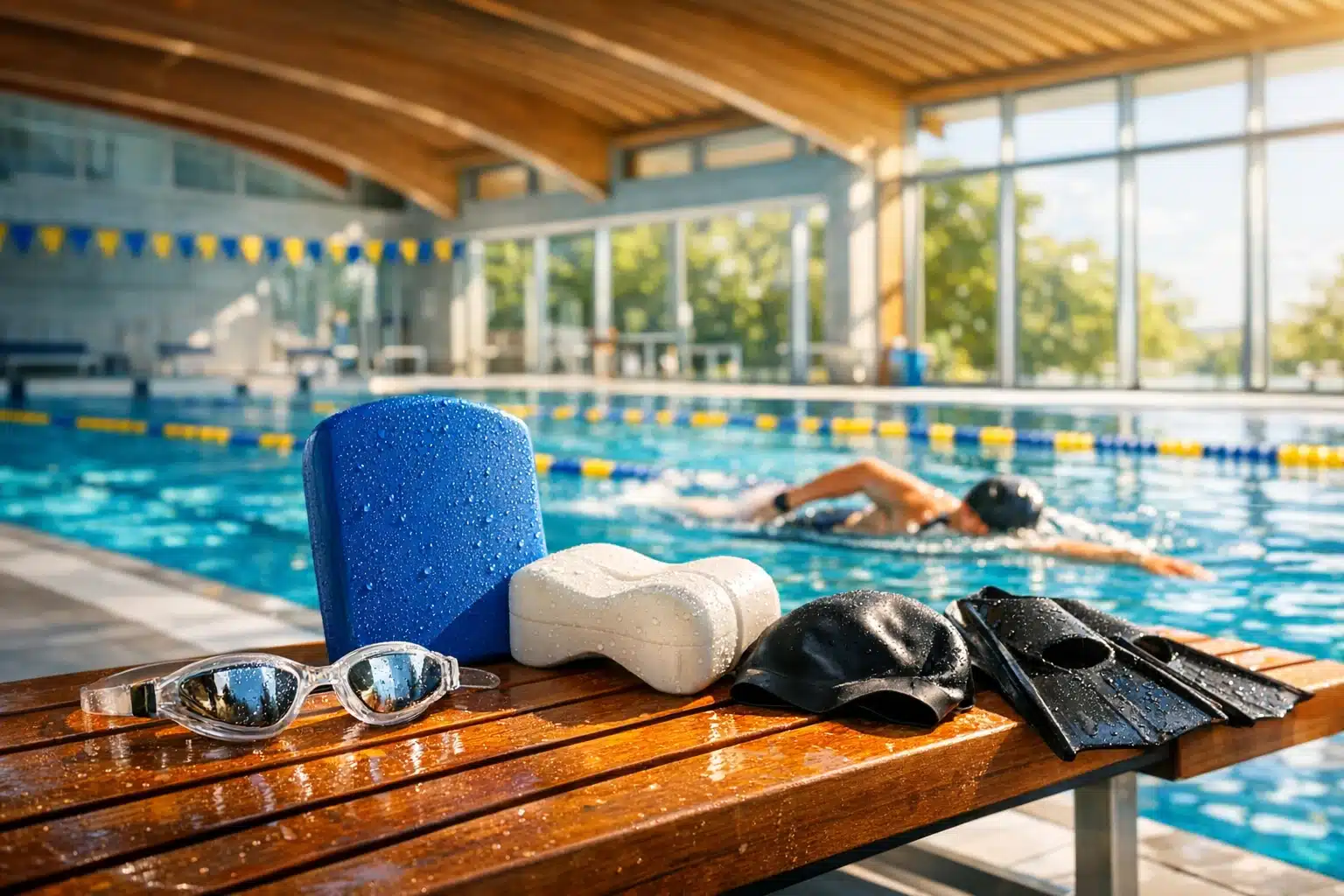
• A kickboard and pull buoy help isolate parts of the stroke during practice.
• Fins can support body position, though they should be used thoughtfully rather than as a constant crutch.
Safety is as important as training. In pools, that means obeying lane etiquette, checking depth before diving, and respecting lifeguard instructions. In open water, the safety checklist becomes much longer. Water temperature, visibility, currents, boat traffic, and weather can change conditions dramatically. Even strong pool swimmers should not assume open water will feel the same. Swimming with a partner, using a brightly colored tow float, and knowing the course are sensible precautions. Cold water can impair breathing and coordination very quickly, so preparation matters.
There are also small details that improve sessions more than people expect. Showering before entering a pool supports hygiene. Hydration still matters even though the body is surrounded by water. A few minutes of shoulder and ankle mobility before swimming can make the first lengths feel smoother. Perhaps most importantly, progress should be measured in more than speed alone. Better breathing, cleaner turns, and finishing a session with energy left in the tank are signs of improvement too. Swimming rewards consistency. Show up, listen to the water, and the body gradually learns the language.
Recreational Swimming, Competition, and the Challenge of Open Water
Swimming is not one experience but several related worlds sharing the same element. Recreational swimming might mean family time at a community pool, easy laps before work, aqua fitness, or floating on holiday with no stopwatch in sight. Competitive swimming is more exacting, with starts, turns, split times, stroke rules, and carefully planned training cycles. Open-water swimming adds another layer altogether, replacing lane ropes and tiled walls with currents, sighting, and the wide psychological space of lakes, rivers, or sea. Each version asks different questions of the swimmer.
In a pool, measurements create order. Lanes are fixed, distances are known, and pace can be tracked with precision. This makes the pool ideal for structured training. Swimmers can repeat sets, compare times, and refine technical details such as underwater push-offs and turns. Competitive events commonly take place in 25-meter, 25-yard, or 50-meter pools, and the difference between short-course and long-course racing can be significant because more walls usually mean more turns and more opportunities to gain speed from push-offs. A race may last under a minute or stretch across longer endurance events, but every detail counts.
Open water feels different from the first stroke. There is no black line on the bottom to follow, and the water itself may move independently of your intentions. Sighting becomes essential, since swimmers must occasionally look forward to stay on course. Wetsuits may be allowed in certain events depending on temperature and regulations, adding buoyancy and warmth. Even experienced athletes often describe open-water swimming in poetic terms because it can feel both liberating and slightly wild. One moment the surface is glassy and bright; the next it turns choppy and argumentative.
The comparisons are revealing:
• Recreational swimming emphasizes enjoyment, confidence, and general fitness.
• Pool competition values precision, repeatability, and measurable performance.
• Open water rewards adaptability, calm decision-making, and environmental awareness.
None of these forms is superior in every way. A recreational swimmer may find more lifelong satisfaction in steady lap sessions than in racing. A competitive swimmer may love the discipline of chasing technical perfection. An open-water enthusiast may treasure the emotional pull of swimming beyond the pool walls. What connects them is the same essential lesson: progress comes from understanding how body, breath, and water interact. Whether the goal is a relaxed weekend swim or a finish line under race banners, the appeal lies in turning resistance into motion and uncertainty into rhythm.
Swimming Across Ages, Goals, and Everyday Life
One of swimming’s strongest qualities is how well it adapts to changing needs. For children, it can be a life skill before it becomes a sport. Learning to float, kick, breathe, and move confidently in water can build safety awareness along with physical literacy. That matters on a public health level as well as a personal one. The World Health Organization has reported hundreds of thousands of drowning deaths globally each year, which is one reason water competence and supervision remain so important. Lessons do not remove all risk, but they can reduce vulnerability and create habits that last.
For teenagers and young adults, swimming often becomes more goal-oriented. Some pursue club training, school competitions, or triathlon. Others use it to balance sports that place heavier strain on the body. Because swimming develops aerobic capacity without the same impact load as many court and field sports, it can complement broader athletic training. It also teaches discipline in a distinct way. Improvements may come in fractions of seconds, and technique must be revisited constantly, which can build patience alongside ambition.
Adults often come to swimming with practical goals: improving fitness, managing stress, losing weight, recovering after injury, or finding an exercise routine they can sustain. Swimming can support these aims well, especially when combined with realistic expectations. It is not a magic shortcut, and nutrition still matters in body-composition goals, but it can be an effective part of a balanced plan. For people with joint discomfort, pregnancy-related movement needs, or a return to exercise after long inactivity, water often provides a more approachable environment than high-impact classes.
Older adults may value swimming for different reasons again:
• It can help maintain mobility and general endurance.
• It offers resistance without heavy external loads.
• It can support social connection through regular classes or lane-swim communities.
• It may feel safer and more comfortable than activities involving quick directional changes.
There are barriers, of course. Access to pools, lesson costs, body-image concerns, and fear of deep water can all discourage participation. That is why welcoming facilities and patient instruction matter so much. A good swimming culture does not assume everyone arrives confident. It makes room for late starters, nervous adults, and people whose goals are modest but meaningful. In everyday life, swimming can be many things: training, therapy, recreation, quiet thinking time, or simply an hour when the body remembers how to move with flow instead of force. That flexibility is part of its lasting power.
Conclusion for Readers Ready to Dive In
Swimming rewards curiosity more than bravado. If you are new to it, the smartest first step is not chasing speed but learning comfort, breathing, and basic technique in a safe setting. If you already swim, there is always another layer to explore, whether that means smoother freestyle, better endurance, or the confidence to try open water. The beauty of the sport is that it meets people where they are and still gives them room to grow.
For casual readers, swimmers returning after a break, or anyone searching for a versatile form of exercise, swimming offers a rare blend of fitness, skill, and calm. It can challenge the body without punishing every joint, and it can sharpen focus without requiring a noisy environment. Start small, stay consistent, and let progress arrive lap by lap. In the water, improvement often feels quiet at first, but it is real, and it tends to last.