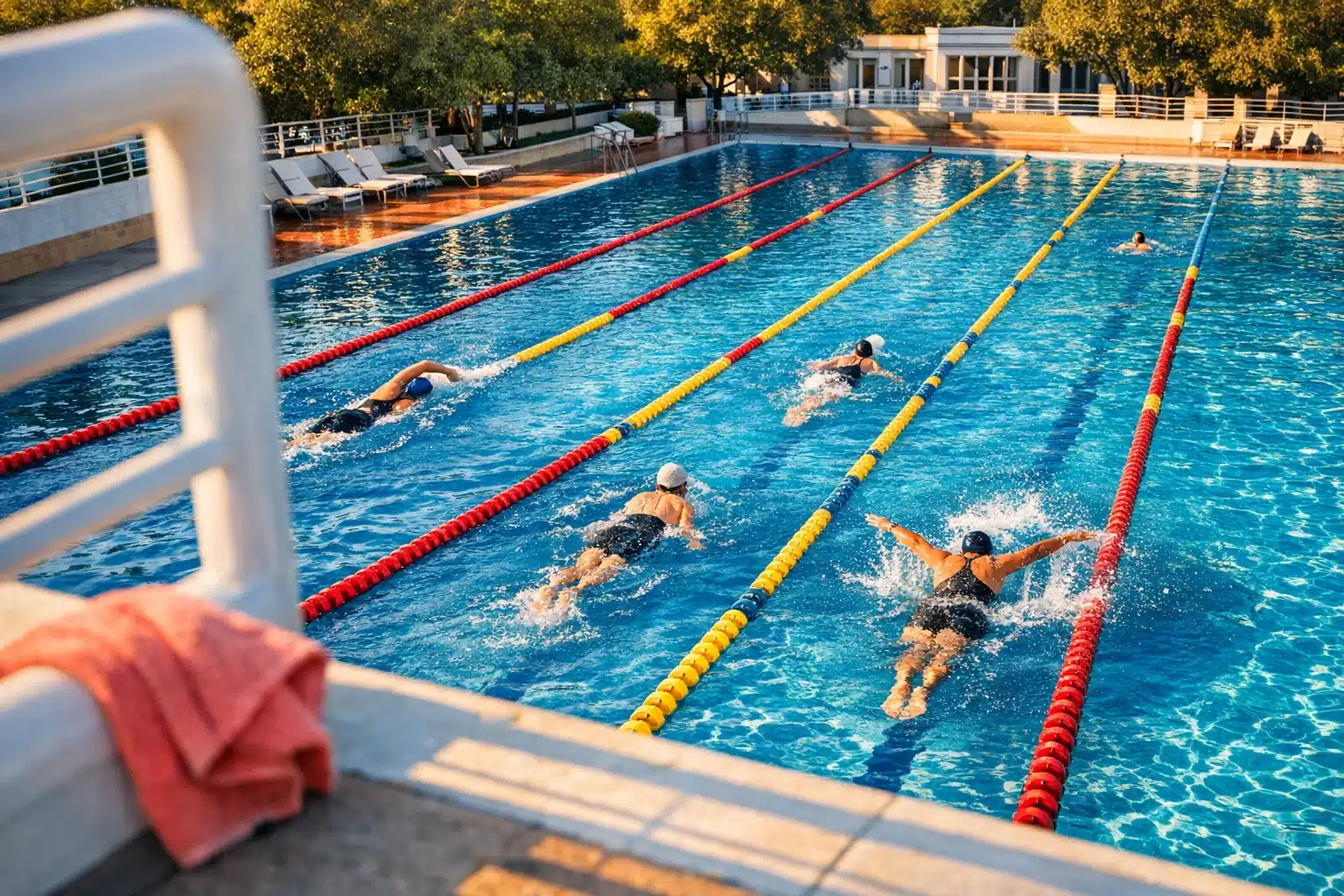
Explore the world of swimming
Swimming sits at a rare crossroads where survival skill, sport, therapy, and recreation meet. Few activities ask the body to work this hard while feeling this smooth, because water supports movement even as it resists every stroke. That balance makes swimming relevant to children learning confidence, adults seeking low-impact fitness, and athletes chasing efficiency. In a fast, noisy world, the pool can feel like a reset button: lane lines, measured breaths, and the quiet rhythm of forward motion.
Outline:
- Why swimming matters as a life skill, sport, and leisure activity
- How swimming benefits cardiovascular health, strength, mobility, and mental well-being
- The differences between freestyle, backstroke, breaststroke, and butterfly
- How to begin training, choose basic equipment, and stay safe in pools and open water
- Why swimming can remain valuable across different ages, goals, and lifestyles
Swimming as a Life Skill, Sport, and Universal Form of Movement
Swimming is often introduced as a sport, yet its importance begins much earlier than competition. At its core, swimming is a life skill. Knowing how to stay afloat, control breathing, and move through water can improve safety in everyday situations, from a family beach trip to an unexpected fall into deep water. That practical value gives swimming a seriousness that many recreational activities do not share. At the same time, it would be unfair to describe it only in terms of safety, because swimming is also enjoyable, expressive, and surprisingly varied.
Historically, people swam for survival, travel, military training, and work long before formal races existed. Over time, swimming evolved into organized recreation and eventually into one of the world’s most recognized Olympic sports. Today it spans a wide spectrum: infant water familiarization, school lessons, masters training, synchronized routines, open-water challenges, triathlon preparation, and gentle exercise for older adults. Few activities reach so many people across so many stages of life.
One reason swimming remains so widely relevant is its adaptability. A runner usually needs firm ground and healthy joints. A cyclist needs a suitable bike and road conditions. A swimmer needs access to safe water, but once that requirement is met, the activity can be adjusted in many ways. It can be slow and meditative, fast and tactical, social and playful, or intensely competitive. A quiet lap session before sunrise feels very different from a crowded public pool on a summer afternoon, yet both still belong to the same world.
Swimming also changes the athlete’s relationship with movement. On land, gravity dominates. In water, buoyancy softens impact while resistance surrounds the body from every direction. That means even simple motions become full-body work. The result is a sport that teaches coordination in an unusual environment, asking the swimmer to think about posture, timing, breath, and balance all at once.
Its broad appeal can be summarized in a few simple roles:
- It is a safety skill with real-world value.
- It is a complete form of exercise.
- It is a competitive sport with technical depth.
- It is a leisure activity that many families can enjoy together.
That range is what makes swimming special. It is not just something people do in water; for many, it becomes a lifelong language of movement.
Health Benefits of Swimming for Body, Mind, and Long-Term Fitness
Swimming is often praised as a full-body workout, and that description is accurate, but it does not fully capture why the activity is so useful. Water creates constant resistance, which means the arms, legs, back, shoulders, and core all contribute to movement. Unlike many land-based workouts, however, swimming does this without repeated pounding on the hips, knees, and ankles. That low-impact quality makes it attractive to a wide range of people, including beginners, older adults, and those returning to exercise after injury, provided they have medical clearance where needed.
From a cardiovascular perspective, swimming can support heart and lung health in the same way other aerobic exercises do. Public health guidance commonly recommends at least 150 minutes of moderate-intensity activity per week for adults, and swimming can help meet that target. A steady lap session raises the heart rate, challenges breathing control, and builds endurance over time. More intense intervals can push the workout into vigorous territory, which is why swimmers often improve stamina even when sessions are relatively short.
The benefits extend beyond endurance. Water is far denser than air, so every pull and kick meets meaningful resistance. That makes swimming useful for muscular endurance and general strength development. It will not replace heavy strength training for maximal power, but it can improve functional control and total-body coordination. Many people also notice better posture because effective swimming rewards a long spine, engaged core, and balanced body position.
Mental well-being is another major reason swimmers stay with the sport. The repetitive rhythm of strokes and breathing can feel almost meditative. For some, the pool provides structure and calm after a stressful day. For others, it offers a break from screens, traffic, and noise. The sensory experience matters too: the muffled sound underwater, the clear boundaries of a lane, and the focus required by each length can create a rare kind of concentration.
Commonly cited advantages include:
- Improved aerobic capacity and endurance
- Low-impact movement that is often easier on joints
- Whole-body muscular engagement
- Better breath control and movement efficiency
- A calming, routine-building effect that may support mental health
Of course, results depend on consistency, technique, and overall lifestyle. Swimming is not a magic shortcut, and calorie burn varies by body size, stroke, and intensity. Still, as a practical tool for long-term fitness, it offers a rare mix of challenge and accessibility. That is why swimmers range from serious competitors to people who simply want a healthier, steadier way to move through the week.
Understanding the Main Strokes and the Technique Behind Efficient Swimming
To an untrained eye, swimming can seem simple: get in, move forward, keep breathing. In reality, technique shapes nearly everything. Two swimmers may put in the same effort, yet one glides smoothly while the other fights the water on every length. That difference comes down to position, timing, and efficiency. Water is unforgiving in that way; it rewards economy and exposes wasted motion immediately.
The four main competitive strokes are freestyle, backstroke, breaststroke, and butterfly. Freestyle, usually performed with the front crawl, is the fastest and most common stroke for fitness swimming. It relies on a streamlined body line, alternating arm recovery, and a flutter kick. Because the face is in the water most of the time, breathing rhythm becomes central. Beginners often lift the head too much to inhale, which causes the hips to sink and increases drag. Learning to rotate the body and breathe to the side usually makes the stroke more efficient almost at once.
Backstroke is often described as freestyle on the back, but it comes with its own challenges. Breathing is easier because the face stays above water, yet body alignment becomes critical. If the hips drop or the kick becomes uneven, momentum fades quickly. For some swimmers, backstroke feels liberating; for others, it feels like navigating the ceiling without a map.
Breaststroke is slower than freestyle but highly technical. Its pull, breath, kick, and glide must work in sequence. Many recreational swimmers like it because the head can come forward regularly and the pace feels controlled. However, breaststroke also places distinct demands on the knees and hips, so clean technique matters. Butterfly is the most dramatic and demanding of the four. It requires coordinated arm recovery, strong timing, and a dolphin kick driven from the core and hips. When done well, it looks like motion carved into water. When done poorly, it feels like wrestling a wave that refuses to cooperate.
Across all strokes, a few principles matter repeatedly:
- Maintain a long, balanced body position.
- Exhale steadily instead of holding the breath.
- Reduce unnecessary splash and tension.
- Let timing, not just force, create propulsion.
Technique is why coaching, video review, and patient practice matter so much. Swimming is not purely about effort. It is about learning how to spend effort wisely. That is one reason the sport stays interesting for years: there is always a smoother turn, a cleaner catch, a calmer breath, or a more efficient line to discover.
Getting Started with Swimming: Training Structure, Equipment, and Safety
Beginning a swimming routine can feel intimidating, especially for adults who did not grow up in lessons or on a swim team. The good news is that progress usually comes from consistency, not heroics. A beginner does not need to swim long distances on day one. In fact, shorter sessions with rest intervals often work better because they allow technique to improve before fatigue turns every stroke into survival mode.
A practical starting structure is simple: a warm-up, a skill-focused middle section, and a short cool-down. For example, a newer swimmer might begin with easy lengths, then alternate short swims and rest, and finish with relaxed backstroke or gentle kicking. As comfort improves, total distance and interval difficulty can increase gradually. Intermediate swimmers often benefit from sets that target a specific purpose, such as endurance, speed, or stroke mechanics. Competitive swimmers go further, using detailed plans that include pacing, turns, starts, and dry-land work.
Basic equipment is straightforward. A swimsuit that allows free movement is essential, and goggles are often the single most helpful purchase because they reduce irritation and let the swimmer maintain proper head position. A swim cap is useful in many pools and practical for reducing hair drag. Kickboards, pull buoys, fins, and paddles can all support training, though they should be used with intention rather than as distractions.
Useful starter gear includes:
- Comfortable swimsuit
- Well-fitting goggles
- Swim cap if needed
- Towel and water bottle
- Optional training aids for drills
Safety deserves equal attention. Pool rules are not decorative, and open water introduces risks that pools do not. New swimmers should choose supervised environments when possible, respect depth markers, and avoid overestimating their ability. Open-water swimmers need added caution because waves, currents, low visibility, and cold temperatures can change conditions quickly. Swimming with a partner or organized group is a far better choice than going alone.
Key safety habits include:
- Never ignore fatigue or cramping
- Learn basic floating and treading-water skills
- Understand local water conditions before entering natural water
- Use lifeguarded areas whenever available
- Build distance gradually instead of chasing numbers
Swimming rewards patience. At first, one length may feel long. Later, ten lengths may feel like a warm-up. That transformation often comes quietly, almost without announcement, until one day the swimmer notices that the water feels less like an obstacle and more like a place they know how to move through with confidence.
Conclusion: Why Swimming Remains Worth Learning, Practicing, and Keeping for Life
For beginners, swimming can start as a practical goal: feel safer in the water, complete a few lengths without panic, or learn to breathe without breaking rhythm. For fitness-focused adults, it may become a reliable way to train hard without punishing the joints. For children, it can build confidence early. For older adults, it can preserve mobility, routine, and enjoyment. That broad usefulness is the clearest sign that swimming is more than a seasonal hobby.
What makes the sport especially compelling is the combination of simplicity and depth. On the surface, the task is easy to describe: move across the water. Yet every part of the experience can be refined. A slightly better hand entry can reduce drag. A calmer exhale can make a whole set feel easier. A smarter training plan can turn random effort into visible improvement. This means swimming stays fresh for a long time. It meets the casual participant and the ambitious athlete on equal terms, then gives each one room to grow.
There is also something quietly memorable about the environment itself. Pools and open water strip movement down to essentials. Breath matters. Balance matters. Attention matters. Progress is measurable, but it is also felt. The swimmer senses it in a smoother glide, a steadier heartbeat, or the moment a once-difficult distance becomes manageable. That feeling keeps people coming back, not because swimming is easy, but because it is honest.
If you are the kind of reader looking for a sport that can support health, teach discipline, and remain relevant for years, swimming deserves serious consideration. Start with technique, learn safety habits early, and be realistic about improvement. Do not worry about looking fast before you learn how to move well. The water has a way of rewarding patience. In time, what begins as effort can become rhythm, and what begins as a lesson can become part of how you care for your body and mind.