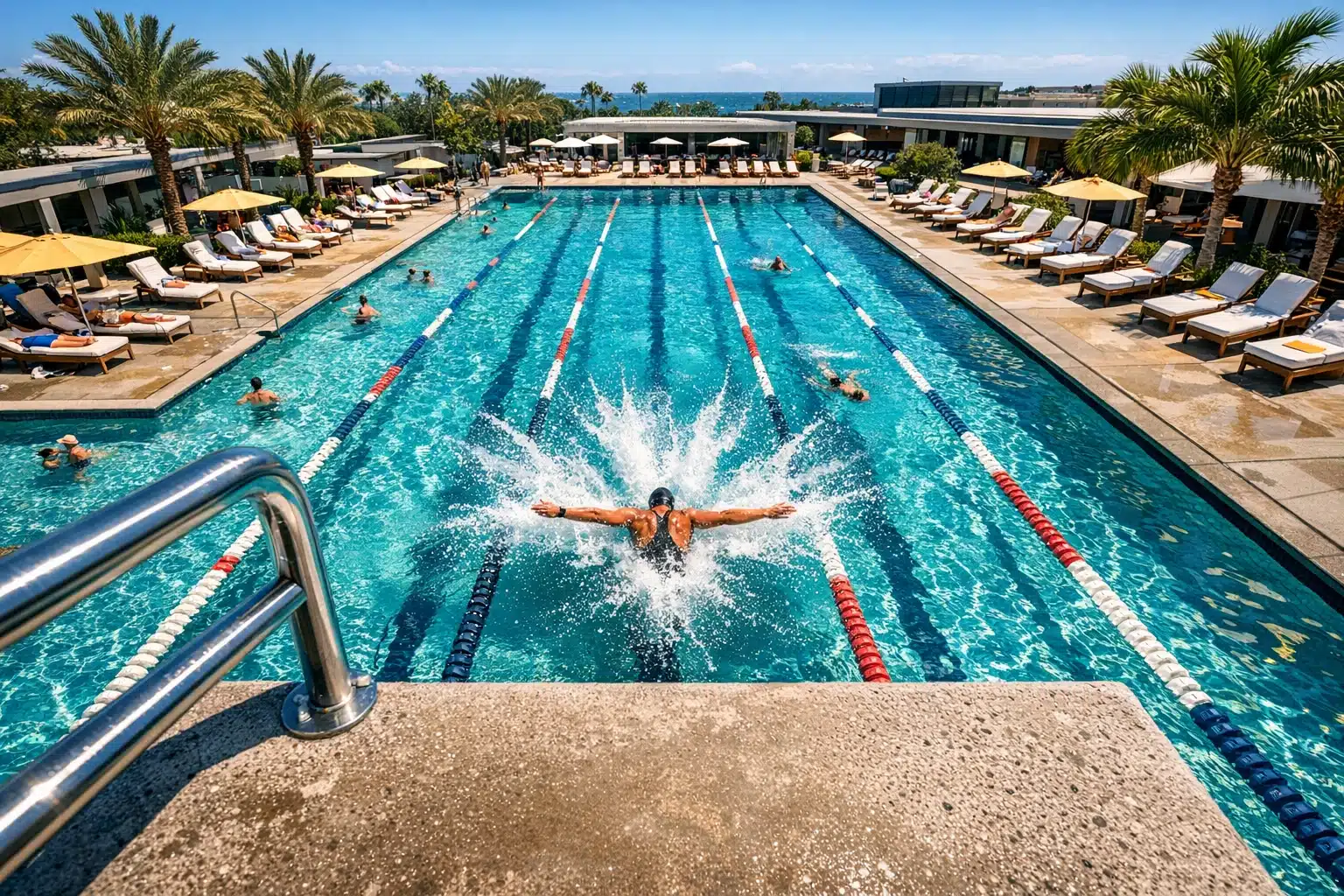
Explore the world of swimming
Swimming sits at the crossroads of survival skill, sport, therapy, and recreation, which is why it remains relevant from childhood lessons to masters competition. In one lane it builds endurance with very little joint impact; in another it teaches confidence, discipline, and respect for changing water conditions. Whether practiced in a neighborhood pool, a lake at sunrise, or an Olympic arena, it offers a rare blend of freedom and structure that keeps people coming back.
Article Outline
- Why swimming matters beyond medals, laps, and leisure.
- How swimming supports physical fitness, recovery, and mental wellbeing.
- The main strokes, technique basics, and the differences between them.
- How to learn, train, and stay safe in pools and open water.
- Why swimming remains valuable across ages, communities, and competitive settings.
Why Swimming Matters: More Than a Sport
Swimming is often introduced as a sport, yet that label captures only part of its value. Unlike many activities that are mainly recreational or mainly competitive, swimming serves several purposes at once. It is a life skill, a fitness method, a rehabilitation tool, a school subject in some regions, and a high-performance discipline watched around the world. That range helps explain why swimming has remained important across centuries and cultures. Humans have always lived near water, depended on it for travel and food, and needed ways to move through it safely. Modern swimming lessons and organized competitions may seem highly structured, but at their core they answer an old practical question: how do people become calm, capable, and efficient in water?
Its uniqueness also comes from the environment itself. Water changes everything. It supports body weight through buoyancy, resists movement from every direction, and rewards balance more than brute force. A runner can fight through poor form for a while; a swimmer with poor alignment usually feels the penalty immediately in the form of drag. That is one reason swimming can feel humbling at first. The water is honest. It gives instant feedback, whether the swimmer is gliding smoothly or churning with unnecessary effort. For many people, that challenge is part of the appeal. Progress can be measured not only in speed, but in ease, rhythm, and confidence.
Swimming also spans a remarkable range of settings and goals. A person may swim to recover after injury, to complete a triathlon, to enjoy family holidays more safely, or to chase a personal best over 100 meters. The same broad activity includes:
- learn-to-swim programs for children and adults
- lap swimming for fitness
- open-water racing and triathlon
- lifesaving and rescue training
- adaptive swimming for people with disabilities
That flexibility makes swimming unusually inclusive. Competitive pathways exist for those who want them, but there is no requirement to race in order to benefit from time in the water. A quiet 30-minute session can be just as meaningful as a hard interval set. In that sense, swimming resembles a language with many dialects: technique, play, endurance, recovery, and adventure all coexist in the same medium. Few activities can claim that kind of breadth without losing their identity. Swimming does not lose it. It simply reveals more of it each time someone enters the pool, the lake, or the sea.
Physical and Mental Benefits of Swimming
One of the strongest arguments for swimming is that it trains the body thoroughly while reducing impact on the joints. Water supports a large portion of body weight, which can make swimming especially appealing to older adults, people returning to exercise, and individuals managing certain injuries or chronic discomfort. That does not mean it is effortless. Quite the opposite: water is far denser than air, so even controlled movement requires consistent muscular work. The shoulders, back, chest, core, hips, and legs all contribute, and effective swimming depends on coordination rather than isolated strength. A well-paced set of laps can challenge the cardiovascular system just as seriously as a land-based workout, yet many swimmers step out of the pool feeling worked rather than battered.
From a fitness perspective, swimming fits well with widely accepted exercise goals. Public health guidance in many countries recommends at least 150 minutes of moderate aerobic activity per week for adults, and swimming can contribute directly to that target. Intensity varies by pace, stroke, and skill level. A relaxed backstroke session feels very different from repeated freestyle intervals or a demanding butterfly set. Energy expenditure also varies widely, but the important point is not a single calorie number; it is that swimmers can scale effort up or down without leaving the water. This makes swimming useful for steady endurance work, cross-training, and progressive conditioning.
The mental effects are just as important. Many swimmers describe the water as both stimulating and calming. There is a rhythm to breathing, stroking, and turning that can sharpen focus while lowering mental clutter. The sensory experience matters too: muffled sound, repetitive motion, and the clear logic of one lap leading into the next can create a form of moving concentration. For some people, that is one of the few times in a busy week when attention narrows in a healthy way. Swimming will not solve every stress-related problem, but it can provide a dependable reset.
Some of its widely recognized benefits include:
- cardiovascular conditioning without repeated pounding on hard surfaces
- full-body muscular engagement through resistance in every direction
- improved mobility and posture when technique is taught well
- temperature regulation that can make exercise feel more manageable
- confidence gains that come from learning a practical skill
Compared with running, swimming usually places less load on knees and ankles. Compared with cycling, it demands more upper-body contribution and breathing control. Compared with gym circuits, it often feels more fluid and less segmented. That does not make it superior in every case, only distinct. Its real strength is that it combines conditioning, coordination, and recovery-friendly movement in one practice. For people who want exercise that is useful, sustainable, and mentally refreshing, swimming earns its place with quiet authority.
Understanding the Strokes and the Craft of Efficient Movement
To an inexperienced eye, swimming can look like simple propulsion: move arms, kick legs, reach the wall, repeat. In practice, the sport is far more technical. Small changes in body position, head angle, timing, or breathing can transform a swimmer from frantic to efficient. This is one reason coaching matters so much. A swimmer who improves technique often becomes faster while feeling less tired, which is a rare and satisfying combination. Water punishes wasteful movement, so skill is not a decorative extra; it is the engine of progress.
The four competitive strokes each have a distinct personality. Freestyle, usually performed as front crawl, is the fastest and most common for fitness swimming. It relies on body rotation, a streamlined line from fingertips to toes, and breathing that fits into the rhythm rather than interrupting it. Backstroke shares some structural principles with freestyle, particularly rotation, but it challenges orientation because the swimmer faces upward and must navigate without seeing the direction of travel as clearly. Breaststroke is slower, more timing-dependent, and often easier for beginners to understand at first because the face can stay forward more often. Butterfly is the most demanding of the four for many swimmers, blending undulating body motion with simultaneous arm recovery and powerful timing. It is dramatic when done well and exhausting when done poorly.
Good technique begins with a few durable principles:
- keep the body long and aligned to reduce drag
- use the core to connect upper and lower body
- breathe in a way that preserves balance instead of lifting the head excessively
- apply force backward through the water rather than slapping at the surface
- match kick rhythm to the needs of the stroke and the swimmer’s energy
Freestyle offers a useful example. Many beginners think speed comes mainly from kicking harder. In reality, a stable body position and an effective catch often matter more. The catch is the phase where the swimmer anchors the hand and forearm in the water to pull the body forward. When that action is mistimed or shallow, effort leaks away. Similar truths apply across all strokes. In breaststroke, timing the kick after the arm recovery is crucial. In butterfly, the body dolphin motion must support the arms, not fight them. In backstroke, a steady head and organized rotation help maintain direction and rhythm.
Technique also extends beyond the stroke cycle itself. Starts, turns, and push-offs can save surprising amounts of time in competitive swimming. Even recreational swimmers benefit from learning streamlined push-offs and controlled turns because they teach body tension and water awareness. The beauty of swimming is that it rewards patience. A single technical correction can make the water feel suddenly more cooperative, as if a locked door has quietly opened. That moment keeps swimmers curious. There is always another layer to learn, and the next improvement often begins with something subtle rather than dramatic.
Learning, Training, and Staying Safe in the Water
Learning to swim is not a single leap from fear to fluency; it is a sequence of manageable steps. For beginners, the earliest victories are often simple ones: exhaling into the water, floating without panic, pushing off the wall, or completing a short distance with control. These milestones matter because they build trust. A new swimmer is not just learning movements, but also learning how the water behaves around the body. That is why good instruction starts with comfort and safety before it chases speed. A confident beginner who understands breathing and buoyancy usually progresses more steadily than someone who is pushed into distance too early.
Structured training becomes more important as ability grows. Most swim sessions include some version of four parts: a warm-up, drills, a main set, and a cool-down. Drills are especially useful because they isolate specific skills such as rotation, catch position, kicking balance, or timing. A simple example is a side-kicking drill for freestyle, which teaches the body to stay long and stable while breathing. More advanced swimmers often train with interval sets that improve aerobic endurance, speed control, and recovery. Equipment can help, but it should be used deliberately. Kickboards, pull buoys, fins, paddles, and snorkels all have training value when matched to a purpose rather than used as shortcuts.
Safety remains essential at every level. Pool swimming is generally more predictable than open water, yet even pools demand attention to rules, lane etiquette, depth markings, and fatigue. Open water introduces variables such as currents, waves, temperature, visibility, and navigation. The difference between a calm lake and a windy sea can be as dramatic as the difference between a treadmill and a mountain trail. Smart swimmers respect that complexity. Key habits include:
- never swimming alone in open water
- checking weather, water conditions, and local guidance before entering
- wearing bright, visible gear when swimming outdoors
- understanding personal limits instead of copying stronger swimmers
- using lifeguarded areas whenever possible
There is also a practical side to safety that is less dramatic but just as important. Hydration matters, even in the pool. So does recovery, especially after hard training blocks. Swimmers who ignore shoulder discomfort, overtrain kick volume, or skip rest can accumulate problems that eventually interrupt progress. Technique quality often falls before injury announces itself, so paying attention to feel is part of self-care.
For readers considering a start, the best path is usually straightforward: take lessons, practice consistently, and measure progress in control as much as distance. For experienced swimmers, smart training means balancing ambition with awareness. Water can feel playful, but it deserves respect. When skill and caution work together, swimming becomes not only enjoyable, but sustainable over many years.
Swimming Across Life Stages, Communities, and Competitive Culture
One of swimming’s greatest strengths is that it does not belong to only one age group or social role. Children often meet it through lessons that teach safety and coordination. Teenagers may discover competition, school teams, or cross-training benefits for other sports. Adults frequently return to swimming after years away because it offers exercise that feels purposeful without punishing every joint. Older swimmers often value it for mobility, circulation, routine, and social connection. The same lane can host a former racer refining technique, a newcomer learning bilateral breathing, and a retiree maintaining fitness. Few physical activities create that kind of shared space so naturally.
Swimming culture also stretches beyond standard lap lanes. Community pools can be gathering places where families, coaches, therapists, and casual swimmers all intersect. Adaptive swimming programs and para-swimming have expanded access and visibility, demonstrating that technique and competition can be meaningfully shaped around different physical realities. Masters swimming has shown the same truth from another angle: performance and improvement do not expire at a certain birthday. In many clubs, the atmosphere balances seriousness with camaraderie. People chase times, but they also cheer milestones that would never appear on a world ranking list, such as finishing a first 1500-meter swim or learning tumble turns at 50.
Competitive swimming brings its own vocabulary and rituals: splits, taper, relay exchanges, heat sheets, and the silent tension before a start. Yet even at high levels, the essentials remain surprisingly familiar. Race outcomes still rest on streamline, pacing, efficiency, and nerve. Olympic finals may look worlds away from a public pool session at dawn, but both depend on the same relationship between body and water. That continuity is part of the sport’s charm. It links elite performance to everyday practice in a way that feels tangible.
Swimming also travels well into other parts of life. It supports surfers, rowers, divers, and triathletes. It deepens holiday experiences by turning beaches and lakes into places of confidence rather than hesitation. It can strengthen family routines, giving parents a practical skill to pass on. It can even reshape how people think about effort. Progress in swimming is often gradual, technical, and quietly earned. You learn to value refinement, patience, and persistence because thrashing rarely wins.
For many people, that may be swimming’s most lasting lesson. It teaches that strength is not always loud, and improvement is not always obvious from the deck. Sometimes the real breakthrough is invisible to everyone else: calmer breathing, cleaner timing, a better line through the water, or the simple realization that a space once feared now feels familiar. That is a powerful transformation, whether it happens in a child’s first lesson or during an adult’s return to the pool after many years away.
Conclusion for Readers Ready to Dive Deeper
Swimming rewards curiosity at every level. If you are new to it, begin with instruction, patience, and respect for safety, because confidence grows fastest on a stable foundation. If you already swim, refining technique and structuring training can unlock progress that brute effort alone rarely produces. For fitness seekers, competitive athletes, parents, and lifelong learners alike, swimming remains one of the most versatile activities available: practical, demanding, restorative, and deeply memorable. The water asks for attention, but it gives something valuable in return—a skill that can support health, resilience, and enjoyment for years to come.