Explore the world of swimming
Swimming sits at the crossroads of survival skill, sport, and everyday wellness, which is why it remains relevant in nearly every stage of life. A child may meet it as a first lesson in confidence, an athlete may use it to sharpen endurance, and an older adult may return to it for movement that feels kind to the joints. Because water changes how the body works, swimming also teaches balance, breath control, and calm in a way few activities can. This article follows that journey from basics to lifelong practice.
Outline:
• Why swimming matters for health and resilience
• How the main strokes differ and what good technique looks like
• Ways to train efficiently, from first laps to race preparation
• Safety rules, gear choices, and the contrast between pools and open water
• Why swimming remains valuable from childhood to older age
Why Swimming Matters: Health, Confidence, and Whole-Body Fitness
Swimming is often described as a full-body exercise, but that phrase only hints at its real value. In water, the body is supported and challenged at the same time. Buoyancy reduces impact on the joints, which is one reason swimming is often recommended as a lower-impact option for many people who find running or court sports uncomfortable. At the same time, water creates resistance in every direction, so even a smooth and graceful stroke asks the muscles to work. The result is a form of exercise that can improve cardiovascular fitness, muscular endurance, coordination, and mobility in one session.
Its relevance becomes even clearer when placed beside public health advice. The World Health Organization recommends that adults aim for 150 to 300 minutes of moderate aerobic activity each week, or 75 to 150 minutes of vigorous activity. Swimming can help meet those targets while also training breathing control and posture. Unlike many land-based workouts, it rarely feels like the body is being pounded into improvement. Instead, progress often arrives in a quieter way: longer sets, steadier breathing, less fear in deep water, and a stronger sense of control.
Swimming also has an unusual practical dimension. It is not only exercise; it is a life skill. Water safety experts routinely emphasize that learning to swim can reduce risk around pools, beaches, lakes, and rivers, especially when lessons include floating, safe entry and exit, and awareness of hazards rather than stroke mechanics alone. That makes swimming important for families, schools, and communities, not just athletes. A person who can stay calm, float, and move efficiently in water carries a useful form of confidence that extends beyond the pool wall.
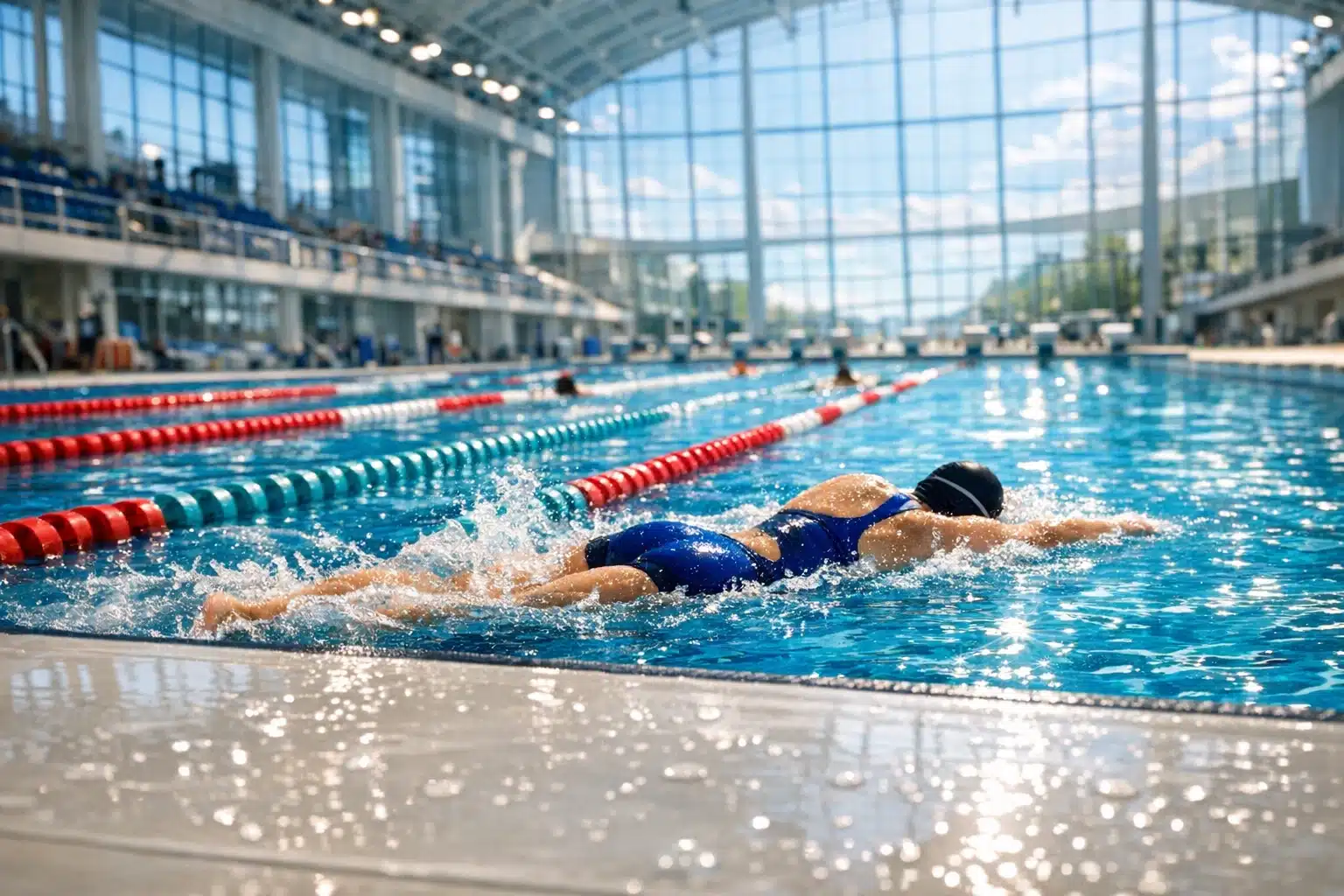
There is also a mental side that regular swimmers know well. Pools have their own atmosphere: echoing starts, lane ropes trembling under turns, and the odd peace of hearing little beyond bubbles and breath. Repetitive movement in water can be calming, and many swimmers describe sessions as a way to manage stress or clear their minds. This should not be confused with a medical treatment for mental health conditions, but it can be a meaningful part of a balanced routine.
Several groups benefit from swimming in particular:
• Beginners who need a gentle entry point into exercise
• Older adults seeking movement with less joint stress
• People recovering fitness after time away from sport
• Athletes using the pool for aerobic conditioning or active recovery
• Children learning confidence, safety, and discipline
That broad usefulness explains why swimming has lasted for centuries as both a necessity and a pleasure. It can be competitive, social, meditative, rehabilitative, or simply fun. Few activities move so easily between those roles.
The Language of the Water: Strokes, Breathing, and Technique
To someone standing on a pool deck, swimming may look simple: get in, move arms, kick, breathe. In practice, technique is what separates struggle from flow. Water is honest in a way that land is not. A slight lift of the head, a rushed breath, or a mistimed kick can turn a comfortable length into a tiring one. That is why learning the major strokes is less about memorizing motions and more about understanding how the body travels through water with minimal drag and useful propulsion.
The most common stroke for fitness and racing is freestyle, usually swum as front crawl. It is the fastest of the four competitive strokes because its body position is long and streamlined, the kick is continuous, and the arm recovery happens out of the water. Good freestyle depends on a few linked skills: a horizontal body line, a relaxed but effective flutter kick, rotation through the hips and shoulders, and efficient breathing without lifting the head too high. Many beginners assume the arms do most of the work, yet body position and timing often matter just as much.
Backstroke is sometimes easier for nervous swimmers because the face stays out of the water, but it brings different challenges. Without a view of where one is going, awareness and alignment become important. A good backstroke uses a stable head, rolling shoulders, and a steady flutter kick. It rewards rhythm. For some swimmers, it also feels more open and less claustrophobic than face-down strokes.
Breaststroke is popular in recreational settings because it allows regular forward visibility and can be swum at a comfortable pace. Technically, however, it is not as easy as it looks. The pull, breath, kick, and glide must occur in the right sequence, and the whip kick can place stress on the knees if performed poorly. When done well, breaststroke is economical and controlled. When done badly, it becomes exhausting and wide.
Butterfly is the most demanding of the four. It is powerful, beautiful, and famously unforgiving. Both arms recover together, the kick is a dolphin action, and timing is everything. Even strong swimmers often treat butterfly with respect, because it punishes poor rhythm quickly. Yet its difficulty teaches a useful lesson: speed in water comes from coordination as much as force.
A few technical ideas apply to all strokes:
• Streamline matters after every push-off and turn
• Exhaling underwater usually makes breathing easier
• Looking down or keeping the head neutral helps reduce drag
• Short, controlled drills often improve form faster than endless tired laps
For beginners, the best comparison is this: freestyle is usually the most efficient, breaststroke often feels the most familiar, backstroke teaches balance from a different angle, and butterfly showcases advanced timing and power. Learning them builds not only variety but also body awareness. Over time, the swimmer starts to feel when the water is being pressed well and when it is slipping away. That moment of recognition is where technique really begins.
From First Laps to Fast Sets: How to Train for Improvement
Swimming rewards patience more than bravado. New swimmers often expect progress to come from sheer effort, but thrashing harder usually leads to poor breathing, rising heart rate, and a technique breakdown that makes the water feel heavier than it is. Effective training works differently. It combines skill practice, aerobic development, and manageable progression. In other words, the smartest swimmers do not just swim more; they swim with intention.
A useful session usually has four parts: warm-up, drill work, a main set, and a cool-down. The warm-up raises body temperature and settles breathing. Drill work isolates one element, such as kicking from the hips or entering the hand cleanly in freestyle. The main set develops endurance, pacing, or speed. The cool-down lowers effort and helps the swimmer leave the pool feeling composed rather than wrecked. This structure works for beginners and advanced swimmers alike, although the volume and complexity differ.
For beginners, consistency beats heroic single sessions. Two or three swims a week can build a strong foundation if the sessions are regular and not overly long. Many coaches prefer short repeats with rest rather than one unbroken distance, because short repeats allow swimmers to reset technique before fatigue takes over. A new swimmer might start with 25- or 50-meter repeats and gradually increase total distance as breathing and confidence improve.
Here is an example of a simple beginner-friendly workout:
• 200 meters easy choice of stroke
• 4 x 25 meters kick with rest between repeats
• 4 x 25 meters drill focusing on body position
• 6 x 50 meters freestyle at a steady pace with 20 to 30 seconds rest
• 100 meters easy cool-down
For more experienced swimmers, training becomes more specific. Competitive swimmers often track pace per 100 meters, stroke count, turn efficiency, and split times. They may organize sessions around aerobic threshold work, sprint sets, race-pace repeats, or lactate-tolerance efforts. Tools like pull buoys, fins, paddles, and tempo trainers can help, but only when used with purpose. Gadgets do not replace skill; they amplify what is already present, whether good or bad.
Dryland training also matters. Strength work for the core, shoulders, back, hips, and legs can improve power and durability, while mobility exercises help maintain range of motion. Still, swimmers need balance. Too much shoulder loading without proper technique or recovery can lead to overuse problems. Sleep, hydration, and nutrition remain part of the training plan, even if they happen outside the pool.
A practical way to judge effort is the rate of perceived exertion, or RPE. On a scale from easy to very hard, most sessions should not be maximum effort from start to finish. Easy swims build technique and aerobic capacity. Moderate sets develop sustainable pace. Hard work has its place, especially for competition, but it should arrive in measured doses. Training is less like one dramatic dive and more like laying tiles carefully across the floor. Piece by piece, the surface changes, and suddenly the swimmer moves farther and faster with less waste.
Swimming Safely: Pools, Open Water, Equipment, and Good Judgment
Swimming is enjoyable partly because it feels freeing, yet it demands respect. Water can be playful one moment and dangerous the next, especially when confidence outruns skill. That is why safety should sit beside technique from the beginning. A strong swimmer is not simply someone who moves quickly; it is someone who recognizes conditions, understands limits, and makes sensible decisions before problems begin.
Pools are controlled environments, which makes them ideal for learning. Distances are measured, temperatures are generally managed, and lifeguards may be present depending on the facility. Even so, pool safety is not automatic. Slippery decks, shallow water, collisions in crowded lanes, and overestimating one’s ability can all create risk. Basic habits matter: check lane direction, avoid diving where depth is unclear, rest when dizzy, and supervise children closely even in familiar settings. Formal swim lessons and water competency education remain among the best investments a family can make.
Open water changes the equation. Lakes, rivers, and the sea add currents, waves, limited visibility, changing temperatures, and the absence of lane ropes or walls. Distances can feel longer, and orientation becomes part of the task. Many strong pool swimmers are surprised the first time they swim in open water because the environment removes the rhythm of turns and introduces uncertainty. For that reason, open-water swimming should be approached progressively, ideally with experienced partners, event support, or supervised groups.
Key open-water precautions include:
• Never swim alone
• Check weather, wind, and water conditions before entering
• Use a bright swim cap and, when appropriate, a tow float for visibility
• Enter gradually if the water is cold, and understand the risks of cold shock
• Know local hazards such as boat traffic, rip currents, or sudden depth changes
Equipment can support safety and comfort, but it should be chosen realistically. Goggles protect the eyes and improve visibility. A well-fitted suit reduces distraction. Swim caps can help with warmth and visibility. Kickboards, pull buoys, fins, and snorkels are training tools, not shortcuts. In colder or open-water conditions, wetsuits may improve warmth and buoyancy where permitted. None of these items replaces judgment.
Lane etiquette is another form of safety often ignored. Sharing space well reduces stress and accidents:
• Join a lane that matches your speed
• Circle swim if the pool requires it
• Rest in the corner, not the middle of the wall
• Let faster swimmers pass at an appropriate moment
• Communicate politely when the lane is busy
Finally, hygiene and recovery matter too. Showering before entering the pool helps maintain water quality, and rinsing afterward can reduce skin irritation from chlorine. If something feels wrong during a session, such as chest pain, severe breathlessness, or unusual weakness, stopping is the smart choice. In swimming, caution is not cowardice. It is skill in another form.
Swimming for Life: A Practical Conclusion for Beginners, Fitness Seekers, and Families
One of swimming’s greatest strengths is that it does not belong to a single age, body type, or ambition level. A six-year-old learning to float, a triathlete chasing split times, a parent returning to exercise, and an older adult preserving mobility can all meet the same water for different reasons. That flexibility gives swimming unusual staying power. Trends in fitness come and go, but the ability to move calmly and efficiently through water remains useful, healthy, and deeply human.
For beginners, the message is simple: start smaller than your ego wants. Focus on comfort in the water, relaxed breathing, and short, controlled lengths rather than dramatic distances. If possible, take lessons from a qualified instructor, because early feedback can save months of frustration. A few good habits learned early, such as exhaling underwater and keeping the body long, pay off again and again. Progress in swimming can feel slow at first, but it is often more solid than it appears.
For adults using swimming as exercise, variety helps keep the habit alive. Alternate easy sessions with technique work, and use goals that are specific but realistic. These might include swimming continuously for ten minutes, improving pacing across four 50-meter repeats, or becoming comfortable in deep water. When motivation dips, remember that swimming offers more than calories burned. It develops coordination, patience, and resilience. The pool can be a training ground, but it can also be a reset button after a noisy day.
Families and communities have their own role to play. Access matters. Affordable lessons, safe facilities, and inclusive programs can widen participation and reduce fear around water. Swimming is especially valuable when taught as water competence rather than as a narrow performance skill. Floating, treading water, safe entry, basic rescue awareness, and respect for conditions are not glamorous topics, but they are essential. A community that teaches them well gives people more than recreation; it gives them confidence and a measure of safety.
For older adults or people seeking lower-impact movement, swimming and water exercise can be a practical long-term option. The support of water may make regular activity feel more manageable, and the rhythmic nature of lap swimming can encourage consistency. Of course, individual needs differ, especially for those with medical conditions, so it is wise to follow professional advice where necessary. Still, the broader point stands: swimming adapts well across life stages.
If there is one idea worth carrying away, it is this: swimming is both humble and profound. It asks you to learn patience, accept feedback, and work with the properties of water rather than against them. In return, it offers fitness, skill, confidence, and moments of rare clarity. Whether you are stepping into the shallow end for the first time or refining a turn after years in the sport, the invitation is the same. Keep showing up, keep learning, and let the water teach you how to move forward.