Explore the world of swimming
Swimming sits at the crossroads of sport, survival, and simple joy, giving people a way to move that feels both disciplined and freeing. It matters because few activities build endurance, coordination, and confidence while placing so little stress on the joints. From crowded city pools to open lakes at sunrise, it adapts to nearly every age and ambition. This article maps the essentials, from technique and health benefits to safety, training, and the many reasons water keeps calling people back.
To keep the journey clear, the outline below moves from the roots of swimming to the habits that help beginners and experienced swimmers improve with purpose. It also compares pool and open-water experiences, explains the main strokes, and closes with practical guidance for readers who want to make time in the water part of everyday life.
- How swimming developed from survival skill to global sport
- Why it benefits cardiovascular health, strength, mobility, and mental balance
- How the main strokes differ, and what efficient technique looks like
- What safety habits, learning environments, and equipment matter most
- How to build a sustainable swimming routine for recreation, fitness, or competition
How Swimming Became a Global Practice
Long before lane ropes, stopwatches, and Olympic finals, people entered water for necessity. Rivers needed crossing, coastlines invited fishing, and floods made floating skills more than a pastime. Ancient civilizations left visual evidence of swimmers in tomb art and wall paintings, showing that movement through water was already recognized as a learned ability rather than an accident of instinct. Over time, what began as survival widened into ritual, training, recreation, and eventually organized sport. That slow transformation helps explain why swimming still feels broader than many athletic disciplines. It belongs to history, public health, leisure culture, and performance all at once.
The modern sporting version took shape in the nineteenth century, especially in Europe and Australia, where clubs, races, and standard rules became more common. Swimming was included in the first modern Olympic Games in 1896, although women’s events were added later, in 1912. Since then, the sport has evolved into a highly technical field shaped by biomechanics, pool design, training science, and even fabric technology. Yet beneath the sleek competition structure remains something ancient and recognizable: a human body learning how to cooperate with water rather than fight it.
Part of swimming’s enduring relevance comes from its flexibility across settings. A pool offers measured distance, controlled temperature, and a predictable floor beneath the surface. Open water adds currents, weather, uneven visibility, and a sense of scale that can feel thrilling or humbling depending on the day. One setting rewards precision; the other asks for adaptation. Neither is inherently better. They simply teach different forms of awareness. A swimmer in a 50-meter pool may learn rhythm through repetition, while a swimmer in the sea learns to read waves, sight landmarks, and stay calm when the horizon replaces the ceiling.
Water itself changes the rules of movement. It is far denser than air, which means every stroke meets resistance from all directions. That resistance can build muscular endurance, but buoyancy also supports body weight, reducing impact compared with land-based exercise. This combination is one reason swimming occupies a unique place in fitness and rehabilitation. It asks for effort without the pounding associated with activities like road running. The result is a discipline that can feel gentle to the joints while remaining demanding to the heart and lungs.
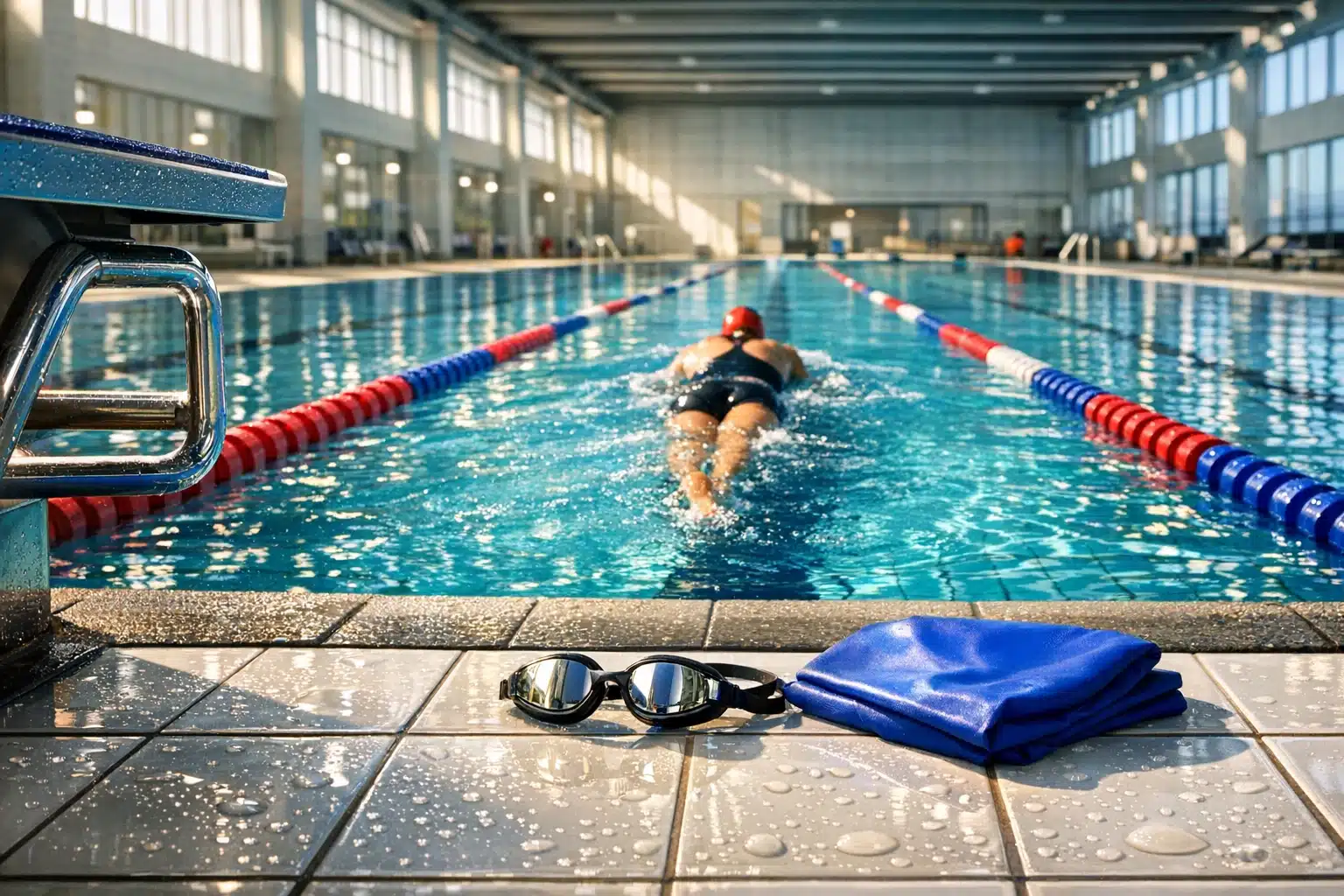
Seen from a distance, a swimmer slicing through blue water can look effortless, almost like a drawn line coming alive. In reality, that elegance is earned through thousands of adjustments in timing, posture, and breath. The history of swimming matters because it shows how a basic human skill became an artful, measurable, and widely shared practice. Understanding that background makes every lap more interesting. A pool is never only a pool; it is also a classroom, a laboratory, and for many people, a quiet place where concentration becomes visible.
Why Swimming Matters for Health, Fitness, and Mental Well-Being
Swimming is often recommended because it combines aerobic work, muscular engagement, mobility, and coordination in a single session. When someone swims continuously, the heart and lungs must deliver oxygen efficiently, which supports cardiovascular fitness over time. At the same time, the arms pull, the legs kick, and the core stabilizes the body against constant resistance. That is a different experience from isolated gym exercises, where one machine may focus on one region. In water, the body behaves more like an orchestra than a solo instrument.
Public health guidance gives this practical weight. The World Health Organization advises adults to aim for 150 to 300 minutes of moderate-intensity aerobic activity each week, or 75 to 150 minutes of vigorous activity. Regular swimming can contribute meaningfully to those targets. A steady lap session can raise heart rate, improve endurance, and help maintain general fitness, while a technique-focused swim may support mobility and balance even when intensity stays lower. This range makes the activity adaptable across life stages. Children can gain confidence and coordination. Adults can use it for conditioning. Older swimmers often appreciate the reduced joint stress and the chance to stay active without high-impact strain.
Comparisons with other exercises reveal its particular strengths. Running may build bone-loading benefits that swimming does not emphasize to the same degree, but it can be harder on knees, ankles, and hips for some people. Cycling is excellent for endurance, yet it does not usually recruit the upper body as actively. Swimming stands out by involving large muscle groups while cushioning the skeleton through buoyancy. That does not make it superior in every case, but it does make it especially valuable for people recovering from injury, managing arthritis, or looking for variety in a training plan.
The mental side deserves equal attention. Water narrows attention in a useful way. Breathing has to be timed. Body position has to be felt. External noise fades. Many swimmers describe the pool as one of the few places where the mind stops scattering and settles into a repeatable pattern. There is a meditative quality to counting strokes, hearing bubbles, and noticing the clean turn at the wall. Research on physical activity consistently links regular movement to reduced stress and improved mood, and swimming offers that effect with a sensory environment that many find unusually calming.
There are social benefits as well. Lessons can teach trust and resilience. Masters teams give adults a community that blends discipline with humor. Family swim sessions create shared routines that do not depend on screens or perfect weather. For people who feel intimidated by traditional fitness culture, the water can offer a fresh beginning, where progress is measured not by appearance but by distance covered, technique refined, or fear overcome. That shift matters. Health is easier to sustain when the activity feels meaningful, and swimming often becomes meaningful long before it becomes fast.
Understanding Strokes, Breathing, and Efficient Technique
To an untrained eye, swimming can appear to be mostly about effort: pull harder, kick faster, keep going. Skilled swimmers know the opposite is often true. Efficiency matters as much as power, and sometimes more. Water punishes wasted motion. A dropped elbow, a lifted head, or an uneven kick can turn a smooth lap into a tiring struggle. Good technique reduces drag, improves rhythm, and allows a swimmer to travel farther with the same amount of energy. That is why beginners who learn sound mechanics early often progress faster than stronger athletes who rely only on force.
The four main competitive strokes each ask different questions of the body. Front crawl, commonly called freestyle, is usually the fastest because it pairs a streamlined position with alternating arm recovery and continuous propulsion. Backstroke uses a similar alternating pattern but flips the body face-up, making breathing easier while demanding strong spatial awareness. Breaststroke is slower, more cyclical, and highly dependent on timing; when the kick and pull connect well, it feels like gliding over glass. Butterfly is the most dramatic of the four, using a dolphin kick and simultaneous arm recovery that can look almost theatrical when performed cleanly. Each stroke rewards a different blend of flexibility, coordination, and patience.
Several technical principles apply across all of them:
- Keep the body as long and level as possible to reduce drag.
- Let the head stay neutral instead of craning upward.
- Breathe without disrupting alignment.
- Use the core to connect upper- and lower-body movement.
- Focus on feel for the water, not just splashing volume.
Breathing is often the decisive hurdle for new swimmers. On land, breathing is automatic and irregular. In water, it becomes deliberate and timed. Many beginners hold their breath too long, then rush to inhale, which creates tension and throws off body position. A better pattern is usually to exhale steadily underwater and turn or lift only enough to take a quick breath. Once breathing becomes rhythmic, swimming starts to feel less like a sequence of small emergencies and more like a continuous conversation between effort and recovery.
Training drills help translate theory into habit. Catch-up drill can teach front-crawl timing. Kicking on the side can improve balance and rotation. Pull buoys isolate upper-body mechanics, while kickboards let swimmers concentrate on leg action, though overuse of either can create dependence if not balanced with full-stroke practice. Video analysis has also become useful, especially for intermediate swimmers who want to see what the water hides from them. A coach may say, “Your hips are dropping,” but a recording turns that comment into a visible fact.
Technique work is not only for competitors. Recreational swimmers benefit from it just as much because efficiency makes sessions safer, more comfortable, and more enjoyable. The joy of a well-swum length comes partly from speed, but often from something subtler: the moment when body, breath, and water finally agree with one another.
Safety, Equipment, and the Difference Between Pool and Open Water
No discussion of swimming is complete without safety. Water can be welcoming, but it is never casual in the way a gym floor is casual. According to the World Health Organization, drowning causes well over 200,000 deaths globally each year, which underlines a basic truth: confidence around water should be built on skill, not assumption. Strong athletes are not automatically strong swimmers, and familiarity with shallow pools does not prepare someone for surf, currents, cold shock, or sudden fatigue. Respect is not fear; it is accurate judgment.
For beginners, formal instruction is one of the smartest investments available. Lessons teach far more than strokes. They cover floating, treading water, safe entry and exit, breathing control, and how to stay calm when a mistake happens. Children benefit enormously from early water familiarity, but adults should not feel embarrassed to start late. In fact, many adults learn efficiently because they can understand technique explanations, ask precise questions, and practice intentionally. The only unhelpful timeline is the one shaped by pride.
Pool swimming and open-water swimming require overlapping but distinct habits. In a pool, major safety concerns often include slippery decks, poor lane awareness, fatigue, and overestimating ability. In lakes, rivers, and the sea, the checklist expands. Visibility can change, temperature can drop quickly, and currents may move a person farther than expected before that person realizes what is happening. Open-water swimmers often use bright caps and tow floats for visibility, swim with partners when possible, and learn local conditions before entering. A calm shoreline can hide a very different reality twenty meters out.
Equipment also shapes the experience, although more gear does not automatically mean better swimming. The essentials are simple:
- A comfortable swimsuit that allows full movement
- Goggles with a secure seal and appropriate tint for the setting
- A swim cap, often useful for streamlining and hair management
- A towel, water bottle, and sandals for practical poolside comfort
- Optional training tools such as fins, paddles, pull buoys, or snorkels used with purpose
Each item serves a function rather than a fashion statement. Well-fitted goggles can transform a session by removing the irritation of blurred vision or chlorinated eyes. Fins can teach body position and ankle mobility, but they can also mask kicking flaws if used thoughtlessly. Paddles increase resistance and can sharpen feel for the catch, yet poor mechanics under load may strain shoulders. The rule is straightforward: use tools to illuminate technique, not to hide its weaknesses.
Safety also includes listening to the body. Dizziness, cramping, sharp pain, or unusual breathlessness should never be brushed aside. A good swim leaves a person pleasantly tired, not depleted in a way that clouds judgment. The smartest swimmers are rarely the boldest-looking ones. They are the people who know conditions, respect limits, and understand that caution in water is not a lack of courage but a mark of maturity.
Making Swimming Part of Life: A Practical Conclusion for Readers
For many readers, the real question is not whether swimming is impressive, but whether it can fit into ordinary life. The answer is yes, though the shape of that “yes” varies. A beginner may start with two short sessions a week, focusing on comfort in the water and basic breathing. A fitness-minded adult might use swimming to balance strength training or to replace one high-impact workout. A former competitor may return for the pleasure of structure, the familiar smell of chlorine, and the small satisfaction of watching times improve again. There is no single proper entry point. What matters is choosing one that feels sustainable.
A useful habit usually begins with modest clarity rather than grand ambition. Instead of announcing a sweeping transformation, it is wiser to decide on simple actions: book lessons, find a nearby pool, swim at the same time each week, or set a distance goal that feels realistic. Progress in water is rarely linear. One week the stroke feels effortless; the next week it feels like the pool has become thicker overnight. That unevenness is normal. Adaptation in swimming often arrives quietly, showing itself when a once-challenging distance becomes routine or when breathing stops feeling rushed.
Different goals also deserve different approaches:
- For general fitness, aim for consistent sessions with mixed easy and moderate effort.
- For technique, devote part of each swim to drills and focused repetition.
- For weight management, combine swimming with nutrition habits and other daily movement.
- For competition, add structured intervals, pacing work, and coaching feedback.
- For relaxation, choose steady aerobic sets that encourage rhythm over speed.
Swimming can also remain interesting over the long term because it offers several identities at once. It can be solitary without feeling lonely, social without becoming noisy, and demanding without always becoming aggressive. One day it is a measured workout. Another day it feels like travel without leaving town, especially when sunlight flickers across the pool floor and the rest of the world seems to pause outside the waterline. That ability to change mood while keeping the same basic form is part of its lasting charm.
If you are considering starting, the most helpful mindset is curiosity. Learn one stroke well before chasing all four. Ask for feedback. Respect safety rules. Let technique develop gradually. If you already swim, revisit the basics from time to time because efficiency often grows through refinement rather than brute effort. For the general reader, that is the clearest conclusion: swimming is not only a sport for specialists or a lesson for childhood. It is a lifelong skill, a reliable form of exercise, and a rare activity that can strengthen the body while quieting the mind. In a world full of noisy routines, that combination is worth keeping close.