Explore the world of swimming
Some sports announce themselves with noise, but swimming begins with a quiet lesson: when you learn to move well in water, the body and mind both pay attention. It blends practical safety with serious fitness, asking for coordination, breath control, and patience rather than brute force alone. Because the water cushions impact while adding resistance, it suits many ages and ability levels. That mix of challenge and accessibility is exactly why swimming remains relevant in schools, communities, and lifelong health routines.
Outline
- The broad value of swimming for health, safety, and everyday life
- The main strokes and the techniques that make movement efficient
- How swimmers build skill through practice, drills, and structured training
- The key differences between pool swimming and open-water swimming
- How swimming serves children, adults, older swimmers, and goal-driven athletes
Why Swimming Matters: Fitness, Safety, and Long-Term Well-Being
Swimming occupies a rare place in sport because it is both useful and enjoyable. A person can learn it for recreation, competition, rehabilitation, transport in certain environments, or basic personal safety. That practical importance sets it apart from many other exercises. Running may improve endurance, and strength training may increase muscle mass, but neither directly teaches how to stay calm and capable in water. Swimming does. In communities with pools, lakes, rivers, or coastlines, that skill is not simply athletic; it is relevant to daily life.
From a fitness perspective, swimming offers a full-body workout with less impact than land-based exercise. Water is far denser than air, so every stroke meets resistance. That means the arms, shoulders, back, core, hips, and legs all contribute. At the same time, buoyancy reduces stress on joints, which is one reason swimming is often recommended as a suitable activity for people who find running uncomfortable. For many adults, public health guidance suggests at least 150 minutes of moderate aerobic activity each week, and swimming can help meet that target while feeling less repetitive than some gym routines.
Its mental benefits are equally important. The rhythm of strokes and breathing can create a focused, almost meditative state. Many swimmers describe the pool as a place where outside noise softens. You hear the splash, feel the pull of water, count the tiles, and suddenly the day seems less cluttered. This does not mean swimming solves stress by itself, but it can provide structure, movement, and a sense of control that supports emotional well-being.
- It builds cardiovascular endurance without constant pounding on the joints.
- It develops muscular coordination because every stroke depends on timing.
- It supports confidence by teaching people how to handle water safely.
- It can be adapted for beginners, recreational swimmers, and elite athletes.
Swimming also bridges generations remarkably well. Children may begin with games and floating drills, adults may use it to stay active after years away from sport, and older swimmers often value the freedom of movement that water provides. In that sense, swimming is less like a narrow discipline and more like a long conversation with the body. It can start as play, become training, and remain a reliable companion for decades.
Understanding the Main Strokes and the Technique Behind Efficiency
To an observer, swimmers may appear to be doing little more than moving arms and kicking legs, but good technique reveals how precise the sport really is. Swimming rewards efficiency more than force alone. A strong athlete who fights the water often tires quickly, while a technically sound swimmer seems to slide through the lane with less drama and better results. Learning the main strokes is therefore about understanding how the body should align, rotate, breathe, and apply pressure.
Freestyle, often called front crawl, is usually the fastest and most commonly practiced stroke. It relies on a streamlined body position, flutter kick, alternating arm recovery, and rhythmic side breathing. One of the biggest beginner challenges is lifting the head too much for air, which drops the hips and increases drag. A better habit is to rotate the body and turn the head just enough to breathe. Backstroke uses a similar body line but on the back, which changes orientation and breathing demands. Because the face stays above water, many people find the breathing easier, though straight-line control can be harder without visual cues.
Breaststroke is slower for most swimmers but technically rich. It uses a simultaneous arm pull and a whip-like kick, followed by a glide. Timing matters enormously. If the kick comes too early or the glide disappears, the stroke becomes tiring and inefficient. Butterfly is the most demanding of the four competitive strokes. It asks for coordinated arm recovery, a dolphin kick driven from the hips, and strong rhythm. To watch an experienced butterfly swimmer is to watch a body negotiate with the water in waves rather than separate pieces.
- Freestyle: efficient, fast, and ideal for endurance training
- Backstroke: useful for posture awareness and shoulder balance
- Breaststroke: accessible for many learners, but easy to mistime
- Butterfly: powerful and technical, with high energy demands
Across all strokes, several principles repeat. The first is balance in the water. The second is reducing drag through alignment. The third is propulsion that comes from well-timed movement, not frantic motion. Drills such as side kicking, catch-up freestyle, single-arm backstroke, and breaststroke timing work can isolate these skills. Competitive swimmers may chase hundredths of a second, but even a casual swimmer feels the reward of cleaner technique. The lane becomes shorter, breathing steadier, and effort more productive. In swimming, grace is not decoration; it is economy.
Learning to Swim Better: Practice Structure, Drills, and Training Progress
Improvement in swimming usually comes from deliberate practice rather than simply spending more time in the water. Many new swimmers assume that fitness alone will solve their problems, yet progress often depends first on technique, then on conditioning. This is why a structured session matters. A good swim is usually divided into phases: warm-up, skill work, main set, and recovery. That format gives purpose to each length and prevents the familiar pattern of starting too fast, fading badly, and leaving frustrated.
A beginner session might begin with easy lengths, floating drills, and breathing practice. From there, a swimmer can move into short repeats with rest, such as 8 x 25 meters at a controlled pace. More advanced swimmers may use interval sets such as 10 x 100 meters or broken race-pace work, depending on their goals. Training volume varies widely. Someone swimming for general health may do two or three sessions a week, while competitive swimmers often train far more frequently. The key is consistency. Two thoughtful sessions each week can produce more progress than one exhausting workout followed by ten idle days.
Drills and tools also play a useful role when used well. A kickboard can isolate leg work, fins can help body position and ankle mobility, a pull buoy can emphasize upper-body mechanics, and paddles can increase resistance for experienced swimmers. None of these tools magically fixes technique, but each can highlight specific sensations in the water. Coaching, whether from a teacher, club, or video review, often accelerates progress because swimmers rarely see their own mistakes clearly.
- Warm-up prepares the joints, lungs, and nervous system.
- Drills sharpen one technical idea at a time.
- Main sets build endurance, speed, or pacing control.
- Cool-down helps the body shift out of hard effort gradually.
Tracking progress can make training more satisfying. Useful markers include time for a set distance, number of strokes per length, quality of turns, comfort with bilateral breathing, and how well pace is maintained across repeats. Improvement may arrive quietly. One day the water feels less hostile. Another day a 400-meter swim that once seemed impossible becomes manageable. That is one of swimming’s subtle pleasures: gains are often earned in silence, measured not by noise or spectacle, but by the growing ease with which the body travels forward.
Pool Swimming and Open Water: Two Worlds Linked by Water
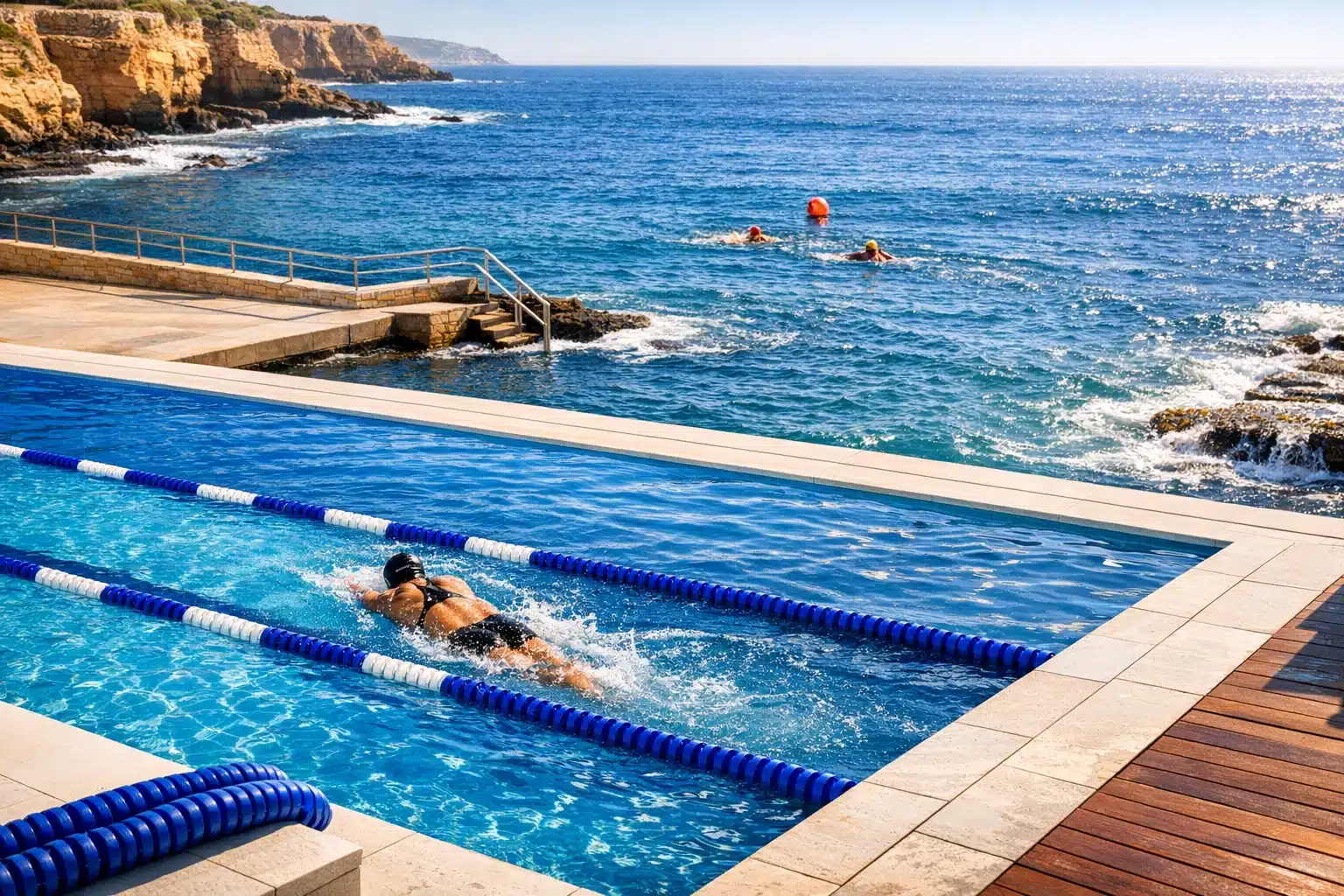
Although the same body moves through both environments, pool swimming and open-water swimming can feel like different sports. A pool is controlled. Distances are marked, walls arrive predictably, water temperature is usually managed, and lane lines help keep swimmers straight. That makes it ideal for learning technique, tracking performance, and completing structured workouts. Open water, by contrast, introduces variability. Lakes, rivers, and oceans bring currents, waves, temperature shifts, changing visibility, and the psychological challenge of depth and distance without black lines on the pool floor.
The pool offers obvious advantages for skill development. A swimmer can repeat exact distances, compare times, and use turns as brief moments of reset. It is easier to stop if needed, easier to receive coaching, and easier to monitor safety. Open water demands other skills. Swimmers must learn sighting, which means lifting the eyes briefly to stay on course without breaking rhythm too much. They may need to draft behind another swimmer in races, adapt to chop, enter cold water calmly, and decide how to pace when there is no wall every 25 or 50 meters.
There is also a major difference in mindset. Pool swimming can feel measured and technical. Open water often feels expansive and unpredictable. Some people find that freedom exhilarating; others find it unsettling at first. Both responses are normal. Safety becomes even more important outside the pool. Weather, boat traffic, currents, and water quality all matter. Swimming with a partner, using a bright cap, choosing supervised areas, and understanding local conditions are basic precautions, not optional extras.
- Pool swimming favors precision, repeatability, and controlled practice.
- Open water rewards adaptability, navigation, and environmental awareness.
- Pool sessions are easier for interval training and technique correction.
- Open-water sessions build confidence in real conditions and longer efforts.
Neither setting is superior in every way. The pool is a laboratory; open water is an adventure. One teaches accuracy, the other teaches resilience. Many strong swimmers benefit from both. A winter of disciplined pool work can sharpen efficiency, while a summer of outdoor swims can restore wonder to the sport. Together, they show swimming at its most complete: one part craft, one part courage.
Swimming for Different Ages, Goals, and Lifestyles
One of swimming’s greatest strengths is that it can change shape without losing its value. For children, it often begins as comfort in the water, playful movement, and foundational safety. Early lessons usually focus on floating, kicking, breath control, and confidence rather than perfect form. That foundation matters. A child who learns to respect water and move calmly through it carries a useful skill into every later stage of life. Parents often appreciate that swimming mixes discipline with fun; it teaches listening, patience, and gradual progress.
For adults, swimming often arrives through different doors. Some return to it after school years, some use it as a low-impact alternative after joint pain or injury, and some discover it through triathlon or general fitness goals. Its appeal lies partly in versatility. A person can swim gently for recovery, complete interval sets for aerobic conditioning, or use technique work as a mentally absorbing challenge. Because intensity is easy to scale, swimming can serve a busy professional, a weekend athlete, or someone rebuilding a routine after inactivity. For older adults, the supportive quality of water can make regular exercise feel more approachable, though individuals with medical concerns should still follow professional guidance.
Swimming also adapts to distinct goals. Someone focused on weight management may value its calorie expenditure and whole-body demand. A competitive swimmer may care more about race splits, underwater phases, and stroke mechanics. A recreational swimmer may simply want better energy, improved confidence in deeper water, and a healthier weekly habit. These goals are different, but the sport can accommodate all of them without losing its core identity.
- Children benefit from water familiarity, play, and safety education.
- Adults often value efficient fitness and manageable joint impact.
- Older swimmers may appreciate mobility, rhythm, and social routine.
- Athletes can use swimming for cross-training, endurance, or competition.
There is also a social side that should not be overlooked. Masters clubs, local lessons, community pools, and open-water groups give swimmers accountability and companionship. Progress feels easier when it is shared. Even solitary swimmers often belong to a quiet tribe of early risers, lane counters, and goggle-adjusters who understand that not every meaningful activity needs applause. Sometimes the goal is simpler than that: show up, get in, move well, leave clearer than you arrived. Swimming fits that ambition beautifully.
Conclusion for New and Returning Swimmers
If you are curious about swimming, the most useful place to begin is not with speed, gear, or comparison, but with comfort and consistency. Learn how the water supports you, build sound technique a little at a time, and choose the environment that matches your experience level. Whether your aim is health, confidence, competition, recovery, or simple enjoyment, swimming offers a path that can grow with you rather than against you. It asks for patience, but it pays back with skill, fitness, and a rare sense of calm. For beginners, busy adults, parents, and lifelong exercisers alike, swimming remains one of the most practical and rewarding ways to stay active.