Explore the world of swimming
Swimming is one of the few activities that works as exercise, recreation, travel skill, and quiet reset all at once. It matters to children learning water safety, adults searching for joint-friendly movement, and older swimmers who want endurance without harsh impact. Whether it happens in a neighborhood pool or open water, swimming blends practical value with real pleasure. That unusual mix makes it worth understanding in depth.
Outline: the article moves through five parts—why swimming matters now, how the main strokes differ, what benefits the water offers, how training and safety should be approached, and what practical steps help new or returning swimmers build a routine that lasts.
Why Swimming Still Matters in Modern Life
Swimming has survived every shift in culture because it answers several human needs at once. Long before it became an organized sport, it was a survival skill, a way to cross water, gather food, and move with confidence in unpredictable environments. Today, it still holds that practical value, but it also serves as exercise, recreation, therapy, and competition. That broad usefulness helps explain why swimming appears almost everywhere: in school lesson plans, holiday resorts, rehabilitation clinics, military training, and the Olympic Games. On the modern Olympic program, swimming has been present since 1896, and women’s events were added in 1912, a reminder that the sport has deep roots in international competition as well as everyday life.
Compared with many land-based activities, swimming occupies a rare middle ground. Running is simple and effective, but it can be hard on joints. Cycling builds endurance, yet it requires equipment, road awareness, or indoor machines. Swimming asks for technique and access to water, but once those are in place, it offers full-body work with reduced impact. It is also one of the few sports where a beginner and an experienced athlete can share the same pool while pursuing very different goals. One person may be learning to float for the first time; another may be practicing interval sets for a triathlon. The water makes room for both.
Its relevance becomes even clearer when safety enters the conversation. Learning to swim is not just about sport; it can lower risk around pools, beaches, rivers, and boats. Public health agencies around the world continue to stress water competence because drowning remains a major preventable cause of accidental death. In that sense, swimming lessons are not a luxury. They are part of basic life preparation, especially for children and for adults who never had access to instruction earlier.
Three lasting reasons keep swimming important:
• it teaches safety and confidence around water;
• it provides low-impact exercise for many ages and fitness levels;
• it creates social spaces, from local clubs to masters programs and school teams.
There is also a quieter reason people keep coming back to it. Swimming changes the rhythm of attention. Once your face meets the water and your breathing settles into a pattern, the outside world loses some of its volume. The lane line hums beside you, the body finds cadence, and the mind often follows. That mental shift is hard to measure on a stopwatch, yet for many swimmers it is one of the most valuable parts of the experience.
Understanding the Main Strokes and What They Teach
To an outsider, swimming can look like a single activity with minor stylistic variations. In practice, each stroke is its own language, with distinct mechanics, breathing patterns, and demands on the body. Learning the four main competitive strokes—freestyle, backstroke, breaststroke, and butterfly—gives swimmers a much clearer picture of what the sport actually involves. Even for people who never plan to race, understanding these differences helps with training choices, technique development, and realistic expectations.
Freestyle, usually swum with the front crawl, is the fastest and most commonly used stroke. It rewards a streamlined body position, a steady flutter kick, and efficient arm recovery. Because the swimmer faces downward most of the time, breathing must be timed carefully with rotation. This makes freestyle a stroke of rhythm and economy. Small technical improvements, such as keeping the head neutral or extending cleanly forward rather than crossing the center line, can produce noticeable gains in speed and reduce wasted effort. For fitness swimmers, freestyle is often the main engine of lap sessions because it is efficient over long distances and easy to pace once the basics are in place.
Backstroke shares some similarities with freestyle, but the face stays above water. That changes everything. Breathing is less restricted, which helps nervous beginners relax, but body alignment becomes trickier because the swimmer cannot watch the lane ahead. Good backstroke depends on hip position, shoulder rotation, and a controlled kick that prevents the legs from sinking. Many swimmers find it useful as a balancing stroke because it opens the chest and works postural muscles that can be neglected during desk-heavy daily life.
Breaststroke is slower, yet it remains popular because the movement pattern feels intuitive to many people. The stroke uses a pull, breath, kick, and glide sequence, creating a stop-and-go rhythm that is very different from the continuous turnover of freestyle. Timing matters more than force. If the kick is too late or the pull too wide, the stroke loses efficiency quickly. Breaststroke can be comfortable for recreational swimmers because it allows forward vision and a moderate pace, though the whip kick may irritate some knees if performed poorly.
Butterfly is the most demanding of the four, powered by a simultaneous arm action and a wave-like body motion. It asks for strength, timing, and coordination, which is why it often feels dramatic even in short repeats. Butterfly teaches discipline in body control, but it is rarely the first stroke beginners should tackle.
A simple comparison helps:
• Freestyle: fastest, efficient, ideal for endurance work.
• Backstroke: easier breathing, strong for posture and body awareness.
• Breaststroke: slower, technical timing, popular for steady recreational swimming.
• Butterfly: highest energy cost, powerful, advanced coordination.
Together, these strokes reveal that swimming is not merely about moving through water. It is about learning how the body negotiates resistance, balance, and breath. Each stroke teaches a different lesson, and that variety is part of what keeps the sport interesting over time.
Health, Fitness, and the Unique Effects of Water
Swimming is often praised for being a full-body workout, and that description is fair, but it only tells part of the story. What makes swimming distinct is the medium itself. Water is far denser than air, so every movement meets resistance from multiple directions. At the same time, buoyancy helps support the body, reducing the impact that usually comes with repetitive land exercise. This combination allows swimmers to train the heart, lungs, and muscles while placing less stress on hips, knees, and ankles than activities such as running or court sports. That is one reason swimming appears so often in rehabilitation settings and exercise plans for people managing joint discomfort.
From a cardiovascular perspective, regular swimming can improve endurance in much the same way brisk walking, cycling, or jogging can. The American Heart Association and the World Health Organization both recommend at least 150 minutes of moderate aerobic activity per week for adults, and swimming can contribute meaningfully toward that target. Depending on body size, stroke choice, and effort level, an hour of swimming may burn roughly 400 to 700 calories, though exact numbers vary widely. Freestyle intervals or butterfly sets generally demand more energy than a relaxed breaststroke session, so intensity matters as much as duration.
The muscular benefits are broad rather than isolated. Freestyle and backstroke challenge shoulders, lats, core, and legs. Breaststroke emphasizes timing through the hips and inner legs. Butterfly adds a heavy dose of power through the upper body and trunk. Because the water pushes back on every phase of movement, swimmers develop a kind of balanced resistance that feels different from lifting weights. Still, swimming is not a complete substitute for strength training. Its low-impact nature is helpful for recovery and sustainability, but it does not provide the same bone-loading stimulus as walking, jumping, or resistance work. For many adults, the strongest long-term plan combines swimming with some form of dry-land strength training.
Water also changes how the body experiences effort. Immersion can make exercise feel cooler and more tolerable, especially in warm weather. At chest or neck depth, buoyancy can significantly reduce how much body weight the legs must bear, which helps many people move more comfortably. This is valuable for beginners, older adults, and those returning from injury, though it should still be guided by medical advice when necessary.
The psychological benefits are less precise but still important. Many swimmers describe a steadying effect after a session: reduced mental clutter, calmer breathing, and a clearer sense of focus. Part of that may come from rhythmic movement and controlled respiration. Part of it may come from temporary distance from screens, noise, and constant notifications. Either way, the pool often works like a reset button that does not need to announce itself loudly to be effective.
In short, swimming supports fitness in a distinctive way:
• aerobic conditioning without constant pounding;
• muscular engagement across the whole body;
• a training environment that often feels sustainable over many years.
How to Start, Train Smarter, and Stay Safe
Beginning swimmers often imagine that progress comes from simply doing more laps. In reality, improvement usually comes from doing clearer laps. Technique matters early because water punishes inefficiency. If the body position is poor, the legs sink, the breath becomes rushed, and each length feels harder than it should. That is why smart swimming starts with manageable sessions and a willingness to practice simple skills: floating, exhaling underwater, gliding, kicking with control, and rotating the body rather than muscling forward with the arms alone. A new swimmer does not need an impressive distance goal on day one. A better goal is to leave the pool feeling more coordinated than when they entered.
A practical beginner structure might involve two or three swims per week, each lasting 20 to 40 minutes. Instead of one unbroken effort, sessions can be divided into short repeats with rest. For example, a novice might swim 8 to 12 lengths of a 25-meter pool as single lengths or pairs, resting 20 to 40 seconds between efforts. As confidence grows, those repeats can turn into sets such as 4 x 50 meters or 6 x 100 meters at a relaxed pace. This gradual approach is effective because it builds technique under less fatigue. Experienced swimmers follow the same principle on a larger scale, using drills, aerobic sets, sprint work, and recovery swims to target different systems.
A small amount of equipment helps, but it is easy to overcomplicate the gear list. Most people start well with the basics:
• goggles that fit without leaking;
• a comfortable swimsuit designed for movement rather than fashion first;
• a cap if required by the facility or useful for hair management;
• a kickboard or pull buoy when drills are introduced by a coach or lesson plan.
Training etiquette matters too. Circle swimming, resting at the wall without blocking turns, and choosing a lane that matches your pace make sessions smoother for everyone. If a public pool feels intimidating, quieter hours or beginner-friendly lanes can make a huge difference.
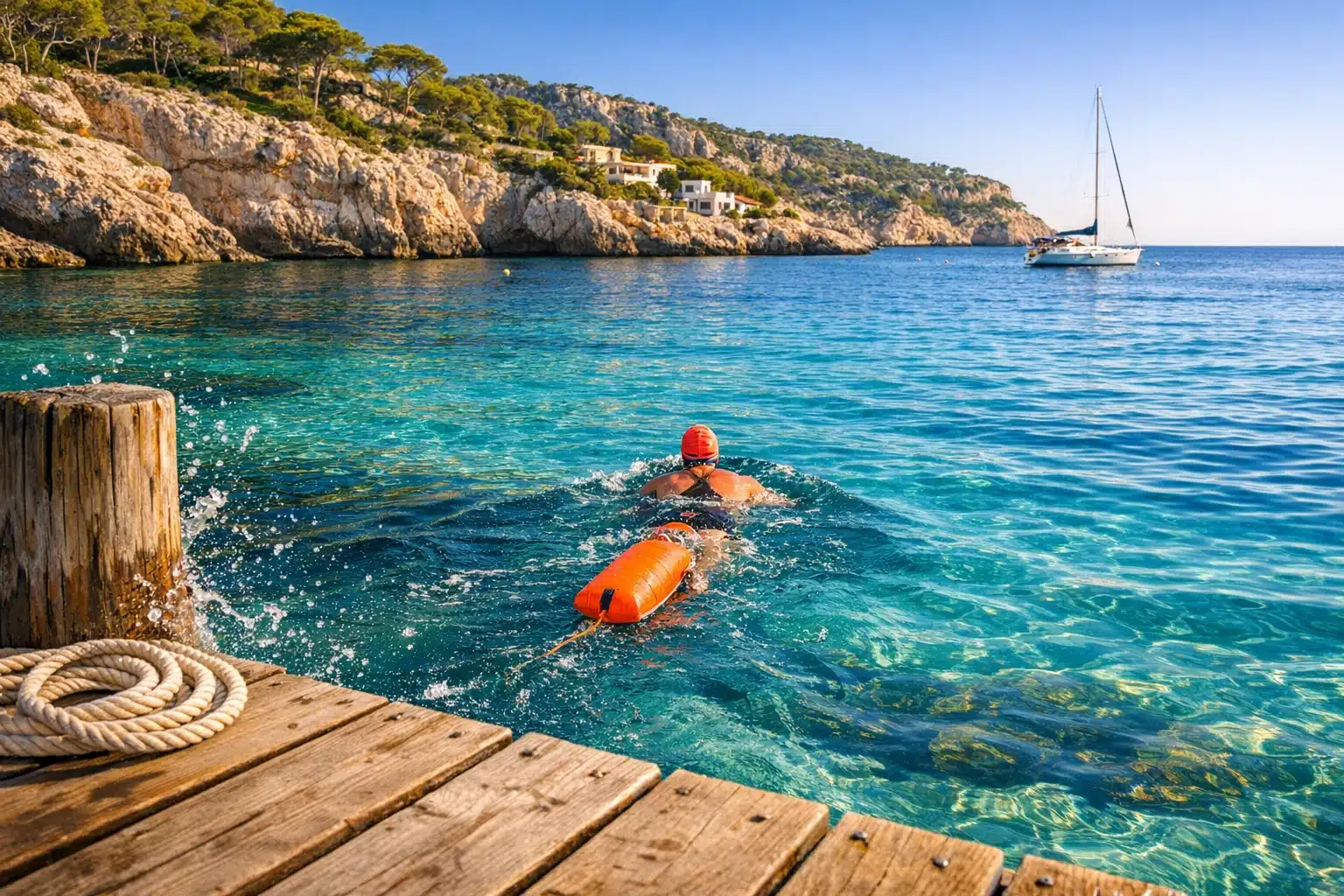
Safety deserves its own emphasis. In pools, that means knowing your limits, respecting lifeguards, and avoiding breath-holding games that can lead to shallow water blackout. In open water, the stakes are higher. Lakes, rivers, and the sea add currents, temperature changes, reduced visibility, and navigation challenges. Open-water swimmers should avoid swimming alone, wear visible gear when appropriate, check weather and water conditions, and enter unfamiliar places cautiously. Confidence in a pool does not automatically transfer to a bay or river.
Improvement in swimming is often quiet. One day you notice your breathing no longer feels frantic. Another day your kick stops fighting the rest of your body. Then a distance that once seemed long becomes a warm-up. That slow accumulation is part of the appeal. Swimming teaches patience, and patient swimmers usually improve the most.
Conclusion for New and Returning Swimmers
If you are curious about swimming, the most useful thing to remember is that it does not demand a single identity from you. You do not have to become a racer, a triathlete, or a lifelong club swimmer to benefit from time in the water. You may be a parent looking for safer family holidays, an office worker wanting exercise that does not punish sore knees, a former athlete rebuilding fitness, or an older adult searching for movement that feels possible again. Swimming can meet each of those needs differently, which is exactly why it remains so valuable.
This article has shown that swimming matters for more than obvious reasons. It is practical because water confidence can improve safety. It is technically interesting because each stroke teaches a separate relationship between balance, propulsion, and breath. It is physically useful because it blends endurance work with broad muscular engagement while staying relatively gentle on the joints. It is also mentally attractive because the pool creates a rare pocket of focused attention in a noisy day.
For readers thinking about a first step, the path does not need to be dramatic. A short lesson block, a beginner lane twice a week, or a return to simple freestyle drills is enough to begin. Progress in swimming is often measured in subtler markers than in some other sports. Better timing, calmer breathing, smoother body position, and greater comfort in deep water are all meaningful improvements. They may not look flashy from the deck, but they change the experience profoundly.
A sensible next move might be:
• book lessons if you are not yet comfortable in the water;
• choose consistency over long, exhausting sessions;
• mix technique practice with easy aerobic swimming;
• treat safety as part of skill, not as an afterthought.
For new swimmers, the goal is confidence. For returning swimmers, the goal is rhythm. For both, the reward is access to an activity that can remain useful for decades. There are few forms of movement that carry this mix of practicality, challenge, and calm. Swimming asks for patience at the start, but it often gives back more than one benefit in return. That is a fair trade, and it is a strong reason to keep going one length at a time.