Understanding Tennis: Rules, Equipment, and Basic Strategies
Tennis can look elegant from the stands, yet on court it is a fast puzzle of timing, balance, and nerve. A single point may last three shots or twenty, and every rally asks players to read spin, angle, and pressure in real time. Because the sport blends simple rules with deep layers of skill, it attracts beginners, weekend players, and elite competitors alike. This guide explains the essentials so you can watch matches more clearly and step onto the court with greater confidence.
Outline: the article starts with a clear map of what makes tennis distinctive and why it remains globally relevant. It then moves through five main areas: the shape and appeal of the sport, the rules and scoring system, the equipment and court surfaces that influence play, the strokes and strategies used to construct points, and the training habits plus mental routines that help learners improve. The aim is not just to define terms, but to connect them, so readers understand how technique, tactics, and match situations work together.
The Shape and Appeal of Tennis
Tennis is one of the few sports that feels both personal and universal. At its simplest, two players or two teams hit a ball over a net and try to stop the opponent from returning it legally. Yet beneath that clean structure sits a game of constant adaptation. Wind changes the toss, spin alters the bounce, fatigue reshapes decision-making, and a single point can swing momentum in a way that feels almost theatrical. That combination helps explain why tennis has remained relevant for generations, from local public courts to the biggest stadiums in the world.
The modern game developed from earlier racquet sports and became formalized in the nineteenth century. Today, it is governed internationally and played across professional tours, college programs, clubs, schools, and neighborhood parks. The four Grand Slam tournaments are the most widely recognized events, and they are held on different surfaces, which gives the sport a distinctive seasonal rhythm. Tennis is also unusual because it is deeply individual even when a coach, trainer, or doubles partner is involved. Once a point begins, the player must solve problems alone. There is no timeout to hide behind, and no bench to substitute in fresh legs.
Part of tennis’s appeal lies in its layered accessibility. A child can understand the basic idea in minutes, while experienced players spend years refining tiny details. The sport welcomes many styles. One player may rely on heavy topspin and patience, another on first-strike power, and a third on touch and court craft. That range creates fascinating contrasts. A defensive baseliner can frustrate an attacker; a strong server can shorten points; a clever returner can turn a match into a grind.
Several core features make tennis stand out:
• It can be played as singles or doubles, changing both geometry and tactics.
• Matches can reward explosive offense, stubborn defense, or a blend of both.
• The same player may look brilliant on one surface and less comfortable on another.
• Physical fitness matters, but so do composure, pattern recognition, and problem-solving.
For spectators, tennis offers a clear story within every rally. For players, it offers endless room to improve. That is why it can feel welcoming on day one and still remain captivating years later. The court is not huge, but it contains an enormous number of possibilities.
Rules, Scoring, and Match Structure
If tennis seems confusing at first, the scoring system is usually the reason. The game counts points as 15, 30, and 40 rather than one, two, and three, and a player must win by a margin rather than simply reach a number and stop. Still, once the building blocks are clear, the structure becomes logical. A match is divided into points, games, and sets. Players win points to win games, games to win sets, and sets to win the match. Most matches are best of three sets, while some major events use best of five for certain competitions.
A standard court is 78 feet long. In singles, the court is narrower than in doubles, which changes the available angles and the amount of ground a player must cover. Each point starts with a serve. The server stands behind the baseline and hits diagonally into the correct service box. Players usually get two chances to land a legal serve. Missing both is called a double fault, and the point goes to the opponent. If the serve clips the net but still lands in the right box, it is generally replayed as a let.
The scoring inside a game works like this:
• First point won: 15
• Second point won: 30
• Third point won: 40
• Fourth point won: game, unless the score reaches deuce
When both players reach 40, the score is deuce. From there, one player must win two consecutive points: one to gain advantage, and another to secure the game. This is where tennis becomes especially tense, because a game can stretch for several minutes and contain repeated swings in pressure. A break of serve, meaning a player wins a game while the opponent is serving, is often one of the most important moments in a set.
To win a set, a player usually needs at least six games with a margin of two. At 6-6, many formats use a tie-break, typically played to at least seven points with a two-point lead required. Match formats can vary by tournament, age group, and level of play, so it is always worth checking the event rules. In doubles, service order rotates among four players, and teamwork becomes vital because movement at the net can decide points quickly.
Tennis also relies on boundaries, etiquette, and concentration. A shot that lands on the line is in. Touching the net during a live point results in losing the point. So does hitting the ball after it bounces twice on your side. At higher levels, electronic line-calling technology is increasingly common, helping reduce disputes. The beauty of tennis rules is that they create constant pressure without becoming chaotic. Every point is small on paper, but in context it can feel enormous.
Equipment and Court Surfaces: Why the Details Matter
Tennis equipment may seem straightforward, but small differences can noticeably change performance and comfort. The main items are the racquet, the ball, shoes, and clothing, yet each of these has meaningful variations. A beginner does not need expensive gear to start, though the wrong gear can make learning harder. A racquet that is too heavy may slow the swing, while one with unsuitable string tension may reduce control or comfort. Good equipment does not replace technique, but it can support it.
Most adult racquets are around 27 inches long, though weight, balance, head size, and string pattern vary. Lighter racquets are often easier to maneuver, which can help newer players react more quickly. Heavier frames can provide more stability, especially against faster shots, but they demand better timing and strength. Strings matter too. Polyester strings often offer control and spin potential, while softer options such as multifilament or natural gut can feel more comfortable on the arm. Tension also changes ball response. Higher tension tends to provide a firmer, more controlled feel, while lower tension can offer more power and a softer impact.
The tennis ball deserves more respect than it usually gets. Its felt covering interacts with the court and the air, affecting speed and bounce. New balls fly and spring differently from worn balls, which is why match conditions can shift within a short period. Even shoes are more specialized than many casual players realize. Tennis requires sudden stops, lateral movement, and repeated recovery steps, so court-specific footwear can improve grip and reduce slipping.
Surface type is one of the sport’s most important variables:
• Hard courts usually provide a balanced, medium-paced game and are common in clubs and public facilities.
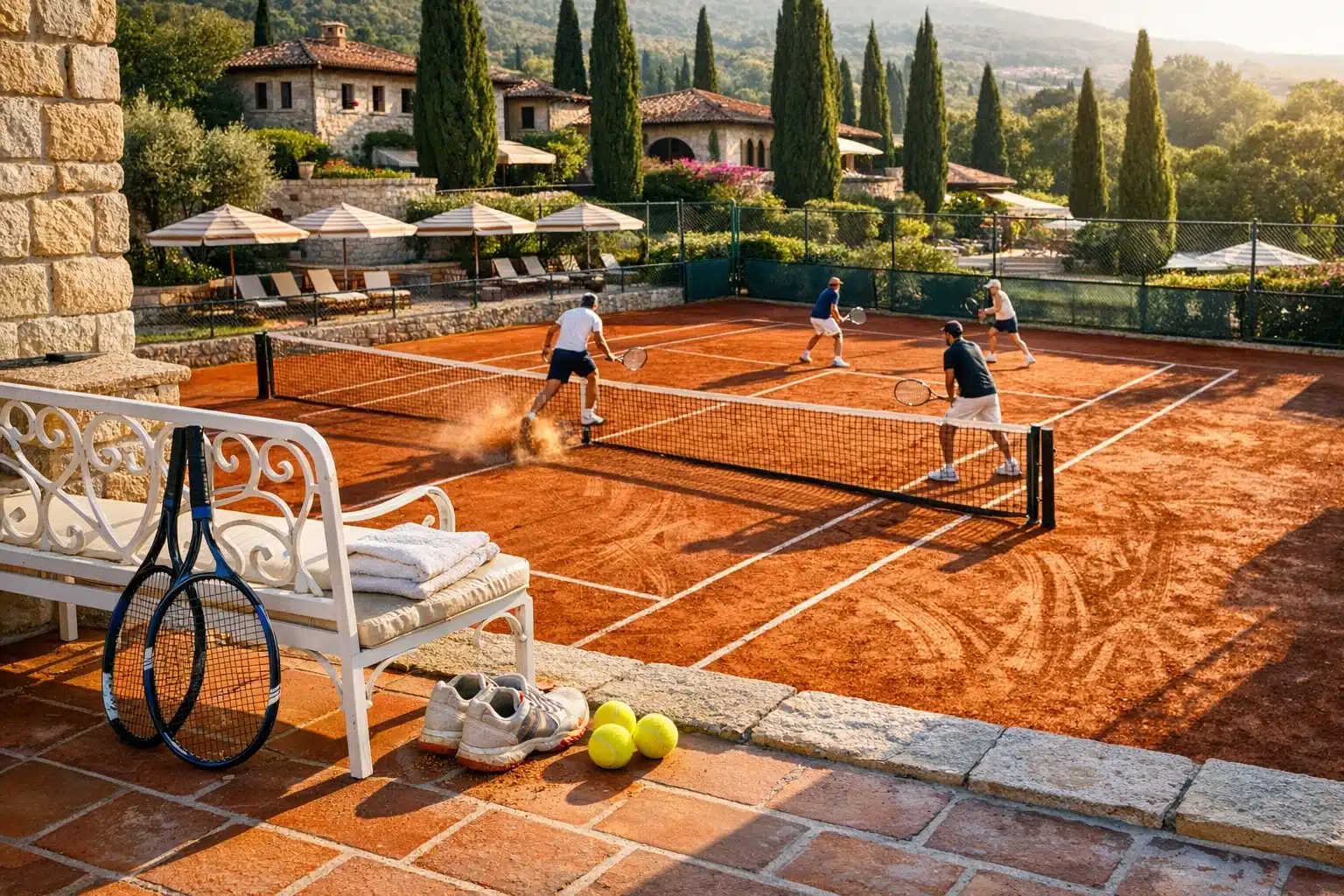
• Clay courts tend to slow the ball and produce higher bounces, often rewarding patience, spin, and strong movement.
• Grass courts usually stay lower and faster, which can favor quick reactions and aggressive first strikes.
• Indoor courts remove wind and sun from the equation, making conditions more predictable.
These surface differences shape playing styles. A topspin-heavy player may thrive on clay, where the ball jumps high and rallies often last longer. A flat hitter with a sharp serve may enjoy faster surfaces that reward early timing. Equipment choices can also follow surface preferences. A player on clay may prioritize movement and endurance, while a player on quicker courts may focus on stability and response speed.
For new players, the best approach is practical rather than flashy: choose a comfortable racquet, wear proper tennis shoes, and learn how surface changes affect bounce and footwork. The game becomes much easier to understand when you realize that the court itself is part of the strategy.
Basic Strokes and Core Strategies
Tennis strategy begins with technique, because a player cannot build points reliably without a functional set of strokes. The basic shots are the serve, forehand, backhand, volley, and overhead, along with specialty options such as the slice, lob, and drop shot. Each shot has a job. The serve starts the point and can immediately create an advantage. The return aims to neutralize that advantage. Groundstrokes from the baseline help control direction, height, and tempo. Volleys shorten time for the opponent by taking the ball early near the net.
For beginners, the forehand is often the first attacking tool. It usually feels more natural because many players strike it on their stronger side. The backhand can be one-handed or two-handed, and both versions can be effective. A one-handed backhand may offer reach and variety, while a two-handed backhand often provides stability and easier handling of higher balls. Neither is automatically better; the right choice depends on the player’s timing, strength, and preference.
Spin is one of the sport’s great hidden languages. Topspin makes the ball dip into the court and bounce higher, which adds margin over the net and pushes opponents back. Slice keeps the ball lower and can disrupt rhythm. Flat shots travel faster but leave less room for error. Good players do not simply hit hard; they vary speed, height, angle, and depth. A rally can feel like a conversation in which every ball asks a question.
Several basic patterns appear again and again:
• Crosscourt shots are often safer because the net is lower in the middle and the court is longer on the diagonal.
• Down-the-line shots can be more aggressive, but they usually carry greater risk.
• Deep returns and groundstrokes limit the opponent’s attacking options.
• Short balls invite players to move forward and take control near the net.
• Serving wide can open space for the next shot into the opposite side.
Positioning is equally important. Many points are lost not because the swing is terrible, but because the feet are late. After each shot, players recover toward a sensible central position based on the geometry of the rally. In singles, that often means adjusting a few steps toward the side where the ball was just hit, not blindly running back to the exact middle. In doubles, net positioning, poaching, and communication become major tactical elements.
A useful early lesson is that high-percentage tennis usually beats heroic tennis. Trying to blast winners from impossible positions may look exciting, but constructing points with shape and patience wins more often. The smartest players notice patterns: a weak second serve, a shaky backhand under pressure, a tendency to stand too far behind the baseline. Strategy in tennis is not only about what you hit. It is about what you notice, when you attack, and which risks are actually worth taking.
How Beginners Improve: Training, Mindset, and a Practical Conclusion
Learning tennis is rarely a straight climb. Some days the ball seems to obey; on others it feels as if the racquet has developed its own opinions. That uneven progress is normal. Tennis asks the body to sprint, stop, rotate, balance, and recover over and over, often while the mind is calculating score, spin, and placement. Improvement comes faster when players treat the sport as a set of linked habits rather than a hunt for miracle tips.
Physical preparation matters because tennis is built on repeated explosive efforts. Even recreational matches involve short bursts of movement separated by brief recovery. Strong legs help players get into position, core stability supports balance and rotation, and shoulder health matters for serving and overheads. Flexibility and mobility are useful because the sport demands reaching, turning, and absorbing force at awkward angles. Warm-ups should not be skipped. A few minutes of movement, light shadow swings, and gradual acceleration can make the first games feel far better.
Beginners usually benefit from focusing on a short list of priorities:
• Make clean contact before chasing extra power.
• Learn a reliable serve motion rather than forcing speed too early.
• Practice footwork patterns, especially split steps and recovery steps.
• Build consistency crosscourt before attempting low-percentage winners.
• Keep score carefully, because tactical awareness improves when the score is understood.
The mental side is just as important. Tennis offers constant little tests of patience. A player can hit three good points and still lose the game with one double fault and one rushed error. That is why routines matter. Taking a breath before serving, using the same reset after mistakes, and choosing one simple target can prevent the mind from drifting. Emotional control is not about looking calm for the crowd; it is about preserving decision-making under stress.
For readers who want to start playing, the best plan is simple: watch a few matches with the scoring in mind, hit regularly instead of occasionally, and judge progress by better choices as much as better shots. If you are mostly a fan, understanding surfaces, patterns, and momentum will make matches much richer to follow. If you are a beginner player, remember that tennis rewards patience. The first clean rally, the first solid serve, and the first point you build on purpose all feel memorable for a reason. They mark the moment when the game stops looking random and starts making sense. That is the real invitation tennis offers: not instant mastery, but a sport that keeps revealing new layers the longer you stay with it.