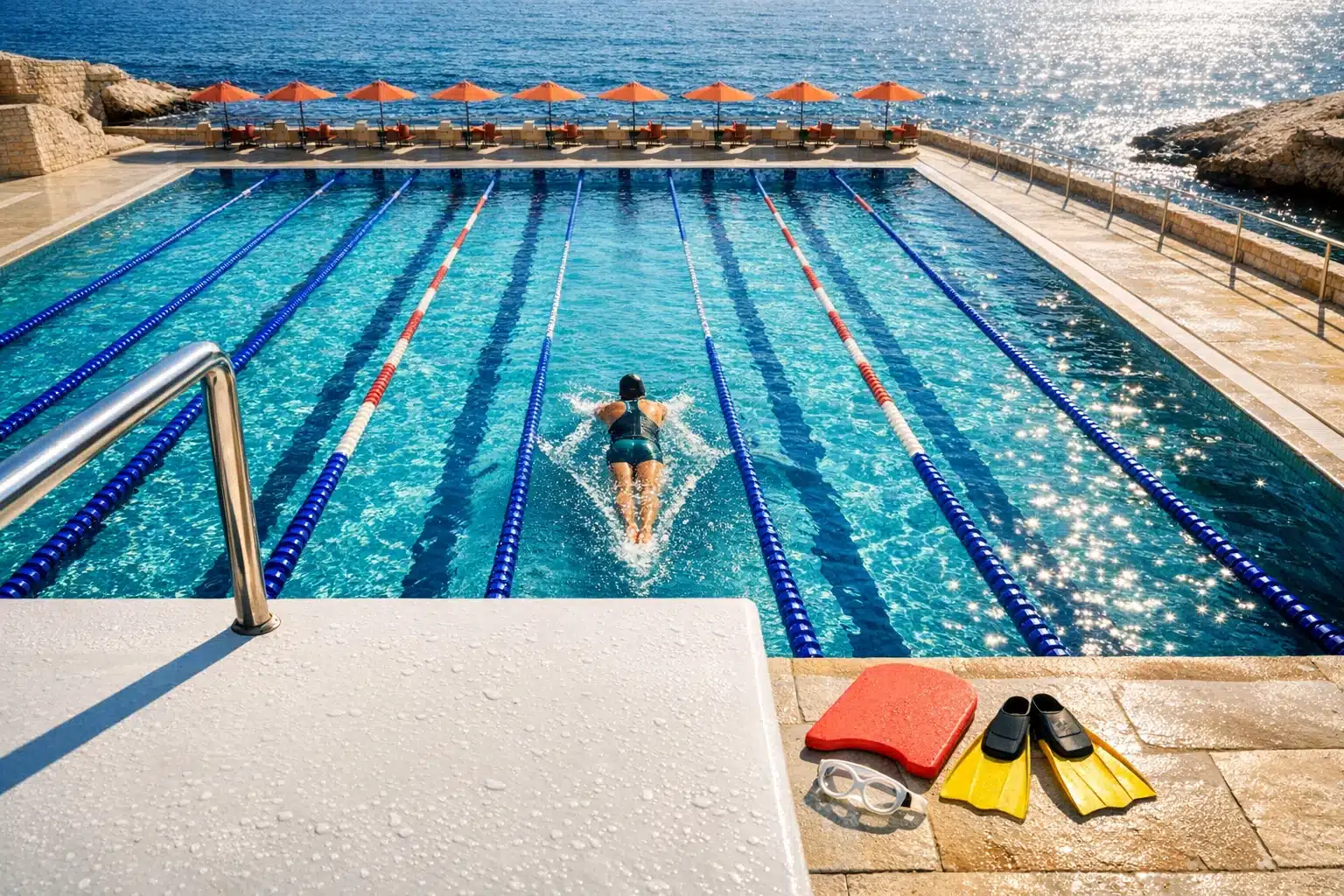
Explore the world of swimming
Explore the world of swimming
Swimming invites people into a space where effort feels lighter, sound softens, and movement becomes almost musical. It works at once as a safety skill, a demanding sport, and a practical way to stay active across different ages and fitness levels. Because water supports the body while resisting every motion, it rewards coordination just as much as strength. That rare mix of usefulness, challenge, and calm gives swimming lasting relevance in everyday life.
Outline
- The wider meaning of swimming as a life skill, fitness practice, and organized sport
- The major strokes and the technical principles that make movement through water efficient
- The physical and mental benefits that explain swimming’s broad appeal
- Training structure, equipment choices, and safety habits that support steady progress
- A practical conclusion for beginners, returning adults, competitive athletes, and lifelong recreational swimmers
Swimming as a Life Skill, a Sport, and a Form of Freedom
Swimming occupies a rare place in human life because it is useful long before it becomes competitive. A person may first learn it for safety, later use it for exercise, and eventually discover it as a sport with its own tactics, traditions, and quiet rituals. That layered value sets it apart from many activities. Someone can stop playing tennis or football and lose little outside the game itself, but comfort in water can matter on a family holiday, during a boating trip, or in an emergency. In that sense, swimming is not only recreation; it is a practical capability.
From a sporting perspective, swimming is also remarkably democratic. Elite racing takes place in highly regulated pools, yet the core act remains simple: move through water efficiently. Children in learn-to-swim classes, older adults in aqua fitness sessions, triathletes chasing seconds, and open-water swimmers following a distant buoy are all solving versions of the same puzzle. They must balance breathing, body position, rhythm, and confidence. The pool does not care about status, and the water gives immediate feedback. If technique slips, progress slows. If timing improves, motion becomes smoother almost at once.
Compared with many land-based sports, swimming offers a different kind of challenge. Running often feels direct and impact-heavy, while cycling depends strongly on equipment and terrain. Swimming, by contrast, asks the athlete to work inside a medium that is far denser than air, so even small errors cost energy. A dropped elbow, a late breath, or a tense kick can turn a graceful lap into a tiring struggle. This is part of its fascination. Improvement is measurable, but it is also deeply felt. The swimmer senses better balance, cleaner rotation, and a longer line through the water before the stopwatch confirms it.
Its importance can be summed up in three broad roles:
- Safety: basic swimming ability can reduce panic and increase survival chances around water.
- Health: it provides full-body aerobic exercise with relatively low joint impact.
- Identity: for many people, it becomes a lifelong habit linked to discipline, calm, and self-belief.
There is also an emotional dimension that statistics cannot fully capture. Water changes perception. Noise fades, movement becomes fluid, and the mind often settles into a focused state that feels different from a gym session or a road workout. Some people experience this as relief, others as challenge, and many as both. That is why swimming often stays with people for decades. It meets the beginner with patience, tests the ambitious with precision, and rewards the persistent with a sense of freedom that few sports can imitate.
The Four Main Strokes and the Technical Language of Water
To understand swimming beyond the surface, it helps to know the major strokes and the principles behind them. Competitive swimming is built around freestyle, backstroke, breaststroke, and butterfly. Freestyle in races is almost always performed as front crawl because it is the fastest option. Backstroke reverses the body position and allows constant access to air. Breaststroke uses a more cyclical pull-and-kick pattern and is often the first stroke many beginners find intuitive. Butterfly, with its symmetrical arm action and dolphin kick, is the most physically demanding of the four for most swimmers.
Each stroke teaches a different lesson. Front crawl rewards streamlining, rotation, and a relaxed but effective breathing pattern. A swimmer who keeps the head still, turns just enough to inhale, and enters the hand cleanly will usually travel farther per stroke. Backstroke highlights alignment and balance because the face stays above water while the hips must remain high. Breaststroke punishes mistimed movements; if the kick and glide are rushed, the body meets extra resistance. Butterfly exposes technical flaws quickly because it depends on rhythm. When the chest, core, hips, and kick move in sequence, the stroke looks powerful. When the timing breaks apart, it becomes exhausting.
Several technical ideas connect all strokes:
- Body position: a horizontal line reduces drag and makes propulsion more efficient.
- Breathing control: good timing prevents panic and preserves rhythm.
- Catch and pull: the hands and forearms must hold water rather than slip through it.
- Kick function: the legs support balance, timing, and propulsion in different proportions.
- Relaxation under effort: unnecessary tension wastes energy faster in water than many novices expect.
Technique matters so much because water resists movement strongly. Coaches often say that swimming is not about fighting water but learning to cooperate with it. That idea sounds poetic, yet it is practical. A strong beginner with poor mechanics can be overtaken by a smaller swimmer whose stroke is longer and calmer. This is one reason swimming is so compelling to analyze. Progress does not depend only on raw fitness. It also depends on awareness.
Even the vocabulary of the sport reveals its precision: streamline, catch, pull, recovery, rotation, glide, turnover. These are not decorative terms. They describe the difference between churning and travelling. Watch a skilled swimmer during an easy session and it can resemble calligraphy written across the lane, each lap tracing a cleaner line than the one before it. That beauty is not accidental. It is technique made visible.
How Swimming Benefits the Body and Mind
Swimming is often praised as a full-body workout, and that description is accurate, but it only tells part of the story. What makes it especially valuable is the way it combines cardiovascular training, muscular engagement, mobility, and controlled breathing in a single activity. The arms pull, the legs kick, the core stabilizes, and the lungs must coordinate with motion. Unlike many exercises that isolate one area at a time, swimming trains systems together. That is one reason a moderate session can feel satisfying without the pounding commonly associated with running or court sports.
For heart and lung health, regular swimming can contribute meaningfully to the standard recommendation that adults accumulate at least 150 minutes of moderate aerobic activity per week. Laps, interval sets, water jogging, and technique-focused sessions can all count, depending on intensity. Because the body is cooled by the surrounding water, some people are able to sustain effort comfortably for longer periods than they expect. Many also notice that heart rate readings in water may differ from comparable land workouts, so perceived effort and pacing become useful tools rather than relying only on a watch.
The physical advantages are broad:
- Low impact: buoyancy reduces stress on joints, making the activity appealing for older adults and people managing certain injuries.
- Balanced muscle use: shoulders, back, hips, glutes, core, and lower legs all contribute in different ways.
- Mobility and posture support: efficient strokes encourage length through the spine and better body awareness.
- Scalable intensity: the same pool can host gentle recovery work and demanding race preparation.
Mental benefits are just as important. Swimming creates a structured environment with fewer distractions than many workouts. In lap swimming, the pattern of push, stroke, breathe, turn, and repeat can become almost meditative. Stress does not disappear, but it often loses volume. For busy professionals, students, and parents, that rhythm can feel like a reset button. Open-water swimming adds another psychological layer. Lakes, rivers, and seas replace ceiling tiles with sky and distance, which some people find exhilarating and others deeply calming.
Swimming can also rebuild confidence. Adults who return to exercise after years away often appreciate that progress is private and measurable. A person who begins by completing four slow lengths and later handles twenty with steady form does not need a dramatic transformation story to feel proud. The evidence is there in stamina, technique, and comfort. For children, swim lessons may nurture discipline and safety awareness alongside fitness. For athletes in other sports, water sessions provide conditioning with less impact. For people in rehabilitation settings, carefully supervised aquatic work can make movement possible when land exercises feel harsh.
In short, swimming is not merely about burning calories. It improves capacity, teaches control, and offers a setting where exertion and relief can exist in the same hour. That combination explains why so many people see the pool not as a chore, but as a place where the body learns resilience without unnecessary punishment.
Training, Equipment, and Safety: Building Skill Without Guesswork
Good swimming improvement rarely comes from mindless distance alone. Endless laps may build tolerance, but structured training builds competence. A well-designed session usually includes a warm-up, a skill component, a main set, and a cool-down. The warm-up raises temperature and restores feel for the water. Drills sharpen one technical detail at a time, such as balance, high elbows, or kick timing. The main set targets endurance, speed, pacing, or race-specific demands. The cool-down lowers intensity and helps the swimmer finish with composure rather than collapse.
A practical beginner or intermediate workout might look like this:
- 200 to 400 meters easy swimming to settle breathing and rhythm
- 4 to 8 short drills with rest, focusing on one skill rather than many
- A main set such as 8 x 50 meters at controlled effort or 4 x 100 meters with consistent pacing
- 100 to 200 meters easy recovery at the end
This type of structure helps swimmers learn an important truth: not every length should feel the same. Some laps teach control, some develop fitness, and some test speed. Variety matters because swimming is technical. When fatigue rises too early, form often falls apart, and bad habits can hide inside effort.
Equipment should support the swimmer, not distract from the basics. A well-fitting pair of goggles matters more than many newcomers realize; discomfort around the eyes can ruin concentration quickly. A comfortable swimsuit, a cap for hair management, and a reliable towel cover the essentials. Training aids can be useful when chosen carefully. Kickboards isolate leg work, pull buoys reduce kicking to highlight upper-body mechanics, fins can help body position and ankle flexibility, and paddles increase resistance for experienced users. None of these tools replaces sound technique, but each can amplify a lesson when used at the right time.
Safety deserves equal attention. Confidence in water should never slide into casual overestimation. Pool rules, lane etiquette, and supervision standards exist for a reason. In open water, additional risks appear: currents, cold shock, low visibility, boat traffic, and changing weather. Bright caps, tow floats, knowledge of the route, and swimming with others are sensible precautions. Formal lessons remain one of the smartest investments a family can make, especially for children, because instruction teaches not only strokes but decision-making around water.
Several habits support long-term progress and safety at once:
- Increase volume gradually rather than chasing sudden jumps in distance.
- Prioritize technique when tiredness starts to distort the stroke.
- Learn basic breathing control to prevent panic.
- Respect recovery, particularly for the shoulders.
- Ask for coaching feedback instead of repeating hidden errors for months.
Swimming rewards patience. The water is honest, but it is not unkind. With clear training structure and smart precautions, improvement becomes less mysterious and much more sustainable.
A Practical Conclusion for New and Returning Swimmers
For readers wondering whether swimming is worth the effort, the clearest answer is that it offers unusual range. A child can begin with floating and blowing bubbles. A nervous adult can build confidence one shallow-water session at a time. A competitive athlete can refine starts, turns, pacing, and race strategy down to fractions of a second. An older adult can use the pool to stay active while limiting impact on joints. Very few activities meet such different needs without losing their core value.
If you are a beginner, the best starting point is not speed but familiarity. Learn how to exhale in water, how to float without stiffness, and how to move a short distance while staying calm. Early success in swimming often comes from reducing fear and tension rather than forcing distance. If you are returning after a long break, resist the temptation to measure yourself against your past. A smart comeback is built on short, regular sessions and technical attention, not on dramatic first-day ambition. If you already train seriously, the message is different: keep respecting the details. In swimming, minor gains in alignment, turns, and pacing can produce large results over time.
The audience for swimming is wider than many people assume:
- Families benefit from water safety and shared recreational time.
- Fitness seekers gain a scalable aerobic workout with muscular involvement.
- Injury-conscious exercisers often find it more forgiving than impact-heavy routines.
- Competitors can chase measurable progress through times, splits, and stroke efficiency.
- People under stress may value the focused, almost meditative quality of steady laps.
There is also room for joy here, and that point should not be overlooked. Not every session needs a stopwatch. Some days the goal is simply to feel lighter, breathe better, and leave the water clearer than when you entered it. Other days invite discipline: counting strokes, holding pace, practicing turns until they become automatic. Swimming can contain both moods without contradiction.
In summary, swimming matters because it is useful, teachable, demanding, and adaptable. It strengthens the body, sharpens awareness, and builds a relationship with water that can last a lifetime. For the curious reader, the practical next step is simple: begin where your comfort level truly is, seek good instruction, and let consistency do the quiet work. The first confident length may feel small from the deck, but in the water it can feel like opening a door.