Explore the world of swimming
Swimming sits at the crossroads of sport, survival, and simple pleasure, which is why it remains relevant in schools, fitness programs, and everyday life. It trains the heart and muscles without the repeated impact that running can place on joints, making it useful for children, athletes, and older adults alike. In a pool it can feel meditative, while in open water it asks for awareness, calm, and respect for changing conditions. This article explores the skills, science, and culture behind swimming so readers can understand not just how it is done, but why it matters.
Outline: The article begins with the broader value of swimming as a practical skill, a form of exercise, and a shared human activity. It then compares the four main strokes and explains how technique changes speed, comfort, and energy use. The third part looks at health benefits and essential safety rules, while the fourth focuses on learning methods, equipment, and training structure. The final section brings everything together with a reader-focused conclusion on how to make swimming a realistic part of modern life.
Swimming as a Life Skill, Exercise, and Shared Human Experience
Swimming matters for reasons that go well beyond medals, stopwatch times, or holiday photos. At its most basic level, it is a safety skill. People who are comfortable in water, understand floating, and know how to breathe calmly are better prepared to handle unexpected situations near pools, lakes, rivers, or the sea. That point alone gives swimming unusual importance. Unlike many hobbies, it combines enjoyment with a direct practical benefit, and that is one reason it remains part of school programs, community recreation, military training, and rehabilitation work in many countries.
As exercise, swimming is equally distinctive. Water supports the body and reduces the pounding that often comes with land-based activity. That makes it attractive for people managing joint sensitivity, recovering from certain injuries, or returning to fitness after a long break. At the same time, the water provides resistance in every direction, so even controlled, graceful movement can challenge the muscles. A lap swimmer may look smooth and effortless from the pool deck, yet beneath the surface the body is constantly working to stay aligned, breathe efficiently, and move forward without wasting energy. In that sense, swimming is a quiet kind of labor: less noise, less impact, and still a serious workout.
Swimming also has a social and cultural dimension. Public pools, seaside towns, school teams, and masters clubs all create different versions of the same world. One person swims to compete, another to recover, another to clear a crowded mind after work. The setting changes, but the appeal remains familiar. The pool lane offers routine and measurable progress; open water offers uncertainty, scenery, and a more elemental thrill. Both experiences matter, and both teach something valuable.
A useful comparison can be made with other common forms of exercise. Running is accessible and efficient, but it places repeated force through the legs. Cycling builds endurance, yet it depends on equipment and road conditions. Weight training develops strength in targeted ways, though it does not always challenge breath control and body coordination at the same time. Swimming occupies a rare middle ground:
• it builds cardiovascular fitness
• it develops full-body coordination
• it can be low impact
• it remains useful as a lifelong activity
That combination explains its lasting relevance. Swimming is not just about moving through water; it is about learning how body, breath, and environment work together. Few activities teach that lesson so clearly.
Understanding the Main Strokes: Technique, Speed, and Energy Use
The four competitive strokes, front crawl, backstroke, breaststroke, and butterfly, form the technical heart of swimming. Each asks the body to solve the same problem in a different way: how to move through dense water with as little wasted effort as possible. Because water is far denser than air, small inefficiencies become obvious. A dropped elbow, a mistimed breath, or a wide kick can slow the swimmer more than many beginners expect. That is why technique is not decoration in swimming; it is performance itself.
Front crawl, often called freestyle in racing, is usually the fastest stroke. The body stays long and horizontal, the flutter kick helps maintain balance and momentum, and alternating arm recovery allows a continuous rhythm. For distance swimming, it is often the most practical choice because it combines speed with comparatively efficient energy use once technique is developed. Yet it is also easy to do badly. Many novice swimmers fight the water by lifting the head too high, kicking too hard, or pulling with straight arms instead of using a catch that grips the water more effectively.
Backstroke shares some features with front crawl, but the face stays above the surface. That makes breathing simpler for many learners, although body position can be harder to judge without seeing forward. A strong backstroke depends on hip rotation, a steady kick, and trust in the water. It can feel oddly freeing, almost like moving under the sky rather than through a lane, but it punishes crooked alignment and wandering direction.
Breaststroke is often the stroke casual swimmers find most familiar because the head can come forward regularly and the pace feels more controlled. Even so, good breaststroke is highly technical. The timing of the pull, kick, and glide must match closely. When done well, it looks economical and precise. When done poorly, it becomes tiring and slow. It is usually slower than front crawl or backstroke, but many swimmers find it comfortable for short recreational distances.
Butterfly is the most demanding of the four for most people. It requires coordinated dolphin kicks, strong upper-body timing, and a wave-like motion driven from the core. It can be beautiful to watch because it turns power into rhythm, but it is unforgiving if timing breaks down. In practical terms, swimmers often learn it later because it demands both strength and control.
A quick comparison helps:
• Front crawl: fastest, efficient for fitness and distance, technically sensitive
• Backstroke: easier breathing, useful for posture awareness, direction can be tricky
• Breaststroke: controlled tempo, highly technical timing, often favored by recreational swimmers
• Butterfly: powerful and dramatic, very demanding, usually hardest to sustain
The deeper lesson is simple: no stroke is automatically easy. Each one rewards patience, repetition, and attention to detail. In swimming, smoothness is not the opposite of effort; it is what effort looks like after practice.
Health Benefits, Mental Focus, and the Safety Rules That Matter Most
Swimming is often praised as a full-body workout, and that description is accurate, but it still undersells the activity. It challenges the cardiovascular system, asks multiple muscle groups to cooperate, and encourages mobility through repeated movement at the shoulders, hips, knees, and ankles. Regular sessions can improve endurance, muscular stamina, and general fitness, while the water environment often makes exercise feel more manageable for people who find running or high-impact classes uncomfortable. That combination helps explain why swimming is used by competitive athletes, casual exercisers, and many adults who want a sustainable routine rather than a punishing one.
The mental side deserves equal attention. Pools have a rhythm that many people find calming: the sound of water, the repetition of lengths, the clear structure of sets and rest periods. Swimming can create a rare state of focused quiet, where the mind narrows to breathing, timing, and movement. For some, that feeling is close to meditation; for others, it is simply a relief from digital noise and crowded schedules. Open-water swimming adds a different kind of mental effect. Lakes, rivers, and the sea can feel expansive and refreshing, but they also demand respect. The reward is often a powerful sense of presence, as if the body and mind have stopped arguing and started paying attention to the same thing.
Of course, the benefits only matter when safety comes first. Water is enjoyable, but it is not casual. Even strong swimmers can get into difficulty through fatigue, cold, currents, panic, or overconfidence. That is why good habits matter more than bravado. The most basic rules are not glamorous, yet they prevent a remarkable number of problems:
• never overestimate your ability
• pay attention to lifeguards, signs, and local conditions
• avoid swimming alone in unfamiliar open water
• warm up before hard efforts
• stop if you feel dizzy, unusually cold, or short of breath
• supervise children closely, even in shallow water
Pool safety and open-water safety also differ in important ways. In a pool, hazards often involve collisions, slippery surfaces, or poor lane awareness. In open water, the list expands to include currents, waves, changing weather, low visibility, and water temperature. Cold water, in particular, can reduce coordination and change breathing quickly. That is one reason open-water swimmers often build experience gradually rather than treating a lake or ocean like a larger version of a pool.
The strongest argument for swimming is not simply that it can improve fitness. It is that it can improve fitness while teaching self-control, breath management, and environmental awareness. When approached thoughtfully, it strengthens both the body and the judgement that keeps the body safe.
Learning to Swim and Training with Purpose: Skills, Equipment, and Progress
Learning to swim well is less about force than about sequence. Many beginners assume they must first become strong enough to conquer the water, but experienced teachers usually work the other way around. They build comfort, then control, then efficiency. Breath control comes first, because panic and poor breathing cause more trouble than weak arms. Floating and body position follow, because a swimmer who rides high and long in the water spends less energy fighting to stay up. Kicking, pulling, and coordinated stroke timing only become useful once that foundation is in place. This is why patient beginners often progress more steadily than impatient athletic people who try to overpower the water from day one.
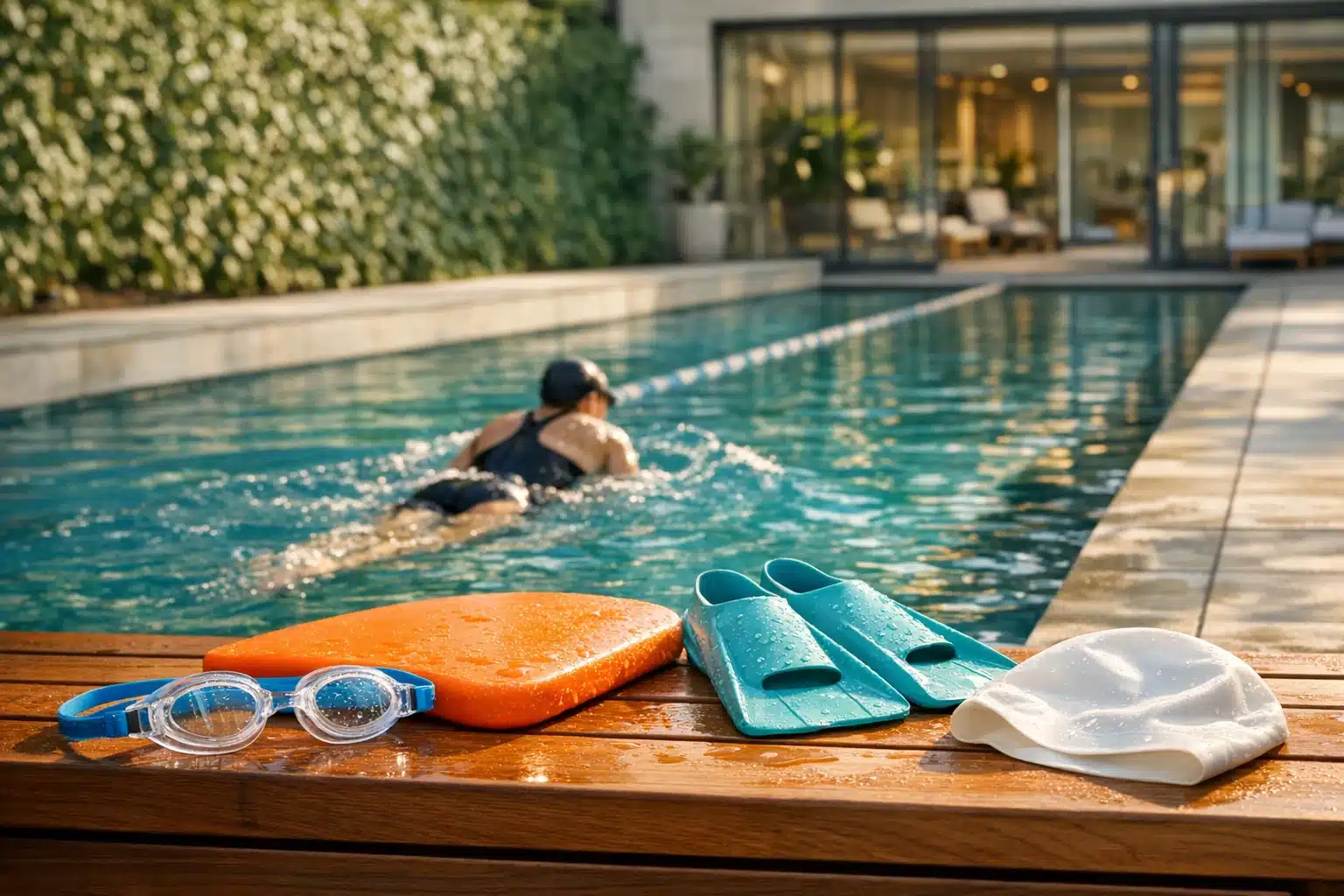
Equipment can help, but it works best when it supports technique instead of replacing it. Goggles are the simplest and perhaps most useful tool because they reduce irritation and allow swimmers to see clearly enough to relax. Kickboards isolate leg work and body alignment, though too much board use can encourage a lifted head and poor posture if handled carelessly. Pull buoys reduce kicking so swimmers can focus on the arm stroke and body line. Fins add propulsion and can help learners feel the correct position at the surface, but they should not become a crutch. A swim cap improves comfort and reduces drag slightly, while a well-fitted suit matters more than many people realize because distraction and restriction both interfere with skill development.
Training structure is what turns occasional swimming into improvement. Random laps can provide exercise, but planned sessions produce clearer progress. A useful workout often includes:
• an easy warm-up to establish breathing and rhythm
• technique drills that target one specific skill
• a main set that develops endurance, speed, or pacing
• short recovery periods to maintain quality
• a relaxed cool-down to finish under control
For example, a beginner might swim short repeats with generous rest and simple drill work, while an experienced swimmer might track pace over repeated 100-meter efforts or add pull sets and kick sets for variety. Progress can be measured in several ways: fewer stops, smoother breathing, better lane awareness, improved distance, faster times, or a lower stroke count at the same pace. The smartest swimmers do not chase every marker at once. They pick one or two goals and train with enough consistency for those goals to become visible.
There is also an art to knowing what not to do. Common mistakes include swimming every length too hard, skipping technique work, using gadgets without understanding their purpose, and comparing early progress to experienced swimmers in the next lane. Improvement in swimming is often uneven. One week your breathing clicks; the next week your timing feels awkward again. That is normal. The water is an honest teacher, and honest teachers rarely hand out quick rewards. They reward repetition, attention, and the willingness to stay curious long enough for awkward movements to become fluent ones.
Conclusion for New and Returning Swimmers: Making Swimming Part of Real Life
If you are new to swimming, returning after years away, or wondering whether it deserves a place in your routine, the answer depends less on talent than on purpose. Swimming can serve many roles at once. It can be a practical life skill, a low-impact fitness option, a structured competitive sport, a form of active recovery, or simply an hour in the week when the mind finally quiets down. That flexibility is one of its greatest strengths. You do not need to love racing, own specialized gear, or train like an elite athlete to benefit from time in the water.
What matters most is choosing an entry point that matches your reality. A cautious beginner may need lessons focused on breathing and confidence. A busy adult may only have two short sessions a week and should treat consistency as success. A former athlete might enjoy the measurable side of lap swimming, where pace, stroke count, and interval work create clear goals. Someone seeking stress relief may prefer steady, moderate lengths or supervised open-water sessions. These are all valid versions of swimming, and each can be meaningful when approached with patience.
There are a few practical ways to begin well:
• start with realistic session lengths instead of heroic ones
• focus on comfort and technique before speed
• ask for feedback from a qualified coach or instructor
• choose safe environments and respect local rules
• track progress in simple terms, such as distance, confidence, or recovery time
The larger point is that swimming rewards steady participation more than dramatic ambition. A person who swims modestly for months often gains more than someone who attacks the pool for a week and disappears. Over time, the benefits accumulate: better aerobic fitness, improved coordination, stronger breath control, greater confidence around water, and in many cases a healthier relationship with exercise itself. Swimming does not need to become your entire identity to be valuable. It only needs a regular place in your life.
For readers deciding where to start, the most useful next step is a simple one: pick a safe setting, set a small goal, and get in the water with attention rather than ego. The pool will not care about your age, your job title, or whether your first length looks graceful. It will simply give clear feedback and ask for honest effort. That is part of the sport’s enduring appeal. Swimming meets people where they are, then invites them, one stroke at a time, to move a little farther.