Explore the world of swimming
Swimming is one of those rare activities that feels playful, practical, and powerful at the same time. It teaches survival, builds endurance, and offers a low-impact way to move that suits children, older adults, and serious athletes alike. From crowded city pools to open-water coastlines, it links fitness with confidence in a direct, memorable way. This article explores how swimming works, why it matters, and how people at every level can enjoy it more.
Outline
- The role of swimming in history, daily life, and modern sport
- The physical and mental benefits that make swimming widely valuable
- The major strokes, essential technique, and common learning mistakes
- Safety, equipment, and practical training habits for beginners and regular swimmers
- A concluding guide for readers who want to make swimming part of their routine
Swimming in Context: Why This Skill and Sport Still Matters
Swimming has been part of human life for thousands of years, long before it became a lane-based sport with stopwatches, flags, and podiums. Historical evidence shows that people learned to move through water for survival, travel, fishing, and military purposes. Over time, that practical skill grew into recreation, education, and organized competition. In the modern Olympic Games, swimming has been present since 1896, and women’s events were added in 1912, which helped turn the sport into a global spectacle. Today, swimming sits in a rare category: it is at once a life skill, a health practice, a family activity, and a serious athletic discipline.
Part of its relevance comes from its flexibility. A person can swim for very different reasons and still be participating in the same broad world. One swimmer might be a child learning to float safely. Another might be a triathlete refining race pace over 1,500 meters. Someone else may simply enjoy gentle laps after work because the water creates a calm break from screens, traffic, and deadlines. Few activities can stretch across such different needs without losing their basic identity.
Swimming also has multiple forms, each with its own culture and challenges:
- Pool swimming focuses on technique, pacing, and structured training.
- Open-water swimming adds currents, temperature changes, and navigation.
- Competitive racing rewards speed, efficiency, and race strategy.
- Recreational swimming emphasizes enjoyment, confidence, and mobility.
- Adaptive swimming creates access for people with physical or sensory differences.
That range matters because it keeps swimming relevant in schools, community centers, health clubs, vacation settings, and elite sport programs. It is not limited to one age group or social identity. Children benefit because water competency reduces risk and builds self-belief. Adults benefit because swimming offers exercise that can be scaled up or down. Older participants often appreciate the support that water provides for joints and balance. Competitive swimmers value the measurable nature of the sport, where small changes in stroke length or turns can influence results.
There is also something emotionally distinctive about swimming. Running pounds the ground, cycling chases the road, but swimming asks the body to cooperate with an element that does not naturally hold it up. The result can feel almost poetic: progress depends less on force alone and more on rhythm, timing, and trust. That is one reason so many people stay with swimming for years. It challenges the body, but it also teaches patience. In a hurried world, that combination gives swimming lasting importance.
Health, Fitness, and Mental Benefits of Time in the Water
Swimming is often recommended because it trains the body without the repetitive impact associated with some land-based activities. Water supports a large portion of body weight, which can reduce stress on hips, knees, and ankles. At the same time, the body still has to work hard because water creates resistance in every direction. That means a lap session can combine cardiovascular effort with muscular engagement. Shoulders, back, chest, core, hips, and legs all contribute, especially when technique is sound. This full-body demand is one of swimming’s strongest advantages.
For general health, regular swimming can help people work toward widely accepted physical activity guidelines. Organizations such as the World Health Organization advise adults to accumulate at least 150 minutes of moderate-intensity aerobic activity per week, or 75 minutes of vigorous activity, along with muscle-strengthening work. Swimming can contribute meaningfully to that target. A relaxed session may support steady endurance, while interval training can raise intensity considerably. Because pace can be adjusted so easily, swimmers can progress from short, easy lengths to more demanding workouts over time.
The benefits are not only physical. Many swimmers describe a session as mentally clarifying. That feeling has several possible explanations. Rhythmic breathing can calm the nervous system. Repeated movement can create a meditative effect. Water muffles external noise, which gives the mind a break from constant stimulation. People who swim regularly often report improved mood, reduced stress, and better sleep, although outcomes vary from person to person. The pool can become a rare place where the day slows down enough for thoughts to settle.
Swimming is not magic, and it is helpful to speak plainly about that. It does not remove the need for technique, recovery, or consistency. Poor form can irritate the shoulders or neck, and beginners sometimes overestimate how much distance they can cover. Yet when approached sensibly, it is a powerful option for many groups:
- Beginners who want an approachable form of aerobic exercise
- People returning to movement after a long break
- Older adults seeking joint-friendly activity
- Athletes using cross-training to reduce repetitive strain
- Individuals in supervised rehabilitation programs, when medically appropriate
Another practical strength is scalability. A novice may start with 10 or 15 minutes, mixing kicking drills and short rests. An experienced swimmer may complete several kilometers with targeted intervals. Both are swimming meaningfully. The water does not ask for perfection; it asks for adaptation. Over weeks and months, that adaptability can translate into better stamina, stronger breath control, and a more confident relationship with exercise itself. For people who dislike high-impact workouts or crowded gym floors, the lane line can feel like a better invitation.
Understanding the Strokes: Technique, Efficiency, and Common Mistakes
To an observer, swimming may look simple: move the arms, kick the legs, breathe when possible, and keep going. In practice, technique makes an enormous difference. Two swimmers with similar strength can produce very different results depending on body position, timing, and efficiency. Water is unforgiving when movement is rushed or poorly aligned. A lifted head can drop the hips. An uneven kick can create drag. A mistimed breath can interrupt rhythm. That is why good coaching and patient repetition matter so much, especially in the early stages.
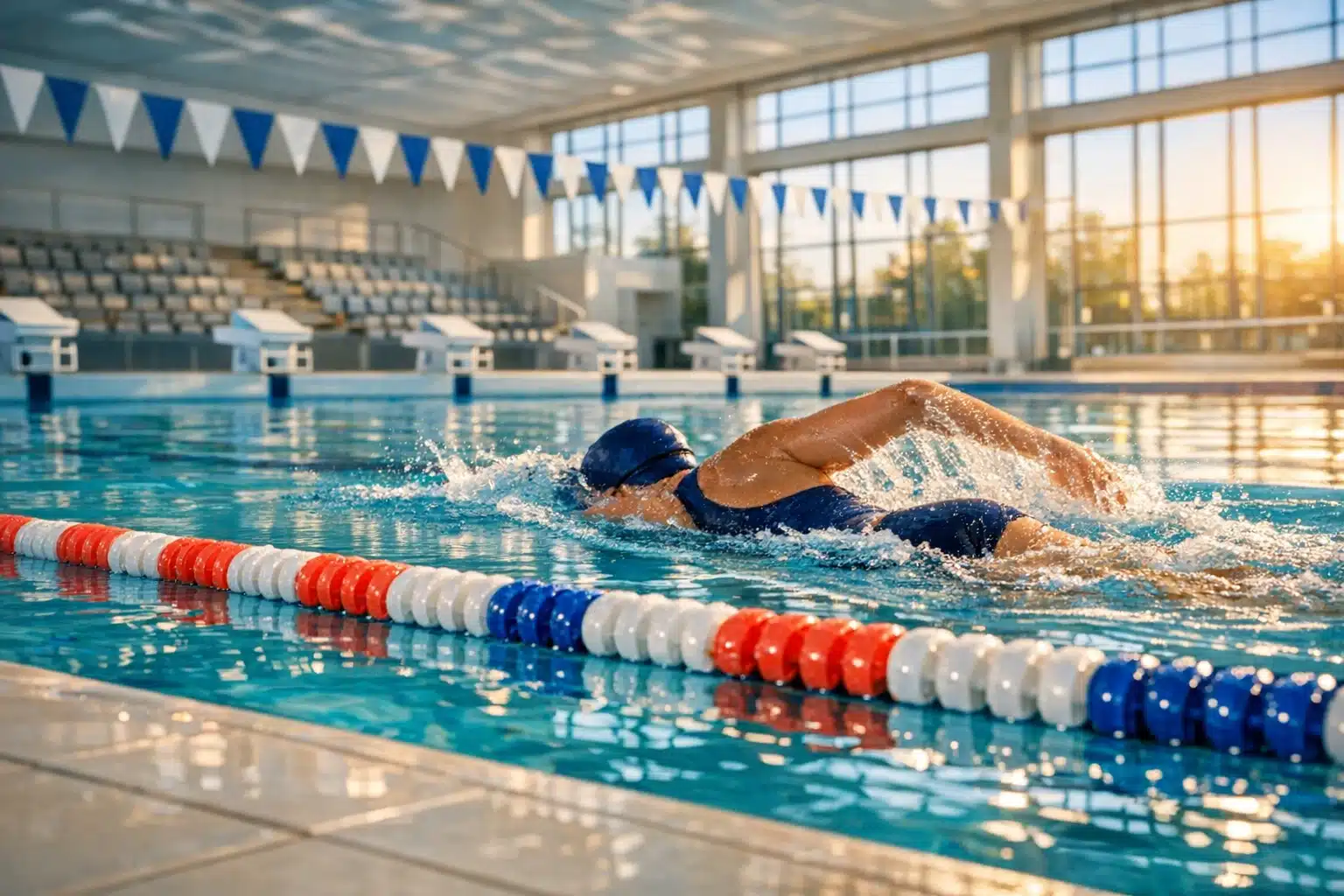
The four main competitive strokes each have a distinct identity. Freestyle, usually swum as front crawl, is typically the fastest and most efficient for covering distance. It relies on body rotation, a steady flutter kick, and breathing that fits naturally into the stroke cycle. Backstroke uses a similar alternating arm pattern but places the swimmer face-up, which changes orientation and timing. Many learners find it easier for breathing but harder for swimming straight. Breaststroke is often the first formal stroke taught to beginners because its movement pattern can feel intuitive, yet efficient breaststroke is technically complex. Butterfly is the most demanding of the four, requiring strong coordination, timing, and upper-body power.
A useful comparison looks like this:
- Freestyle: efficient, versatile, best for fitness and distance work
- Backstroke: shoulder-friendly for some swimmers, strong for body alignment awareness
- Breaststroke: slower but popular, with a glide phase that feels controlled
- Butterfly: powerful and dramatic, but highly fatiguing and technique-dependent
Across all strokes, several fundamentals keep appearing. Body position should be long and balanced, not tense and rigid. The head should remain stable, with eyes directed appropriately for the stroke rather than looking around constantly. Breathing needs to happen without panic or over-lifting. The kick should support the stroke instead of splashing wildly with little propulsion. Most important of all, the pull should “hold” the water rather than slap at it.
Common mistakes are easy to recognize once a swimmer knows what to look for. Beginners often kick too hard and tire early, believing more splash means more speed. Many breathe late and twist awkwardly, which breaks alignment. Others rush the arms and never finish the stroke. Useful drills can correct these issues. Side-kicking helps balance in freestyle. Single-arm practice improves timing. Sculling develops feel for the water. Stroke counting can reveal whether efficiency is improving, since fewer strokes per length often indicate better travel through the water.
The beauty of technique work is that progress can be felt before it is measured. A clean length often feels smoother, quieter, and strangely easier. Instead of fighting the pool, the swimmer begins to travel through it with intention. That shift is one of the most satisfying moments in the sport.
Safety, Equipment, and Training Habits That Build Confidence
Swimming is enjoyable precisely because water can feel freeing, but that freedom has to be matched with caution. Safety is not an optional extra added after skill develops; it is part of the foundation. Every beginner should learn basic water competency, including floating, controlled breathing, turning back to a wall or shore, and understanding how fatigue changes judgment. Children need close, active supervision around any body of water, including shallow pools and hotel facilities. Adults also overestimate their ability more often than they admit, especially in open water where distance, temperature, and currents can change the experience quickly.
Pool safety starts with simple habits. Check the depth before entering. Respect lane direction and pace differences. Avoid diving unless the area is clearly designed for it. Use equipment properly rather than as a substitute for skill. If a lifeguard is present, follow instructions without argument. These rules may sound plain, but they create the structure that lets swimmers focus on learning instead of reacting to preventable problems.
Open-water swimming adds a different layer of responsibility. Lakes, rivers, and oceans do not offer tiled lines or predictable temperatures. Visibility can be poor, currents can shift, and weather can change without much warning. Anyone new to open water should go with experienced partners, wear a bright cap, understand local conditions, and consider a tow float for visibility and support. Even strong pool swimmers can feel disoriented outside a controlled environment because navigation, chop, and cold water place new demands on breathing and pacing.
Equipment matters too, although it should stay in proportion. A comfortable swimsuit and reliable goggles are the real basics. Beyond that, swimmers may use:
- A swim cap to reduce drag and keep hair managed
- A kickboard for isolated leg work
- A pull buoy to focus on upper-body mechanics
- Fins for propulsion and body position awareness
- A pace clock or waterproof watch for structured training
For training, consistency beats occasional heroics. A beginner often gains more from three modest sessions each week than from one exhausting effort followed by long gaps. A simple plan might include one technique-focused day, one steady endurance day, and one mixed session with short intervals. Rest between lengths is normal, especially while learning. Improvement does not come from pretending to be advanced; it comes from stacking manageable work over time.
Good habits also include warm-ups, hydration, and recovery. Even though swimmers are surrounded by water, they still sweat and lose fluids. Shoulders and ankles benefit from light mobility work before and after sessions. Most of all, swimmers should treat confidence as something built, not assumed. In the water, calm skill is far safer than bravado. That lesson serves beginners well and continues to matter even at experienced levels.
Conclusion: A Practical Path into Swimming for Modern Readers
For readers wondering whether swimming is worth the effort, the most honest answer is yes, but not because it is effortless or trendy. It is worth learning because it combines utility, health value, and personal satisfaction in a way few activities can match. You can approach it as a sport, a survival skill, a stress outlet, or a gentle return to movement after time away. The water makes room for all of those reasons. That is why swimming remains relevant across ages, backgrounds, and fitness levels.
If you are a beginner, start small and stay patient. Focus first on comfort in the water, breath control, and simple body position rather than speed. If you are a parent, think of swimming as more than an extracurricular option; it is a practical life skill that can shape safety and confidence. If you are an adult looking for exercise that feels less punishing than running or high-impact classes, swimming offers a strong alternative. If you are already active in another sport, it can serve as intelligent cross-training that builds endurance while asking the body to move differently.
The most useful mindset is to value progress over performance. A first unbroken length matters. A calmer breath pattern matters. Feeling less anxious in deep water matters. Those milestones may not look dramatic from the deck, but they are the real architecture of improvement. Competitive times and longer distances can come later if they matter to you. Many people find that the lasting reward is not a medal or a number on a watch, but the quiet confidence that develops when they move through water with control.
A practical next step can be very simple:
- Book a lesson or refresher session if technique feels uncertain
- Choose a pool time that is realistic for your schedule
- Set one short-term goal, such as two swims per week for a month
- Track how you feel as well as what you achieve
- Stay curious, because skill grows faster when frustration does not take over
Swimming has a way of teaching humility and reward at the same time. The water does not care about excuses, but it responds generously to attention, rhythm, and practice. For the reader standing at the edge, unsure whether to dive in, that may be the clearest invitation of all. Start where you are, learn steadily, and let the sport reveal itself one length at a time.