Explore the world of swimming
Outline
- The wider value of swimming as a life skill, a sport, and a form of recreation
- The main strokes and the technical habits that make movement in water more efficient
- The physical and mental health benefits of regular swimming
- Safety, training habits, and equipment for beginners and developing swimmers
- How swimming fits different ages, goals, and lifestyles over time
Swimming is one of those rare pursuits that feels playful and serious at the same time, equally at home in a backyard pool, a busy community lane, or open water under a bright morning sky. Its relevance goes well beyond sport because it combines fitness, safety, technique, and confidence in a single practice. Whether the goal is better health, calmer breathing, or the simple ability to move well in water, swimming offers a skill that stays useful for life.
Why Swimming Matters Beyond the Pool
Swimming occupies a special place among physical activities because it is both practical and deeply rewarding. Many sports are tied to competition, a specific age range, or a single setting. Swimming is different. A child may first encounter it through play, an adult may return to it for fitness, and an older person may value it for joint-friendly movement and steady cardiovascular work. That range gives swimming unusual staying power. It is not just something people do for a season; for many, it becomes a lifelong companion.
Its importance also rests on a simple truth: knowing how to move safely in water can matter far beyond exercise. Lakes, rivers, beaches, and pools are part of everyday life in many places, and confidence around water is a meaningful skill. Unlike activities that stay inside a gym wall, swimming connects fitness with real-world awareness. The person learning to float, tread water, and control breathing is also building composure. In that sense, swimming teaches more than movement. It teaches how to stay calm when the body wants to panic, and that lesson reaches beyond the waterline.
Compared with land-based exercise, swimming offers a different sensory experience. Running often brings impact and repetition. Cycling can be efficient and enjoyable, but it places the body in a fixed posture for long periods. Swimming surrounds the body with resistance from every direction. Water is roughly 800 times denser than air, so even simple motions demand coordination and effort. Yet buoyancy helps support body weight, which is why swimming often feels gentler on joints than high-impact sports. That combination, resistance without heavy impact, explains why swimmers can challenge the body while still protecting it.
Swimming also moves easily between worlds. It can be recreational, therapeutic, social, or highly competitive. A person might swim laps in silence before work, join a masters club in the evening, or spend a summer morning in open water tracing a line through reflected clouds. Few activities adapt so well to different personalities and goals.
- It is a life skill as well as a sport
- It suits a wide range of ages and fitness levels
- It offers both challenge and low-impact movement
- It can be practiced alone or in a strong community setting
That broad usefulness is why swimming remains relevant. It does not ask everyone to want the same outcome. It simply offers a medium where health, skill, safety, and enjoyment can meet.
The Main Strokes and the Craft of Efficient Movement
To a new swimmer, all strokes can look like a blur of arms, kicks, and splashing. In practice, each stroke has a distinct rhythm, purpose, and difficulty level. The four main competitive strokes are freestyle, backstroke, breaststroke, and butterfly. Together, they form the technical language of swimming, and learning them reveals how much the sport depends on efficiency rather than brute force. Water punishes wasted motion. A swimmer who fights the water usually slows down, while a swimmer who aligns the body and times each action well seems to slide forward with surprising ease.
Freestyle, usually swum as front crawl, is the fastest and most common stroke. It relies on a streamlined body position, alternating arm recovery, flutter kick, and regular breathing to the side. Because it is efficient over many distances, it is often the first stroke used for lap swimming and endurance work. Backstroke shares the alternating rhythm of freestyle but turns the swimmer face-up. That changes breathing and orientation. Many beginners find backstroke reassuring because the face stays out of the water, yet it demands good body alignment and awareness of direction.
Breaststroke is slower for most swimmers but highly technical. Its pull, kick, and glide must be timed carefully. When that timing clicks, the stroke feels smooth and controlled; when it does not, it can feel like trying to dance while wearing heavy boots. Butterfly is the most demanding of the four. It uses a powerful simultaneous arm action and dolphin kick, requiring strength, flexibility, and timing. It is beautiful when done well, but even experienced swimmers respect its difficulty.
-
Freestyle is typically best for speed and longer continuous efforts.
-
Backstroke encourages balance, posture, and shoulder rhythm.
-
Breaststroke suits swimmers who prefer a measured pace and clear breathing pattern.
-
Butterfly develops power and whole-body coordination, though it is rarely the easiest place to begin.
Beyond the named strokes, a few technical principles shape all swimming. Body position matters because the hips and legs create drag when they sink. Breathing matters because rushed, panicked breaths break rhythm. The kick matters not just for propulsion but for balance. Even the hand entry matters, since the water rewards clean lines more than dramatic splashes. Good technique is not decoration; it is the engine of the sport.
This is one reason swimming can feel endlessly interesting. Improvement often comes not from doing more, but from doing something slightly better: holding the head steadier, rotating a bit cleaner, exhaling more fully, or catching the water with more precision. In a pool, tiny refinements can create a noticeable difference. The swimmer learns a quiet truth that many sports reveal eventually: speed is often hidden inside control.
Health Benefits: Cardio, Strength, and a Quieter Mind
Swimming is widely valued because it trains several systems at once. It supports cardiovascular fitness, strengthens major muscle groups, develops mobility, and can help people stay active without the repetitive pounding associated with some land-based exercise. For adults looking to meet public health activity goals, swimming can contribute meaningfully. The World Health Organization recommends that adults aim for at least 150 minutes of moderate-intensity aerobic activity each week, and swimming is one practical way to reach that target while also building muscular endurance.
The body works hard in the water, even when the effort does not always look dramatic from the pool deck. Arms, shoulders, chest, back, core, hips, and legs all contribute to propulsion and balance. Because water provides resistance in every direction, simple movements ask for coordination and control. That does not mean swimming automatically builds strength in the same way heavy weight training does, but it does create broad, functional muscular work. Compared with walking, swimming usually involves more upper-body contribution. Compared with running, it often reduces impact stress on knees and ankles. Compared with cycling, it requires more full-body balance rather than primarily lower-body repetition.
There is also a strong breathing element to swimming. Rhythmic inhalation and controlled exhalation can improve breath awareness, and many swimmers notice that structured breathing creates a calming effect. The pool can become a place where noise drops away and attention narrows to stroke count, body position, and the soft percussion of water against the lane line. For some people, that experience feels meditative. The mind has something concrete to do, so anxious thought loses some of its grip.
Swimming is often recommended for people who want lower-impact activity, but “lower impact” should not be mistaken for “easy.” A steady set of laps can challenge the heart and lungs significantly. Intensity varies according to stroke, pace, rest intervals, and experience level. Butterfly is generally more taxing than breaststroke. Short sprint sets stress the body differently from long aerobic repeats. That flexibility is one of swimming’s strengths: the same pool can host rehabilitation exercises, skill drills, gentle fitness work, and elite training sessions.
- It can improve aerobic conditioning and endurance
- It engages many muscle groups at the same time
- It offers resistance with less joint impact than many running-based workouts
- It can support stress relief through rhythm and controlled breathing
For many swimmers, the greatest benefit is not one isolated metric. It is the combination. The body grows fitter, the breathing grows steadier, and the mind learns a calmer cadence. In that sense, swimming does not just train performance. It reshapes how effort feels.
Learning Safely: Technique, Equipment, and Training Habits
Swimming becomes far more rewarding when safety and skill develop together. New swimmers sometimes focus so heavily on distance that they overlook the basics: floating, controlled breathing, body position, and the ability to rest calmly in deep water. These are not minor details. They are the foundation that turns nervous movement into confident swimming. Formal lessons can accelerate this process because instructors spot habits that swimmers rarely notice on their own, such as lifting the head too high, holding the breath too long, or kicking hard without actually moving efficiently.
In a pool, safety begins with realistic self-awareness. Swim in a lane that suits your pace, learn local pool rules, and avoid pushing to exhaustion without rest. Lane etiquette also matters more than many beginners expect. Circle swimming, passing only when safe, and leaving space at the wall make shared training smoother for everyone. Open water requires even greater caution. Conditions change quickly, and the challenges differ sharply from pool swimming. Temperature, currents, waves, visibility, and navigation can all affect performance and safety. Swimming with a partner, using a bright cap or tow float where appropriate, and checking local guidance before entering unfamiliar water are sensible habits.
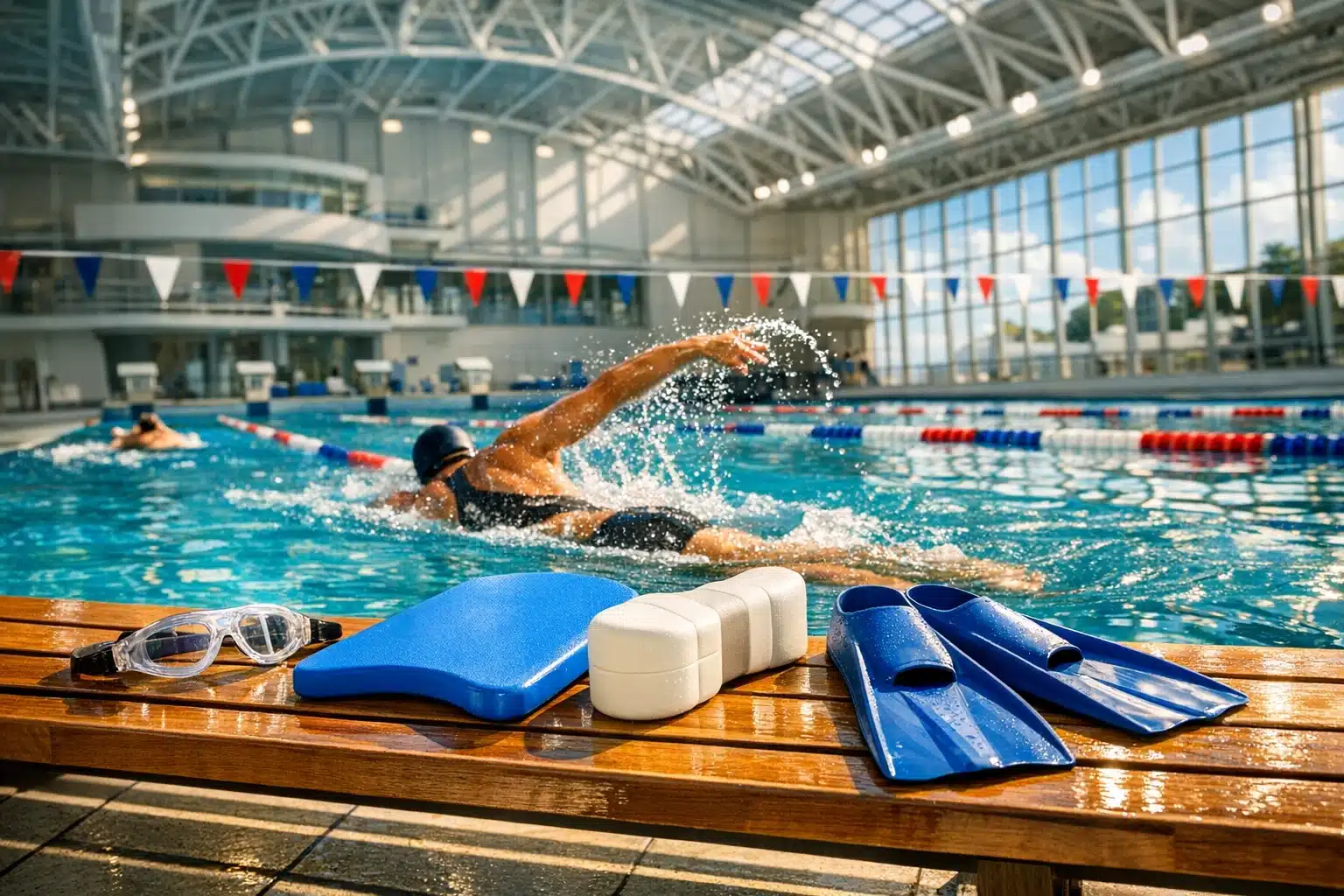
Equipment can help, but it should support learning rather than replace it. A well-fitted swimsuit and a good pair of goggles are the essentials for most people. Swim caps reduce drag and keep hair more manageable, though they are not mandatory everywhere. Training tools have more specific uses:
-
A kickboard helps isolate leg work and body alignment drills.
-
A pull buoy shifts emphasis toward the upper body and highlights stroke mechanics.
-
Fins can improve body position and help swimmers feel propulsion more clearly, but overreliance may hide technical weaknesses.
-
A pace clock or waterproof watch helps structure intervals and track progress.
Good training habits matter as much as gear. Most beginners improve faster with shorter, consistent sessions than with occasional heroic workouts. A balanced session might include a warm-up, a few drills, a main set, and an easy finish. Technique work deserves a permanent place because swimming magnifies bad habits when fatigue arrives. Even strong swimmers return to basic drills for that reason.
There is a small but important shift that experienced swimmers learn over time: progress in the water is rarely loud. It often arrives as less struggle, smoother turns, steadier breathing, and the strange pleasure of realizing that the lane feels shorter than it did a month ago. Safety, patience, and repetition create that change.
Swimming Across Ages, Goals, and Everyday Life
One of swimming’s greatest strengths is that it does not belong to one type of person. It fits many stages of life and many definitions of success. For children, swimming can begin as comfort in the water, playful skill-building, and basic safety awareness. For teenagers, it may grow into team sport, racing, and disciplined training. Adults often come to it for different reasons: fitness, stress relief, rehabilitation, social connection, or the desire to finally learn something they missed earlier. Older swimmers may value it for mobility, routine, and the satisfying feeling of staying active without harsh impact.
Goals in swimming vary widely, and that is part of its appeal. One swimmer wants to float confidently and cross a pool without stopping. Another wants to complete a first triathlon. Someone else chases faster split times, cleaner turns, or the endurance needed for open-water events. There is no single proper ambition. The water does not care whether your goal is modest or ambitious; it responds to consistency, technique, and patience all the same.
Swimming also has a community side that is easy to underestimate. Pools are often quiet, but they are not isolating. Learn-to-swim classes, local clubs, masters groups, school teams, and open-water communities create a shared culture around improvement. It is a culture built less on spectacle and more on steady effort. People trade lane space, compare goggles, discuss stroke drills, and celebrate small milestones that outsiders might miss. Finishing a first continuous 400 meters, mastering bilateral breathing, or feeling relaxed in deep water may not look dramatic from afar, but inside the swimming world those moments matter.
For readers wondering how to make swimming part of ordinary life, the most effective approach is usually simple:
-
Choose a realistic schedule, even if it starts with one or two sessions a week.
-
Set a skill goal as well as a fitness goal, because technique keeps practice interesting.
-
Track progress by feel, confidence, and consistency, not only by speed.
-
Allow your relationship with swimming to change over time as your needs change.
That flexibility is rare. Some sports demand youth, perfect weather, or a narrow body type. Swimming asks for none of those things as a condition of belonging. It can be serious without becoming joyless, demanding without being punishing, and restorative without becoming passive. Whether someone enters the pool to compete, recover, learn, or simply clear the mind after a long day, swimming has room for that purpose. It is a skill, a workout, and for many people, a way of feeling more at ease in their own body.
Conclusion for New and Returning Swimmers
Swimming rewards curiosity more than bravado. If you are new to it, begin with comfort, breathing, and basic technique rather than speed. If you are returning after years away, expect the first sessions to feel humbling, then notice how quickly rhythm starts to come back. The sport offers uncommon value because it supports health, builds practical water confidence, and remains adaptable through different ages and goals. A few steady sessions can grow into a habit, and that habit can become a lifelong asset. For anyone looking for movement that is challenging, useful, and quietly satisfying, swimming is well worth exploring with patience and purpose.