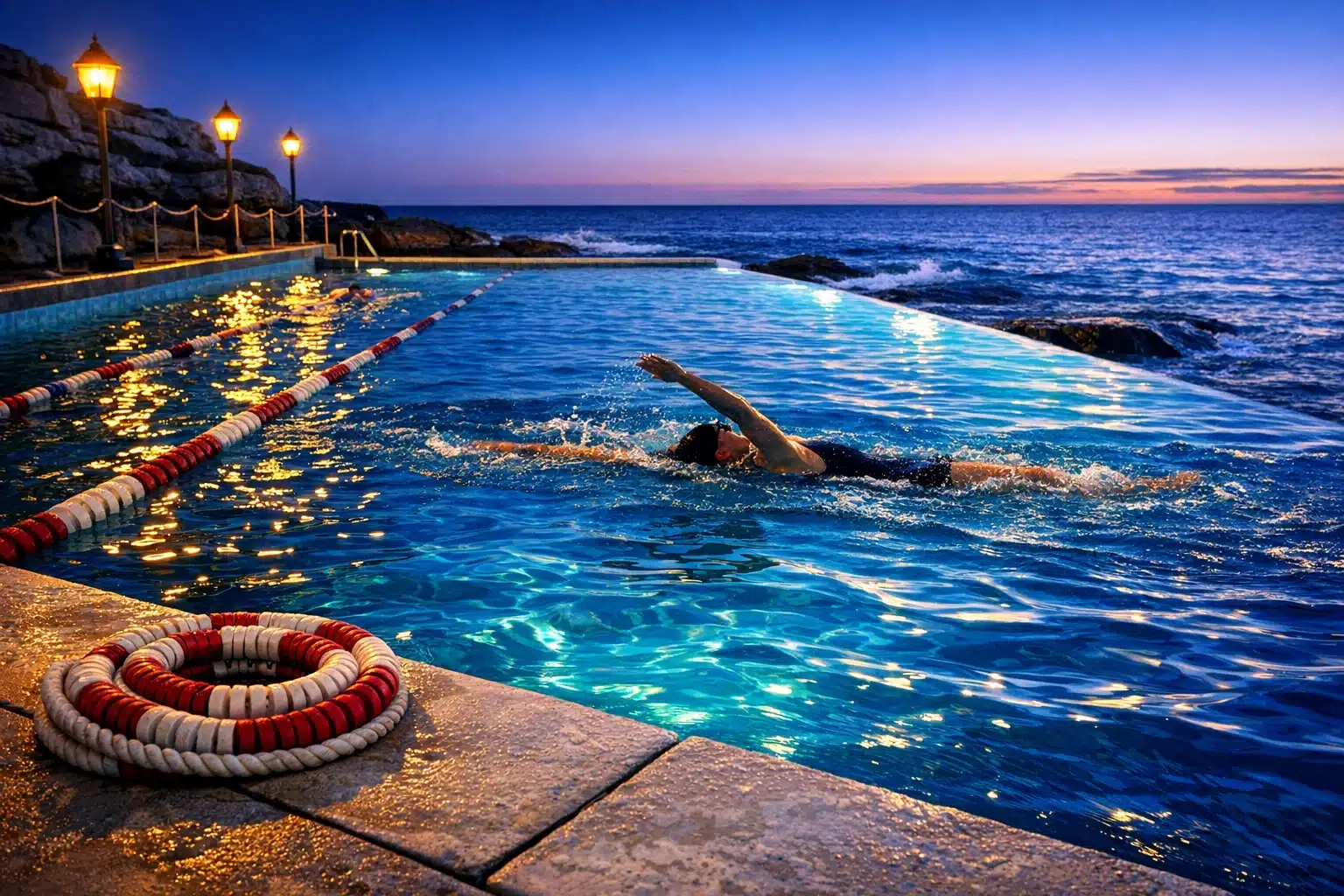
Explore the world of swimming
Swimming is one of those rare activities that feels playful and purposeful at the same time. It builds endurance, develops coordination, and teaches a practical skill that matters far beyond competition or recreation. Whether you want movement with less joint stress, safer habits around water, or a sport you can keep for decades, swimming offers unusual range. The sections below sketch the map first and then dive into the details.
Outline
1. Why swimming matters: the physical, mental, and practical value of time spent in the water. 2. How swimming works: the main strokes, core technique, and the mechanics behind efficient movement. 3. How to improve: learning stages, training structure, and the habits that turn casual laps into steady progress. 4. What swimmers use and where they swim: equipment, pool culture, and open-water differences. 5. How to make swimming part of real life: a concluding guide for beginners, returners, and anyone ready to build a sustainable routine.
The value of swimming: fitness, confidence, and a skill for life
Swimming earns its place among the most useful forms of exercise because it combines health benefits with a practical safety skill. Many sports improve strength or stamina, but relatively few can also help a person stay calmer and more capable around water. That alone gives swimming a wider relevance than many people first assume. For children, it often begins as play. For adults, it may start as fitness or rehabilitation. In both cases, the long-term reward is broader than calories burned or laps completed.
One reason swimming feels so different from land-based exercise is the nature of water itself. Water is far denser than air, so every stroke meets resistance. That resistance challenges muscles through the whole movement rather than only at a few points. At the same time, buoyancy reduces the impact that joints normally absorb while running or jumping. For people with knee discomfort, back stiffness, or a need for lower-impact training, this combination can make swimming especially attractive. It is not effortless, but it is often gentler on the body.
Its cardiovascular value is also significant. A steady swim session can contribute to the general recommendation of at least 150 minutes of moderate aerobic activity per week for adults. The exact intensity depends on stroke, pace, and rest intervals, yet even moderate swimming can challenge the heart and lungs while engaging the shoulders, back, core, and legs. In practical terms, swimming is a full-body task rather than a narrowly isolated workout.
It also offers benefits that are harder to measure but easy to feel:
• the rhythm of breathing can reduce mental clutter
• the water creates a quiet, focused training environment
• progress is visible in technique as much as in speed
These features help explain why swimmers often speak about the pool as a place of both effort and reset.
Compared with cycling, swimming places less prolonged load on the hips and lower back. Compared with running, it usually creates less pounding on ankles and knees. Compared with gym machines, it demands more coordination, because breathing, balance, and propulsion must work together. That coordination can be humbling at first, yet it is part of the appeal. Swimming asks the body to move as a system.
There is another layer to its value: confidence. A person who learns to float, tread water, control breathing, and move efficiently becomes more capable in beaches, lakes, hotel pools, and family outings. That does not replace caution, but it changes the relationship with water from uncertainty to respect supported by skill. In that sense, swimming is not only exercise. It is a form of literacy in an environment humans do not naturally master, and that makes it worth learning at nearly any age.
Understanding the strokes: how technique shapes speed, control, and efficiency
If swimming has a secret, it is this: strength matters, but technique matters more than most beginners expect. In the water, force that is poorly directed disappears quickly. A swimmer can feel as if they are working hard while moving very little, much like spinning wheels on wet pavement. Good technique turns effort into travel. It improves speed, saves energy, and makes each length of the pool feel smoother.
The four competitive strokes offer useful comparisons. Freestyle, often called front crawl, is usually the fastest and most commonly practiced. It relies on a long body line, alternating arm recovery, a steady flutter kick, and rhythmic side breathing. Breaststroke is slower but highly technical, with a glide phase, a coordinated pull, and a whip kick that demands precise timing. Backstroke mirrors some freestyle mechanics while removing the challenge of face-down breathing, although body position and directional awareness become more important. Butterfly is the most physically demanding for many swimmers, using simultaneous arm action and a wave-like body rhythm that rewards timing more than brute force.
Across all strokes, a few fundamentals appear again and again:
• body position should stay long and balanced near the surface
• the head should remain calm rather than lifting unnecessarily
• breathing should fit the stroke rhythm instead of disrupting it
• propulsion works best when the catch phase grips the water rather than slapping at it
These ideas sound simple, yet they take practice to turn into instinct.
Freestyle offers a good example of how small details change everything. A dropped elbow during the pull can reduce traction. Lifting the head to breathe can cause the hips and legs to sink. Kicking too hard without control may waste energy without improving balance. By contrast, a relaxed recovery, a clean hand entry, and a stable rotation through the torso can make the stroke feel almost effortless. That graceful look is usually the product of deliberate repetition, not natural talent alone.
Breaststroke highlights a different lesson: timing. Pull too early, and the kick loses effect. Glide too long, and momentum fades. Rush the head movement, and the body line breaks. This is why some swimmers with excellent general fitness still struggle with breaststroke, while technically aware swimmers move efficiently at lower apparent effort.
Backstroke teaches alignment and rhythm. Because the face stays above water, many learners assume it is easy, yet a wandering hand entry or overbent knees can create drag quickly. Butterfly, meanwhile, teaches economy under pressure. Done well, it looks like a wave crossing the lane. Done poorly, it becomes a tiring fight against the water.
The most useful mindset for learning technique is curiosity. Watch how the water reacts to each movement. Notice whether a change in breathing, kick, or hand path makes the stroke quieter and longer. Swimming rewards this kind of observation. The pool gives immediate feedback, and over time, efficient form begins to feel as satisfying as speed itself.
Learning and improving: from first lessons to structured training
People enter swimming through very different doors. Some begin in childhood lessons, some return after years away from the pool, and others start as adults who simply decide it is time to learn. The encouraging truth is that progress does not belong only to those who start young. Adult learners often improve quickly because they can follow instruction with patience and intention. What matters most is a structured approach that builds confidence step by step.
For beginners, the first goals are rarely about distance. They are about comfort, breathing, and control. Floating on the front and back, exhaling into the water, pushing off the wall, and learning how to stand up calmly are all foundational skills. Without them, strokes become stressful. With them, the water starts to feel less like an obstacle and more like a medium the body can work with. Instructors often teach these basics before formal stroke work because fear and tension make almost every technical problem worse.
Once a swimmer is comfortable, training can become more deliberate. A useful session often includes:
• a warm-up to ease into movement
• drills that isolate one skill, such as kicking balance or breathing rhythm
• a main set focused on endurance, speed, or technique
• a short cool-down to relax the stroke
This structure gives purpose to each length. Instead of swimming until tired, the swimmer works on specific qualities and can measure improvement over time.
There is a major difference between casual pool time and training. Casual swimming is excellent for general activity and enjoyment. Training adds intention. For example, a swimmer might do short intervals with rest, such as 8 repetitions of 50 meters at a controlled pace, rather than one long unstructured effort. Intervals help manage fatigue and improve consistency. Many swimmers also notice that heart rate in the water can feel different from land exercise, which is one reason perceived effort, pacing, and technique awareness matter so much.
Progress usually follows three lines at once: efficiency, endurance, and confidence. Efficiency means using fewer strokes or less strain to cover the same distance. Endurance means lasting longer at a sustainable pace. Confidence means staying calm when breathing feels challenged or when the lane becomes busy. These improvements do not always rise together in a straight line. A swimmer may refine technique one month and only later see faster times.
Coaching can accelerate development, especially when bad habits begin to settle in. Video feedback, simple drills, and outside observation often reveal issues a swimmer cannot feel clearly on their own. Still, self-directed swimmers can improve a great deal by setting realistic goals. Examples include swimming two times per week for a month, learning bilateral breathing, or completing a continuous 400 meters without rushing. Small milestones keep motivation grounded.
The key is consistency. Swimming rewards regular exposure more than heroic, occasional sessions. Two or three purposeful swims a week often do more for skill than one exhausting effort every ten days. The water has a long memory, but fortunately, so does the body when practice becomes routine.
Gear, pool culture, and open water: choosing the right environment
Swimming does not require a mountain of equipment, which is part of its appeal, but the right gear can remove unnecessary frustration. At the simplest level, most swimmers need a suit that allows free movement, goggles that fit well, and access to safe water. Everything beyond that is optional, though some tools can speed learning or add variety to training.
Goggles are often the first piece of equipment swimmers learn to appreciate. A poor fit can leak, fog, or press uncomfortably around the eyes, turning a good session into a distracted one. A well-fitted pair becomes almost invisible in use. Swim caps are another practical item. They do not need to be fashionable to be useful. They help keep hair managed, reduce drag slightly, and are often required in training settings. Kickboards, pull buoys, and fins are common practice aids. A kickboard isolates lower-body work, a pull buoy supports the legs so the arms can be emphasized, and fins can help beginners feel body position and momentum more clearly. Hand paddles are usually better left to experienced swimmers because they increase shoulder load.
The environment matters just as much as the gear. Pools are controlled spaces, which makes them ideal for learning. Distances are known, water conditions are stable, and supervision is often available. Lane etiquette also becomes part of the experience. Swimmers learn to circle in shared lanes, leave space at the wall, and choose speeds that match the group. These unwritten rules help the pool run smoothly and make sessions safer and less stressful.
Open water is a different story entirely. Lakes, rivers, and the sea add beauty, freedom, and challenge, but they also introduce variables a pool does not have:
• temperature can change quickly
• currents and waves affect direction and effort
• visibility is limited
• distances are harder to judge
Because water removes body heat faster than air, cold conditions can become serious sooner than inexperienced swimmers expect. Bright caps, tow floats, and swimming with a partner are sensible precautions in many open-water settings.
There is also a psychological contrast. A pool is measured and familiar, tiled from end to end like a page with lines already drawn. Open water feels more like an unwritten paragraph. Some swimmers find that exhilarating, while others find it unsettling until they gain experience. Neither setting is inherently better. Pools support technical repetition and structured training. Open water develops navigation, adaptability, and a different kind of composure.
Choosing between them depends on your goals. If you are learning strokes, building routine, or training with clear metrics, the pool is usually the better classroom. If you want adventure, triathlon preparation, or a closer encounter with natural environments, open water offers a powerful extension of the sport. Many swimmers eventually enjoy both, carrying the discipline of the pool into the unpredictability of the wider world.
Conclusion for new and returning swimmers: how to make swimming part of your life
If you are standing at the edge of swimming as a beginner, a returning athlete, a parent, or simply a curious reader, the most useful message is a simple one: start smaller than your ambition and stay longer than your doubt. Swimming can look polished from the deck, but most progress begins in awkward, quiet moments. The first relaxed exhale into the water, the first clean length without stopping, the first session that leaves you pleasantly tired rather than overwhelmed, these are the real turning points.
For beginners, the smartest path is not to chase speed too soon. Focus on comfort, floating, breathing, and a few reliable basics. For adults coming back after years away, do not compare today’s stroke with a memory from school, competition, or youth. Water is honest but not cruel; it responds to present skill, present patience, and present effort. For parents guiding children, confidence should come before performance. A child who respects the water and feels calm in it is on firmer ground than one who is pushed too quickly toward distance or medals.
A practical way to build the habit is to keep the first month uncomplicated:
• choose two or three swim times per week
• keep sessions manageable rather than exhausting
• track one meaningful goal, such as continuous distance or smoother breathing
• spend a little time after each session noticing what felt easier
This kind of routine turns swimming from an intention into a lived pattern.
It also helps to remember what makes the sport distinctive. Swimming is not only about fitness numbers. It teaches coordination, patience, and respect for an environment that does not naturally hold us. It can be social in a busy lane, peaceful in an early morning pool, or quietly dramatic in open water under a wide sky. Few activities carry such a mix of discipline and release.
So the target audience for this article, which is really almost anyone interested in moving better and feeling safer around water, does not need a perfect plan. You need a sensible first step, a willingness to learn, and enough consistency to let small gains accumulate. With time, the pool stops feeling like a place you visit and starts feeling like a place you know. That is when swimming becomes more than exercise. It becomes part of how you care for your body, your confidence, and your everyday life.