Explore the world of swimming
Swimming sits at the crossroads of sport, safety, and everyday wellbeing. It can be a child’s first lesson in confidence, an athlete’s test of discipline, and an adult’s low-impact route back to movement. Few activities ask the body to work so completely while giving the joints such generous support. From neighborhood pools to open water coastlines, swimming remains relevant because it is practical, challenging, and deeply refreshing in ways that land-based exercise rarely matches.
Outline
• Why swimming matters in daily life, sport, and public safety
• The four main competitive strokes and the mechanics behind them
• Physical and mental benefits supported by widely accepted fitness guidance
• Training habits, equipment choices, and water safety essentials
• A practical conclusion for beginners, families, fitness seekers, and lifelong swimmers
Why Swimming Matters: More Than a Sport
Swimming has a special place among physical activities because it is both a recreational pleasure and a serious life skill. A person may first meet water through play, but very quickly that playful environment becomes a classroom. Learning to float, breathe calmly, and move with purpose can reduce fear and build self-trust. That alone gives swimming a social value that goes beyond medals or exercise plans. In many communities, water competence is closely linked with safety education, especially where beaches, rivers, or home pools are common. Parents often enroll children in lessons for this reason, and adults frequently return to the pool later in life to gain a skill they missed earlier.
As a formal sport, swimming also has enormous global reach. It has been part of the modern Olympic Games since 1896 for men and since 1912 for women, and it remains one of the most watched events in international competition. Its appeal is easy to understand: races are simple to follow, performance is measurable down to fractions of a second, and technique matters just as much as power. At the highest level, elite swimmers combine flexibility, cardiovascular endurance, muscular coordination, and precise pacing. A small adjustment in body position or turn timing can separate first place from the rest of the field.
Swimming also stands out because it welcomes many types of participants. Some arrive for fitness, some for rehabilitation, and some for competition. Others come because the water offers relief from heat, stress, or chronic joint discomfort. That versatility is rare. A runner with a temporary injury may switch to pool training. An older adult may prefer swimming because buoyancy reduces impact on knees and hips. A child may discover discipline through lap practice without feeling trapped in a rigid routine.
Several qualities explain the sport’s lasting relevance:
• It teaches practical water safety.
• It can be recreational or highly competitive.
• It suits a broad age range.
• It develops endurance, coordination, and confidence at the same time.
In that sense, swimming is not just a way to move through water. It is a way to combine skill, health, and self-reliance in one setting, with a rhythm that can feel either calm as a lake at dawn or fierce as a championship final.
Understanding the Main Strokes and the Mechanics Behind Them
To watch skilled swimmers is to watch physics turned into motion. Water is far denser than air, so every mistake in alignment creates drag, and every efficient movement matters. Body position, breathing pattern, kick timing, and arm recovery all affect speed and endurance. That is why swimming is often described as technical before it is described as tiring. A beginner may feel exhausted after a few lengths not only because the effort is new, but because the body is still learning how to move without wasting energy.
The four main competitive strokes each solve the challenge of movement in a different way. Freestyle, usually swum as front crawl in races, is generally the fastest because it allows a streamlined body line and continuous propulsion. Swimmers rotate through the hips and shoulders, breathing to the side while maintaining a steady flutter kick. Backstroke uses a similar alternating arm action, but on the back, requiring strong body awareness and timing because the swimmer cannot look in the direction of travel. Breaststroke is slower but highly technical, with a pull, breath, kick, and glide sequence that rewards patience and exact rhythm. Butterfly is the most demanding for many people, pairing simultaneous arm recovery with a dolphin kick and wave-like body movement.
A quick comparison makes their differences clearer:
• Freestyle: fastest and most common for fitness training
• Backstroke: excellent for posture awareness and shoulder coordination
• Breaststroke: easier for many beginners to learn, but difficult to master efficiently
• Butterfly: powerful and beautiful, yet physically intense and technically unforgiving
Good technique begins with fundamentals rather than speed. A neutral head position helps the hips stay high. Controlled exhalation underwater reduces panic and makes inhalation quicker. A well-timed kick supports balance rather than simply creating splash. Even turns matter. Competitive swimmers use flip turns in freestyle and backstroke to maintain momentum, while open turns are used in breaststroke and butterfly because of stroke rules.
There is also a creative side to stroke work. Freestyle can feel like slicing a narrow path through glass. Breaststroke resembles a measured negotiation with the water, never rushed, always shaped. Butterfly, when done well, looks almost improbable, as though effort and grace have signed a temporary truce. Understanding these strokes adds depth to every swim session, whether the goal is finishing a first lesson or shaving time from a race.
The Physical and Mental Benefits of Swimming
Swimming is often praised as a full-body workout, and that description is accurate when understood properly. Unlike exercises that emphasize one movement plane or a limited group of muscles, swimming asks the arms, shoulders, chest, back, core, hips, and legs to cooperate continuously. At the same time, buoyancy supports body weight, which reduces impact on joints compared with activities such as running on pavement. This combination helps explain why swimming attracts everyone from youth athletes to older adults and people returning to exercise after a break.
From a cardiovascular perspective, regular swimming can contribute meaningfully to overall fitness. Public health guidance from organizations such as the World Health Organization recommends at least 150 minutes of moderate-intensity aerobic activity per week for adults, and swimming is one practical way to meet that target. Because water provides resistance in every direction, even steady lap swimming can feel substantial without the pounding associated with some other endurance sports. Depending on body size, stroke choice, and pace, a 30-minute swim may expend a significant amount of energy, often falling in a broad range of roughly 200 to 400 or more calories. The exact number varies, but the broader point remains solid: swimming can be both efficient and scalable.
The mental side is just as interesting. Many swimmers describe the pool as a place where noise falls away. Breathing becomes rhythmic, attention narrows, and time is measured in lengths rather than notifications. That structure can be calming. Repetitive movement, sensory immersion, and controlled breathing may help reduce everyday stress for some people. Group lessons and masters programs also add a social benefit, giving swimmers routine, community, and visible progress.
Key advantages often include:
• aerobic conditioning without heavy joint impact
• improved muscular endurance and coordination
• support for mobility and body awareness
• a structured setting that can encourage focus and stress relief
Swimming is not a magical answer to every health goal, and it should not be treated as one. Still, it offers a rare balance of challenge and accessibility. A hard set can leave the lungs burning and the shoulders humming with effort, while an easy session can feel restorative. That range makes the sport unusually useful for long-term fitness, because people are more likely to continue an activity that can adapt to changing needs, schedules, and stages of life.
Training, Equipment, and Water Safety for Beginners and Regular Swimmers
Starting to swim regularly does not require expensive gear or an advanced training plan, but it does require a sensible approach. For most people, the essential equipment list is modest: a comfortable swimsuit, goggles that fit properly, and access to safe water. A swim cap can help keep hair controlled and reduce drag, while a kickboard or pull buoy may be useful in lessons or structured workouts. Competitive swimmers might add fins, paddles, tempo trainers, and race suits, but these are refinements, not prerequisites.
Training should begin with consistency rather than intensity. A beginner who tries to power through long sessions often meets frustration quickly because swimming technique breaks down when fatigue arrives. Short repeats with rest usually work better. For example, a new swimmer may build a session around easy 25-meter or 50-meter efforts, alternating stroke practice with recovery. As efficiency improves, distance can increase gradually. Intermediate swimmers often organize sessions into warm-up, drill work, main set, and cool-down, which creates a clear purpose for each length. Competitive programs add pacing sets, sprint work, turn practice, and dryland strength training.
Good habits make training more productive:
• focus on relaxed breathing before chasing speed
• keep the body long and aligned to reduce drag
• use drills to correct one technical issue at a time
• increase volume gradually instead of making sudden jumps
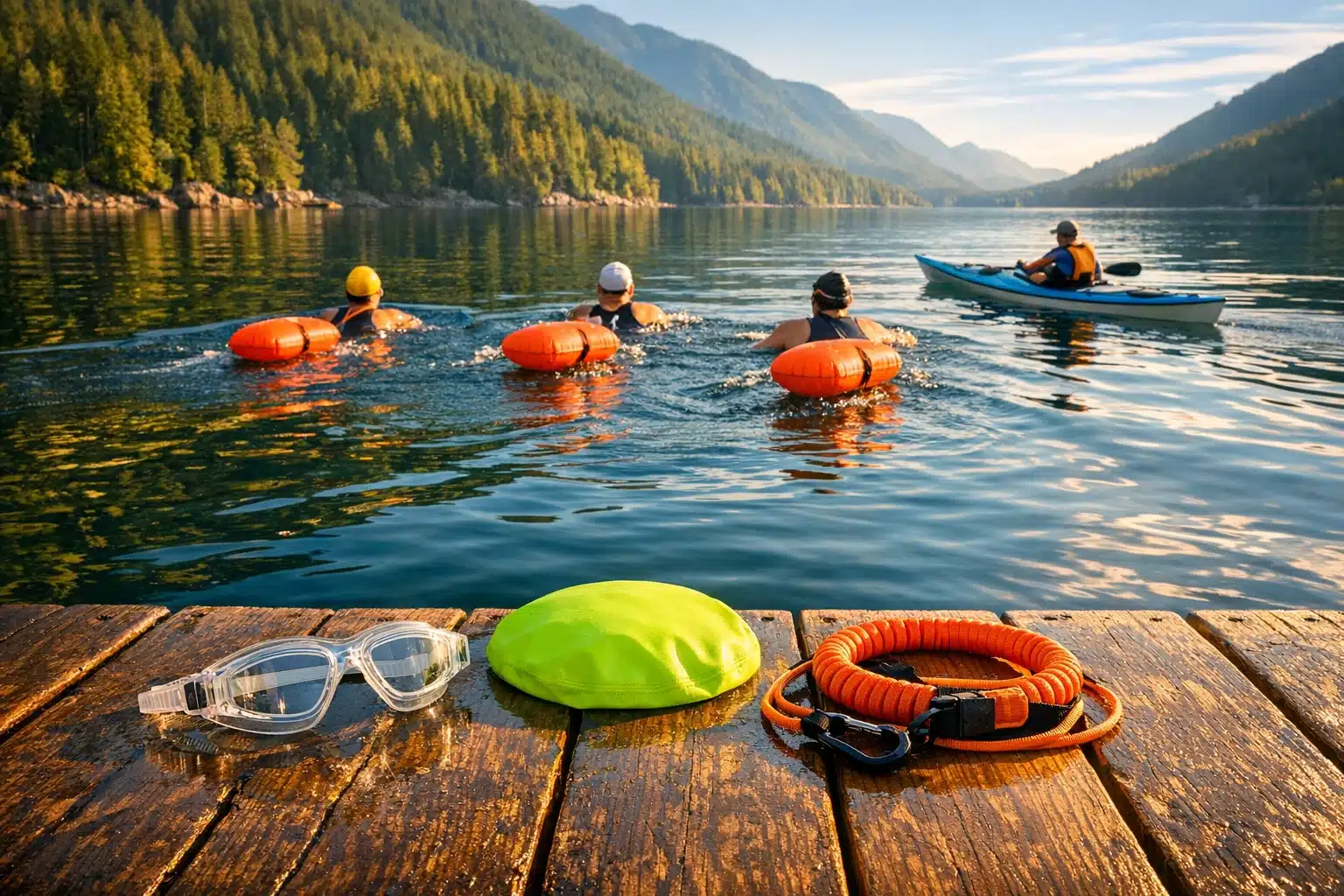
Safety deserves equal attention. Pool swimming may look controlled, but accidents still happen when people overestimate ability, ignore fatigue, or become careless around deep water. Open water introduces additional variables such as temperature, currents, waves, low visibility, and changing weather. A beautiful lake can turn serious very quickly, and the sea has little interest in a swimmer’s confidence. That is why open water swimming is best approached with preparation: never swim alone, use visible gear such as bright caps or tow floats where appropriate, learn local conditions, and respect lifeguard warnings.
Parents, adult beginners, and experienced athletes all benefit from the same principle: confidence should be built on skill, not assumption. Formal instruction matters. So does knowing basic rescue logic, recognizing signs of distress, and understanding that endurance in a pool does not automatically translate to rivers, surf, or cold water. The strongest swimmers are not just technically sound; they are also cautious, observant, and realistic. In swimming, smart judgment is every bit as important as strong lungs.
Making Swimming Part of Your Life: A Practical Conclusion for Modern Readers
If swimming seems appealing but slightly intimidating, that reaction is completely normal. Water has a way of revealing both hesitation and potential at once. The good news is that swimming does not demand the same starting point from everyone. A child learning to blow bubbles, a parent returning to exercise, a triathlete chasing efficiency, and an older adult looking for joint-friendly movement can all belong in the same broad world of swimming without sharing the same goals.
For beginners, the smartest first step is simple: choose instruction over guesswork. Even a few well-taught lessons can improve breathing, floating, and body position enough to make the water feel less hostile and more welcoming. For fitness-focused readers, swimming can become a reliable weekly habit by pairing short, manageable sessions with clear targets. Two or three visits to the pool each week are often more useful than one heroic session followed by ten days away. For families, swimming offers something many activities do not: a mix of fun, safety education, and lifelong utility. For older adults, it can provide movement that feels supportive rather than punishing.
There is also room to grow once the basics feel comfortable. Some swimmers join clubs, train for open water events, or use lap swimming to complement cycling, rowing, or strength work. Others keep it informal and still gain immense value from regular time in the water. That flexibility is part of the sport’s charm. It does not insist that everyone become a racer. It simply rewards patience, practice, and respect for the environment.
For readers deciding whether swimming is worth their time, the answer is practical rather than dramatic. It teaches a useful skill, supports broad fitness goals, and can remain enjoyable for decades. Start where you are, stay honest about your level, and let progress come stroke by stroke. In a world full of noisy habits, swimming offers a rare kind of clarity: a lane, a breath, a rhythm, and a steady reminder that meaningful improvement is often built one length at a time.