Explore the world of swimming
Introduction and Outline
Swimming is unusual in the best way: it is a life skill, a sport, and a steady form of exercise all at once. One lane can hold a beginner learning to float, a triathlete refining endurance, and an older adult protecting joints without giving up intensity. This article first maps the topic, then follows five paths through health benefits, stroke technique, training methods, safety, and the wider culture that keeps people returning to the water. By the end, the pool feels less mysterious and far more inviting.
Why Swimming Deserves Serious Attention
Swimming earns its place among the most respected physical activities because it combines cardiovascular training, muscular engagement, and low-impact movement in a single session. On land, gravity constantly asks the joints to absorb force. In water, buoyancy changes that equation. The body still works hard, but the knees, hips, and lower back usually face less pounding than they would during running or court sports. That makes swimming especially valuable for people returning from injury, older adults trying to stay active, and anyone who wants demanding exercise without a harsh mechanical load. It is also one of the few sports where breathing itself becomes part of the skill, so every lap trains not only muscles and endurance, but timing and composure as well.
From a health perspective, swimming supports goals that many readers care about: heart health, stamina, coordination, and consistency. Public health guidance commonly recommends at least 150 minutes of moderate aerobic activity per week for adults, and swimming can contribute meaningfully to that target. Depending on body size and pace, a moderate swim session may burn several hundred calories in an hour, but the real value runs deeper than calorie math. Water resistance acts in every direction, so the body must stabilize and propel itself at the same time. The shoulders, back, core, glutes, and legs all contribute. A few practical benefits stand out:
• water resistance strengthens movement without heavy external loading
• buoyancy can make exercise more accessible during recovery periods
• rhythmic breathing and repeated laps often create a calming, almost meditative effect
• skill progression gives swimmers a clear sense of improvement, which helps motivation
There is also a democratic side to swimming that often goes unnoticed. It can be recreational, therapeutic, social, or intensely competitive, sometimes within the same facility on the same day. One person may use it to prepare for a triathlon, another may join an aqua fitness class, and a child may simply be learning how not to fear water. That range matters. Many sports narrow as people age or as goals change, but swimming keeps opening doors. The quiet splash of a turn at the wall may look simple from the deck, yet beneath that surface is a full-body conversation between physics, confidence, and discipline. That is why swimming is more than exercise; it is a durable practice that adapts to real life.
Understanding the Main Strokes and Core Technique
To an experienced swimmer, technique is not decoration; it is efficiency in motion. A strong swimmer is not merely someone who works harder, but someone who wastes less energy between one end of the pool and the other. The four competitive strokes, freestyle, backstroke, breaststroke, and butterfly, each demand a different relationship between body position, kick pattern, arm action, and breathing. Freestyle is usually the fastest and most energy-efficient stroke for distance because the body stays relatively streamlined and propulsion remains continuous. Backstroke offers a valuable contrast: the body is still long and horizontal, but the face stays above water, which changes breathing demands while introducing new challenges in balance and direction. Breaststroke is often more intuitive for beginners because the head can rise more naturally, yet it can be technically tricky because timing matters so much. Butterfly looks dramatic and powerful, but it is also the most physically demanding of the four for many swimmers.
Across all strokes, certain principles matter again and again. A horizontal body line reduces drag. A controlled kick supports balance rather than wildly churning the water. The catch phase of the stroke, when the hand and forearm begin to hold water, is where propulsion becomes real. Breathing should fit into the stroke rather than interrupt it. Many new swimmers lift the head too high to breathe, which causes the hips to drop and creates resistance. Coaches often return to a few recurring ideas:
• streamline first, because reducing drag is often easier than creating more power
• rotate the body in freestyle and backstroke to improve reach and reduce shoulder strain
• keep the kick purposeful instead of frantic
• exhale steadily underwater so inhalation can be quick and calm
Technique work is also where swimming becomes unexpectedly elegant. A good stroke can feel less like fighting water and more like persuading it. Drills help build that feeling. Freestyle swimmers may use fingertip drag drill to improve elbow position or catch-up drill to highlight alignment. Breaststroke swimmers often practice the sequence of pull, breathe, kick, glide to avoid rushed timing. Backstroke benefits from single-arm work that exposes asymmetry, while butterfly may begin with body undulation and dolphin kick before the full stroke is attempted. Comparisons between strokes are useful because they teach different lessons: freestyle rewards economy, breaststroke punishes impatience, backstroke reveals balance flaws, and butterfly exposes whether power is truly coordinated. Learning these differences gives swimmers a richer understanding of movement, not just a bag of separate techniques.
How to Train, Improve, and Build Endurance
Many people think swimming improvement comes mainly from logging endless laps, but progress usually depends more on structure than raw volume. A thoughtful session blends technique, aerobic work, and appropriate recovery. For beginners, the first milestone is rarely speed; it is continuity. Can you swim several lengths while keeping a stable rhythm and avoiding unnecessary tension? Once that answer becomes yes, training can expand. A useful swim session often starts with an easy warm-up to raise body temperature and loosen the shoulders, followed by drills that sharpen mechanics before fatigue sets in. The central set then targets a goal such as endurance, threshold pace, sprint speed, or stroke control. A short cool-down helps the body settle and gives the swimmer a chance to feel what changed during the workout.
Progression matters because water can hide effort. A person may feel smooth for two lengths and then discover, halfway through a longer set, that breathing pattern, kick timing, or concentration starts to break apart. That is why coaches frequently use intervals. Instead of swimming until form collapses, swimmers complete repeats with planned rest, such as 8 x 50 meters with 20 seconds recovery or 4 x 200 meters at a sustainable pace. This approach improves conditioning while protecting technique. Training tools can help when used with purpose. Kickboards isolate leg work, pull buoys reduce kick demands so the upper body can be studied, and fins can support body position during drills. Still, equipment should not become a crutch. The point is to teach the body something useful, not to disguise a weakness forever. A practical progression often looks like this:
• start with short repeats and generous rest to preserve control
• add total distance gradually across weeks, not all at once
• alternate harder days with easier technique-focused sessions
• track times, stroke count, or perceived effort to make improvement visible
For intermediate and advanced swimmers, training becomes more specific. A sprinter may prioritize explosive starts, turns, and short high-intensity work, while a distance swimmer needs pacing discipline and efficient mechanics over long sets. Open-water swimmers must learn sighting and group positioning. Triathletes train to transition from horizontal swimming to cycling and running with minimal energy loss. Even recreational swimmers benefit from simple planning, such as swimming three times a week with different intentions: one technique day, one endurance day, and one mixed session. Improvement is rarely cinematic. It is usually built in quieter moments: holding form on the final repeat, breathing bilaterally without panic, or touching the wall and realizing the set that once seemed impossible is now routine. That is training at its most satisfying, less thunderbolt, more tide.
Safety, Water Confidence, and Smart Practice
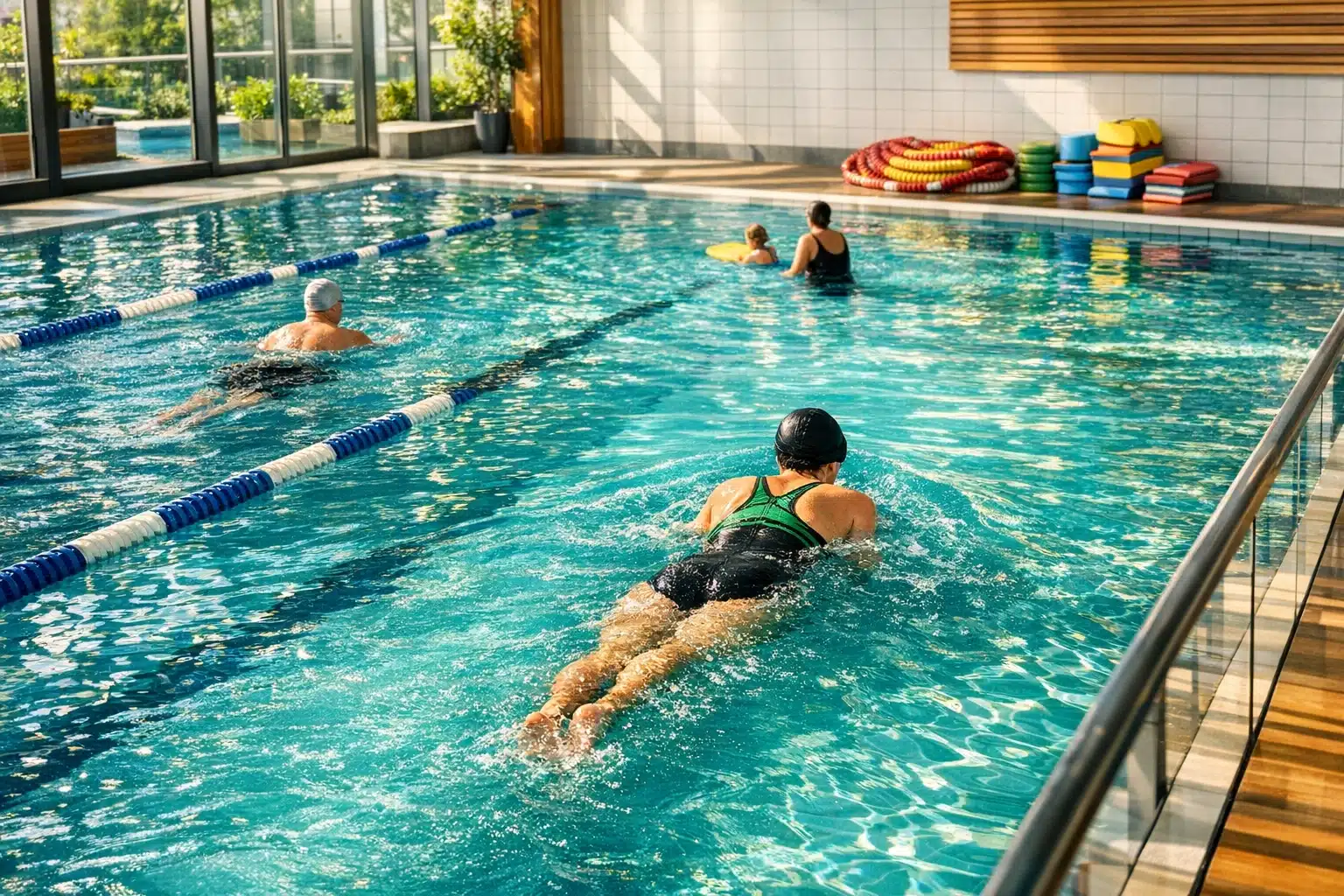
Swimming is joyful, but it also demands respect. Water does not negotiate with overconfidence, fatigue, or poor judgment. That is why safety is not a side note to the sport; it is part of being a competent swimmer. At the most basic level, water confidence begins with foundational skills such as floating, treading water, controlled breathing, and knowing how to reach an exit calmly. These are not merely beginner milestones. They remain essential in real-world conditions, especially when visibility is low, waves are present, or exhaustion arrives faster than expected. In supervised pools, safety often feels built into the environment because there are lane ropes, depth markers, and lifeguards. Yet even there, avoidable problems happen when swimmers ignore signage, dive into shallow water, or train beyond their current level without rest.
Open water adds complexity that a pool cannot fully simulate. Lakes, rivers, and the sea introduce currents, temperature shifts, uneven visibility, and moving craft. Distance can become deceptive when there are no lane lines or walls to break the effort into pieces. For that reason, experienced open-water swimmers often emphasize preparation over bravado. Good habits include checking local conditions, swimming with a partner or organized group, using bright swim caps for visibility, and choosing routes with clear entry and exit points. A few smart precautions are worth remembering:
• never assume calm-looking water is risk-free
• learn local rules about tides, currents, and weather changes
• tell someone where you are swimming and when you expect to return
• stop immediately if you feel disoriented, chilled, or unusually short of breath
• respect lifeguard instructions and posted warnings without argument
Safety also includes practical care before and after the swim. Showering before entering the pool helps maintain water quality, while showering afterward can reduce irritation from chlorine or salt. Well-fitted goggles protect the eyes and make orientation easier. Ear care, skin care, hydration, and sun protection matter more than many casual swimmers realize, particularly during long outdoor sessions. Parents, coaches, and adult learners should remember that confidence and competence are not the same thing. Someone may enjoy splashing in shallow water and still lack the skills needed for deeper or more dynamic environments. Formal lessons, even later in life, are not an admission of weakness; they are one of the smartest investments a swimmer can make. The goal is not fear. The goal is informed ease, the kind that allows a swimmer to enjoy the water because the risks have been understood rather than ignored.
Swimming Across Ages, Goals, and Everyday Life
One of swimming’s strongest qualities is its ability to stay relevant across decades of life. A child may begin with simple water familiarization, learning that the pool is not an alien world but a place where the body can adapt and move. A teenager may shift toward competitive training, where split times, starts, and turns become meaningful. Adults often return to swimming for practical reasons: improved fitness, rehabilitation, stress relief, or preparation for events such as triathlons and charity swims. Older adults may value the reduced joint impact, steady resistance, and social structure of regular sessions. Few activities travel this well through changing bodies, schedules, and ambitions. The same basic environment, water, supports completely different purposes without losing its identity.
Swimming also creates community in a distinctive way. Unlike some sports that revolve around direct physical opposition, swimming often fosters parallel effort. People train side by side, sharing a lane, a workout, or a quiet nod at the wall between repeats. Clubs, school teams, masters programs, and local aquatic centers often become small ecosystems where beginners and veterans overlap. This matters because consistency is easier when it is social. A lane booked with a training partner or a weekly group session can turn intention into habit. The sport is also adaptable. Para swimming, therapeutic exercise, learn-to-swim programs, and multisport training all show how water can welcome different abilities and objectives. In that sense, swimming is less a narrow discipline than a versatile platform.
For everyday readers, the bigger lesson may be this: swimming does not have to become your entire identity to become deeply useful. You do not need competition medals to benefit from better stroke mechanics, stronger lungs, improved confidence in water, or a calmer mind after twenty focused minutes in the pool. A sustainable relationship with swimming can be built from modest routines:
• one lesson a week to correct technique
• two short lap sessions for general fitness
• occasional recreational swims to keep the experience enjoyable
• seasonal goals, such as completing a longer continuous swim or learning a new stroke
There is a quiet poetry to the sport. You enter carrying the noise of the day, and the water edits it. Sounds soften, movement becomes deliberate, and progress is measured not only in time but in feel. For students, professionals, parents, retirees, and returning exercisers, that quality is rare and valuable. Swimming meets people where they are, then steadily asks them to become a little more coordinated, a little more patient, and a little more capable each week.
Conclusion for New and Returning Swimmers
If you are curious about swimming, the best starting point is not perfection but regular contact with the water. Learn the basics well, pay attention to technique early, and treat safety as part of the sport rather than an optional extra. From there, your path can stay simple, a few weekly sessions for health and confidence, or grow into something more ambitious, such as endurance events, club training, or open-water challenges. Swimming rewards patience because improvement often arrives through refinement, not spectacle. For readers balancing fitness goals, busy schedules, and long-term wellbeing, that is good news: the sport is flexible, teachable, and durable. Start where you are, stay consistent, and let the water teach you how much more efficient and confident your body can become.