Explore the world of swimming
Swimming is one of those rare activities that feels playful and serious at the same time. It can help children build confidence, give adults a full-body workout, and offer older people a joint-friendly way to stay active. Because water changes how the body moves, the sport combines breathing, balance, timing, and awareness in a way few land exercises can match. That unusual blend is exactly what makes swimming so widely relevant.
Outline
1. Why swimming matters for health, movement, and everyday life.
2. The major strokes and the technical basics that shape efficient swimming.
3. Training methods, progression, and how beginners and experienced swimmers improve.
4. Safety, pool etiquette, and the differences between swimming in a pool and open water.
5. A practical conclusion for readers who want to make swimming part of life.
Why Swimming Matters Beyond the Pool
Swimming occupies a special place in the world of physical activity because it is both a sport and a life skill. Many forms of exercise improve strength or stamina, but swimming adds another layer: it teaches people how to move safely and effectively in water. That makes it valuable in ways that go beyond fitness goals, race times, or leisure. A person who learns to swim is not just picking up a hobby. They are gaining confidence in an environment that can be joyful, unpredictable, and, at times, dangerous if misunderstood.
From a physical perspective, swimming is often praised for being low impact, and the praise is deserved. Water supports much of the body’s weight, which reduces stress on joints compared with activities like running. At the same time, the resistance of water is constant in every direction. Since water is far denser than air, even simple movements demand more control and effort than they might on land. That is why a well-designed swim session can train the heart, lungs, shoulders, back, core, and legs in a single workout without the harsh pounding associated with many high-impact sports.
Swimming also adapts well to different stages of life. For children, it can develop coordination and water confidence. For adults with busy schedules, it offers an efficient workout that blends strength and endurance. For older swimmers, it can be a sustainable way to remain active while managing stiffness or reduced mobility. This flexibility gives swimming unusual longevity. A person might begin with splashy lessons in childhood, compete in school, return for exercise in adulthood, and later use it to preserve mobility and routine.
Its mental value is often overlooked. There is something distinct about the soundscape of a pool: the muffled rush of water, the rhythm of breathing, the clean repetition of a stroke cycle. For many swimmers, that pattern creates a focused state that feels halfway between work and meditation. Unlike some gym routines that invite distraction, swimming demands attention. A missed breath, poorly timed kick, or tense arm entry immediately changes the feel of the water. The body gets feedback in real time.
Swimming matters because it meets people where they are. It can be:
- a survival skill that increases safety around water
- a recreational pastime shared with friends and family
- a rehabilitation-friendly form of exercise
- a competitive sport with measurable goals
- a personal ritual that supports mental clarity
That breadth is rare. Few activities can be taught to toddlers, practiced by elite athletes, recommended by physiotherapists, and enjoyed on vacation all at once. Swimming succeeds because it is not limited to one identity. It is practical, challenging, and, when approached with patience, deeply rewarding.
The Four Main Strokes and the Art of Efficient Movement
To an observer, swimming can look simple: arms move, legs kick, body advances. In reality, efficient swimming is a technical craft built on position, timing, and feel for the water. The four main competitive strokes freestyle, backstroke, breaststroke, and butterfly each ask the body to solve a different movement puzzle. Understanding those puzzles helps beginners improve faster and helps casual swimmers appreciate why skilled athletes appear to glide rather than fight the water.
Freestyle, usually swum as the front crawl, is the fastest and most widely used stroke. Its appeal lies in efficiency. Swimmers rotate through the torso, keep the body long, and coordinate alternating arm pulls with a flutter kick. The breath is taken to the side, which means timing is crucial. Lift the head too much, and the hips drop. Pull too short, and momentum fades. A good freestyle does not feel like frantic splashing. It feels sleek, balanced, and continuous, almost as if the swimmer is threading a line through the lane.
Backstroke shares some mechanics with freestyle but flips the relationship to air and water. Because the face remains above the surface, breathing is easier, yet body alignment can be trickier. Many novices bend at the hips or let the knees break the surface too dramatically. Skilled backstrokers stay high in the water, rotate through the shoulders, and keep a steady kick that stabilizes the whole stroke. Swimming on the back also requires trust, since the swimmer cannot see where they are going in the same way.
Breaststroke is the slowest of the four competitive strokes, but it is often the first one recreational swimmers find approachable. The movement is symmetrical: both arms sweep, both legs kick, and the breath is integrated into a clear rhythm. Yet breaststroke is deceptively technical. Tiny changes in timing can make the difference between smooth forward travel and lots of effort with little progress. It rewards patience and precision more than raw force.
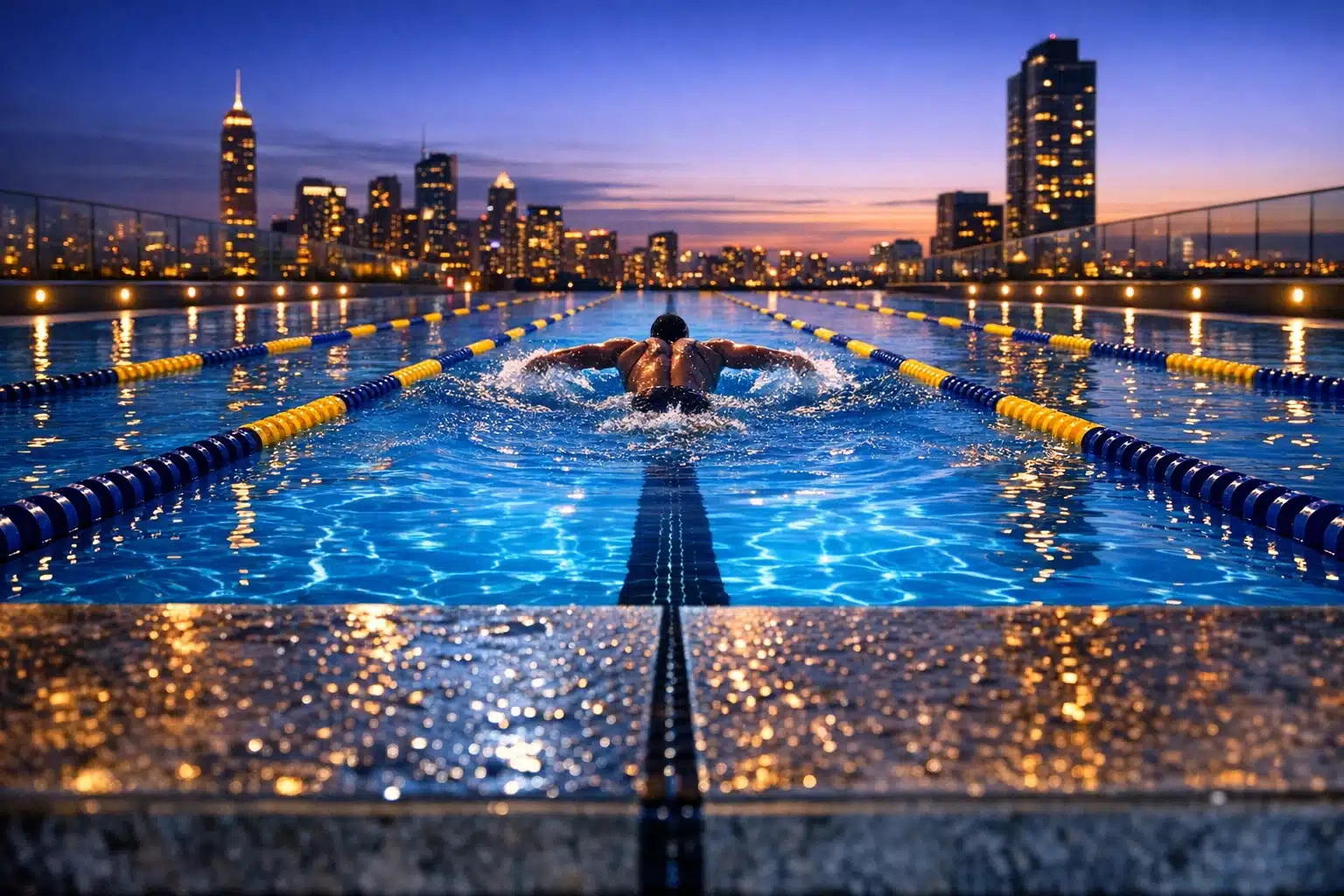
Butterfly is often viewed as the dramatic sibling of the stroke family. It uses simultaneous arm recovery and a dolphin kick powered by a wave-like body motion. When done well, butterfly looks almost theatrical, all power and flow. When done poorly, it quickly becomes exhausting. That contrast reveals an important truth about swimming: water punishes wasted motion. Technique is not decoration. It is the engine.
Across all strokes, a few fundamentals matter again and again:
- body position that reduces drag
- breathing patterns that support rhythm rather than interrupt it
- a controlled kick that stabilizes movement
- an effective catch and pull through the water
- relaxation in the right places, especially the neck and shoulders
In swimming, speed rarely comes from trying harder in a chaotic way. It comes from organizing movement so the water works with you rather than against you. That principle applies whether someone is chasing an Olympic standard or simply trying to cross the local pool without feeling drained after two lengths.
Training, Fitness, and How Swimmers Actually Improve
One reason swimming keeps people engaged for years is that improvement can be measured in many ways. Some swimmers care about lap times. Others want better breathing, smoother technique, or enough stamina to finish a long set without stopping. This variety makes training highly adaptable. Progress in the water is not reserved for elite competitors. It happens whenever a swimmer learns to use less effort for more distance, recover more quickly, or move with greater confidence and control.
Swimming is a full-body cardiovascular workout, but its training structure often differs from land-based exercise. A runner may think in miles, while a swimmer usually thinks in sets, intervals, stroke counts, and rest periods. That sounds technical, yet the logic is straightforward. Water creates resistance with every movement, so training is about managing both effort and efficiency. Swimming harder is not always better. In fact, many plateaus come from forcing the stroke instead of refining it.
Beginners benefit most from simple goals. These often include learning to exhale underwater, maintaining a horizontal body line, and swimming short repeats with rest. Early success should be built on skill, not just exhaustion. It is far better to complete several controlled lengths with decent form than to flail through a long nonstop swim that reinforces poor habits. Instructors often break progress into manageable pieces: kicking drills, arm isolation, breathing practice, and whole-stroke integration. That method works because swimming is learned through repetition with feedback.
Intermediate swimmers usually shift toward endurance and consistency. They may begin structured sessions with a warm-up, drill set, main set, and cool-down. A practical workout might include relaxed freestyle, kick work with a board, and repeated intervals that challenge pacing. Competitive swimmers go much deeper, blending aerobic development, sprint work, starts, turns, race strategy, and dryland strength training. They may track split times, stroke efficiency, and how fatigue changes mechanics across a session.
A balanced swim program often includes:
- technique drills to improve body position and timing
- endurance sets to build aerobic capacity
- speed work for power and neuromuscular sharpness
- recovery swims to maintain feel for the water
- mobility and strength work outside the pool
The fitness benefits are broad. Regular swimming can support heart health, muscular endurance, coordination, and flexibility. Because breathing is deliberate, many swimmers also become more aware of pacing and respiratory control. There is a practical lesson in that. In the pool, panic wastes energy; rhythm conserves it. The body learns what the mind eventually understands: smooth effort lasts longer than frantic effort.
Perhaps the most encouraging part of swim training is how non-linear progress can still be meaningful. One week the breakthrough is physical, such as completing ten lengths without stopping. Another week it is technical, like finally feeling the catch in freestyle or mastering a tumble turn. Improvement in swimming often arrives quietly, then all at once, like a door that was stiff for months and suddenly swings open.
Safety, Pool Etiquette, and the Difference Between Pool and Open Water
Swimming has a graceful image, but it demands respect. Water can be inviting and unforgiving in the same moment, which is why safety is not an optional side note to the sport. Learning how to swim well includes learning how to judge conditions, manage fatigue, and behave responsibly around other people. Strong technique matters, yet awareness matters just as much. A confident swimmer knows not only how to move, but also when to slow down, ask for help, or change the plan.
Pool safety begins with basics that sound obvious until they are ignored. Wet decks are slippery. Diving into shallow water can cause severe injury. Hyperventilating before underwater swimming is dangerous. Children need active supervision, not casual glances from a distance. Even experienced swimmers can get into trouble if they overestimate stamina, train while unwell, or underestimate the effects of heat and dehydration. A pool is a controlled environment, but controlled does not mean risk-free.
Etiquette is another form of safety because it reduces confusion and collisions. In public lanes, swimmers usually sort themselves by speed, keep to the correct side, and allow faster swimmers to pass at appropriate moments. Resting at the wall should leave space for turns. Equipment like kickboards, fins, and pull buoys should be used without disrupting others. None of this is complicated, yet it makes the difference between a smooth shared session and a chaotic one. A well-run lane can feel like silent choreography.
Open water introduces a very different set of variables. A pool offers walls, lane lines, predictable temperature, and clear visibility. A lake, river, or sea offers currents, wind, waves, uneven temperatures, and limited visual reference points. In a pool, the black line guides you. In open water, you must sight by lifting your eyes toward a buoy, shoreline marker, or escort craft while staying composed. That simple change can unsettle swimmers who are comfortable in lanes.
Key safety habits include:
- swimming with a buddy or supervised group whenever possible
- checking weather, currents, and water quality before entering open water
- using bright caps or tow floats for visibility where appropriate
- knowing personal limits and turning back early rather than late
- respecting lifeguard instructions and posted facility rules
The emotional difference between pool and open water is worth noting too. A pool is orderly, repetitive, and measurable. Open water feels expansive, less scripted, and sometimes humbling. Fish may brush past, waves may slap sideways, and distances may look shorter from shore than they feel in motion. Yet for many swimmers, that uncertainty is part of the appeal. It replaces the neat geometry of tiles and lane ropes with something more elemental. Still, enjoyment should never outrun judgment. The wisest swimmers bring curiosity to the water, but they bring caution with it.
Conclusion: Making Swimming a Lifelong Skill and Habit
For most readers, the real value of swimming is not found in medals or dramatic finish times. It is found in usefulness, sustainability, and the quiet satisfaction of moving better through water over time. Swimming can begin as a practical lesson, grow into a fitness routine, and eventually become part of a person’s identity. That journey does not require elite talent. It requires consistency, patience, and a willingness to learn details that may seem small but add up to major change.
If you are new to swimming, start with fundamentals and remove the pressure to perform. Learn how to breathe out underwater. Practice floating and body alignment. Spend time getting comfortable rather than trying to impress yourself with distance. Many people quit too early because they mistake unfamiliarity for inability. In truth, swimming often feels awkward before it feels natural. The water asks for cooperation, not force, and that takes time.
If you already swim, there is nearly always another layer to explore. You might refine your catch, improve your turns, vary your training intensity, or experiment with open water under proper supervision. Progress does not always need to be faster. It can mean more relaxed breathing, cleaner rhythm, or greater confidence in different environments. Those gains are real and often more durable than a temporary burst of speed.
Swimming also rewards a broad definition of success. A good swim might be a technique session before work, a family hour at the local pool, rehabilitation after injury, or steady training toward a charity event. The common thread is that swimming meets people in practical ways. It supports health without demanding impact. It teaches caution without removing enjoyment. It offers challenge without excluding late starters.
If you want to turn swimming into a lasting habit, keep the approach simple:
- set a realistic schedule you can maintain
- focus on technique before intensity
- treat safety as part of skill, not a separate issue
- use variety to stay interested and avoid burnout
- measure progress by comfort, control, and consistency as well as speed
The beauty of swimming is that every session gives immediate feedback. Water tells the truth. It reveals tension, rewards balance, and teaches patience one stroke at a time. For readers who want an activity that is physically demanding, mentally refreshing, and genuinely useful for life, swimming is not just worth exploring. It is worth returning to, again and again, whenever you need movement with meaning.