Explore the world of swimming
Swimming is one of the few activities that can teach survival, build fitness, and quiet a crowded mind at the same time. It matters in schools, public health, recreation, and competitive sport because water changes how the body moves, breathes, and responds to effort. Whether you want to complete your first confident length or sharpen race-day technique, learning the fundamentals makes every session safer and more rewarding. This guide brings the topic into clear focus, from basic skills to lifelong practice.
Article Outline
This article begins with the reasons swimming remains relevant across cultures, age groups, and ability levels. It then examines physical and mental benefits, breaks down the major strokes and training principles, and compares pool swimming with open-water experiences. The final section offers a practical path for beginners and returning swimmers who want steady progress without unnecessary complexity.
- Why swimming matters and what makes the water environment unique
- Health, fitness, and mental benefits supported by practical examples
- Main strokes, technique basics, and training structure
- Safety habits, essential equipment, and pool versus open-water comparisons
- How to start, improve, and stay consistent over time
Why Swimming Matters: Water, Movement, and Human Life
Swimming matters for a simple reason before any medal, stopwatch, or fitness goal enters the picture: it is a life skill. In many parts of the world, access to rivers, lakes, beaches, canals, and swimming pools makes basic water competence as important as learning how to cross a road safely. Drowning prevention experts often emphasize that confidence in the water is not the same thing as true swimming ability. Real competence includes floating, breathing control, safe entry and exit, and the judgment to recognize changing conditions. That practical foundation gives swimming a relevance that goes far beyond sport.
It also holds a special place because the water environment changes the rules of movement. On land, gravity and impact shape nearly every exercise. In water, buoyancy supports body weight, hydrostatic pressure creates a gentle squeeze around the body, and resistance comes from every direction. Water is far denser than air, so even a small change in hand position or body angle can alter speed and effort. That is why swimming can feel graceful one moment and demanding the next. A calm lap may look effortless from the deck, yet beneath the surface the swimmer is constantly solving a moving puzzle of balance, timing, and propulsion.
Swimming has a long social history as well. Ancient civilizations practiced it for survival, military preparation, and recreation. Today, public pools, school lessons, community clubs, and masters programs keep that tradition alive in a more organized form. One lane may hold a teenager training for competition, another an adult learning to breathe comfortably, and a third an older swimmer preserving mobility after years of joint pain. Few activities gather such different goals in the same space so naturally.
Compared with many land-based sports, swimming is also unusually adaptable. It can be gentle enough for someone easing back into exercise and demanding enough for elite athletes who train with remarkable precision. That wide range comes from adjustable variables:
- Stroke choice
- Distance and rest intervals
- Water temperature and setting
- Use of drills, fins, pull buoys, or kick sets
In short, swimming matters because it sits at the intersection of safety, health, skill, and recreation. It can protect lives, improve fitness, and offer a form of movement that feels both technical and strangely liberating. For many people, the first moment of real progress is unforgettable: the water stops feeling like an obstacle and starts feeling like a place you can work with.
Benefits for Body and Mind: More Than a Workout
Swimming is often described as full-body exercise, but that phrase only hints at what makes it valuable. A well-structured swim session challenges the cardiovascular system, recruits major muscle groups, and develops coordination without the repeated impact seen in activities such as running or court sports. Because buoyancy reduces stress on the joints, many people find swimming more manageable during recovery periods or when they want aerobic training with less pounding on the knees, hips, or lower back. That does not mean it is automatically easy. Water resistance can make moderate laps surprisingly demanding, especially when technique is still developing.
For general health, widely used public-health guidelines recommend at least 150 minutes of moderate aerobic activity each week for adults. Swimming can contribute to that goal while also building muscular endurance in the shoulders, back, core, and legs. Freestyle tends to distribute effort across the upper body and trunk with continuous rotation. Breaststroke often feels intuitive for beginners, though it places different demands on timing and leg action. Backstroke encourages body alignment and shoulder control, while butterfly is powerful but technically taxing. The result is a form of exercise that can be scaled from gentle movement to high-intensity training.
Energy expenditure in swimming varies by body size, intensity, and stroke. A relaxed session may feel restorative, while harder interval training can raise heart rate substantially and burn a meaningful number of calories. Yet the appeal of swimming is not just what it burns or builds. It also changes attention. Breathing patterns become deliberate. Noise softens. The mind has fewer places to wander because rhythm matters every few seconds. Many swimmers describe this as one of the sport’s quiet gifts: the water demands presence.
Mental benefits can be just as important as physical ones:
- Steady lap work may reduce stress by creating a repeatable routine
- Skill improvement often builds confidence faster than generic exercise alone
- Group sessions can support motivation and social connection
- Water-based movement may help some people feel less intimidated than a busy gym floor
There are also practical advantages across the lifespan. Children can learn safety and coordination. Adults with desk-heavy routines can counter stiffness through controlled, cyclical movement. Older swimmers often value the sense of freedom that comes from moving with less discomfort. Rehabilitation settings sometimes use aquatic exercise because water support allows motion that might be harder on land, although specific medical guidance should always come from qualified professionals.
The strongest case for swimming is not that it is perfect for everyone. It is that it offers an unusual combination of conditioning, skill, and sustainability. A single session can leave you tired in a satisfying way, mentally reset, and more aware of how your body works. That is a rare return from one activity.
Strokes, Technique, and the Craft of Efficient Swimming
Learning to swim well is not only about strength. Technique often determines whether a swimmer glides with control or feels as if every length is a negotiation. The four competitive strokes freestyle, backstroke, breaststroke, and butterfly each have distinct mechanics, but they share several fundamentals: body position, breathing, timing, and the ability to reduce unnecessary drag. In water, poor alignment acts like a brake. A dropped hip, a rushed breath, or a wide kick can make the swimmer work harder without moving much faster.
Freestyle, also called front crawl, is usually the first stroke adults pursue for fitness because it is efficient over distance. The body rotates from side to side, the kick stays relatively compact, and the arms alternate in a continuous pattern. The major challenge is breathing without lifting the head too high, which often causes the legs to sink. Backstroke uses a similar long-body concept but flips the swimmer onto the back, making breathing easier while demanding good spatial awareness. Breaststroke is more symmetrical and often feels approachable, though the timing of pull, breath, kick, and glide must be coordinated carefully. Butterfly is the most visually dramatic of the four. Done well, it looks like a smooth wave passing through the body. Done poorly, it becomes exhausting almost immediately.
Beginners frequently improve fastest when they stop chasing speed and start refining small details. The basics matter more than many people expect:
- Keep the head in a neutral position rather than craning forward
- Exhale into the water to avoid holding tension in the chest and neck
- Reach forward with balance, not with a stiff or overextended shoulder
- Use the kick to support rhythm instead of creating frantic splash
- Finish strokes with control so one movement sets up the next
Drills help isolate these pieces. A kickboard can focus attention on body line and leg action, though overusing it may encourage poor head position. Side-kicking drills teach balance and rotation. Single-arm freestyle can reveal timing problems. Pull-buoy sets reduce kick involvement and highlight the catch phase of the stroke. None of these tools replace whole-stroke swimming, but they make hidden flaws easier to notice.
Training structure matters too. Swimming sessions usually combine warm-up, skill work, main sets, and recovery. A beginner might swim short repeats with generous rest, such as eight lengths broken into manageable efforts. A more experienced swimmer may use intervals to build aerobic capacity or sprint sets to improve speed. Comparing swimming to running is useful here: endless slow mileage is not the only path. Variety sharpens technique and keeps fatigue from distorting movement.
The real craft of swimming lies in turning complexity into rhythm. At first, every element feels separate. Then, after enough patient repetition, breathing, rotation, pull, and kick begin to lock together. That moment is subtle but powerful. The swimmer stops fighting the water and starts negotiating with it intelligently.
Safety, Equipment, and Choosing Between Pool and Open Water
Swimming rewards preparation more than bravado. Safety begins with honest self-assessment: what distances can you actually cover, how calm do you stay when breathing becomes difficult, and how well do you handle unexpected conditions. In supervised pools, many risks are reduced by lane markers, clear walls, controlled depth changes, and lifeguards. Even there, good habits matter. Swimmers should avoid diving into unknown depth, respect lane direction, allow faster swimmers to pass, and stop a session if dizziness, pain, or unusual shortness of breath appears. Confidence is useful; overconfidence is not.
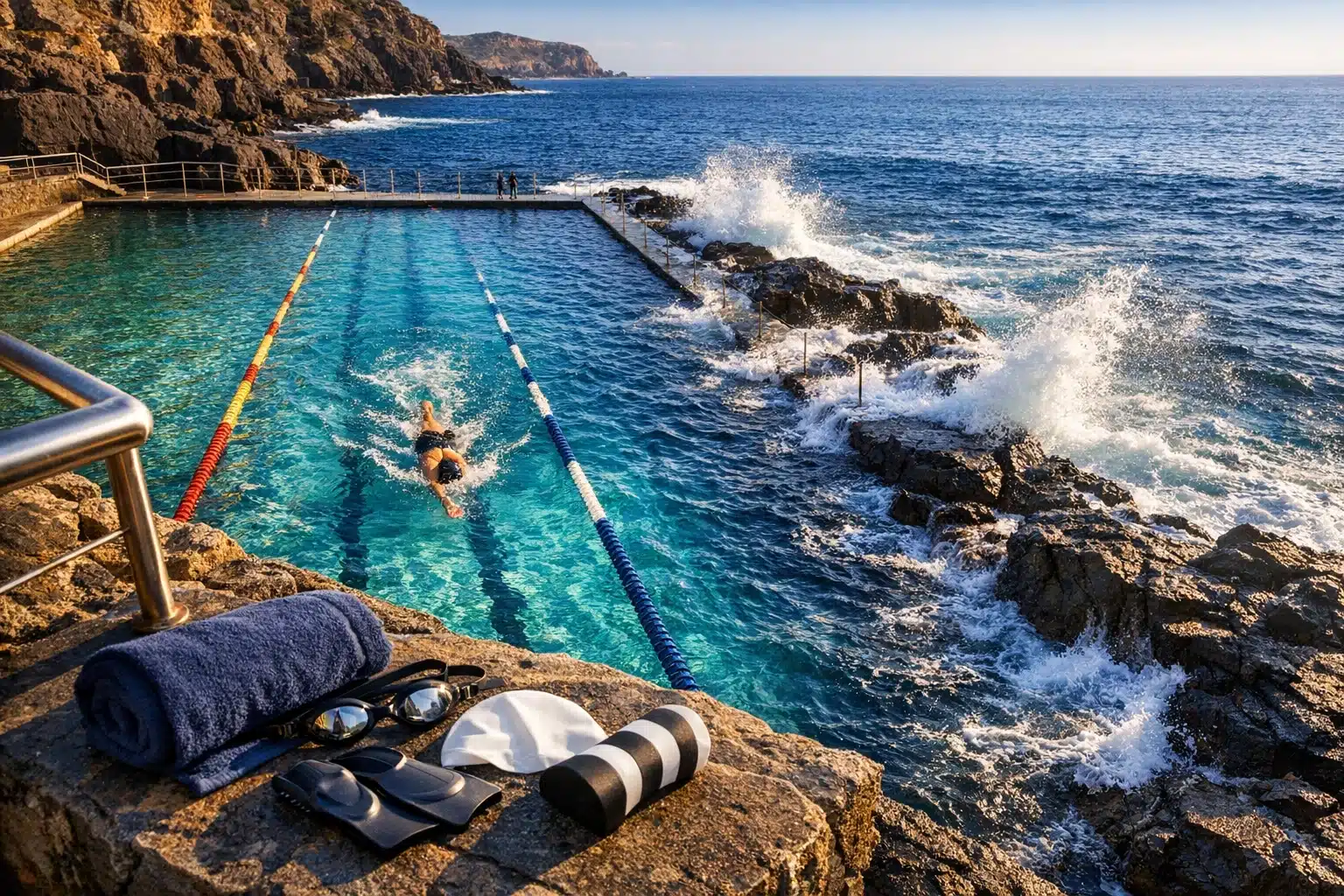
Equipment can be simple, but the right basics make learning far smoother. A comfortable swimsuit that stays in place matters more than style. Goggles protect the eyes and let swimmers see clearly, which reduces anxiety and improves body alignment. Swim caps are optional in many settings but helpful for hair management and reduced drag. Training aids such as kickboards, fins, hand paddles, and pull buoys can add variety, though beginners should treat them as tools rather than shortcuts.
- Goggles: clearer vision and less irritation
- Cap: convenience, warmth, and tidier movement through the water
- Fins: stronger kick awareness and added propulsion
- Pull buoy: upper-body focus and body-position support
- Mesh bag and towel: simple organization that saves frustration
Pool swimming and open-water swimming feel related but not identical. The pool is structured. Distances are measurable, pace clocks create accountability, and walls offer brief recovery. Water temperature is usually controlled, often around the range preferred for lap swimming, and the environment stays predictable enough for focused training. Open water replaces that order with variables: current, chop, wind, visibility, cold, navigation, and the psychological effect of depth. A pool swimmer counting black lines on the floor may feel suddenly disoriented in a lake where the bottom disappears after a few meters.
Because of those differences, open-water safety deserves special attention. Swimming with a partner or organized group is far wiser than going alone. Bright caps and tow floats improve visibility. Entry and exit points should be planned before getting in. Weather can change quickly, and cold water can impair breathing control faster than people expect. Skill transfers from the pool, but judgment becomes even more important outside it.
The comparison is not about declaring one environment better. The pool is ideal for measured improvement and technical precision. Open water offers adventure, variety, and a different kind of focus. Early morning in a quiet lake can feel vast and cinematic, while a clean lane under steady lights can feel almost meditative. The smart swimmer respects both settings, uses each for its strengths, and never lets familiarity replace caution.
Getting Started, Building Progress, and Keeping Swimming for Life
Starting swimming as an adult can feel more vulnerable than starting other forms of exercise. In a gym, uncertainty is easy to hide. In the pool, technique is visible, breathing errors are immediate, and progress can seem slow during the first few sessions. That makes a realistic approach essential. The goal at the beginning is not elegance or speed. It is comfort, consistency, and the gradual development of reliable movement patterns. Once those pieces settle, improvement often becomes much faster.
New swimmers benefit from short, manageable sessions rather than heroic efforts. Two or three visits per week are often enough to build momentum. Early practice can focus on floating, kicking with control, exhaling into the water, and swimming short lengths with rest. Many adults do better with lessons than with trial and error because a coach can quickly spot issues that otherwise turn into stubborn habits. Something as small as head position during a breath can determine whether a swimmer feels balanced or exhausted.
A simple beginner structure might look like this:
- 5 to 10 minutes easy warm-up and water adjustment
- Drills for breathing, floating, or body rotation
- Short repeats such as 6 to 10 lengths with rest between efforts
- A few minutes of relaxed swimming to finish
As fitness and confidence improve, swimmers can expand one variable at a time. They may increase total distance, shorten rest intervals, or include a faster set in the middle of the workout. That measured approach works better than changing everything at once. It also reduces frustration, which is a common reason people quit. Progress in swimming is not always obvious from one day to the next. It appears in quieter ways: fewer panicked breaths, smoother turns, a more stable kick, the ability to hold form when tired.
Swimming can also evolve with life stages. Children may begin with games and safety skills. Busy adults often use lap sessions as efficient exercise before work or after long hours at a desk. Older adults may value mobility, circulation, and the ability to stay active with less joint impact. Competitive pathways exist through school teams, clubs, triathlon, and masters groups, but competition is only one branch of the sport. Many people build a lifelong relationship with swimming simply because it continues to meet them where they are.
The key to staying with it is to define success broadly. Some days success is learning bilateral breathing. Some days it is completing twenty minutes without stopping. On other days it is just showing up, slipping into the water, and letting the first cold shock give way to rhythm. Swimming lasts because it can be serious without becoming joyless. It asks for patience, then pays it back over time with skill, fitness, and a kind of confidence that follows you beyond the pool deck.
Conclusion for New and Returning Swimmers
If you are curious about swimming, returning after years away, or trying to improve without getting overwhelmed, the best starting point is simple: learn the basics well and practice them regularly. Focus on breathing, body position, and safety before chasing distance or speed. Use the pool as a controlled place to build trust in your skills, and approach open water only when preparation matches ambition. Swimming rewards patience more than talent, and that is good news for ordinary readers who want steady, practical progress. The water does not ask for perfection. It asks for respect, repetition, and a willingness to keep learning.