A Beginner’s Guide to Tennis
Tennis is one of those rare sports that looks simple from the stands and turns richly layered the moment you pick up a racket. It blends movement, timing, strategy, and patience, which is why children, adults, weekend players, and serious competitors can all find a place in it. For beginners, the sport offers visible progress, from the first clean rally to the first well-built point. This guide explains the rules, equipment, basic strokes, and practical habits that help new players enjoy tennis without feeling lost.
Outline:
• How the game is structured: court layout, scoring, and match formats
• What equipment matters most: rackets, shoes, balls, and surfaces
• Which technical skills deserve early attention: grips, strokes, movement, and serving
• How strategy works in real points: shot selection, positioning, and consistency
• How to begin well and keep improving: practice plans, fitness, etiquette, and a conclusion for new players
1. Understanding the Shape of the Game: Court, Scoring, and Match Flow
Before a beginner worries about topspin or dramatic passing shots, it helps to understand the basic architecture of tennis. The court is 78 feet long, and its width changes depending on the format: 27 feet for singles and 36 feet for doubles. That extra doubles width comes from the alleys on each side, which are in for doubles and out for singles. The net divides the court in half, standing 3 feet high at the center and 3 feet 6 inches at the posts. Each side also includes a baseline, a service line, and two service boxes. These markings are not decorative details. They create the map of the game, telling players where to stand, where to serve, and how to build points with purpose rather than guesswork.
Scoring is the part that often confuses new players, because it does not follow the straightforward count used in many other sports. A game moves from 15 to 30 to 40, and then to game point. If both players reach 40, the score becomes deuce. From there, one player must win two points in a row: one for advantage and one for the game. Sets are usually won by the first player to reach six games with at least a two-game lead. If the set reaches 6-6, many formats use a tie-break, commonly first to 7 points with a two-point margin. Recreational doubles sometimes replace a full third set with a match tie-break to 10, which saves time while preserving competitive tension.
The rhythm of a match becomes much easier to follow once these units are clear: points form games, games form sets, and sets form the match. Singles emphasizes court coverage, stamina, and precision because there is more open space to defend. Doubles introduces shared movement, volley exchanges, and sharper angles, often making points feel quicker and more tactical. In both forms, the server must begin each point by serving diagonally into the correct service box. After that, the ball can bounce once on each side, but not twice. Suddenly, what once looked like chaos starts to feel more like chess in motion, with every line on the court carrying a practical purpose.
Useful rules to remember early:
• A serve must land in the diagonally opposite service box.
• The ball may bounce once before you hit it.
• If your shot lands outside the lines, the point is lost.
• If the ball hits the net and goes over during a rally, play continues.
• In singles, the alleys are out; in doubles, they count.
2. Choosing Equipment Wisely: Rackets, Shoes, Balls, and Court Surfaces
One of the easiest mistakes a beginner can make is assuming better tennis begins with expensive gear. In reality, appropriate equipment matters more than premium branding. A helpful starter racket usually has a head size around 100 to 105 square inches, because the larger hitting area offers a more forgiving sweet spot. Many adult beginners feel comfortable with a racket in the general range of 280 to 300 grams strung, which balances stability with manageable swing speed. A racket that is too heavy can tire the arm and slow the swing, while one that is too light may feel unstable on contact. Grip size also matters. If the handle is too small, the player may squeeze too tightly; if it is too large, wrist comfort and control can suffer.
Strings influence feel more than many new players expect. Lower string tension usually provides a little more power and comfort, while higher tension can offer a firmer, more controlled response. Beginners often do well with durable synthetic gut or soft multifilament strings rather than stiff setups designed for advanced players with fast swings. Shoes are even more important than many first-timers realize. Running shoes are designed for forward motion, but tennis demands sharp stops, side shuffles, and quick recoveries. Tennis-specific shoes support lateral movement and can reduce the risk of ankle trouble on court. Add a few practical basics and a beginner is well equipped rather than overequipped.
A simple starter kit can include:
• One forgiving racket
• Tennis shoes with good lateral support
• A few regular-duty balls for softer play, or slower training balls for learning
• Comfortable moisture-wicking clothing
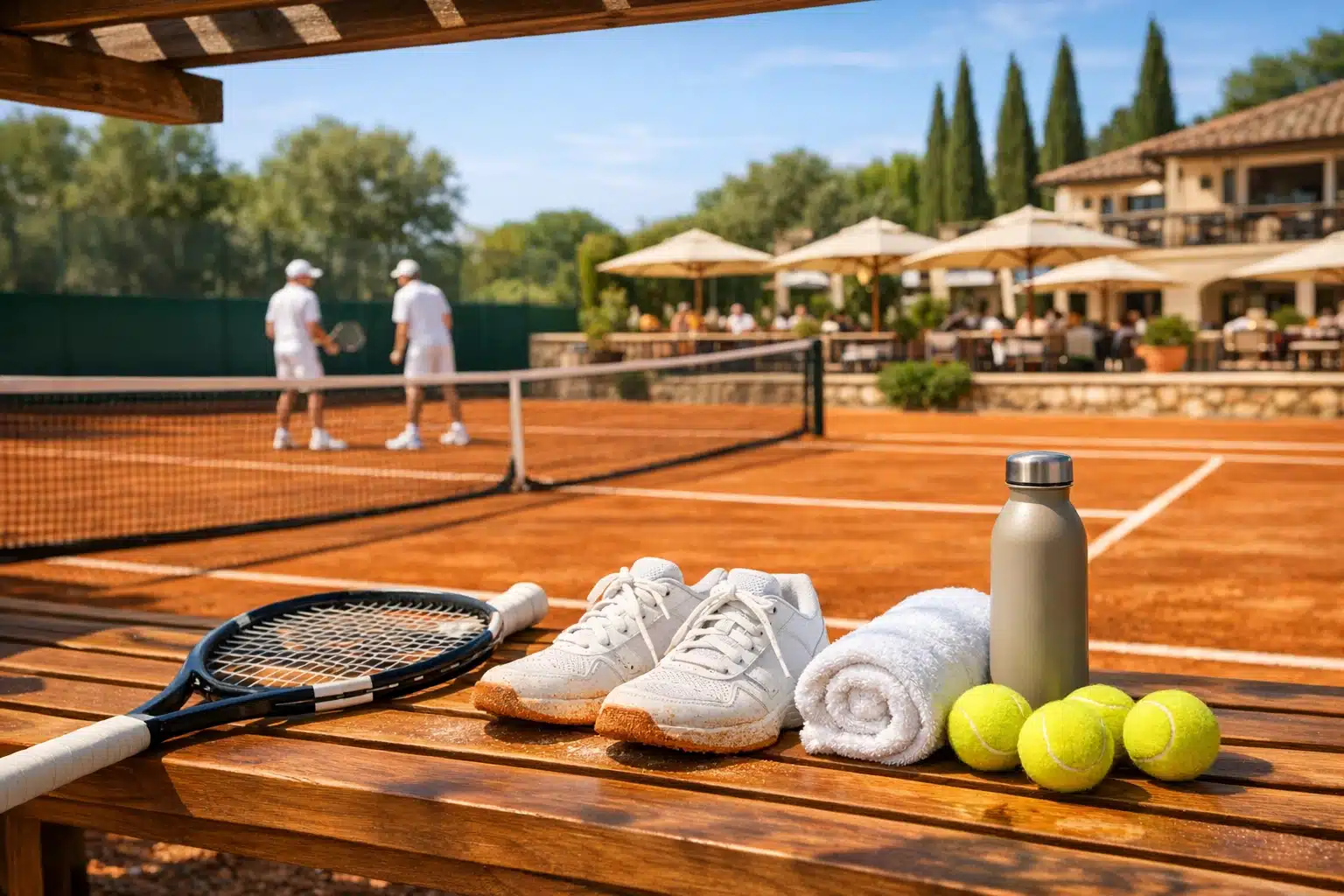
• Water, a small towel, and an overgrip
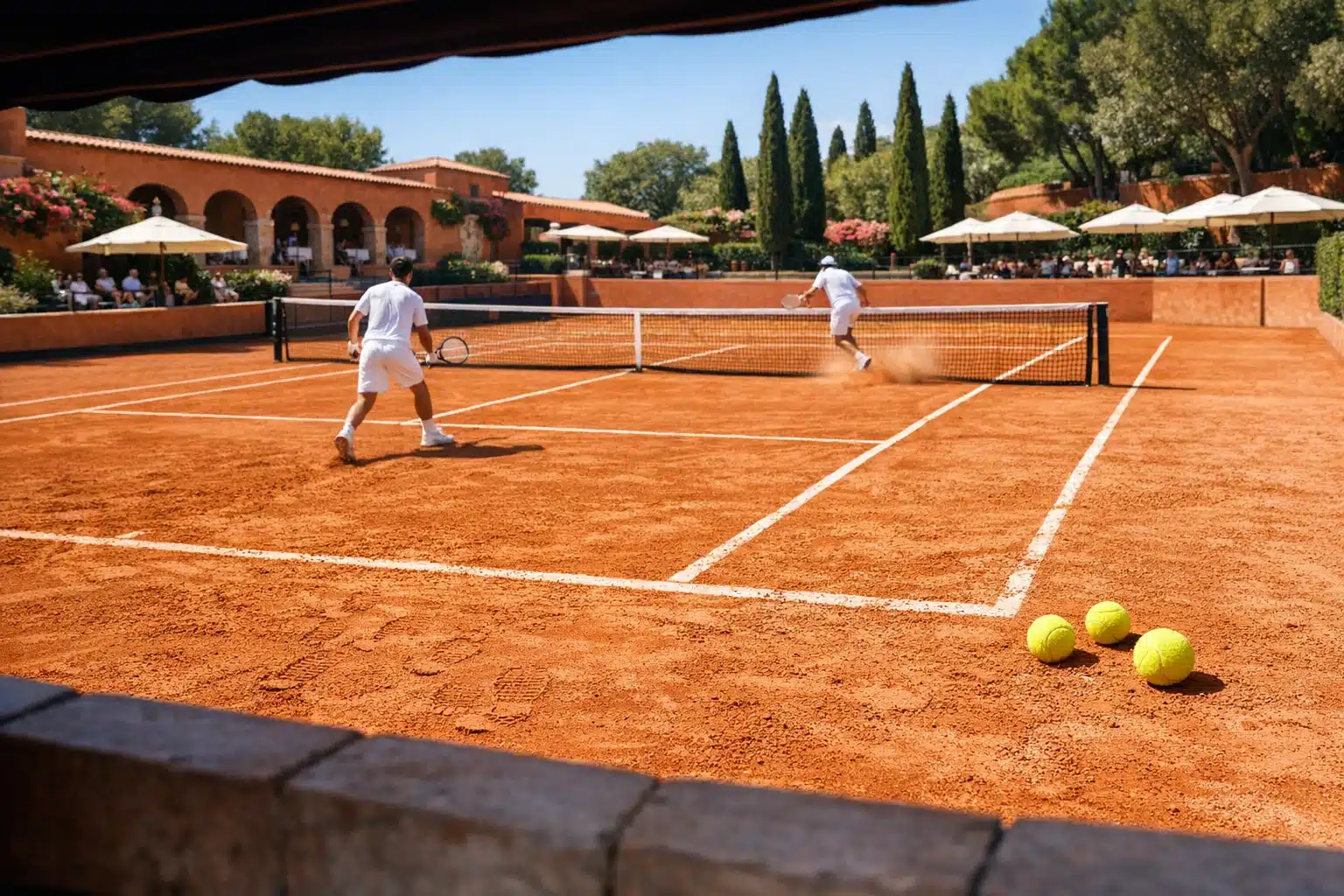
Court surfaces also shape the game in noticeable ways. Hard courts are the most common in many public facilities and clubs. They offer a medium-to-fast bounce and a fairly predictable response, which makes them suitable for learning fundamentals. Clay courts slow the ball down and usually produce a higher bounce, giving players more time to react and encouraging longer rallies. They can be gentler on the body for some players, though movement on clay requires learning to slide or at least decelerate smoothly. Grass courts are less common and typically faster, with lower and less predictable bounces. For beginners, hard courts and clay courts are usually more practical learning environments. The key lesson is simple: good equipment should support learning, comfort, and confidence, not distract from them.
3. Building Real Skills: Grips, Strokes, Footwork, and the Serve
Tennis technique can look intimidating because advanced players make complex actions appear effortless. For a beginner, however, the goal is not to copy every flourish. It is to build repeatable fundamentals. Everything starts with the ready position: knees slightly bent, racket held in front, body balanced, eyes alert. From there, footwork becomes the hidden engine of nearly every successful shot. Good players do not simply swing well; they arrive well. Small adjustment steps, a timely split step, and balanced recovery after contact matter as much as the stroke itself. A clean forehand hit from the right spot is far easier than a desperate swipe taken while leaning the wrong way.
On the forehand side, many modern players use a semi-western grip because it supports topspin and a strong contact zone. Beginners do not need to obsess over grip labels, but they should use a grip that helps them meet the ball in front of the body with a stable racket face. The basic pattern is simple: turn the shoulders, drop the racket smoothly, swing forward through contact, and finish under control. The backhand can be one-handed or two-handed. A two-handed backhand often feels more secure for beginners because it adds stability and helps with timing. A one-handed backhand can offer reach and variety, but it usually demands more precise preparation and strength. Neither option is automatically better for everyone; the better option is the one a new player can repeat comfortably and correctly.
The serve deserves special attention because it is the only shot a player starts without pressure from an incoming ball. That makes it both empowering and frustrating. A reliable beginner serve is built from rhythm, not violence. The player sets the stance, tosses the ball to a reachable height, leads upward with the body, and contacts the ball fully extended. Power can come later. At first, consistency is the greater prize. The return of serve is the opposite skill: fast reactions, compact swing, and early preparation. Volleys, meanwhile, require shorter motions and a firm but not rigid racket face. Think of the volley as a guided redirection, not a full groundstroke at the net.
Useful technical checkpoints:
• Watch the ball until contact instead of looking up too soon.
• Prepare early with a shoulder turn.
• Hit from a balanced base whenever possible.
• Recover toward a sensible court position after each shot.
• Treat smooth timing as more valuable than raw force.
Progress in tennis often feels uneven. One day the forehand sings, the next day it seems to vanish into the net. That is normal. Technique improves through patient repetition, feedback, and many ordinary sessions that do not feel dramatic at the time. The beauty of the sport is that small corrections often produce surprisingly visible changes. A cleaner split step, a calmer grip pressure, or a better contact point can turn a frantic rally into one that suddenly feels playable and controlled.
4. Playing Smarter: Strategy, Shot Selection, and the Mental Side of Tennis
Beginner tennis improves faster when players understand that winning points is not just about hitting harder. In fact, at early and intermediate levels, consistency often matters more than outright power. A player who can send eight ordinary balls in a row into sensible areas of the court will usually beat someone who goes for a spectacular winner on every third shot. This is the foundation of high-percentage tennis. Aim with margin over the net, use the middle of the court when under pressure, and avoid forcing risky shots from poor positions. The middle is not glamorous, but it is honest. It shrinks your angle of error and makes your opponent do more work to create a sharp reply.
Depth is another strategic tool beginners should learn early. A deep ball that lands near the baseline can push an opponent backward, making it harder for them to attack. A shorter ball, by contrast, often invites the opponent to step in and take control. Height matters too. A ball that clears the net by several feet usually carries safer net clearance and still lands in the court if hit with moderate topspin. Strategy in singles often revolves around moving the opponent side to side, then using depth or angle to open space. Doubles changes the picture. Net play becomes more important, communication matters, and smart positioning with a partner can decide more points than brilliant shot-making.
The mental side of tennis is where many matches tilt. Because play stops after every point, the sport gives players time to think, and not all thinking is useful. Beginners often replay mistakes, rush between points, or confuse one bad game with total collapse. A better habit is to treat each point as a fresh puzzle. Ask practical questions: Was my position too deep? Did I aim too close to the line? Did I rush the serve? This turns frustration into information. Even professionals talk about routines between points because routine steadies attention. A deep breath, a clear target, and one decision are often enough.
Practical patterns for new players:
• Serve wide, then hit the next ball into the open court.
• Rally crosscourt when you need safer geometry.
• Attack short balls instead of forcing winners from behind the baseline.
• In doubles, follow a good approach shot to the net.
• When nervous, choose bigger targets and trust longer rallies.
Tennis rewards patience without making the game passive. The best beginner strategy is active but sensible: move well, recover quickly, use generous targets, and make the opponent beat you with quality rather than receiving free points through rushed errors. That approach may lack drama, but it builds matches on substance instead of impulse.
5. Conclusion for New Players: Practice, Fitness, Etiquette, and a Sustainable Tennis Habit
Starting tennis is easier when the early goal is regular participation rather than rapid perfection. Two or three sessions a week can be enough to create noticeable improvement, especially if those sessions have structure. One day might focus on rallying and consistency, another on serves and returns, and a third on point play or doubles. Even 45 to 60 minutes of concentrated work can be valuable. A wall is useful for repetition when a partner is unavailable, and a ball machine can help if access and budget allow, though neither replaces the reading and reacting that come from hitting with real people. Lessons, whether private or in groups, can speed up learning by correcting habits before they harden.
Fitness supports skill more than many beginners expect. Tennis asks for short bursts of speed, repeated changes of direction, shoulder mobility, leg strength, and enough endurance to keep technique from falling apart under fatigue. A simple support plan works well:
• Dynamic warm-up before play
• Light strength work for legs, core, and upper back
• Mobility for shoulders, hips, and ankles
• Recovery through rest, hydration, and sensible training volume
Injury prevention is not glamorous, but it is part of smart improvement. Overplaying with poor technique, using the wrong grip size, or serving too hard too soon can irritate the arm or shoulder. It is wiser to build volume gradually and stop treating discomfort as a badge of dedication. Good etiquette also makes tennis more enjoyable. Call lines fairly, return balls to nearby courts politely, avoid walking behind players during a point, and respect the rhythm of both singles and doubles play. These habits create better sessions and better communities, especially in clubs and public parks where regular players quickly notice who brings a cooperative attitude.
For beginners, the most encouraging truth about tennis is that enjoyment does not require mastery. You do not need a heavy topspin forehand or a booming serve to start having real fun. You need a basic understanding of the rules, a workable racket, a few reliable movements, and the willingness to keep showing up. Improvement in tennis often arrives quietly, almost like dawn rather than fireworks. One week you are chasing the ball; a month later you are building rallies; before long you are reading patterns and making choices with intention. If you begin with patience, curiosity, and sensible practice, tennis can become not just a sport you try, but one you return to for years.