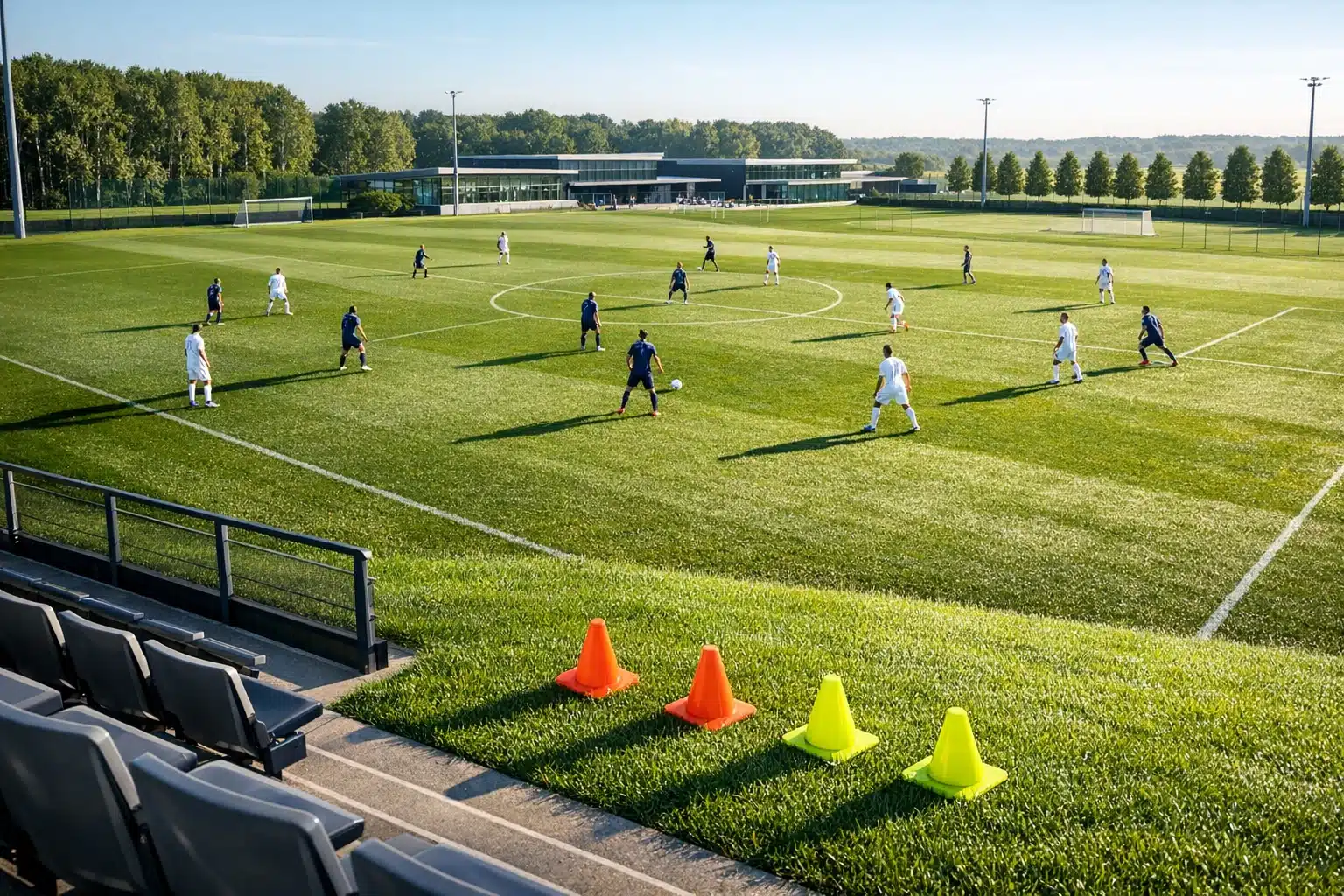
Football: Rules, Positions, and Why the Sport Matters
Football matters because it combines simple rules with endless depth, turning an open field, a ball, and two goals into a language understood almost everywhere. It shapes schoolyards, city rivalries, national pride, and weekend routines, while also teaching timing, teamwork, resilience, and decision-making under pressure. From local parks to World Cup stadiums, the sport stays relevant because it is both accessible and complex, familiar and constantly evolving.
Outline
- The basic rules that give football its structure and rhythm
- The key positions on the pitch and how responsibilities differ
- Common formations, tactical ideas, and changes in modern play
- The cultural, social, and economic importance of football worldwide
- Why football continues to attract new players and fans in a changing era
1. The Rules of Football: Simple at First Glance, Deep in Practice
Football can look like organized chaos to a new viewer: twenty-two players moving at speed, a referee blowing a whistle, a crowd reacting before the television replay even appears. Yet the game is built on a fairly clear framework. Two teams of eleven players try to score by putting the ball into the opponent’s goal, and the team with the most goals at the end wins. A standard match lasts 90 minutes, divided into two halves of 45 minutes, with added time at the end of each half to account for stoppages. In knockout tournaments, matches may continue into extra time and, if needed, a penalty shootout.
The field itself follows standardized dimensions, especially in professional competitions. International pitches are generally around 100 to 110 meters long and 64 to 75 meters wide, though exact measurements can vary within the laws of the game. Goals are 7.32 meters wide and 2.44 meters high. These numbers matter more than they may seem. The width of the pitch affects attacking space, pressing angles, and how quickly teams can switch play from one side to the other.
Among the most important rules are the following:
-
The ball is in play unless it fully crosses the touchline or goal line, or the referee stops play.
-
Players cannot use their hands or arms deliberately, except for the goalkeeper inside the penalty area.
-
Fouls can lead to free kicks, penalty kicks, cautions, or red cards depending on severity.
-
Offside prevents attackers from gaining an unfair advantage by waiting too close to goal.
The offside law is often the most misunderstood. A player is not automatically offside simply for standing near the opponent’s goal. The offense depends on position at the moment the ball is played by a teammate and whether the player becomes actively involved in the move. This rule encourages timed runs rather than goal-hanging, preserving a balance between attack and defense.
Set pieces add another layer of structure and drama. Corners, throw-ins, free kicks, and penalties can change a match in seconds. A team that struggles in open play may still be dangerous from dead-ball situations, especially if it has strong aerial players or precise delivery. Modern football has also added technology, including goal-line systems and video review in many competitions. These tools have not removed debate, but they have improved accuracy on key decisions.
What makes football special is not only that the rules are understandable, but that they create constant tension. One goal can feel like a thunderclap, partly because scoring is hard. Unlike sports with frequent points, football often asks viewers to wait, read patterns, and sense momentum. That waiting is not empty time. It is where anticipation lives.
2. Positions on the Pitch: The Roles That Shape Every Match
Every football team shares the same objective, but not every player reaches that objective in the same way. Positions give the game order, distribute responsibility, and reveal how a coach wants the team to function. Traditionally, players are grouped into goalkeepers, defenders, midfielders, and forwards. In practice, each of those broad labels contains several distinct jobs, and modern football has made many of them more fluid than ever.
The goalkeeper is the only player allowed to handle the ball, but the role now extends far beyond shot-stopping. A top goalkeeper must judge crosses, organize the defensive line, distribute the ball under pressure, and stay calm when isolated. In older eras, keepers were seen mainly as specialists. Today, many teams ask them to act almost like an extra outfield player in possession, starting attacks with short passes or long diagonal balls.
Defenders protect space, win duels, and begin transitions. Their roles usually include:
-
Center-backs, who mark strikers, clear danger, and often direct the back line
-
Full-backs, who defend wide areas and increasingly support attacks
-
Wing-backs, who play even higher in systems with three center-backs
Center-backs are no longer judged only by tackling and heading. Passing range, positioning, and composure are now major qualities. Full-backs have changed even more dramatically. Once seen mainly as wide defenders, they are now often creators, runners, and tactical problem-solvers. Some overlap outside the winger, while others move inward into midfield to help control possession.
Midfield is the engine room, the chessboard, and sometimes the traffic jam all at once. Defensive midfielders screen the back line, recover loose balls, and keep the team compact. Central midfielders connect defense to attack, offering passing options and controlling tempo. Attacking midfielders operate between the lines, where a half-second of freedom can unlock a defense. The best midfielders combine technique with scanning, the habit of constantly checking surroundings before receiving the ball.
Forwards carry the obvious burden of scoring, but even this area includes different profiles. A central striker may play with back to goal, attack crosses, or stretch defenses with runs behind the line. Wingers can stay wide and deliver crosses, or cut inside to shoot and combine. Some teams use a false nine, a forward who drops deeper to pull defenders out of shape. Others prefer a traditional target player who brings teammates into the attack.
The most fascinating part of football positions is that they are both fixed and flexible. A lineup may begin on paper as a 4-3-3, yet shift constantly during the match. A full-back may become a midfielder in possession. A winger may defend as a second full-back. A striker may start the press. In football, positions are less like boxes and more like starting points on a map. The lines exist, but the best players know when to cross them with purpose.
3. Tactics and Formations: How Teams Turn Talent into a System
If positions are the cast, tactics are the script. They determine how a team presses, defends space, builds attacks, and reacts when possession changes hands. Formations such as 4-4-2, 4-3-3, 4-2-3-1, and 3-5-2 are useful labels, but they are only the opening sketch. The real picture emerges in movement: who drops deep, who pushes forward, who covers wide zones, and how quickly the team adapts to different moments.
The 4-3-3 is often associated with width and pressing. It gives teams natural triangles across the pitch, making passing combinations easier and supporting aggressive recovery when the ball is lost. A 4-2-3-1 offers defensive stability through two deeper midfielders while allowing a creative attacking midfielder to operate behind the striker. A 3-5-2 can strengthen central areas and free wing-backs to cover the flanks, though it demands high stamina and positional awareness. None of these systems is automatically superior. Their success depends on the players available and the clarity of the coaching.
Modern football usually revolves around a few major tactical ideas:
-
High pressing, where a team tries to win the ball back near the opponent’s goal
-
Low blocks, where defenders stay compact and protect dangerous spaces
-
Possession play, which values controlled buildup and patient circulation
-
Transition football, which attacks quickly after winning the ball
-
Set-piece planning, which can decide tight matches
Pressing has become especially important. Rather than waiting passively, many teams hunt in coordinated waves. A striker may angle a run to force the ball wide, a winger may trap the full-back, and a midfielder may step in to intercept the next pass. When done well, pressing is less about sprinting wildly and more about synchronized movement. It is a dance performed at full speed, where one missed step can open a gap large enough for a counterattack.
Possession, meanwhile, is often misunderstood as passing for its own sake. Good possession is purposeful. It draws opponents out, creates overloads, and prepares a high-value attack. Some teams use short combinations to progress through the center; others invite pressure, then switch play quickly to the far side. In contrast, transition-focused sides accept that they may see less of the ball but attack with speed and directness when space appears.
Data analysis now supports many of these choices. Coaches and analysts study expected goals, passing networks, ball recoveries, defensive line height, and sprint distances to understand performance more clearly. These numbers do not replace judgment, but they sharpen it. A team may appear dominant while creating few real chances, or seem under pressure while quietly generating more dangerous opportunities on the break.
Tactics matter because football is a game of margins. A slightly higher press, a narrower midfield, or a smarter rotation on one wing can tilt a contest. The beauty of the sport lies in how ideas meet reality. A whiteboard plan may look perfect in the dressing room. Then the whistle blows, and the match asks a harder question: can your structure survive motion, noise, fatigue, and the stubborn creativity of the other team?
4. Why Football Matters: Culture, Community, Opportunity, and Identity
Football is not only a sport; it is also a social force. Its importance comes partly from its accessibility. At the most basic level, the game requires little equipment and relatively little space. Children can play with cones, shoes as goalposts, or even a marked wall. That simplicity has helped football spread across continents, classes, and generations. According to FIFA, more than 200 national associations are part of the global structure of the game, a sign of extraordinary reach. Few activities connect so many places through such a shared set of rules and rituals.
For communities, football can provide belonging. Local clubs give neighborhoods an identity and a meeting point. Match day routines create social glue: the familiar walk to the ground, the same food stand, the same songs, the same debates after the final whistle. In some towns, the local team is part memory, part mirror. It reflects migration, industry, class history, and civic pride. Even those who never step onto the pitch may feel woven into the story.
The sport also has educational and developmental value. Young players learn discipline, cooperation, patience, and emotional control. Training demands repetition, but it also teaches adaptation. No drill unfolds exactly like a real match, so players must blend habit with awareness. Football can support physical health through running, agility, and coordination, while also developing confidence and communication.
Its broader significance can be seen in several areas:
-
Social inclusion, because teams often bring together people from different backgrounds
-
Youth development, through school, academy, and community programs
-
Economic activity, from ticket sales and broadcasting to tourism and local business
-
Representation, especially as women’s football gains greater visibility and investment
The growth of women’s football is especially important. Increased media attention, higher attendance at major matches, and stronger youth pathways have expanded who sees themselves in the sport. That matters because visibility changes aspiration. When more players can imagine a future in football, the game becomes not just a spectacle but a space of participation.
At the elite level, football also carries enormous emotional and economic weight. Major tournaments can shape national mood, attract global audiences, and generate substantial revenue. Yet the essence of the sport often survives best at smaller scales: on community grounds, in school competitions, and in amateur leagues where people play after work simply because the game still calls them back.
Football matters because it holds contradiction without breaking. It is local and global, ordinary and dramatic, structured and unpredictable. A child’s first kick in a park and a packed international final belong to the same family of moments. That continuity is rare. It helps explain why football does not merely entertain millions; it gives them a language for effort, rivalry, hope, and collective memory.
5. Football Today and Tomorrow: How to Watch, Learn, and Stay Connected to the Game
Football’s endurance is not accidental. The sport keeps renewing itself without losing its basic shape. For new fans, this is good news. You do not need decades of experience to enjoy a match, but learning a few habits can deepen your understanding quickly. Instead of watching only the player with the ball, try following the spaces around the action. Notice how a team defends when it loses possession, how midfielders check their shoulders before receiving, or how full-backs decide whether to overlap or stay behind. Suddenly the match opens up like a book with hidden chapters.
For people who want to play, football remains one of the most approachable team sports. A beginner can improve with regular practice in first touch, passing, movement off the ball, and basic fitness. The game rewards technical skill, but also rewards reading situations well. A smart pass played at the right time can matter more than a flashy trick. In that sense, football is generous. It offers many ways to contribute.
Useful starting points for players and fans include:
-
Learn the core rules, especially offside, fouls, and restart situations
-
Watch one position closely during a match to understand its responsibilities
-
Follow a team across several games to see patterns rather than isolated highlights
-
Practice simple skills consistently instead of chasing difficult techniques too early
Technology is changing the experience as well. Fans now access matches, tactical analysis, performance data, and training resources more easily than ever. Clubs use video, GPS tracking, and data models to assess player workload and decision-making. Refereeing has also evolved through video review and goal-line systems. These tools have sparked arguments, but they reflect a broader truth: football keeps adapting to modern expectations of fairness, speed, and insight.
At the same time, the sport faces serious questions. Fixture congestion can strain players physically and mentally. Commercial growth can increase inequality between clubs and leagues. Youth development systems must balance competition with well-being. Supporters also debate ticket prices, ownership models, and the risk that football becomes too distant from the communities that built it. These are not small concerns. They shape whether the sport remains accessible in spirit, not just in theory.
Still, football retains a rare power to pull people in. One match can begin as background noise and end as a memory stamped onto a season, a friendship, or a family tradition. A clever midfield turn, a desperate last-ditch tackle, a goalkeeper’s save in silence before the crowd erupts, these moments keep the game alive across generations.
The future of football will likely include more analytics, broader participation, stronger women’s competitions, and continued debate over rules and scheduling. Yet its heart will stay recognizable. Two teams, one ball, limited time, and endless possibilities. That is a remarkably durable formula. It leaves room for tactics, emotion, improvement, and surprise, which is exactly why football still matters and why it will keep mattering.
Conclusion for New Fans, Players, and Curious Readers
Football rewards attention at every level. If you are new to the sport, start with the rules and basic positions, then let the tactics reveal themselves over time. If you already play or watch regularly, the game remains rich enough to keep teaching you something different each week. That lasting mix of simplicity, strategy, community, and emotion is what makes football one of the world’s most meaningful sports.