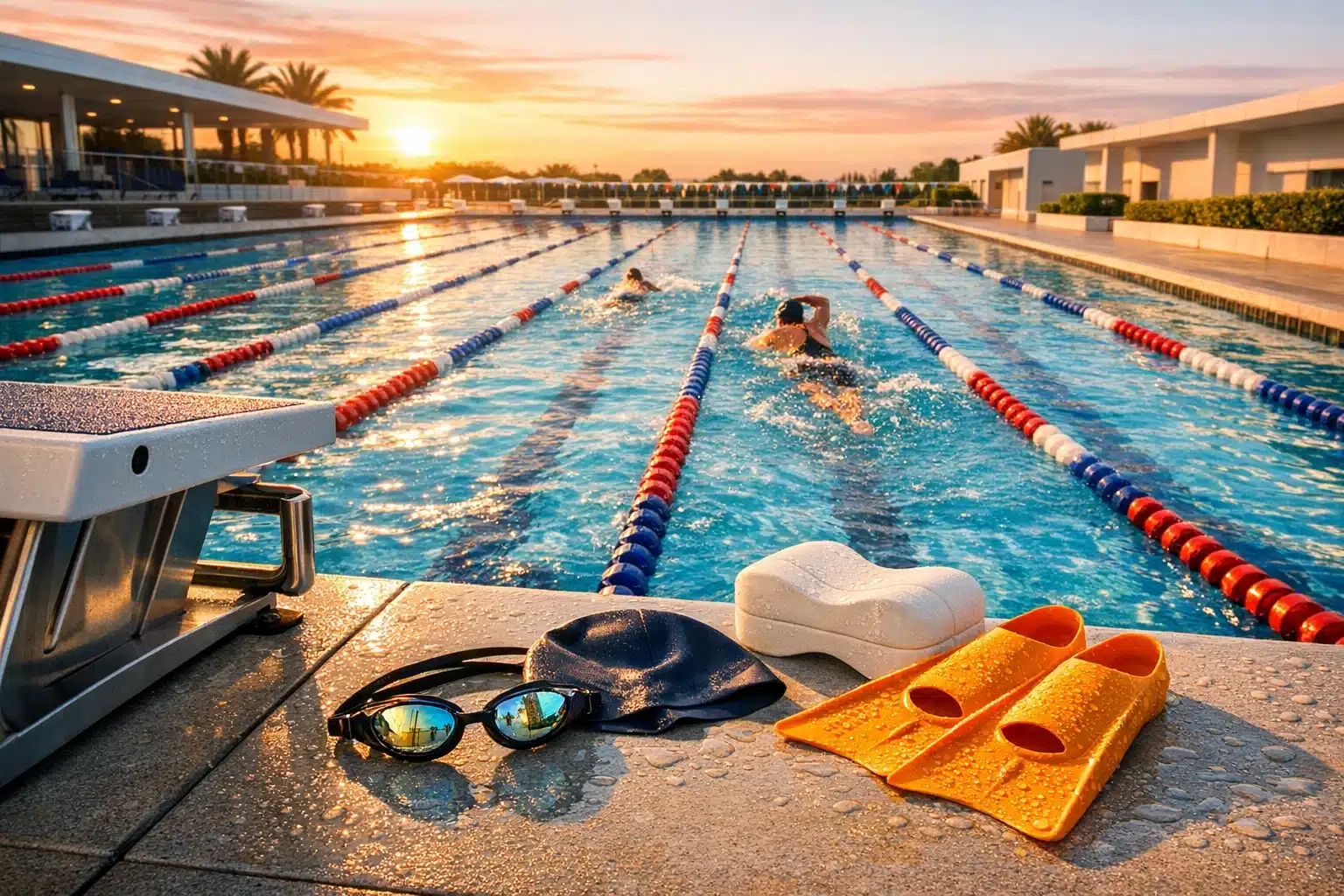
Explore the world of swimming
Swimming sits at a rare crossroads where sport, survival skill, therapy, and recreation meet. It matters because it can challenge elite athletes, welcome nervous beginners, and offer low-impact movement to people who find many land-based workouts uncomfortable. From school lessons to open-water adventures, swimming shapes health, confidence, and community across ages in ways few activities can match.
This article begins with a clear outline before diving into the details:
- The unique value of swimming as both a sport and a life skill
- The four main strokes and how they differ in purpose, rhythm, and difficulty
- The physical and mental benefits of regular swimming
- Training methods, useful equipment, and essential safety habits
- A concluding look at how swimming can become a lifelong practice for beginners and experienced swimmers alike
Why Swimming Matters: A Sport, a Skill, and a Different Kind of Exercise
Swimming is unusual among popular activities because it is not only a form of exercise but also a safety skill. A person who learns to swim gains more than a workout option; they gain greater confidence around pools, lakes, rivers, and coastlines. That practical value gives swimming a relevance that goes beyond medals, calorie burn, or weekend hobbies. It belongs in the same conversation as cycling or running when people discuss fitness, yet it also belongs in discussions about education, child development, and public safety.
One reason swimming feels so different from land sports is the environment itself. Water supports part of the body’s weight through buoyancy, which reduces impact on joints. For people with knee discomfort, older adults easing back into activity, or those recovering from certain injuries under professional guidance, that can make movement feel smoother and less punishing than pounding pavement. At the same time, water creates resistance in every direction. That means even simple motions ask muscles to work. In other words, the pool can feel gentle and demanding at once, a combination that explains much of swimming’s broad appeal.
Compared with running, swimming usually places less stress on ankles, hips, and knees, but it asks for more technical coordination. Compared with cycling, it involves a broader range of upper-body movement and stricter breathing timing. Unlike many gym exercises, it requires the body to organize balance, rotation, propulsion, and breath control all at the same time. A swimmer does not simply move through water; they negotiate with it. The water gives support, but it also pushes back.
Swimming also scales well across skill levels. A beginner may start by learning how to float, exhale underwater, and move comfortably along the wall. A recreational swimmer may later build endurance through relaxed laps. A competitive athlete may train for speed, race tactics, and split times. The same pool can host children at lessons, adults managing stress after work, triathletes refining technique, and older swimmers preserving mobility.
Its importance becomes even clearer when viewed through a wider lens:
- It can support cardiovascular fitness without heavy impact.
- It teaches body awareness and breath control.
- It can build water confidence that may reduce panic in aquatic settings.
- It offers both solitary focus and social connection.
That range is rare. Some sports are fast but hard on the joints. Others are accessible but limited in intensity. Swimming moves across categories with ease, which is why it has remained relevant from school programs to Olympic arenas. For many people, entering the water is the beginning of a healthier routine. For others, it is the beginning of a calmer mind. Often, it becomes both.
Understanding the Main Strokes: Technique, Purpose, and Practical Differences
To someone standing on a pool deck, swimming may look like a single activity with different styles layered on top. In practice, each stroke teaches the body a different conversation with the water. The four main competitive strokes, freestyle, backstroke, breaststroke, and butterfly, vary in rhythm, efficiency, muscle demand, and learning curve. Understanding those differences helps beginners choose where to start and helps developing swimmers understand why one stroke feels smooth while another feels like an argument.
Freestyle, usually swum as front crawl, is the fastest and often the most efficient stroke for covering distance. Its alternating arm action and flutter kick create a relatively continuous flow. Because the face is in the water much of the time, breathing technique becomes central. Swimmers typically turn the head to the side for quick breaths while maintaining body rotation. Freestyle is popular in fitness swimming because it can be sustained for long sets once technique improves. It rewards streamlined body position, relaxed recovery, and steady rhythm.
Backstroke is almost the mirror image in mood. The swimmer lies on the back, which makes breathing easier because the face stays above the surface. That can be comforting for beginners who feel anxious about inhaling at the wrong moment. However, backstroke introduces different challenges: keeping the hips high, moving in a straight line without seeing forward, and coordinating an effective kick. Many swimmers use it as an active recovery stroke because it opens the chest and changes posture after long freestyle sets.
Breaststroke is often considered approachable for recreational swimmers, partly because the head can rise regularly and the pace can feel more controlled. Yet good breaststroke is highly technical. Timing matters enormously. The pull, breath, kick, and glide must link together cleanly, or the swimmer loses momentum. It is generally slower than freestyle, but it can be economical and elegant when done well. For many learners, breaststroke feels intuitive at first and then surprisingly complex as they refine it.
Butterfly is the most demanding of the four for many people. Both arms recover together, the body moves in a wave-like pattern, and the kick usually comes from a dolphin motion. It requires strength, timing, and efficient body undulation. When technique clicks, butterfly looks dramatic and fluid, almost like the swimmer is riding the surface rather than fighting it. When it does not, it becomes exhausting very quickly.
A practical comparison helps:
- Freestyle: fastest, versatile, common for endurance work
- Backstroke: easier breathing, strong for posture and balance awareness
- Breaststroke: controlled pace, precise timing, popular recreationally
- Butterfly: powerful, technical, energy-intensive
Beyond the strokes themselves, strong swimming also depends on starts, turns, kicking mechanics, and streamlining. A swimmer who learns to push off the wall in a tight line can gain free speed without extra effort. A swimmer who exhales calmly underwater often becomes more relaxed overall. That is part of the beauty of technique in swimming: small changes can produce large results. The water is a strict teacher, but it is honest. When movement becomes efficient, the reward is immediate.
Health Benefits of Swimming: Fitness, Recovery, and Mental Reset
Swimming earns its reputation as a full-body activity because it asks multiple systems to work together at once. The heart and lungs support sustained effort, the muscles generate propulsion, and the nervous system coordinates breathing with movement and balance. For adults, public health guidance commonly recommends at least 150 minutes of moderate aerobic activity per week, and swimming can contribute to that target. Whether someone swims steady laps, joins an aqua fitness class, or alternates strokes and drills, time in the water can meaningfully support overall physical activity.
From a conditioning standpoint, swimming trains endurance while engaging major muscle groups. The shoulders, back, chest, core, glutes, and legs all contribute, though the exact emphasis shifts by stroke. Freestyle and butterfly place strong demands on the upper body and trunk rotation. Breaststroke has a distinct pull-and-kick pattern that challenges coordination and inner-thigh involvement. Backstroke encourages posture control and stable hip position. Because water resists movement in every direction, even simple drills can create muscular effort without heavy external loading.
One of swimming’s most practical advantages is its low-impact nature. Buoyancy reduces load on joints, which is why many people who dislike the jarring feel of some land exercises find the pool more welcoming. That does not mean swimming is easy. It simply distributes effort differently. A well-structured swim can raise heart rate, improve stamina, and leave the body pleasantly tired without the same pounding effect associated with high-impact exercise. For some people, especially those returning to activity after time away, that makes adherence more realistic.
The mental side is equally important. Repetitive strokes, controlled breathing, and the muffled soundscape of the water can create a focused, almost meditative experience. Exercise in general is linked to reduced stress and improved mood, and swimming offers an especially rhythmic version of that effect. Many swimmers describe the pool as a place where mental clutter thins out. The lane line becomes a border between noise and quiet. Count the strokes, feel the pull, hear the splash, exhale into bubbles, and the mind often settles.
Some benefits often associated with swimming include:
- Improved aerobic endurance and circulation
- Greater mobility and whole-body coordination
- Lower-impact exercise for many people with joint sensitivity
- Structured breathing that can promote calm and pacing awareness
It is still important to stay realistic. Swimming is not a cure-all, and technique issues can cause shoulder or neck discomfort if ignored. People with medical conditions should follow professional advice when starting a new routine. But as a sustainable form of movement, swimming offers an impressive blend of strength, stamina, and mental refreshment. Few workouts can leave a person both energized and quieter inside. A good swim often does exactly that.
Training, Technique, and Safety: How to Build Skill Without Rushing the Process
Many beginners assume swimming progress depends mainly on fitness. In reality, early improvement often comes more from technique than from raw effort. A strong but tense swimmer can tire quickly, while a relaxed swimmer with sound mechanics may glide past with less visible strain. That is why good training in the water usually starts with body position, breathing, and feel for the water before it moves into harder intervals or ambitious distance goals. Swimming rewards patience. Force helps, but efficiency lasts longer.
A sensible beginner approach starts small. First comes comfort: putting the face in the water, exhaling steadily, floating, and pushing off the wall. Then come basic movement patterns such as kicking with support, streamlined glides, and short repeats with rest. Over time, swimmers add longer swims, structured sets, and stroke drills. This gradual build matters because poor habits can become stubborn if repeated at speed. It is far better to swim a shorter distance well than to practice exhaustion with messy form.
A simple training session for a newer swimmer might include:
- 5 to 10 minutes of easy warm-up and relaxed kicking
- Drills focused on breathing, balance, or arm timing
- Short repeats such as 6 x 25 meters with generous rest
- An easy cooldown to settle breathing and reinforce technique
Equipment can help, though it should support learning rather than replace it. Goggles are close to essential for comfort and clear vision. A well-fitted swimsuit reduces drag and distraction. Swim caps are useful in many pools and can keep hair more manageable. Kickboards isolate leg work, pull buoys reduce leg involvement to emphasize upper-body mechanics, and fins can help swimmers feel body position and speed more clearly. Still, none of these tools fixes bad timing on its own. They are aids, not shortcuts.
Safety deserves equal attention. In pools, swimmers should learn lane etiquette, respect depth markings, and avoid overestimating their ability. In open water, caution increases dramatically. Conditions can change with temperature, visibility, currents, waves, and weather. Open-water swimmers should avoid swimming alone, use visible safety gear where appropriate, and understand entry and exit points before starting. Cold water, in particular, can affect breathing and coordination very quickly.
Key safety habits include:
- Choose supervised environments whenever possible.
- Build endurance gradually rather than proving a point.
- Learn how to rest, float, and roll onto the back calmly.
- Stop when technique breaks down from fatigue.
There is something refreshing about swimming’s honesty: the water gives immediate feedback, but it also forgives steady learners who pay attention. Progress may arrive as a cleaner breath, a smoother turn, or the first time 200 meters feels controlled instead of chaotic. Those moments matter. They are signs that skill is taking root, and once that happens, training becomes not just productive but deeply satisfying.
Conclusion: Why Swimming Is Worth Starting, Returning To, and Keeping for Life
For beginners, swimming can look intimidating because the environment is unfamiliar and technique matters so much. For returning adults, it can feel humbling to discover that old confidence does not instantly reappear. Yet this is exactly why swimming is such a rewarding pursuit. Improvement is visible, practical, and personal. A person who once clung to the pool edge may learn to float calmly. Someone who stopped swimming for years may return and rediscover rhythm, endurance, and a version of physical freedom that is hard to replicate on land.
Swimming also has an unusually long lifespan as an activity. Children can begin with water confidence and basic safety. Teenagers may explore school teams or lifesaving skills. Adults often use swimming for fitness, recovery, stress management, or cross-training. Older swimmers may value the combination of mobility, aerobic work, and manageable joint stress. Competitive pathways exist through clubs, masters programs, triathlon training, and open-water events, but competition is never the only destination. For many people, the real victory is consistency.
There is also a social side that should not be overlooked. Pools create small communities built on routine: the early-morning lap swimmers, the weekend learners, the coach correcting breathing patterns from the deck, the parent cheering from behind the glass. Open-water groups often add another layer of camaraderie, mixing adventure with mutual care. Even solitary swimmers are rarely fully alone in the culture of the sport. Shared etiquette, shared effort, and shared respect for the water tie people together.
If you are deciding whether swimming is worth your time, the answer depends less on natural talent than on willingness to begin sensibly. Start with lessons if needed. Focus on comfort before speed. Let technique develop gradually. Measure progress in smoother movement, steadier breathing, and growing confidence rather than dramatic milestones. A few lengths can become a habit, and a habit can become a skill that stays with you for decades.
For readers who are curious, cautious, unfit, competitive, or simply looking for a better way to move, swimming offers a rare combination of challenge and support. It can ask a lot from the body while being kind to it. It can sharpen discipline while easing mental noise. Most importantly, it invites people into a relationship with water that is useful, healthy, and often joyful. That is a world worth exploring, one lap at a time.